

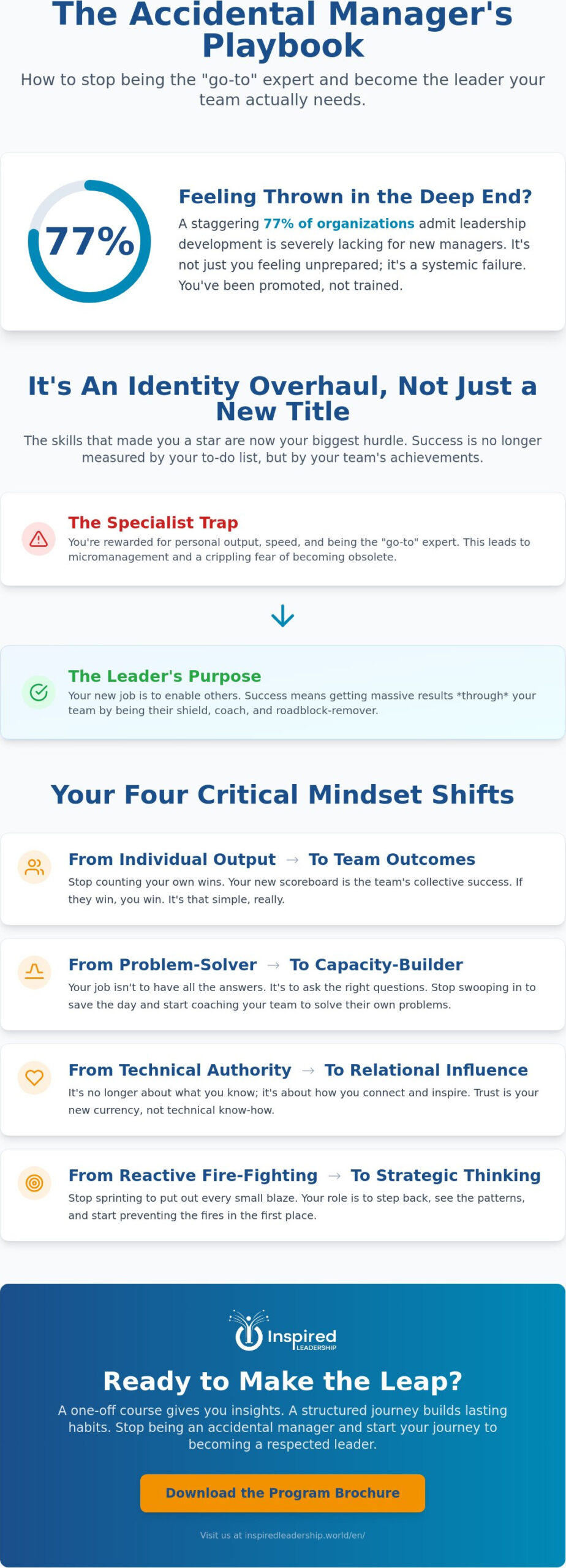
Did you know that 77% of organisations report that leadership development is severely lacking at their lower levels? It’s a staggering figure that explains why you might feel like you’ve been tossed into the deep end without a life jacket. This gap is exactly why new manager leadership development often feels more like a trial by fire than a genuine career milestone.
It’s exhausting to feel like an accidental manager, micromanaging every tiny detail because it’s simply faster than watching someone else muck it up. You’ve spent years becoming the “go-to” expert, and the fear of losing your technical edge while drowning in admin is incredibly real. I know you want to be a respected leader, not just a stressed-out supervisor who’s forgotten how the actual work gets done.
In this guide, you’ll learn the exact steps to transition from a technical specialist to a confident leader who gets massive results through others. We’ll cover practical tools for delegation and a structured path to help you master those dreaded difficult conversations. Here is your roadmap for moving from the “doer” to the “driver” without losing your mind in the process.
Key Takeaways
- Realise that management is a total identity overhaul, not just a reward for being the best technical expert in the room.
- Learn to measure success by your team’s outcomes instead of how many tasks you personally ticked off your to-do list.
- Find out why effective new manager leadership development must be a structured process to turn fresh insights into actual, repeatable habits.
- Master the capacity-builder mindset by stepping back and allowing your team to solve their own problems instead of swooping in to save the day.
- Start your transition with our First Line Manager Program and download the brochure to see how we turn experts into respected leaders.
The Specialist-to-Leader Shift: Why New Manager Leadership Development Is a Different Beast
Most people think getting promoted to manager is like finally reaching the next level in a video game. It isn’t. It’s more like being a world-class chef and suddenly being told you’re now the restaurant’s lead accountant. Effective new manager leadership development recognises that this isn’t just about a bigger paycheck or a flashier title; it’s a fundamental identity transition that shakes your very foundations.
Being a brilliant individual contributor is actually your biggest hurdle to becoming a great boss. You’ve spent years being rewarded for your output, your speed, and your technical precision. Now, those same traits often lead to micromanagement because you’re still trying to win as an individual rather than through your team.
The “accidental manager” is a classic Aussie staple where a high-performing technician is promoted into leadership without any support, essentially being left to sink or swim while clutching a clipboard they never asked for. It is a systemic friction point that stalls growth and burns out your best people. According to research on the employee to first-line manager transition, 60% of new managers fail within their first 24 months precisely because this systemic failure goes unaddressed. Success is no longer about what you can do with your own two hands.
Your new role is about how well you enable others to do their best work. This transition is a core part of any robust leadership development process, moving your primary metric from “doing” to “enabling.” It’s a shift that requires you to stop being the star of the show and start becoming the director.
The Identity Trap for Technical Experts
There’s a quiet panic that sets in when you stop coding, designing, or selling. You worry that if you aren’t the smartest person in the room, you’re becoming obsolete. This is why many high performers fail as managers; they simply can’t let go of the tools that made them famous.
Here’s a bit of a reality check: your team doesn’t need you to be the expert anymore. They need you to be the shield, the coach, and the person who removes the roadblocks. If you’re still the smartest person in every meeting, you haven’t actually started leading yet. You’re just a very expensive supervisor doing someone else’s job.
If you’re ready to stop the “doing” and start the leading, head over to our First Line Manager Program page and download the brochure to see how we help you make the leap.
Four Critical Mindset Shifts for Every First-Time Manager
You can’t just bolt new skills onto your old way of working. Genuine new manager leadership development requires a radical rewiring of how you perceive value, and you can learn more about London Hypnotherapy & NLP to see how clinical techniques can assist with this behavioral shift. If you keep looking for the same dopamine hit you got from finishing a task yourself, you’re going to burn out before the first quarter ends.
There are several common challenges new managers face, but most stem from these four fundamental shifts:
- From individual output to team outcomes: Stop counting your own wins and start measuring the collective scoreboard.
- From problem-solver to capacity-builder: Your job isn’t to fix everything; it’s to help your team learn how to fix it themselves.
- From technical authority to relational influence: It’s less about what you know and more about how you connect and inspire.
- From reactive fire-fighting to strategic thinking: Stop sprinting to every small blaze and start looking for the arsonist.
If this sounds like a massive mountain to climb, our leadership journey programs provide the climbing gear you need. Transitioning is easier when you have a map and a guide who has been there before.
Moving from Player to Coach
Think of a managing moment as telling someone exactly how to format a spreadsheet. A coaching moment is asking them why they chose that layout and what they think would make it clearer for the client. One gets the job done today; the other builds a better employee for tomorrow.
Asking the right questions is far more powerful than having all the answers. When you stop being the person with the solution, you give your team the space to actually think. It might feel slower at first, but it’s the only way to scale your impact.
The Power of Delegation
Delegation isn’t just about dumping the boring stuff on someone else’s desk. It’s a development tool that stretches your team’s capabilities while freeing you up for higher-level thinking. If you don’t delegate, you aren’t leading; you’re just a bottleneck with a fancy title.
Yes, they might do it differently than you would. They might even make a few mistakes along the way. That is perfectly okay because letting them struggle a bit is actually a kindness that helps them grow. You can see the full details of how we support this growth in our First Line Manager Program brochure.
How to Organise Your Leadership Growth Without Falling into the Accidental Manager Trap
You can’t just wing it and hope for the best. Without a plan, you’ll end up as another “accidental manager” who is just a technical expert with a stress-induced eye twitch. To avoid this, you need to treat your own development with the same rigour you apply to your technical projects.
Start by auditing your “doing” versus “leading” ratio every Friday afternoon. If you’re still spending 80% of your week in the weeds doing the work yourself, you’re not leading; you’re just a bottleneck. You need to identify your core leadership competencies within the division so you know exactly which skills to sharpen first.
Ditch the idea that a one-off workshop will fix everything. Real new manager leadership development is a marathon, not a sprint. You need a structured journey that allows you to test new ideas, fail safely, and try again with support. Our First Line Manager Program is designed as that exact journey. You can download the brochure to see how we turn that theory into actual results.
Building a Feedback Culture That Isn’t Awkward
Feedback shouldn’t feel like you’re calling someone into the principal’s office. Focus on growth and future potential rather than just pointing out where they tripped up. A simple 10-minute “check-in” every week keeps the lines open and prevents small issues from turning into massive dramas.
Ask questions like, “What’s one thing I can do to make your job easier this week?” This flips the script and shows you’re there to support them, not just police them. It’s a low-pressure way to build trust without it feeling like a forced interrogation.
The 70:20:10 Rule in a Medium-Sized Enterprise
In a fast-paced Aussie business, time is a luxury you probably don’t have. Use the 70:20:10 model to your advantage. This means 70% of your learning happens on the job, 20% through others, and only 10% from formal training.
Every awkward meeting or difficult conversation is actually a practice session for your leadership skills. Don’t wait for a classroom to start improving. Use your daily challenges as the training ground to build the habits that define a respected leader.
Why a Structured Leadership Journey Beats a One-Off Course
Most one-off training courses are essentially just a day out of the office with a mediocre lunch and a colourful workbook that ends up gathering dust. Training is a single event, but genuine development is a continuous process that requires time, support, and a fair bit of trial and error. If you want to actually change how you lead, you need a journey rather than a quick fix.
The “forgetting curve” is a brutal reality of traditional workshops, where participants often lose 70% of new information within just 24 hours. Effective new manager leadership development beats this by spacing out the learning and forcing you to apply new habits in real-time. This structured approach ensures that insights don’t just stay in your head but actually make it into your daily routine.
There is also immense power in having a peer group to lean on during this transition. Our first line manager development program connects you with others facing the same hurdles, proving you aren’t the only one worried about micromanaging. Sharing these experiences turns a lonely climb into a collective trek where everyone helps each other reach the summit.
Translating Insight into Action
Knowing what to do is the easy part; actually doing it when a deadline is looming and your best developer just resigned is where the real work happens. Most managers fail because they revert to their “expert” habits the moment the pressure rises. We focus on results-driven alternatives to traditional training that bridge this gap between theory and practice.
At Inspired Leadership, we don’t do “fluffy” content or theoretical models that don’t work in the real world. We provide the pragmatic tools you need to handle high-stakes environments with a level head and a clear strategy. Our goal is to make sure you have the confidence to lead even when everything feels like it’s going pear-shaped.
Ready to move from specialist to leader without losing your sanity? Visit our First Line Manager journey page and download the brochure to start your transformation today.
Ready to Hang Up the Expert Cape?
Making the leap from technical wizard to team guide is a massive shift that requires more than just a new title. You’ve now seen that it takes a total identity overhaul and a focus on team outcomes rather than your own individual wins. It’s about moving from the “doer” to the “enabler” without burning yourself out in the first six months.
We’ve spent 20 years in the corporate trenches helping leaders in Australian medium-sized enterprises find their feet. Our results-driven methodology skips the usual corporate fluff and focuses on what actually works when the pressure is on. Effective new manager leadership development isn’t a happy accident; it’s a deliberate choice to invest in a structured process that builds real, repeatable habits.
You don’t have to navigate this transition alone or figure it all out by exhausting trial and error. If you’re ready to trade the stress of micromanaging for the confidence of true leadership, we’re here to help. Download the First Line Manager Journey Brochure today and let’s start your transformation. You’ve totally got this.
Frequently Asked Questions
What are the most important skills for a new manager to develop first?
You need to prioritise emotional intelligence and active listening over your old technical skills. The goal is to stop being the person with all the answers and start being the person who asks the right questions. This shift helps you build trust, ensuring your team feels safe enough to take risks without you hovering over their shoulder.
How can I stop micromanaging my team when I know I can do the job faster?
You have to accept that your personal speed is now a liability to the team’s growth. If you do the work yourself, you win today but lose tomorrow because your team hasn’t learned a thing. Think of delegation as an investment in your future sanity; letting them take longer now means you won’t be doing their work for them in six months.
How long does it typically take to transition from an individual contributor to a confident leader?
Most people find their feet within six to twelve months, although the internal identity shift can often take much longer. This is why new manager leadership development shouldn’t be treated as a quick fix but as a sustained journey of habit-building. You are learning a entirely new craft, so give yourself a bit of a break while you are finding your rhythm.
What should I do if my team used to be my peers and now I am their manager?
Be transparent and have the “new deal” conversation as soon as possible. Acknowledge that the dynamic has changed and ask them directly what they need from you in this new role. It is not about being “the boss” in a power-trip sense; it is about being the person who clears the path so they can succeed in their own roles.
Establishing clear communication is the foundation of these new relationships, especially in digital spaces. To learn how to use culturally respectful greetings and sign-offs in your professional emails, visit Achieve With Nate Movement for a practical guide on digital communication.
Is a one-day leadership workshop enough to become an effective manager?
Honestly, no. A single day might give you a few nice ideas, but it won’t change your deep-seated habits or help when things get messy on a Tuesday afternoon. Genuine new manager leadership development requires a structured, ongoing journey like our First Line Manager Program to ensure you are actually applying what you learn. Visit our journey page and download the brochure to see how we make these changes stick for the long haul.