
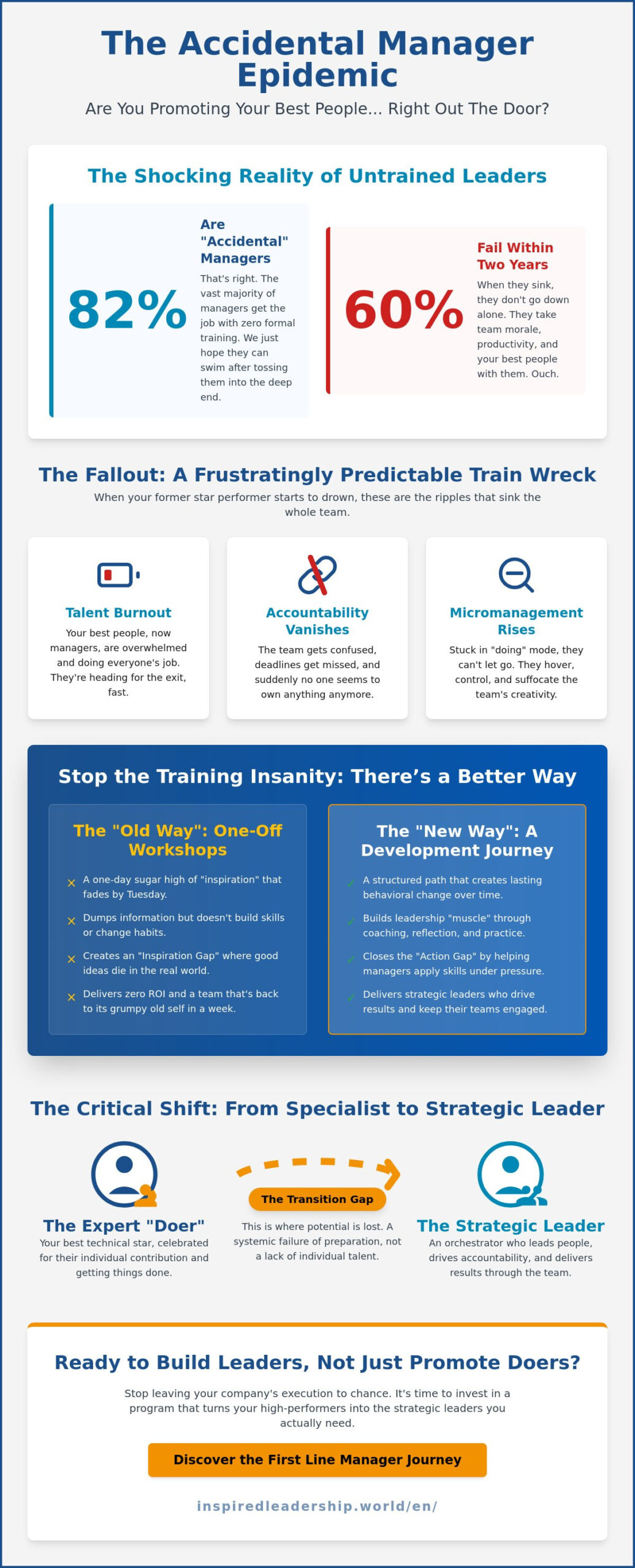
Did you know that 82% of managers are “accidental” leaders who never received formal training before their promotion? This statistic from the Chartered Management Institute explains why your best technical stars often end up burnt out and ready to quit. It’s time to invest in a first line manager development program that stops throwing high performers into the deep end and hoping they’ve secretly been Olympic swimmers all along.
You’ve likely seen the fallout: a brilliant specialist gets promoted, and suddenly, the team’s accountability vanishes while the new manager tries to do everyone else’s job. It’s frustrating to watch your top talent drown in a sea of “doing” when they should be orchestrating the big picture. We know you want a leadership pipeline that thinks, owns, and actually delivers.
You’ll discover how to transform these individual contributors into strategic leaders who drive ownership and deliver measurable results. This article previews a systemic approach for 2026 that moves beyond boring workshops to create lasting behavioral change. We’re going to show you how to build a team that stays for the long haul and performs at its peak.
Key Takeaways
- Stop treating your managers like glorified task-checkers and learn why they are actually the secret sauce to your company’s execution.
- Find out why most leadership workshops are a total snooze-fest that fails to create real change once everyone gets back to their desks.
- Discover the specific skills that help technical wizards stop micromanaging and start leading with actual influence.
- Explore how a modern first line manager development program uses a journey-based approach to turn high performers into strategic thinkers.
- Learn how to build a team that finally stops your best people from quitting because they are overwhelmed.
Defining the Strategic Impact of a First Line Manager Development Program
Your first line managers are the heartbeat of your business, even if they occasionally feel more like the stressed-out traffic wardens of the office. They aren’t just supervisors. They are the people who actually make sure the work gets done while ensuring your company culture doesn’t turn into a scene from a disaster movie.
Without a robust first line manager development program, you’re essentially leaving your company’s execution to chance. A report from the CMI shows that 82% of managers enter their roles without formal training. When 60% of new managers fail within two years, you aren’t just losing a leader; you’re losing productivity, morale, and the very people who were your best workers.
This risk-heavy approach is the opposite of how other high-stakes professions operate. For instance, in the aviation industry, future captains receive intensive, career-focused education from institutions like 2FLY Airborne to ensure they are fully prepared for the cockpit’s demands.
A one-day workshop won’t fix this. Real growth happens through a structured management development process that treats leadership as a marathon, not a sprint. We focus on a “Leadership Journey” because it allows for the messy, human work of unlearning old habits and building new ones that actually stick.
The ‘Managerial Glue’ of the Medium-Sized Enterprise
In a scaling business, these managers are the glue holding everything together. They take big, fancy executive strategies and turn them into daily tasks that actually make sense to the team. When these leaders are engaged, your retention rates soar. When they’re stressed, the whole house of cards can come tumbling down. If you want a deeper look at how to approach this challenge, our leadership development for medium sized companies buyer’s guide breaks down exactly what to look for in a program that scales with your business.
The Specialist-to-Leader Transition Gap
We’ve all seen it happen. You promote your best coder or salesperson, and suddenly they’re miserable because they’re stuck in meetings instead of doing what they love. This shift causes massive psychological friction as they move from “doing” the work to “leading” the people who do it. The transition gap is a systemic failure of preparation, not a lack of talent. Understanding why high performers fail as managers is the first step to designing a program that actually prepares them for this identity shift.
If you’re ready to stop the cycle of accidental management, head over to our First Line Manager Program journey page and download the brochure to see how we can help your team thrive.
Why Traditional Leadership Workshops Fail First Line Managers
Look, we’ve all been there. You spend a small fortune on a fancy hotel ballroom, buy everyone leather-bound notebooks, and hire a speaker with a very expensive haircut to talk about “synergy.” Three days later, everyone is back to their old, grumpy habits and those notebooks are being used as coasters.
This is the “Inspiration Gap.” It’s that fleeting moment where your team feels like they can conquer the world, right before reality hits them in the face with a budget crisis and a broken coffee machine. Real change requires a strategic program design that accounts for how humans actually learn and adapt over time.
A truly effective first line manager development program isn’t a one-day sugar high. It’s a structured architecture designed to fight against “organizational gravity,” which is the powerful force that pulls your managers back into their old, comfortable ways of doing things. If you want results that actually show up on a spreadsheet, you have to stop treating training like an event and start treating it like a journey. For organizations navigating this challenge, understanding the full landscape of leadership development for medium sized companies is essential before committing your budget to any single approach.
The Fallacy of the ‘One-Off’ Training Event
Temporary motivation is great for a pep talk, but it’s useless for long-term behavioral transformation. Training often focuses on dumping information into a brain, while development is about building the muscle to use that info when things get hairy. If you’re tired of seeing zero ROI on your training budget, you might want to explore our First Line Manager Program for a more sustainable approach.
Knowledge vs. Action: The Implementation Gap
Knowing what to do is easy. Actually doing it when your star performer is throwing a tantrum is the hard part. This is why peer coaching and constant reflection are non-negotiable parts of any program that actually wants to bridge the gap between “knowing” and “doing.”
If you’re ready to move past the “group hug” style of training, head over to our First Line Manager Program journey page. You can download the brochure there to see how we help your team build habits that actually stick.
Essential Competencies for the Modern First Line Manager
Being the smartest person in the room is a trap. If you’re still the one fixing every bug or closing every deal, you aren’t managing; you’re just a very expensive bottleneck. Modern leadership requires a radical shift from technical authority to relational influence, where your value comes from how you empower others rather than what you can do yourself.
In our first line manager development program, we categorize these skills into three essential buckets: Self, Team, and Organization. You have to manage your own ego and stress first, then master the messy “people stuff,” and finally understand how your team’s daily grind fuels the company’s grand strategy. It is about being a strategic thinker even when you are knee-deep in the tactical trenches.
Ownership is the non-negotiable trait here. We aren’t looking for managers who just follow orders; we need leaders who act like they own the place. This mindset ensures that when things go sideways, they look for solutions instead of someone to blame. If you want a practical framework for auditing whether your leaders actually possess these traits, the divisional leadership development program checklist for 2026 offers a no-nonsense way to identify the gaps before they cost you.
From Individual Contributor to Team Orchestrator
Moving from “doing” to “orchestrating” is like learning to conduct an orchestra after years of playing the tuba. You have to learn how to deliver results through other humans, which is far more unpredictable than code or spreadsheets. This means mastering delegation that doesn’t feel like dumping and providing feedback that actually helps people grow instead of making them want to hide under their desks.
Building a culture of psychological safety is your secret weapon. When your team feels safe enough to take risks without being shamed, they’ll finally have the guts to innovate and solve problems on their own.
Driving Ownership and Accountability at Scale
We need to move past the “compliance” mindset where people do just enough to avoid a stern email. You want a “commitment” mindset where your team actually cares about the outcome as much as you do. The Ownership Mindset is the bridge between individual effort and organizational output.
When you foster an environment where every team member takes initiative, you can finally stop playing “Whac-A-Mole” with daily fires. If you’re ready to build a team that actually owns their work, head over to our First Line Manager Program journey page and download the brochure to see how we make it happen.
Designing a High-Impact Development Journey
A high-impact first line manager development program isn’t just a collection of random workshops. It is a structured journey designed to deliver actual ROI, rather than just a certificate that collects dust on a shelf.
To make it work, you need a multi-modal approach. We combine digital learning for the basics, peer coaching for the “people stuff,” and experiential tasks that force managers to apply what they’ve learned in the real world. Throwing a PDF at someone and calling it “training” is just a great way to waste money and annoy your staff.
Executive sponsorship is the secret sauce that keeps everything from falling apart. When your senior leaders actively support the journey, it signals that leadership growth is a priority, not just a box-ticking exercise for HR. We also build in measurable checkpoints to track progress and ensure the new habits are actually taking root.
Phase 1: Mindset Shift and Identity Reconstruction
The first hurdle is breaking the “specialist” identity. You have to stop being the person who does the work and start being the person who leads it. We use diagnostic tools to uncover leadership blind spots that usually hide behind technical expertise and setting the stage for a long-term commitment to growth.
Phase 2: Mastering the Mechanics of Leadership
Once the mindset is right, it’s time to get into the mechanics. This phase is all about practical application, from handling a team member’s meltdown to aligning daily tasks with the company’s big-picture goals. We integrate live workplace challenges into the curriculum so your managers can practice their new skills on real problems in real time.
If you’re ready to stop guessing and start building a high-impact leadership pipeline, check out our First Line Manager Program and download the brochure today to see the full roadmap.
The Inspired Leadership Journey: Elevating Your Management Pipeline
We aren’t here to give your managers a participation trophy and a lukewarm lunch. The Inspired Leadership first line manager development program is built for results, focusing on the messy, human reality of leading people in 2026. It’s designed for those who are tired of the status quo and ready for a team that actually takes the lead.
While other vendors hand out toolkits that get forgotten by Friday, we design a journey that sticks. It is about shifting how your leaders think and act, not just giving them a new way to fill out a spreadsheet. We focus on identity reconstruction because a manager who doesn’t see themselves as a leader will never act like one.
Our approach is a radical departure from the “one and done” workshop model. We stay with you, ensuring that the new habits your team builds don’t just vanish when the next crisis hits. It is about creating a sustainable culture where leadership is part of the daily rhythm, not just a line item in the budget.
Results-Driven Accelerators for Medium-Sized Enterprises
Medium-sized businesses don’t have time for fluff. You need agility and leaders who can scale as fast as your revenue, which is why we partner with executives who value ownership over simple compliance. We help you build a pipeline that is robust enough to handle growth without losing the human touch that made you successful in the first place.
You can maintain this personal connection during rapid growth by using Loopify to provide premium corporate gifting that reinforces a culture of appreciation across your leadership teams.
Many of our clients find that the High-Potential Technical Talent Program is a perfect precursor to this journey. It prepares your future stars for the mental shift they need before they even step into the management ring. Starting the development process early means fewer “accidental managers” and more intentional leaders.
Translating Insight into Organizational Action
Our methodology ensures that every lightbulb moment translates into immediate action on the shop floor or in the digital workspace. You will see the transformation in how your teams communicate and solve problems without waiting for permission. We bridge the gap between “knowing” and “doing” by making real-world application a core part of the curriculum.
Our ‘Strategic Catalyst’ facilitators aren’t just teachers; they are guides who help your managers navigate the specific friction points of your business. We don’t just talk about change; we make it inevitable through constant support and measurable checkpoints. Your organization’s performance is the ultimate metric of our success.
If you are tired of stagnant pipelines and want leaders who actually lead, Contact Inspired Leadership to begin your organization's journey. Head over to our First Line Manager Program journey page and download the brochure to see the full roadmap for your team’s transformation.
Build the Leadership Pipeline Your Business Actually Deserves
You now know that promoting your top technical star and hoping for a miracle is a fast track to burnout and lost productivity. We’ve explored why the standard one-day workshop fails and how a real first line manager development program creates a lasting shift from “doing” to “orchestrating.”
Our systemic approach is specialized for medium-sized enterprises that need to scale leadership capability without the corporate fluff. We focus on translating every insight into immediate workplace action, ensuring your investment delivers measurable results rather than just a stack of unused notebooks.
It’s time to stop the cycle of accidental management and start building a team that thinks and acts with total ownership. Explore our First Line Manager Journey and build a culture of ownership today. Head over to our journey page to download the brochure and start your team’s transformation.
Frequently Asked Questions
What is a first line manager development program?
A first line manager development program is a structured journey designed to turn your best technical “doers” into effective people leaders. It focuses on reconstructing their professional identity so they stop trying to do everyone else’s job and start driving team performance through others. This isn’t just a list of rules; it is a systemic approach to building a pipeline of leaders who actually think for themselves.
How long does it take to see results from a leadership journey?
You will start seeing subtle shifts in mindset almost immediately, but real behavioral transformation is a marathon, not a sprint. While a one-off workshop gives you a three-day “high,” a structured journey takes several months to bake in new habits that actually stick. We focus on long-term sustainability so your investment doesn’t vanish the moment a new crisis hits the office.
Why do technical experts struggle when promoted to first-line management?
Most experts struggle because they are still addicted to the “doing” that made them successful in the first place. They fall into the specialist trap, trying to solve every technical bug themselves instead of empowering their team to do it. Without proper preparation, they become very expensive bottlenecks who are perpetually on the edge of a total meltdown. The deep psychological reasons why high performers fail as managers are rooted in this very identity trap, and addressing it is essential to any effective development program.
What is the difference between a leadership workshop and a leadership journey?
A workshop is a one-off event that usually ends in a group hug and a notebook that becomes a permanent coaster on someone’s desk. A leadership journey is a sustained, multi-modal architecture that includes peer coaching, digital learning, and real-world application. It is the difference between reading a book about the gym and actually showing up for the workout every day.
How do you measure the ROI of a new manager development program?
You measure success through the lens of retention, team productivity, and employee engagement scores. When your first line manager development program is working, you will see a measurable drop in “accidental” attrition and a rise in team accountability. Effective leadership isn’t just a “nice to have”; it is a direct driver of your organization’s financial performance.
Can this program be customized for medium-sized enterprises?
Absolutely, because medium-sized businesses don’t have the luxury of slow, bloated corporate training models. We specialize in the agility and scale required for organizations that need to move fast and see results without the typical HR fluff. Our journeys are designed to be pragmatic and battle-tested for the unique pressures of a growing enterprise.
What are the core competencies of a successful first-line manager?
They need a blend of self-awareness, relational influence, and the ability to think strategically even when they are in the tactical trenches. Above all else, they must possess an Ownership Mindset that drives them to take initiative rather than waiting for permission. If they don’t act like they own the results, they are just glorified task-checkers. For a structured way to evaluate whether your managers genuinely demonstrate these qualities in practice, the 2026 checklist for real results in divisional leadership development is a useful resource to benchmark your current pipeline.
How do we stop our best managers from burning out?
You stop the burnout by giving them the skills to delegate effectively and set clear boundaries with their teams. Burnout usually happens when a manager feels they have to be the hero who saves every project because they haven’t learned to trust their people. If you are ready to save your leaders from their own hero complexes, head over to our First Line Manager Program journey page and download the brochure to see how we help them find balance.