
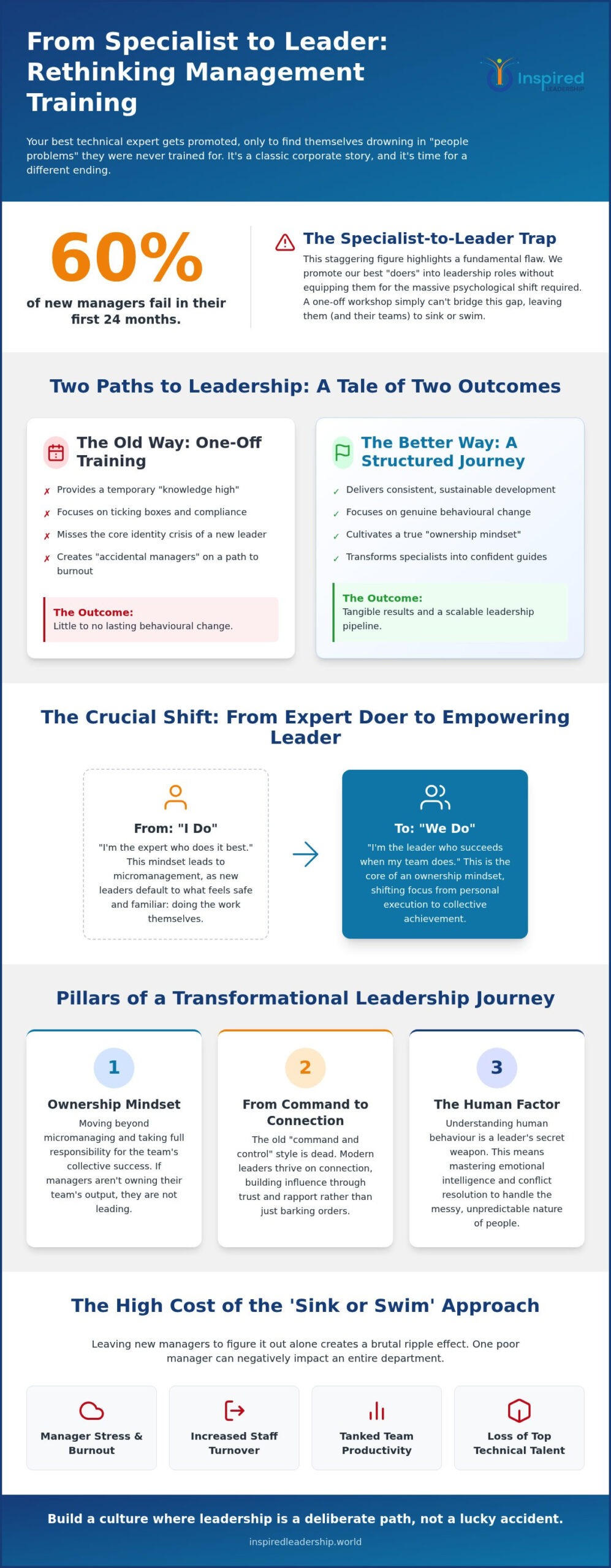
Did you know that 60% of new managers fail within their first 24 months? It’s a staggering figure that highlights the fundamental flaw in the traditional first line manager training program. You’ve likely seen this play out when your best technical expert is promoted, only to find themselves drowning in team friction and “people problems” they were never prepared for.
We can agree that simply ticking a box with a one-off workshop is a bit like reading a cookbook and expecting to be a Michelin-starred chef. You want managers who take full ownership of their actions and a leadership pipeline that actually scales without breaking. It’s about protecting your technical talent from burnout and ensuring they don’t quit just because they’ve been asked to lead.
This article will show you why a structured development journey is the only way to transform specialists into confident, capable leaders. You’ll learn how to move beyond superficial training to deliver tangible results that your organisation will actually value. Let’s look at how to build a culture where leadership is a deliberate path rather than a lucky accident.
Key Takeaways
- Understand why your top technical experts often struggle when promoted and how to bridge the gap between being a “doer” and a leader.
- Discover why a traditional first line manager training program rarely delivers a return on investment and why a structured journey is the secret to lasting behavioural change.
- Learn how to cultivate an ownership mindset in your managers so they stop micromanaging and start taking full responsibility for their team’s collective success.
- Identify the essential criteria for a scalable leadership development strategy that ensures your entire organisation speaks the same professional language.
- Explore how a dedicated “Manager to Leader” journey stops the specialist-to-leader rot and transforms your best talent into confident, battle-tested guides.
The Specialist-to-Leader Trap: Why Your Best Doers Often Struggle to Lead
Promoting your top engineer or salesperson to a management role is a classic corporate move that often ends in a bit of a mess. You’re effectively taking someone who thrives on “doing” and asking them to find joy in “facilitating,” which is a massive psychological shift. It’s like asking a world-class sprinter to suddenly coach a relay team without giving them a whistle or a stopwatch.
Most new managers default to micromanagement because it feels safe and familiar. They know how to do the job, so they hover over their team to ensure it’s done “their way.” This isn’t because they’re control freaks; it’s because they lack the toolkit to lead. A standard first line manager training program often misses this identity crisis entirely, leaving your new leaders stranded.
Historically, frameworks like Training Within Industry (TWI) recognised that supervisory skills are distinct from technical ones. Yet, many modern organisations still treat leadership as a reward for technical brilliance rather than a brand-new career. You’re essentially asking them to change their professional identity overnight without a roadmap.
The Hidden Cost of the “Sink or Swim” Approach
When you leave a new manager to figure it out on their own, you create “accidental managers.” These folks are often stressed, frustrated, and on the fast track to burnout. The ripple effect is brutal; one poor manager can tank the productivity of an entire department whilst driving your best talent out the door.
Why Traditional Training Fails the Modern Manager
One-off workshops are great for a temporary “knowledge high,” but they rarely result in lasting behavioural change. You can’t build leadership muscles in a single afternoon. Real change requires a consistent manager to leader journey rather than a generic first line manager training program that only focuses on ticking boxes.
Defining the Mindset Shift: Core Pillars of a Transformational Leadership Journey
If you want to stop the rot we discussed earlier, you have to change how your managers think. It’s a bit of a shock to the system for most. You’re moving from a headspace of “I’m the expert who does it best” to “I’m the leader who succeeds when my team does it best.”
This isn’t just a nice sentiment; it’s the core of an ownership mindset. A standard first line manager training program often treats management like a checklist of chores rather than a psychological evolution. Real development must bridge the gap between internal psychological states and the actual results you see on the shop floor or in the office.
You need to focus on essential topics for first-line manager training like emotional intelligence and conflict resolution to make this stick. It’s about taking those high-level insights and turning them into practical, daily action. If your managers aren’t owning their team’s outputs, they’re just expensive babysitters.
Without this shift, any first line manager training program you buy will just be expensive wallpaper. You need a process that translates theory into the grit of daily office life. If you’re ready to see how this shift could work for your team, you might want to get in touch with us for a chat.
Moving from Command to Connection
The old-school “command and control” style is well and truly dead, and honestly, good riddance. Successful medium enterprises now thrive on connection rather than barking orders. Our Beyond Command Journey helps leaders navigate this new landscape where influence beats authority every time.
The Human Factor in Management
Understanding human behaviour is the secret weapon of the most effective first line managers. It’s not enough to know the process if you don’t understand the people running it. The Human Factor Journey equips your leaders with the soft skills needed to handle the messy, unpredictable nature of humans.
How to Choose a First Line Manager Journey That Actually Delivers Results
Choosing a development partner is a high-stakes decision for any growing firm. You don’t want someone who just “delivers a course” and leaves you with a pile of unused ring binders. You need a partner who collaborates with your executives to ensure the first line manager training program aligns with your strategic goals.
Scalability is the secret sauce here. When your entire organisation begins to speak the same leadership language, you eliminate the friction that usually slows down scaling firms. It’s about creating a unified culture where everyone knows what “good” looks like from the top down.
Always prioritise results over “happy sheets.” If a provider can’t show you how their first line manager training program leads to tangible organisational outcomes, they’re probably selling you fluff. And a quick tip: if they use too much corporate jargon, they likely don’t understand your business reality.
The Importance of Assessment
You can’t fix what you haven’t measured, and guessing is a very expensive way to fail. Wasted budgets often stem from training that solves a problem you don’t actually have. Start with a Leadership Assessment to pinpoint exactly where your managers are wobbling before you commit to a path.
Why Medium-Sized Enterprises Need Bespoke Solutions
Scaling firms face unique pressures that massive corporations just don’t get. You can’t afford the generic, off-the-shelf fluff that often clogs up larger HR departments. You need a pragmatic architect of change who understands your specific friction points and builds a journey that fits your culture perfectly. For Australian startups, The Elevatory provides expert coaching that helps founders and early leaders bridge the gap between technical expertise and business leadership.
Making the Leap: Why the Inspired Leadership Manager to Leader Journey is Different
Most organisations are tired of the same old superficial training that feels like a waste of a Tuesday morning. Our Manager to Leader Journey is specifically designed to stop the specialist-to-leader rot before it poisons your company culture. It’s a battle-tested alternative for those who want real results rather than just another generic first line manager training program.
We don’t just teach tasks; we build the capability for your managers to own their actions at scale. You get a partner who acts as both a visionary mentor and a pragmatic architect of change, ensuring your leadership pipeline is actually sustainable. It’s about transforming your experts into leaders who truly understand the human dynamics of their teams.
Real Stories of Transformation
You don’t have to take our word for it. Our Leadership Coaching Testimonials show exactly how we’ve helped technical experts become the backbone of their company’s leadership. These are real people who moved from being “great at the job” to being “great at leading the people who do the job.”
Your Next Step Towards a Leading Organisation
You already know that your current approach isn’t delivering the goods, so let’s stop the madness and try something that actually works. Your best specialists deserve more than a tick-box first line manager training program that leaves them feeling unsupported. It’s time to give them a roadmap that actually leads somewhere useful.
Take the first step by visiting our manager to leader journey page and downloading the brochure. This will give you a full look at the curriculum and the framework we use to deliver tangible results. Let’s move your team from being “accidental managers” to intentional leaders who drive your organisation forward.
Stop the Specialist-to-Leader Rot and Build a Real Pipeline
You’ve seen why the “sink or swim” method is a recipe for burnout and high turnover amongst your best people. Transitioning from a technical expert to a leader isn’t just a simple promotion; it’s a complete career change that requires a total psychological shift. A standard first line manager training program won’t cut it because it usually ignores the identity crisis your new managers face whilst they try to find their feet.
We’ve spent 20 years in the corporate world helping medium enterprises build leadership capability that actually sticks. We focus on human-centred, results-driven methodologies that turn “accidental managers” into confident leaders who own their actions. It’s about moving from technical brilliance to leadership mastery through a structured journey that delivers tangible results for your organisation.
Your team is waiting for the leader they deserve, and you’re just one journey away from making that happen. Let’s get started on building a leadership pipeline that actually scales with your ambition.
Frequently Asked Questions
What is the difference between a management course and a leadership journey?
A management course is typically a one-off event that focuses on ticking boxes and passing on information. In contrast, a leadership journey is a sustained transformational process that changes how you think and behave over time. It’s the difference between reading a book about swimming and actually getting in the pool with a coach until you’ve mastered the stroke.
How long does it typically take for a new manager to become effective?
It usually takes about six to twelve months for a new leader to find their feet, but without support, many never truly get there. Research from Pryor Learning shows that 60% of new managers fail within their first 24 months in the role. A structured first line manager training program helps accelerate this timeline by giving them the tools to handle the pressure early on.
Why do high-performing technical specialists often fail as managers?
They fail because the skills that made them brilliant engineers or salespeople are the exact opposite of what’s needed to lead a team. They often suffer an identity crisis, clinging to their “expert” status whilst trying to solve messy human problems with technical logic. It’s a bit like a star striker trying to manage the club; knowing how to score goals doesn’t mean you know how to build a winning culture.
Is first line manager development worth the investment for medium-sized companies?
What are the most critical skills a first-time manager needs to learn first?
The most vital skills are self-awareness, active listening, and the ability to give feedback without making people want to run for the hills. You need to learn how to step back and let your team own the work whilst you manage the environment around them. It’s about building trust and connection before you even think about complex strategy or high-level reporting.