

What if the strongest case for leadership development had less to do with training hours and more to do with what managers do differently on Monday? If you’re asking how to get leadership buy-in for training budget 2026, start there: decision-makers need to see how the investment addresses a real business priority, not simply adds another item to the calendar.
Training competes with operational demands, and a spend is difficult to defend when its purpose and impact are vague. You also need support from the people who hold the budget and the managers who can help new behaviours take hold at work.
This article will help you build a concise, credible business case. You’ll define the capability gap, compare investment options and agree how progress will be reviewed, with the focus on observable leadership behaviour rather than attendance alone.
Key Takeaways
- Make the case for leadership development by pinpointing a capability gap and showing which business priority it affects.
- When considering how to get leadership buy-in for training budget 2026, give decision-makers a clear view of the need, proposed investment and how progress will be reviewed.
- Compare isolated training activity with a sustained journey, considering how well each supports application and follow-through at work.
- Shape your proposal around executive priorities and invite questions about the evidence and assumptions behind your request.
Why leadership development budgets need a business case in 2026
When operational demands are pressing, leadership development can look like a spend that can wait. You may believe stronger leadership matters, but budget holders need to understand the organisational need, who will support the work and how you’ll assess progress.
That’s the practical answer to how to get leadership buy-in for training budget 2026: make the decision about workplace behaviour, not attendance. A full room or positive participant feedback shows that people took part and valued the experience. It doesn’t show whether they’re leading conversations differently, delegating more effectively or helping their teams work through challenges.
What leadership buy-in means beyond budget approval
Approval releases the money; active sponsorship gives people a fair chance to use what they learn. Buy-in means leaders agree on the organisational need, the investment, who owns the follow-through and what evidence will show progress.
That includes line managers. If participants are expected to practise giving clearer feedback, for example, their managers need to make space for those conversations and discuss what they’re learning. Without that support, even thoughtful development can remain a good idea on a busy calendar. The Leadership Development Overview offers broader context on the field and its common practices.
Why a 2026 request should start with an organisational need
Start with a priority your organisation already recognises, such as smoother collaboration, better decision-making or supporting newly appointed managers. Then identify the leadership capability connected to it, rather than presenting development as a general benefit that should appeal to everyone.
Use internal evidence to show what may happen if the gap remains: recurring escalations, missed handovers, delayed decisions or employee survey feedback. Be precise about what the evidence does and doesn’t show. Don’t dress a hunch up as a forecast.
If your proposal concerns newly appointed managers, explore the manager-to-leader journey and download its brochure. It can help you consider how a focused leadership journey fits your organisation’s needs.
This gives decision-makers a credible starting point: a specific need, observable behaviour to develop and a reason to review what changes at work.
Build a leadership-development case executives can evaluate
A persuasive proposal doesn’t need a glossy dashboard. It needs a clear line from an observed workplace challenge to a capability that can be developed, and then to behaviour you can notice and review.
Choose evidence that makes the need specific
Look first at information your organisation already has: staff feedback, performance discussions, role-transition patterns or recurring issues raised by teams. For example, if project decisions regularly stall between functions, explore whether leaders have the skills and authority to clarify ownership and bring the right people together.
Keep the evidence chain short: challenge, capability gap, intended behaviour. Name the teams affected and explain the likely consequences of leaving the gap unaddressed, using evidence rather than assumptions. This gives executives something concrete to evaluate without claiming that development alone will fix every organisational problem.
Agree how progress will be reviewed
Set a baseline before the leadership-development journey begins. Choose a small number of relevant indicators and describe the behaviour you’d expect to see change. If the need is clearer cross-functional decision-making, for instance, you might review whether decision ownership is more consistently understood, alongside feedback from the people involved.
Use more than one viewpoint. Participant reflection can show what someone is trying, while manager observations can help establish whether it’s showing up at work. Organisational indicators may add context, but don’t promise that one development investment will cause a change influenced by many factors. Agree when you’ll review the evidence and who will take part.
If you need a structured starting point for identifying leadership strengths and development needs, explore the leadership assessment. If your proposal focuses on newly appointed managers, explore the manager-to-leader journey and download its brochure to consider how it fits your organisation’s needs.
Compare investment options before you ask for funding
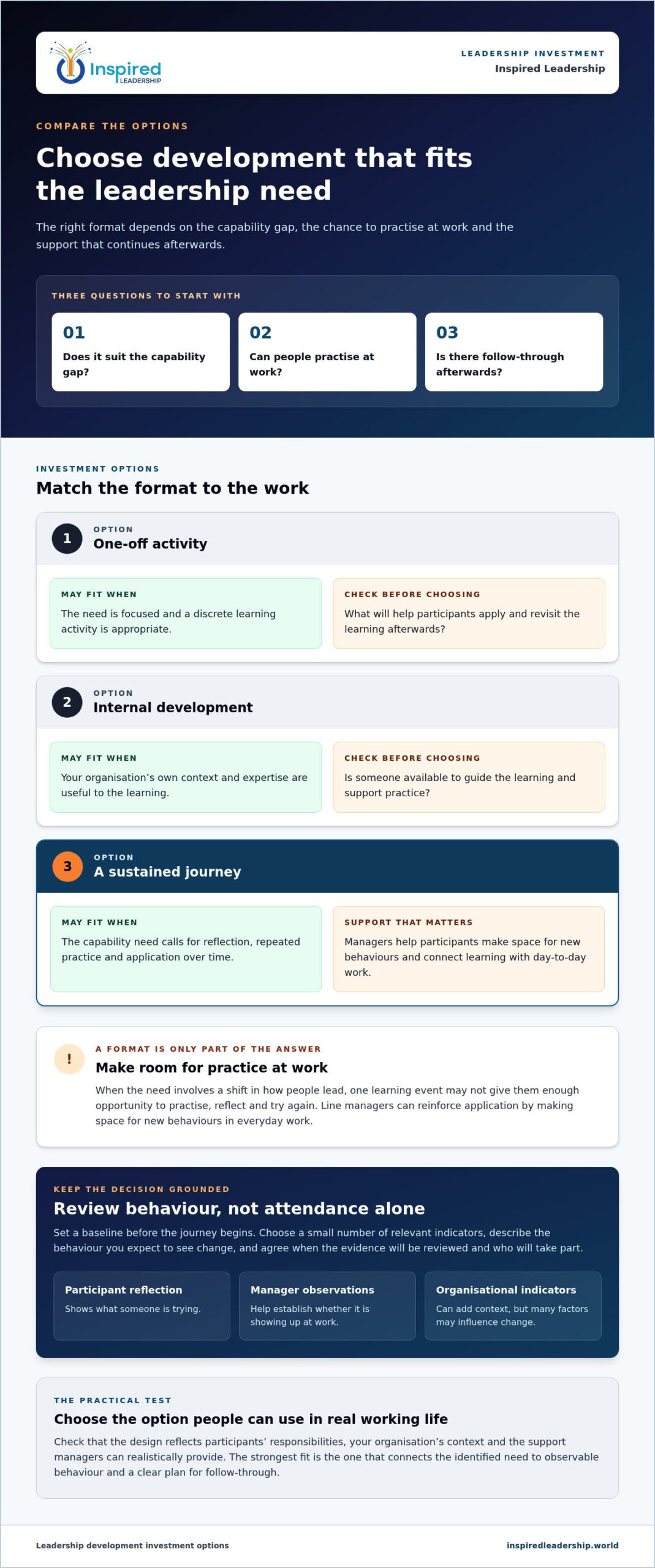
There isn’t one right format for every leadership need. Compare options by asking whether they suit the capability gap, help people practise at work and include follow-through after facilitated learning ends. The most impressive-looking option on paper is little use if it doesn’t fit people’s roles or working reality.
- One-off activity may suit a focused need, but consider what will help participants apply and revisit the learning afterwards.
- Internal development can draw on your organisation’s own context and expertise, provided someone has capacity to guide the learning and support practice.
- A sustained journey may suit capability needs that call for reflection, repeated practice and application over time, with managers helping participants make space for new behaviours.
When a sustained leadership journey may fit better
If the need involves a shift in how people lead, a single learning event may not provide enough opportunity to practise, reflect and try again. A sustained journey can connect insight with day-to-day work, while line managers reinforce that application. For new managers, a manager-to-leader journey is one relevant option to consider against your organisation’s needs.
How to assess the proposal’s organisational fit
Check whether the design reflects participants’ responsibilities, your organisation’s context and the support managers can realistically provide. A First Line Manager journey, for instance, focuses on development for people moving into management, but it won’t automatically suit every capability gap.
Look for a clear plan for applying insight after facilitated sessions. Opportunities to practise, time for reflection and manager conversations can all support follow-through. Leadership journey testimonials may offer qualitative context about participants’ experiences, but they aren’t proof of guaranteed results. This is how to get leadership buy-in for training budget 2026 without pretending one format is a magic wand.
For a closer look at the manager-to-leader journey, download its brochure and consider how it aligns with the needs you’ve identified.
Present the 2026 request and agree the next decision
Your proposal doesn’t need to be a lengthy presentation. It needs to help decision-makers understand what you’re asking them to approve, why it matters and what will happen next. This simple structure keeps the conversation focused:
- Need: name the organisational priority and leadership capability involved.
- Evidence: share the internal information that supports your case.
- Intended behaviours: describe what participants should practise at work.
- Investment scope: explain who the development is for and what the proposed journey includes.
- Review plan: agree how progress will be discussed and assessed.
A clear, low-friction way to make the ask
Open with the business need, not a tour of activities. For example: “We’ve identified [verified challenge] in [affected team]. I’m proposing a leadership-development journey to strengthen [relevant capability], with progress reviewed through [agreed evidence].” Replace the brackets with facts your organisation recognises, not assumptions dressed up for a boardroom.
Then make the decision explicit. Are you seeking approval to develop a proposal, agree the investment scope or release funding? Tailor your emphasis to the executive’s priorities, and invite questions about the evidence, assumptions and intended measures. A candid discussion now is far more useful than a polite nod followed by silence.
Turn approval into accountable workplace application
Before the meeting ends, agree who owns the decision, what happens next and when you’ll review progress. Name the sponsor who will keep the priority visible, the managers who will support workplace practice and the participants responsible for applying their learning. If your proposal focuses on emerging leaders, an emerging leader journey may be a useful starting point for that discussion.
That clarity is central to how to get leadership buy-in for training budget 2026: approval becomes a shared commitment, not simply a line in a budget.
Make your next leadership investment count
Turn your case into a decision that feels clear and manageable. Keep the conversation grounded in the leadership capability your organisation needs, and be open about what you’ll review as people put new behaviours into practice. That’s a practical way to approach how to get leadership buy-in for training budget 2026 without promising more than the evidence can support.
Leadership journeys designed for medium-sized enterprises can connect individual development with wider organisational needs. At a pivotal transition, the First Line Manager journey focuses on newly appointed managers and translating insight into action across the organisation.
You don’t need every answer before you begin. A thoughtful discussion can help you shape an investment that fits your people, your priorities and the change you want to see.
Your next leadership investment can start with one clear, well-grounded decision.
Frequently Asked Questions
How early should you submit a leadership training budget request for 2026?
Start by checking your organisation’s planning calendar so you know when decisions are made and how much time you have to prepare. Timing varies, so work backwards from the relevant approval date rather than relying on a generic deadline. Before drafting the full request, find out who owns the decision and what information they need. That small step can save you from building a thorough proposal for the wrong meeting.
Who should sponsor a leadership development budget request?
Look for a leader who understands both the organisational need and how development should be applied at work. Depending on your organisation, that might be a business executive, HR leader or functional head. The person who approves the budget may not be the person who supports participants day to day, so identify both responsibilities early. A sponsor’s role is to keep the need visible and help remove practical barriers to applying learning.
Can you get leadership development funding without a dedicated training budget?
Yes, the absence of a dedicated budget line doesn’t automatically end the conversation. Connect the development need to an existing organisational priority, then identify who owns that priority and can guide the decision. For how to get leadership buy-in for training budget 2026, avoid assuming a particular funding route is available. Instead, ask for a clearly scoped next decision, such as permission to assess the need or develop an investment proposal.
What should you do if executives ask for proof of return on investment?
Be clear about what you can measure and what you can’t confidently attribute to development. Share the starting point, the workplace behaviours you intend to strengthen and relevant organisational indicators, then state when you’ll review them. For example, you might track whether a defined leadership practice is being used, alongside an existing team measure. Don’t promise a guaranteed financial return; if attribution is uncertain, say so and propose a transparent evaluation plan.
How can you keep leadership development visible after the budget is approved?
Agree a review rhythm, sponsor responsibilities and useful workplace indicators before development begins. Managers can help by making room for participants to practise new approaches and by sharing specific observations, rather than relying on general impressions. Keep updates focused on the evidence you agreed to review, not attendance alone. Use each review to decide whether support or priorities need adjusting, without pretending that every change has a single cause.