

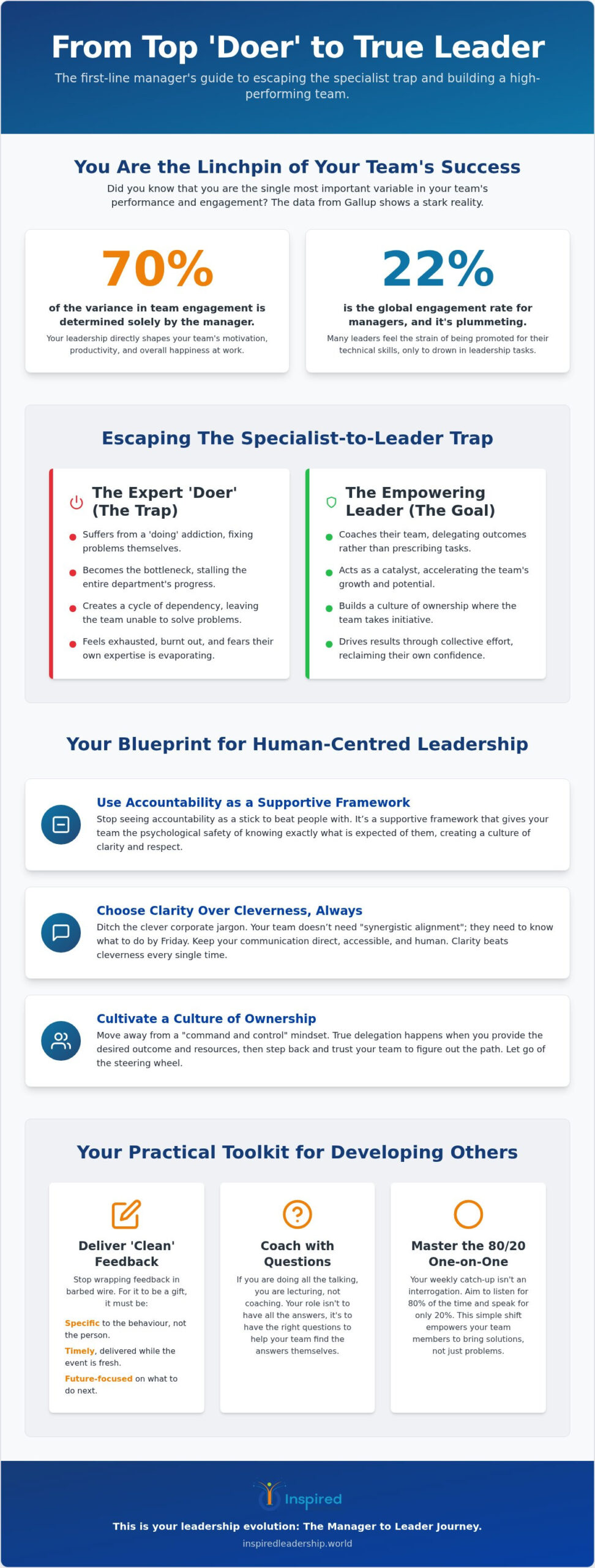
Did you know that you are the single most important variable in your team’s success? Gallup reports that managers account for a staggering 70% of the variance in team engagement, making effective first line management the linchpin of any healthy organisation. Yet, with global manager engagement plummeting to just 22% in 2025, it is clear that many are feeling the strain.
You likely reached this position because you were the best at the technical “doing,” but now you feel like you are drowning in the “leading.” It is exhausting to hold former peers accountable whilst fearing your own hard-earned expertise is evaporating into a cloud of spreadsheets. We understand that the shift from specialist to supervisor often feels more like a trap than a promotion.
This article provides the blueprint for your evolution into a human-centred leader who drives results through team ownership. We will explore practical tools to manage performance and reclaim your confidence without the looming threat of burnout. It is time to stop being the most expensive “doer” in the room and start becoming the architect of your team’s potential.
Key Takeaways
- Escape the trap of being the most expensive “doer” in the room by learning how to bridge the gap between executive strategy and daily execution.
- Master the specific behaviours required for effective first line management, focusing on accountability as a supportive framework rather than a disciplinary stick.
- Stop wrapping your feedback in “barbed wire” and start using practical, human-centred techniques that actually inspire your team to change their behaviour.
- Discover why a transformational leadership journey is the only real antidote to the burnout caused by trying to lead while still doing everyone else’s job.
The Specialist-to-Leader Trap: Defining Effective First Line Management
You are the vital link between the board’s big ideas and the actual work getting done. In the formal definition of a supervisor, you are simply responsible for overseeing staff, but the reality is far more nuanced. Effective first line management is the ability to deliver results through the collective ownership of a team, rather than through your own individual sweat and tears.
Here is a blunt fact for you. Most people are promoted because they were brilliant at their old job, not because they have any innate ability to lead others. This creates a massive friction point, especially in medium-sized firms where a single stagnant manager can stall an entire department’s progress. Without the right support, you become a bottleneck instead of a catalyst.
Why your best experts often struggle to lead
You likely have a “doing” addiction. It’s much faster to just fix the code or rewrite the report yourself than it is to coach someone else through the mess. Ironically, your deep subject matter expertise can become a barrier to team growth because your people never learn to solve problems without your input.
This creates a cycle of dependency that leaves you exhausted and your team bored. You can use our Leadership Assessment to identify your current management baseline and see where you might be standing in your own way. Breaking the habit of being the “answer person” is the first step toward genuine leadership.
The cost of getting it wrong
When management fails, the fingerprints are impossible to ignore. You’ll see high turnover, low morale, and a team that waits for permission before making even the simplest decisions. In a medium-sized organisation, this ripple effect is devastating because there is simply nowhere for inefficiency to hide. You aren’t just managing a task; you are managing the energy and output of the firm’s most expensive assets. This focus on efficiency is mirrored in operational strategy, where firms often partner with Alliance Fleet Solutions to ensure their physical resources are managed as effectively as their human ones.
The Core Behaviours of an Effective First Line Manager
Management isn’t a crown you wear to meetings; it is a set of daily behaviours that either build or erode trust. To achieve effective first line management, you must move beyond the technical “how” and master the relational “why.” This requires a shift in how you view authority and performance.
Accountability is often misunderstood as a stick to beat people with when things go wrong. In reality, it is a supportive framework for success that provides your team with the safety of knowing exactly what is expected of them. When you combine this clarity with a healthy professional distance, you create a space where respect and results can coexist without the awkwardness of trying to be everyone’s best friend.
Ditch the clever corporate jargon. Your team doesn’t need “synergistic alignment”; they need to know what to do by Friday. Clarity beats cleverness every single time, so keep your communication direct and accessible.
Building a culture of ownership
Moving away from a “command and control” mindset is the hardest part of the transition. Our Beyond Command Journey focuses on helping you let go of the steering wheel without losing your grip on the destination. True delegation happens when you provide the desired outcome and the necessary resources, then step back to let your team figure out the path.
The Human Factor in performance
Every performance issue is, at its heart, a human issue, which is why effective first line management requires a deep understanding of people. The Human Factor Journey equips you with the tools to navigate these internal dynamics. If you’re finding it difficult to strike this balance, reach out to us for a pragmatic chat about your specific challenges.
Practical Guidance: Developing Others Without Doing Their Jobs
Feedback is often called a gift, but let’s be honest; most managers wrap it in barbed wire and deliver it with a grimace. To achieve effective first line management, you need to master the art of the “clean” delivery. This means your feedback must be specific to the behaviour, delivered whilst the event is fresh, and focused entirely on the future rather than dwelling on past mistakes.
Coaching isn’t about you having all the answers; it’s about having the right questions. If you are doing all the talking, you aren’t coaching, you are lecturing. You’ll know you’ve spotted high-potential talent amongst your frontline staff when they start asking “why” instead of just “how,” showing they are ready for more responsibility.
The art of the one-on-one conversation
Your weekly catch-up shouldn’t feel like a police interrogation. Try to listen 80% of the time and speak for the remaining 20%. This radical concept allows you to hear the quiet concerns that usually lead to big problems later on. A great structure is to ask what they are proud of, where they are stuck, and what you can do to clear the path for their success.
Translating organisational insight into team action
Your Leadership Evolution: The Manager to Leader Journey
Stop looking for a management “course” and start looking for a transformational journey. Traditional one-off workshops often fail because they treat leadership like a software update rather than a fundamental shift in behaviour. You simply cannot fix a systemic performance issue with a few PowerPoint slides and a lukewarm buffet lunch; it requires a more disciplined approach.
To achieve effective first line management, you need a process that translates psychological insight into immediate, measurable action. Our Manager to Leader Journey is specifically designed for real-world impact, helping you escape the specialist-to-leader trap for good. It represents the first step towards leading an organisation that thinks for itself and takes genuine pride in its collective output.
Why medium-sized enterprises choose Inspired Leadership
We speak the language of growth and tangible results, not just dry HR compliance. Medium-sized firms occupy a unique space where every manager’s effectiveness directly impacts the firm’s overall health and sustainability. Our journeys are battle-tested and tailored to the specific nuances of your organisation, ensuring that the development sticks long after the initial excitement fades.
Ready to stop doing and start leading?
It is time to decide whether you want to remain the most expensive “doer” in the office or become the most effective leader your team has ever encountered. You can take the leap today by visiting our Manager to Leader Journey page to download the brochure. Let’s move beyond the surface-level theory and start building a team that finally owns its own success.
Step into Your New Identity as a Leader
Transitioning into leadership doesn’t mean losing your technical edge; it means sharpening a new one. True effective first line management is about building a team that functions brilliantly even when you aren’t in the room. You now have the framework to move from being the person who does the work to the person who inspires it.
With 20 years of corporate experience, we are specialists in medium-sized enterprise transformation who turn technical experts into human-centred leaders. We know the struggle of the specialist-to-leader trap, and we’ve guided hundreds through it. Don’t just take our word for it; have a browse through our Leadership Coaching Testimonials to see the results.
You don’t have to figure this out alone. It’s time to stop fixing every single fire yourself and start building the team you actually deserve. You’ve got this.
Frequently Asked Questions
What is the main difference between a supervisor and a first-line manager?
A supervisor often focuses on overseeing specific tasks, whereas a first-line manager is responsible for the performance and development of the people themselves. While the terms are sometimes used interchangeably, management implies a deeper level of accountability for team outcomes and alignment with broader strategy. It is about moving from simply watching the work to genuinely leading the workers who do it.
How can I transition from being a team member to being their manager effectively?
You must explicitly reset your boundaries and expectations with the team from day one to avoid confusion. Effective first line management requires you to stop being one of the gang and start being the one who provides the framework for their success. It is helpful to have individual chats to discuss how your relationship will change, ensuring you remain supportive without becoming a pushover.
What are the most common mistakes new first-line managers make?
The biggest blunder is micromanagement by expertise, where you keep doing the technical work because you don’t trust the team yet. Other slip-ups include avoiding difficult conversations to stay liked or failing to translate board-level goals into daily tasks. These habits lead to burnout for you and stagnation for your staff, which is why a structured development journey is so vital.
How do I handle a former peer who is now my direct report?
Address the elephant in the room immediately with a private, candid conversation about the new dynamic. You don’t need to apologise for your promotion, but you should acknowledge that the relationship has shifted. Be consistent with your expectations and treat them with the same professional distance and fairness as everyone else to avoid any hints of favouritism or awkwardness.
Can leadership skills be learned, or are you just born with them?
Leadership is absolutely a set of behaviours that can be studied, practised, and mastered over time. While some people have a natural affinity for communication, the specific tools for effective first line management are skills like any other. It is less about natural talent and more about your willingness to embark on a transformational journey that challenges your existing habits.
How much time should a first-line manager spend on technical work versus leading?
Aim for a 20/80 split where the majority of your energy goes toward leading, coaching, and removing roadblocks for your team. You might still do some technical work to keep your skills fresh, but it should never come at the expense of your people management duties. If you are still doing 50% of the doing, you aren’t managing; you are just a very busy specialist.