
Your most brilliant technical expert is often your most accidental management disaster. You’ve likely watched this play out: a top performer gets promoted, only to become a “super-doer” who micromanages every task whilst their team’s morale slowly evaporates. It’s a common friction point in growing businesses, and frankly, most generic leadership programs for SMEs are too full of corporate fluff to actually fix the mess.
You deserve a team that takes genuine ownership so you can stop firefighting and finally focus on the big picture. Having spent 20 years in the corporate world, I have seen exactly where the transition from expert to leader breaks down. I promise there is a pragmatic way to bridge that gap without the usual jargon or academic nonsense.
We will explore why the typical approach to development fails to stick and how a structured leadership journey creates sustainable behavioural change. You’ll see how to secure a tangible ROI on your spend whilst building a scalable culture that thrives as you grow. It is time to stop acting as the “super-doer” and start building a legacy of leadership.
Key Takeaways
- Learn how to move past the “super-doer” phase and build a culture where your team actually thinks and acts with an ownership mindset.
- Discover why many standard leadership programs for SMEs fail to deliver lasting change and how a structured journey ensures your investment sticks.
- Identify exactly where your leadership pipeline is leaking talent so you can match the right development journey to your specific organisational needs.
- Master the psychological shift required to help your technical experts stop micromanaging and start leading their teams with confidence.
- Understand how to move from “ticking a box” with training to achieving a tangible ROI through measurable behavioural transformation.
The SME Leadership Gap: Why Traditional Training Doesn’t Stick
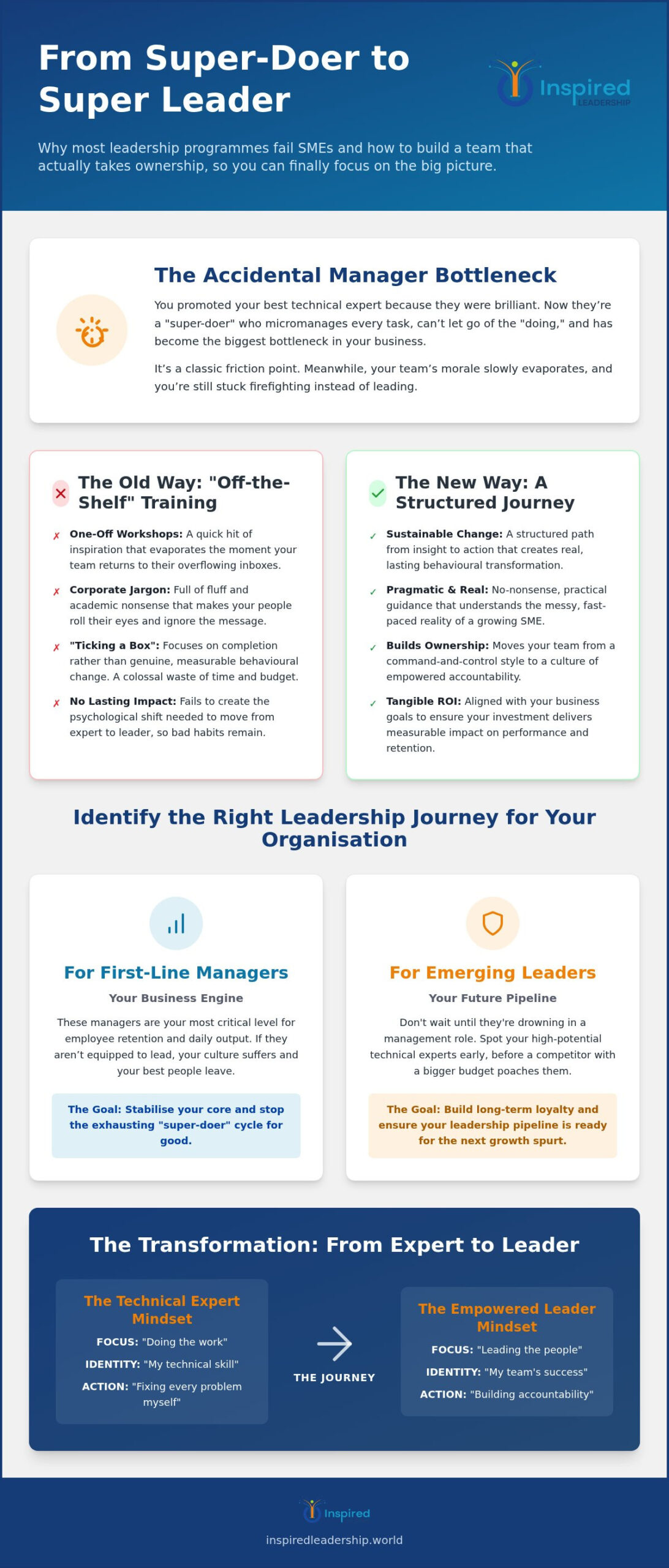
Scaling a business often feels like trying to build a plane whilst you are already flying it. You probably promoted your best engineer because they were brilliant at solving problems, but now they are the bottleneck because they cannot stop doing the work themselves. It is a classic case of the “Accidental Manager,” and it is exactly why many generic leadership programs for SMEs fall flat on their face.
Real leadership in a growing business is not about fancy titles or corporate posturing. It is the art of building a team that thinks and acts with an ownership mindset. Research on Leader development highlights that focusing on the individual’s internal capacity is far more effective than just teaching them how to manage a project timeline. If your managers are still acting like “super-doers,” you have not built a leadership pipeline; you have just created a group of very exhausted experts.
The Problem with “Off-the-Shelf” Solutions
One-off workshops are frequently a colossal waste of your time and budget. They provide a quick hit of inspiration that evaporates the moment your team returns to their overflowing inboxes. Most of these solutions are drowning in corporate jargon that makes your people roll their eyes and ignore the actual message. It is hard to find leadership programs for SMEs that actually understand the messy, fast-paced reality of a growing organisation.
You need a path that moves from insight to action, rather than just talking about abstract theories. If you want to see real change, you have to look for a manager to leader journey that prioritises results over “ticking a box.”
The Human Factor in Scaling
Your culture is your only true competitive advantage as you grow. Moving from a command-and-control style to a culture of empowered accountability requires a massive emotional shift for your team. It is about learning to let go of the “doing” so they can focus on the “leading,” which is often a terrifying prospect for someone whose identity is tied to their technical skill. We help them navigate that shift without the fluff.
Identifying the Right Leadership Journey for Your Organisation
Aligning development with your actual business goals is the only way to avoid wasting your budget on “tick-box” exercises. Understanding current Top Leadership Challenges, such as navigating rapid scale or managing hybrid teams, allows you to pick a path that fits your reality. You deserve a solution that addresses the specific hurdles your people face every day.
The First-Line Manager: Your Business Engine
Your first-line managers are the most critical level for employee retention and daily output. If they aren’t equipped to lead, your culture will feel messy and your best people will eventually look for the exit. Prioritising a manager to leader journey is the fastest way to stabilise your core and stop the exhausting “super-doer” cycle.
Nurturing Emerging Talent Early
Don’t wait until someone is already drowning in a management role to start their development. You need to spot your high-potential technical experts early, before they get headhunted by a larger competitor with a bigger recruitment budget. Creating a journey for emerging leaders builds long-term loyalty and ensures your pipeline is ready for the next growth spurt.
Choosing the right path is a strategic decision that depends entirely on your current growth phase. If you are unsure which level needs the most attention right now, we can help you assess your specific leadership gaps to ensure your investment delivers a genuine impact.
Escaping the Technical Trap: Moving from Expert to Leader
Being the smartest person in the room is a fantastic asset for an engineer, but it is a massive liability for a leader. If you are still the one fixing every technical glitch, you aren’t leading; you are just a very expensive bottleneck. Most technical experts feel like complete imposters when they trade their code or CAD drawings for the messy reality of people management.
From Subject Matter Expert to People Architect
This psychological hurdle is exactly why generic leadership programs for SMEs often fail to produce real change. You need to help your experts shift their identity from “Subject Matter Expert” to “People Architect.” It is about reframing success so that it is no longer about your personal output, but about the performance of every individual you manage.
A comprehensive leadership assessment is a fantastic starting point to identify the blind spots that usually trip up technical minds. It allows your experts to see where their “doing” habit is actually stifling the growth of their subordinates. When you build effective leadership development, you must include a roadmap for this specific identity journey.
Building Emotional Intelligence in a Data-Driven World
Empathy is often dismissed as a “nice-to-have” luxury in the data-driven world of SMEs. However, in a fast-scaling business, emotional intelligence is a strategic tool that delivers very hard financial results. It is the difference between a team that follows orders and a team that innovates because they feel safe enough to fail.
Managing this transition without losing the respect of former peers is a delicate dance. You have to move from being the person with all the answers to the person who asks the right questions. We specialise in helping technical experts make this journey with their dignity and their team’s respect fully intact.
Measuring the Impact: Why Transformation Trumps Training
ROI in an SME is often measured by the silence in your inbox on a Saturday morning. It is the tangible result of moving your team from “super-doers” to genuine leaders who own their results. Whilst many generic leadership programs for SMEs focus on engagement scores, we prioritise the creation of a sustainable leadership capability that does not depend on the founder’s constant intervention.
Real change happens when your team stops “attending a course” and starts “living a transformation.” This shift ensures that your investment translates into a scalable culture of ownership rather than just a pile of unused training manuals. You are building an organisation that can thrive and grow without you having to micromanage every single decision.
This level of organisational maturity is a prerequisite for more complex growth phases. If your strategy involves scaling through strategic acquisitions, PP-X provides the expert consultancy needed to ensure your leadership structure is ready for the transition.
Moving from curiosity to a committed leadership strategy is the only way to secure a long-term competitive advantage. Research shows that 70% of learning from corporate training is lost if it is not reinforced, so we focus on making the change stick. It is time to stop “ticking boxes” and start architecting a team that can carry the business forward.
Translating Insight into Organisational Action
The true test of any leadership journey is whether what is learned on Monday is actually applied on Tuesday morning. Your executive team plays a vital role here by actively supporting new leadership behaviours and rewarding the shift from doing to leading. Without this top-down alignment, even the most brilliant insights will eventually wither under the pressure of daily operations.
Taking the First Step
Stop overthinking the perfect moment and start investing in your most valuable asset: your people. The cost of high turnover and lost productivity amongst your technical staff far outweighs the investment in a structured, pragmatic journey. You have the opportunity to transform your experts into the confident leaders your business deserves.
I encourage you to take a closer look at our manager to leader journey and download the brochure to see exactly how we facilitate this change. If you are focused on building your pipeline from the ground up, our emerging leader journey brochure provides the roadmap you need to develop your future stars.
Build a Team That Leads So You Can Scale
You have seen how standard training fails because it ignores the unique friction points of a growing business. Stop the firefighting. Real growth happens when you trade generic “tick-box” exercises for structured leadership programs for SMEs that focus on genuine behavioural change and long-term sustainability.
I have spent 20 years in the corporate world seeing exactly where these transitions break down. My approach is direct and entirely no-nonsense because you don’t have time for corporate fluff whilst scaling your organisation. We turn your “super-doers” into confident leaders who can finally take the weight of daily operations off your shoulders.
You don’t have to keep acting as the primary bottleneck for your business. Start building a team that takes ownership and watch your culture transform from messy to magnificent. You have got this.
Frequently Asked Questions
How do I choose between a leadership journey and a standard training course?
A leadership journey focuses on sustainable behavioural change over several months, whilst a standard course is usually a one-off event that provides information without application. Standard training often feels like a school assembly you can’t wait to leave. In the context of leadership programs for SMEs, you need a solution that sticks to avoid wasting your budget on temporary inspiration that evaporates by Friday.
What is the typical ROI for leadership programs in medium-sized enterprises?
ROI is typically seen through reduced staff turnover, improved team productivity, and the founder’s ability to step away from daily firefighting. When managers start leading instead of “doing,” you eliminate the bottlenecks that slow down your growth. The cost of a “super-doer” manager causing a high-performer to quit is far higher than the investment in a structured journey that builds a culture of ownership.
Can technical experts really be trained to become effective people leaders?
Yes, but it requires a specific shift in identity from subject matter expert to people architect. Most technical experts feel like imposters in management because they are trying to fix people like they fix code. A structured journey provides the “soft skills” that deliver hard business results, helping them mentor their team rather than micromanaging every technical detail until everyone is miserable.
How much time do my managers need to commit to a leadership journey?
We build our journeys to be high-impact and low-friction, typically requiring a few hours a month of focused learning combined with real-world practice. The idea isn’t to pull your managers away from their desks for days on end. Instead, we weave development into their existing schedule so they can apply new behaviours whilst they are actually doing the job and seeing results in real-time.
What happens if we invest in leadership development and our people leave?
It is a common worry, but investing in development actually increases loyalty and makes your organisation a magnet for top talent. The only thing worse than training people and having them leave is not training them and having them stay. Building a scalable leadership capability ensures that even if one person moves on, the culture of excellence and ownership remains deeply embedded in your organisation.