

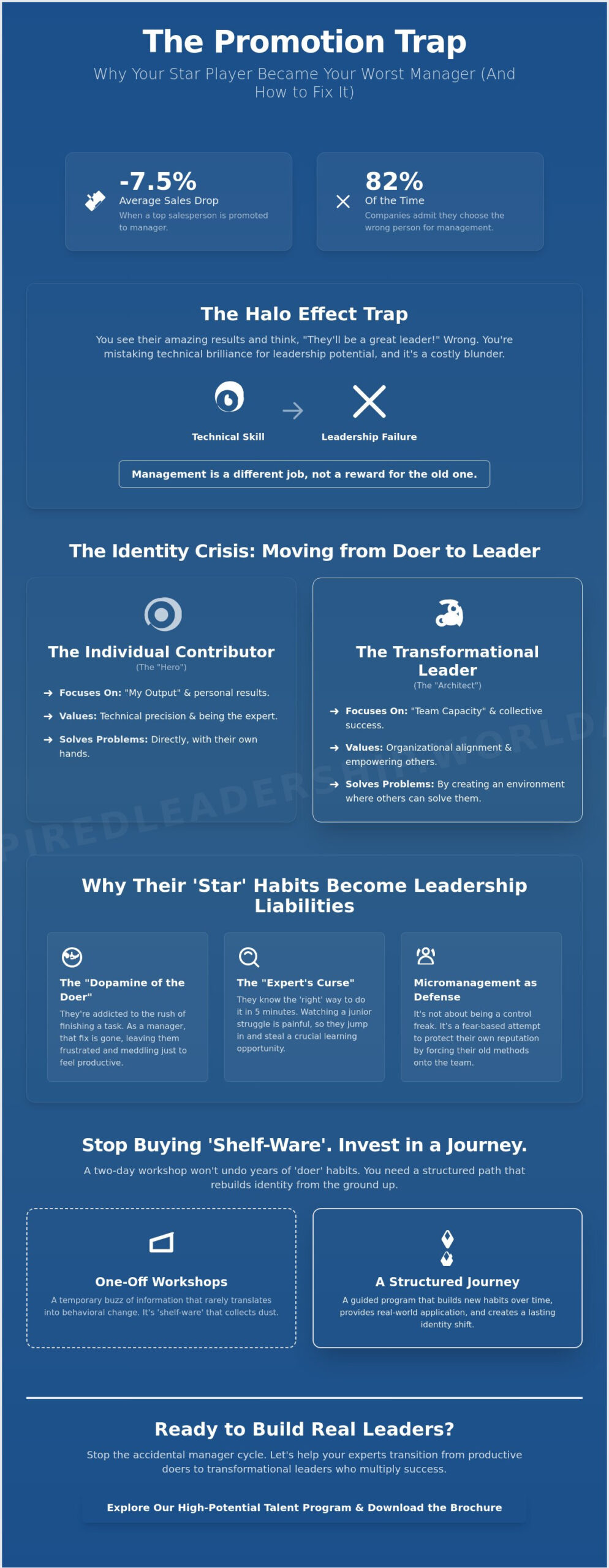
Did you know that when top-performing salespeople are promoted to leadership, their teams’ sales actually drop by an average of 7.5%? It’s a total gut punch for any executive trying to understand why high performers fail as managers after rewarding excellence with a shiny new title. This happens because companies fail to choose the right talent for management roles 82% of the time, according to Gallup research.
Expertise is not leadership. You’ve likely felt the friction when your star player becomes a bottleneck or when turnover spikes under a newly minted expert. The very habits that fueled their success as specialists often act as psychological anchors that drag down their leadership effectiveness.
You’re about to discover the systemic reasons for this struggle and how to break the accidental manager cycle. We will look at the identity shift required to move from technical mastery to organizational ownership. This insight is central to our First Line Manager Program journey; we encourage you to download the associated brochure to see how we bridge this gap.
Key Takeaways
- Stop treating management roles like a trophy for being great at your job. You will learn how to spot the difference between a technical wizard and a potential leader before you make a costly mistake.
- We dive into the psychological “Dopamine of the Doer” to explain why high performers fail as managers when they just can’t stop doing the tasks themselves.
- Discover how failed promotions create a talent drain that poisons your team culture and costs your company a fortune in turnover.
- Learn why a one-off workshop is just “shelf-ware” and how our First Line Manager Program uses a structured journey to build real leadership habits.
- Ready to fix the pipeline? Head over to our High-Potential Technical Talent Program journey page and download the brochure to see how we help your experts become owners.
The Halo Effect Trap: Why We Promote for Past Output Instead of Future Potential
Imagine your best coder is promoted to lead the dev team, and suddenly, the department is a disaster zone. This is the Halo Effect in action. It’s a cognitive bias that tricks us into thinking technical brilliance translates directly into leadership talent.
We often treat management roles like a shiny gold watch or a “reward promotion” for years of hard work. But management isn’t a prize; it’s a completely different career path that requires a total identity shift. This misconception is a massive reason why high performers fail as managers when they realize their old tricks don’t work anymore.
Navigating this shift often requires a dedicated external perspective. Trainer Terry specializes in providing the strategic guidance and career coaching necessary to help professionals successfully bridge this gap, offering insights on how to choose the right support for your trajectory.
By 2026, the rise of decentralized and hybrid teams makes this trap even more dangerous. Leading people you can’t see requires a level of emotional intelligence that technical skills simply don’t provide. If you’re promoting based on a spreadsheet of past deliverables, you’re setting your star up for a very public fall.
The Peter Principle in the Modern SME
When you promote someone to a role they aren’t equipped for, you’re witnessing The Peter Principle in real-time. This concept explains how employees rise to their level of incompetence because the skills that got them there aren’t the ones they need now. In a medium-sized firm, there’s often no safety net or middle management to catch the fallout.
The Performance-Leadership Gap acts as a systemic friction point where individual excellence is sacrificed for collective stagnation.
Why ‘Output’ is a Poor Predictor of ‘Influence’
High performers are usually addicted to tangible results like closed deals or finished projects. Management, however, is about intangible behavioral outcomes and the slow work of coaching others. Your best specialist often struggles to let go of the “tools” because doing the work themselves feels much safer than trusting someone else to do it.
If you’re ready to stop the accidental manager syndrome, visit our High-Potential Technical Talent Program journey page. You can download the brochure to see how we help your experts transition from doers to true leaders.
The Identity Crisis: Why ‘Star’ Habits Become Leadership Liabilities
Ever wonder why your top performer suddenly seems so stressed out after a promotion? It’s often because they’re addicted to the “Dopamine of the Doer.” As a specialist, you get a rush from finishing a task yourself. As a manager, that rush is replaced by the slow, messy work of helping someone else finish it.
Then there’s the “Expert’s Curse.” When you know exactly how to fix a problem in five minutes, watching a team member struggle for an hour feels like torture. This is a primary reason why high performers fail as managers; they jump in to save the day, which accidentally trains the team to stop thinking for themselves. If you’re always the hero, your team stays the sidekick.
Micromanagement isn’t usually about being a control freak. It’s a defense mechanism for people who are scared of losing the high-quality output that defined their career. You’re trying to protect your reputation by doing the work through others, but you end up becoming the very bottleneck you were hired to fix. Research shows that fail as managers often happens because of this lack of emotional intelligence and the inability to let go of the tools.
Individual Contributor vs. Transformational Leader
- Individual Contributor: Focuses on “My Output” and values technical precision. They solve problems directly and thrive on being the smartest person in the room.
- Transformational Leader: Focuses on “Team Capacity” and values organizational alignment. They create environments where problems are solved by others.
If you’re still trying to be the best technician on the team, you aren’t leading. You’re just a very expensive specialist with a “Manager” title.
The ‘Ownership’ Friction Point
Teaching ownership is hard. High performers often struggle here because they assume everyone has their same internal drive. If you want a team that takes initiative, you have to stop being the solution and start being the architect of the solution. Making this mental leap is the core focus of our First Line Manager Program. We invite you to explore that journey page and download the brochure to see how we help your stars make this vital identity shift.
The Medium-Enterprise Penalty: The Hidden Costs of Failed Transitions
In a medium-sized business, you don’t have the luxury of a massive HR safety net or layers of redundant leadership. When a star player struggles in their new role, the ripple effect is immediate and expensive. This is exactly why high performers fail as managers in SMEs; the organizational impact is amplified because every single person counts.
One “expert-turned-bad-manager” can dilute the culture of an entire department in just a few weeks. If your new manager is still acting like a “super-contributor,” they are effectively blocking their team’s growth. The team stops thinking for themselves because the boss is doing all the heavy lifting, creating a stagnation ripple that kills innovation and morale.
Quantifying the Cost of Failed Leadership
Let’s talk numbers, because the math is brutal. Replacing a failed manager can cost your company about 200% of their annual salary according to industry data. You also risk losing your “High-Potential” pipeline when the first rung of management is broken, making future growth nearly impossible.
Since 75% of voluntary employee turnover is linked to managerial issues, a single bad promotion can trigger a mass exodus of talent. SMEs simply cannot afford the 6 to 12 month learning curve of an unsupported manager who is “winging it” while your best people head for the exit. A structured divisional leadership development program gives your new managers the competency framework they need to lead with confidence from day one, rather than learning through costly trial and error.
The Psychological Toll on the High Performer
It’s not just the company’s bank account that takes a hit; the high performer is usually having a miserable time too. They often get hit with a nasty case of Imposter Syndrome because their technical skills no longer provide that sweet validation they crave. They end up totally burnt out, trying to do the team’s work while simultaneously failing to manage them. A dedicated approach to new manager leadership development can help these individuals navigate the emotional and professional challenges of this difficult transition before burnout takes hold.
You can stop this cycle before it starts. Head over to our High-Potential Technical Talent Program journey page and download the brochure to see how we rescue your experts from the management trap.
Beyond the Two-Day Workshop: Why Leadership Requires a ‘Journey’
Most corporate training is like a bad gym membership. You show up for two days of intense activity, feel a bit sore but inspired, and then return to your desk only to do exactly what you’ve always done. This “event-based” approach is a major reason why high performers fail as managers because it treats leadership like a software update instead of a fundamental rewiring of how you think.
Insight without action is just “shelf-ware” knowledge. It looks great on a certificate, but it does nothing to help a stressed-out engineer handle a team conflict at 4:00 PM on a Friday. By 2026, the complexity of the workplace requires sustained, structured development that translates theory into daily organizational action.
Peer-based learning is the secret sauce here. When you’re in a room with other experts struggling through the same transition, the struggle becomes normalized. You realize you aren’t a “bad leader” just because you miss your old technical tools; you’re just in the middle of a difficult shift that requires time and practice.
The Framework for a Successful Transition
- Step 1: Identity Deconstruction. This is the hardest part. You have to let go of the “Expert” label and find value in things you can’t personally “fix.”
- Step 2: Skill Acquisition. This is where you learn the actual mechanics of coaching, giving feedback, and aligning your team with the bigger company goals.
- Step 3: Habit Formation. We help you turn those new skills into daily team rituals so they become second nature.
- Step 4: Organizational Integration. Finally, you move from managing a team to truly owning the outputs of your entire division.
Translating Insight into Action
Structured journeys differ from one-off workshops because they focus on measurable outcomes. In an SME environment, you need battle-tested methodologies that work in the real world, not just in a classroom. We don’t just give you a manual; we guide you through the actual implementation.
If you’re tired of training that doesn’t stick, it’s time for a different approach. Explore our First Line Manager Program journey page and download the brochure to see how we turn high performers into high-impact leaders.
Building a High-Potential Pipeline: The Inspired Leadership Approach
Fixing the pipeline isn’t about more training videos or another awkward team-building day at the bowling alley. It’s about a systemic shift in how you identify and nurture talent. Understanding why high performers fail as managers allows us to build a framework that actually works for the real world.
Our First Line Manager Program isn’t just a course; it’s a strategic intervention designed for medium-sized firms that need their leaders to perform from day one. We act as a Strategic Catalyst, partnering with your executive team to move beyond “managing people” and toward leading a vision that drives sustainable revenue.
By creating a thinking organization, you stop the cycle of accidental managers and start building a leadership legacy. This shift ensures that your top talent remains an asset rather than becoming a liability.
Transforming Technical Experts into Cultural Architects
Your experts are your greatest asset, but forcing them into a traditional management mold is a recipe for disaster. Our High-Potential Technical Talent Program is specifically designed to rescue these specialists from the “Management Trap” by teaching them how to influence without losing their technical soul. We help them become architects of a culture where expertise is shared, not hoarded.
By scaling this capability, your SME can finally stop the talent drain and start building a culture that attracts the best in the business. It’s about preserving what makes them great while adding the leadership tools they actually need to succeed.
Next Steps for Disillusioned Executives
If your current promotion process feels like a game of Russian Roulette, it’s time to look for the red flags. Are you still promoting based on output alone? Do your new managers have a clear path for growth, or are they just “winging it” while your team morale plummets?
You need a results-driven alternative that focuses on behavioral change rather than just ticking boxes. We invite you to discover how our Leadership Journeys translate insight into action and download the associated brochure to start your transformation today.
Turn Your Stars Into Strategic Leaders
Promoting your best specialist without a plan is like asking a world-class chef to build the restaurant’s plumbing. It’s messy, expensive, and usually ends with someone quitting. We’ve explored exactly why high performers fail as managers when they’re trapped by the habits that once made them stars.
You now have the framework to break the cycle by focusing on identity shifts and long-term development journeys. Our specialized accelerators for high-potential technical talent offer a results-driven alternative to traditional, ineffective training workshops. These transformational leadership journeys are tailored specifically for medium-sized enterprises that can’t afford to lose their top talent to burnout.
It’s time to stop the talent drain and start building a thinking organization. Secure your leadership pipeline with our First Line Manager Program and make sure to download the brochure on the journey page to see how we help your team thrive.
Your people are capable of incredible things when they have the right support. Let’s turn that technical brilliance into leadership impact and build a business that lasts.
Frequently Asked Questions
Why do high performers often struggle with delegation when promoted?
High performers struggle with delegation because their self-worth is traditionally tied to being the “doer.” They often feel that doing the task themselves is faster and higher quality than coaching someone else. This creates a bottleneck that prevents the team from growing. To help your team make this jump, visit our First Line Manager Program journey page and download the brochure.
Is it possible for a technical expert to become a great manager without losing their edge?
Yes, you can keep your edge, but you must redefine it. Your new “edge” is your ability to design the environment where technical excellence happens, not doing the work yourself. This identity crisis is a core reason why high performers fail as managers when they can’t stop being the smartest person in the room. The best leaders use their expertise to ask better questions.
What are the early warning signs that a new manager is failing?
The biggest red flag is “super-contributor” behavior. If your manager is working until midnight doing the team’s tasks while the team feels disengaged, they are failing to lead. You’ll also notice a lack of development in their direct reports, as the manager is solving every problem instead of coaching others. This usually leads to high turnover and a team that is too scared to take initiative.
How long does it typically take for a high performer to transition into a leadership mindset?
You should expect a full mindset shift to take between 6 and 12 months. Leadership is a muscle that needs consistent training, not a switch you flip on the day of your promotion. Our High-Potential Technical Talent Program is designed as a journey to support this long-term behavioral change. It takes time to unlearn the habits that made you a star contributor.
Why do traditional leadership workshops fail to help first-line managers?
Traditional workshops fail because they are “events” rather than “processes.” You can’t learn to navigate complex human emotions from a one-day seminar and a stale sandwich. Real growth requires a structured journey with peer support and the chance to apply new insights in the real world. Without action, that workshop manual just becomes another piece of “shelf-ware” collecting dust.
Can a company be too small to need a structured leadership development program?
No company is too small for leadership development. In fact, a single bad manager in a small business can sink the entire culture much faster than in a massive corporation. SMEs need structured programs to ensure their limited talent pool is actually being led effectively. Investing in your people early prevents the costly “accidental manager” syndrome from poisoning your growth.
What is the difference between a high-performing individual and a high-potential leader?
High performers are masters of their own output; high-potential leaders are masters of collective influence. Confusing these two roles is exactly why high performers fail as managers in 82% of cases according to Gallup research. You need to hire for the ability to build others up, not just for a high individual score. Performance is what you do; potential is what you can help others become.
How can HR support technical talent in their first management role?
HR can support them by providing a safety net that allows for the “identity deconstruction” phase. Don’t just throw them into the deep end; give them a structured journey that values people over processes. Check out our High-Potential Technical Talent Program journey page and download the brochure to see how we help HR teams build a sustainable leadership pipeline.