
Here’s a question worth sitting with: what if your biggest leadership problem isn’t a lack of strategy, but a failure to move that strategy from the boardroom into the building?
If you’ve ever walked out of an executive meeting feeling energised, only to watch those carefully agreed priorities quietly dissolve into the daily grind, you’re not alone. Strategic drift, siloed decision-making, and meetings that seem to consume time without producing momentum are symptoms of a deeper misalignment that no single workshop will fix.
That’s precisely why the senior leadership development journey looks so different from traditional executive training. It’s not a one-off event dressed up in a hotel conference room. It’s a structured, sustained process that transforms how your leadership team thinks, decides, and acts as a collective force.
In this article, you’ll discover what a genuinely effective senior leadership development journey entails, why so many organisations get it wrong, and how to build the kind of executive alignment that translates board-level insight into company-wide action. We’ll walk through the critical stages, the common pitfalls, and the measurable outcomes that separate real transformation from expensive window dressing.
Key Takeaways
- A structured senior leadership development journey goes far beyond boardroom agreement – it’s the mechanism that transforms executive alignment into measurable, organisation-wide action.
- Cognitive biases and hidden individual motivations are often the silent saboteurs of leadership effectiveness, and understanding them is essential to building a high-performing executive team.
- Genuine leadership development requires a bespoke approach – one that is mapped to your organisation’s specific goals and the real capability gaps within your team.
- Aligned leaders don’t just perform better individually; they create cultures of accountability and empowerment that cascade throughout the entire organisation.
- Insight without application is simply expensive introspection – the true measure of any leadership journey is whether it produces tangible, lasting change in how your leaders behave day to day.
What is a senior leadership development journey?
At its core, a senior leadership development journey is a structured, sustained process through which an executive team collectively deepens its capability to lead, align, and drive meaningful organisational change – not as a collection of high-performing individuals, but as a unified leadership force.
That distinction matters more than most organisations realise. Broad leadership development literature has long recognised that individual skill-building rarely translates into collective performance without intentional, systemic design. A journey – as opposed to a workshop or a one-day offsite – creates the conditions for behavioural change to take root, be tested in real work, and become embedded in how your leadership team operates day to day.
It’s also about something deeper than capability. A genuine senior leadership development journey builds a culture of ownership and accountability that cascades beyond the executive floor. When your senior leaders are genuinely aligned, that alignment becomes visible to the entire organisation.
The consequences of neglecting leadership development
Here’s where it gets a bit confronting. Many organisations mistake boardroom agreement for actual alignment. Your executive team nods through the strategic priorities, everyone leaves the room feeling good, and then… nothing changes. That’s not alignment. That’s politeness.
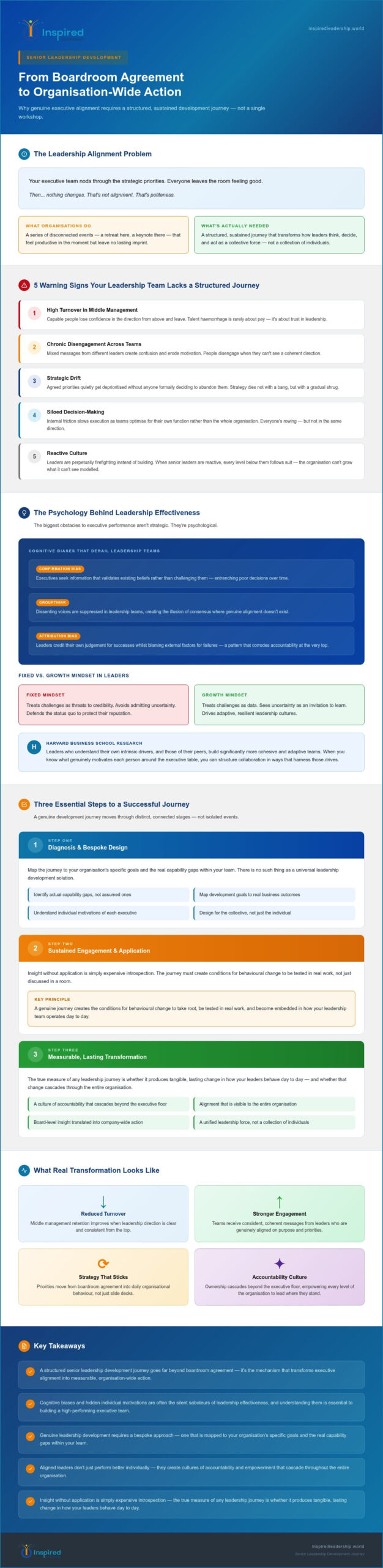
The signs that your leadership team lacks a structured development journey tend to show up in predictable, costly ways:
- High turnover in middle management, as capable people lose confidence in the direction from above
- Chronic disengagement across teams who receive mixed messages from different leaders
- Strategic drift, where agreed priorities quietly get deprioritised without anyone formally deciding to abandon them
- Siloed decision-making that creates internal friction and slows execution
- Reactive cultures where leaders are perpetually firefighting instead of building
Without a structured journey, leadership development becomes a series of disconnected events – a retreat here, a keynote there – that feel productive in the moment but leave no lasting imprint on how your leaders actually behave.
So, be honest with yourself: is your leadership team on a genuine journey, or are you collecting experiences without ever arriving anywhere?
Psychological underpinnings of effective leadership development
Here’s something most leadership development providers won’t tell you: the biggest obstacles to executive performance aren’t strategic. They’re psychological. And until you address what’s happening inside your leaders’ heads, no amount of strategic planning will produce the alignment you’re looking for.
Cognitive biases are the quiet architects of poor leadership decisions. Confirmation bias leads executives to seek information that validates existing beliefs rather than challenging them. Groupthink suppresses dissenting voices in leadership teams, creating the illusion of consensus where genuine alignment doesn’t exist. Attribution bias causes leaders to credit their own judgement for successes whilst blaming external factors for failures – a pattern that corrodes accountability at the very top.
These aren’t character flaws. They’re deeply wired human tendencies that intensify under pressure, and they’re particularly pronounced in high-stakes executive environments where admitting uncertainty feels professionally risky.
Understanding individual motivations adds another dimension entirely. Research on leadership development and organisational performance from Harvard Business School highlights that leaders who understand their own intrinsic drivers, and those of their peers, build significantly more cohesive and adaptive teams. When you know what genuinely motivates each person around the executive table, you can structure collaboration in ways that harness those drives rather than inadvertently working against them.
The growth mindset concept, developed by psychologist Carol Dweck, is equally critical here. Leaders who operate from a fixed mindset treat challenges as threats to their credibility. Leaders with a growth mindset treat the same challenges as data. That distinction shapes everything from how feedback flows within a team to how quickly an organisation recovers from strategic missteps.
Why traditional leadership training often falls short
A one-day offsite might surface these psychological dynamics briefly, but it rarely creates the conditions for lasting behavioural change. Insight without sustained practice is simply expensive introspection.
Genuine development requires continuous feedback loops, real-world application between sessions, and the kind of reflective accountability that only a structured senior leadership development journey can provide. Behaviour changes when it’s observed, challenged, and reinforced over time – not when it’s discussed once in a conference room and then quietly forgotten by Monday morning.
If you’re ready to explore what that kind of sustained, psychologically-informed development looks like in practice, get in touch with the Inspired Leadership team to start a conversation.
Three essential steps to a successful senior leadership development journey
Knowing that your leadership team needs development and actually building a journey that delivers lasting change are two very different things. Most organisations stumble at the gap between intention and design. Here’s how to bridge it.
Step 1: Conduct a thorough leadership assessment
Before you can map a route, you need to know where you’re starting from. A rigorous leadership assessment surfaces the real capability gaps within your executive team, not the ones people are comfortable admitting in a room together, but the ones that quietly undermine strategic execution.
This means looking beyond technical competence. You’re assessing how your leaders make decisions under pressure, how they influence across functions, and where their individual motivations either reinforce or work against collective goals. That diagnostic clarity is the foundation everything else is built on.
Step 2: Design a bespoke journey aligned to your goals
Generic leadership content produces generic leaders. A bespoke senior leadership development journey is architected around your organisation’s specific strategic priorities and the precise gaps your assessment has identified.
That means the sequencing of content, the depth of each module, and the real-world application challenges are all calibrated to your context. It’s the difference between a journey that feels relevant from day one and an off-the-shelf programme that everyone tolerates politely.
Step 3: Implement, measure, and iterate
Execution without feedback is just activity. Build in structured reflection points, peer accountability mechanisms, and clear metrics that tell you whether behavioural change is actually occurring between sessions, not just during them.
Iteration isn’t a sign that the journey is failing. It’s a sign that it’s alive.
Creating a culture of continuous learning
The most effective leadership journeys don’t end with a final session. They create conditions where learning becomes embedded in how your senior team operates week to week.
Encourage your leaders to share insights with their direct reports after each development touchpoint. This single habit does two things simultaneously: it reinforces the leader’s own learning through articulation, and it begins cascading new thinking down through the organisation.
Technology can support this meaningfully. Collaborative platforms, pulse surveys, and digital reflection tools create ongoing feedback loops that keep development visible and accountable between formal sessions. The goal isn’t to digitise learning for its own sake, but to remove the friction that causes momentum to stall the moment people return to their desks.
This isn’t a one-time event with a tidy conclusion. It’s an ongoing commitment to leadership excellence that compounds over time, and that compounding effect is precisely what separates organisations that talk about alignment from those that actually achieve it.
Translating leadership development into organisational impact
Insight is only valuable when it moves. A leadership team that leaves a development session energised but unchanged hasn’t developed – it’s just had a very expensive conversation.
The real measure of any senior leadership development journey is what happens back in the building. Do your leaders make decisions differently? Do their teams feel clearer, more empowered, more trusted? That’s where transformation either proves itself or quietly evaporates.
Aligned leaders don’t just perform better individually – they fundamentally reshape the cultures beneath them. When your executive team operates with genuine cohesion, accountability stops being a top-down demand and becomes a shared expectation that flows naturally through every layer of the organisation.
This is the mechanism that connects effective leadership directly to organisational performance: aligned leaders create the conditions in which their people can do their best work, and that compounds at scale.
Sustaining that alignment requires more than goodwill. Ongoing coaching and structured support between development touchpoints are what prevent leaders from reverting to old patterns the moment pressure returns. Behaviour change is fragile without reinforcement, and reinforcement requires a deliberate architecture – not just good intentions.
Think of it this way: the journey doesn’t end when the sessions do. The real work begins when your leaders walk back through the door.
Your next step in the leadership journey
The question isn’t whether your leadership team needs development. It’s whether you’re willing to invest in the kind that actually sticks.
The leadership coaching testimonials from Inspired Leadership’s clients speak to what’s possible when development is designed with rigour, sustained with intention, and grounded in the real dynamics of executive teams. These aren’t polished success stories – they’re honest accounts of leaders who did the work and built organisations that reflect it.
Investing in your senior leaders isn’t a line item. It’s a decision about the kind of organisation you’re building for the next five, ten, twenty years.
If you’re ready to move from intention to action, reach out to the Inspired Leadership team and take the first step on a journey worth taking.
The Leadership Your Organisation Deserves Starts Here
Boardroom agreement is easy. Genuine, sustained alignment that moves strategy from conversation into action? That’s where most organisations fall short, and where a structured senior leadership development journey makes all the difference.
What you’ve explored here isn’t theoretical. It’s a practical framework built on psychological rigour, bespoke design, and the kind of no-nonsense accountability that actually shifts behaviour. The leaders who commit to this process don’t just perform better individually; they reshape the cultures beneath them in ways that compound across the entire organisation.
With over 20 years of transformational leadership experience and a sharp focus on the real challenges facing medium-sized enterprises, Inspired Leadership brings the depth and discipline your executive team needs to move from intention to impact.
You’ve read the case. You know what’s at stake. The only question now is whether you’re ready to act on it.
Your next chapter of leadership excellence is closer than you think.
Frequently Asked Questions About Senior Leadership Development
How long does a senior leadership development journey typically take?
There’s no universal answer, and any provider who gives you one without first understanding your organisation’s context is selling you a template, not a journey. In practice, most senior leadership development journeys run between six and eighteen months, depending on the depth of capability gaps identified, the complexity of your strategic priorities, and the pace at which your executive team can meaningfully apply learning between touchpoints.
The duration matters less than the architecture. A well-designed journey builds in structured intervals for real-world application, reflection, and iteration – which is precisely what distinguishes lasting behavioural change from a short burst of motivation that fades by the following quarter.
What distinguishes a leadership journey from a standard training programme?
A training programme transfers knowledge. A senior leadership development journey changes behaviour. That distinction is everything. Standard training tends to be episodic, content-driven, and disconnected from the specific dynamics of your leadership team, meaning insights rarely survive contact with the pressures of Monday morning.
A journey, by contrast, is sustained, bespoke, and anchored in your organisation’s actual strategic context. It includes diagnostic rigour at the outset, real-world application challenges between sessions, and accountability mechanisms that keep development visible and alive long after the formal touchpoints end.
Can a senior leadership development journey contribute to organisational transformation?
Yes, but only when it’s designed with that ambition in mind from the start. When senior leaders develop genuine collective alignment, the effects don’t stay at the executive level. They cascade downward through every layer of the organisation, reshaping how decisions get made, how accountability flows, and how teams experience leadership day to day.
The mechanism is straightforward: aligned leaders model the behaviours they want to see, and those behaviours become cultural norms rather than aspirational values gathering dust on a wall. Organisational transformation isn’t a separate initiative – it’s the downstream consequence of genuine executive development done well.
How do we measure the effectiveness of our leadership development initiatives?
Start by defining what success looks like before the journey begins, not after. Effective measurement combines behavioural indicators, such as shifts in how decisions are made and how conflict is navigated at the executive level, with organisational outcomes like employee engagement scores, strategic execution rates, and middle management retention.
Pulse surveys, structured peer feedback, and 360-degree assessments conducted at regular intervals throughout the journey give you real data on whether change is actually occurring between sessions. If your only measure of success is how energised people feel in the room, you’re measuring the wrong thing entirely.
Is this journey suitable for leaders with technical backgrounds transitioning to management roles?
Absolutely, and in many ways, technically-minded leaders benefit most from a structured journey because the shift from individual expertise to collective leadership is one of the steepest transitions in any career. Technical excellence earns you a seat at the table; it doesn’t automatically equip you to lead across functions, navigate organisational politics, or build cultures of psychological safety.
Inspired Leadership’s High-Potential Technical Talent journey is specifically designed for this transition, addressing the mindset shifts and interpersonal capabilities that technical leaders need to develop as they move from doing to leading. If your executive team includes leaders who rose through specialist functions, a bespoke journey that accounts for that context will always outperform a generic one.