
Let’s be honest; your current succession plan is probably just a spreadsheet where high-potential dreams go to die. With 77% of organisations reporting a total lack of leadership depth, it’s clear that the old way of “ticking the box” isn’t working. If you want to stop the talent drain and start building a leadership pipeline that actually functions, you need a radical shift in perspective.
You likely feel the frustration when a brilliant technical expert crumbles under the weight of management responsibilities. It’s a recurring story, but it doesn’t have to be yours if you prioritise human potential over rigid, outdated processes. You need a reliable flow of ready-now leaders who don’t just occupy a seat but actually drive the business forward with strategic intent.
This guide promises to show you how to turn static lists into living, breathing leadership journeys that deliver measurable results. We’ll look at reducing turnover amongst your best people and fostering a culture where ownership is the default setting. It’s time to move past the “used up” feeling and create a sustainable path for your future stars.
Key Takeaways
- Understand why your traditional succession planning often fails and how to transition toward a living system that prioritises human potential over dusty, static spreadsheets.
- Learn to identify specific leadership behaviours so you can stop accidentally setting your favourite technical experts up for failure in management roles.
- Master the five essential steps for building a leadership pipeline that aligns your talent strategy with your long-term business goals.
- Explore how you can scale your leadership capability through battle-tested journeys that turn insight into immediate action.
- Discover how to create a culture of transparency that keeps your top talent engaged by showing them a clear, exciting future within the business.
What is a Leadership Pipeline and Why Does it Fail?
Think of your leadership pipeline as a living system rather than a dusty HR folder. Most organisations treat Succession planning as a static list of names tucked away in a drawer, but building a leadership pipeline requires a constant flow of development. It is the difference between having a backup plan and having a predictable engine for growth.
Traditional methods often fail because they focus on who looks good on a spreadsheet rather than who can actually lead in the trenches. This leaves you with “ready on paper” leaders who crumble the second they have to manage a difficult conversation or a shifting market. Research shows that 40% to 50% of new leaders fail within their first 18 months, often because the system prioritised technical skill over human connection.
The fix isn’t more “command and control” training that treats your managers like robots. You need a culture of ownership where leaders at every level think strategically and take responsibility for their impact. This transformation doesn’t happen in a one-off workshop; it requires a structured leadership journey that bridges the gap between knowing and doing.
The Difference Between Succession Planning and Pipeline Development
Succession planning is usually obsessed with the “who,” specifically focusing on that one person who might take the CEO’s chair one day. Pipeline development is about the “how,” focusing on building capability at scale across your entire organisation. It ensures your First Line Managers are just as equipped to lead as your senior executives.
Before you start moving chess pieces around, you need to know what you’re actually working with. We always recommend starting with an assessment of your current leadership health to identify where the clogs in your pipeline actually are. This data-driven approach ensures you aren’t just guessing who your future stars might be whilst the real talent walks out the door.
Identifying Future Leaders: Avoiding the Specialist Trap
You’ve probably seen it happen: your most brilliant coder or top-tier engineer gets promoted to manager as a “reward” for their hard work. Suddenly, your best technical asset is miserable, and their team is even worse off because they’ve lost their mentor and gained a frustrated boss. This is the classic specialist-to-leader trap that frequently stalls efforts in building a leadership pipeline.
To break this cycle, you must look for behaviours that have nothing to do with technical prowess. Are they naturally empathetic? Do they influence others without needing a formal title? Identifying these traits is part of a practical framework for building a talent pipeline that prioritises human potential over simple tenure.
The emotional journey of letting go of “doing” the work is often the hardest part for high-potential technical talent. They have spent years becoming the expert, and now you’re asking them to step back and let others take the glory. If you’re struggling to identify who is ready for this shift, let’s have a chat about your specific challenges.
The Critical Role of the First Line Manager
Your first-line managers are the engine room of your organisation, yet they are often the most neglected group when you are building a leadership pipeline. When these managers fail, the entire system collapses under the weight of poor morale and high turnover. Transitioning them through a Manager to Leader Journey ensures they have the tools to handle people, not just tasks.
Nurturing Diverse Talent for a Robust Pipeline
A robust pipeline isn’t just about depth; it’s about breadth and ensuring your leadership pool reflects the diversity of the global market. If your future leadership team all looks and thinks exactly the same, your business risks becoming an echo chamber of old ideas. Our Ignite Her Leadership Journey specifically accelerates women into senior roles, ensuring your pipeline is resilient and inclusive.
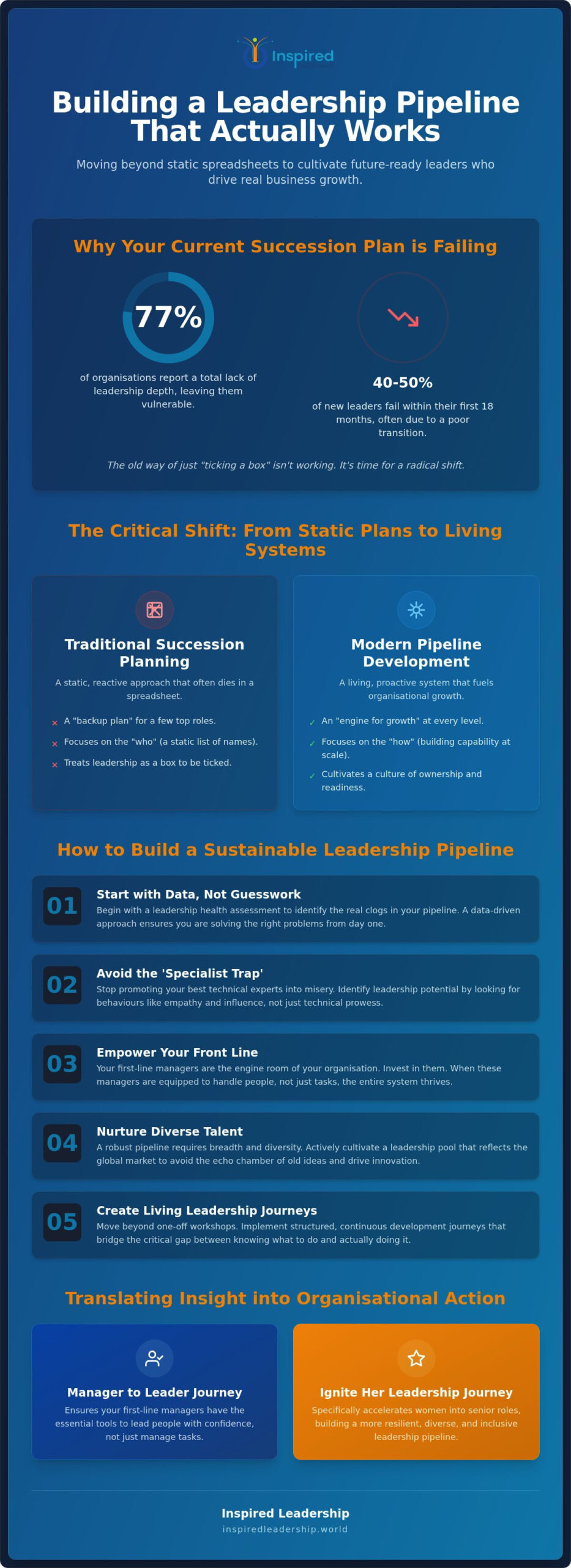
Five Steps to Organise a Sustainable Leadership Pipeline
Building a leadership pipeline shouldn’t feel like a tedious HR tick-box exercise. It is a strategic necessity that ensures your business thrives long after the current executive team has retired to the golf course. You need a system that is as dynamic as the market you operate in.
Success requires moving beyond static planning and into active development. You must align your strategy with long-term goals, foster transparency, and focus on real-world application. Here is how you can structure a pipeline that actually delivers results.
Step 1: Define Your Strategic Leadership Needs
You need to identify the specific behaviours required to drive your organisation forward over the next five years. Forget those generic competency lists that everyone ignores; they are usually too vague to be useful. Instead, focus on what “ownership” looks like in your specific context and culture.
Step 2: Implement Structured Development Journeys
It is time to move away from one-off workshops that are forgotten by Monday morning. You should implement structured, long-term journeys that allow for deep behavioural change and reflection. Integrating the Emerging Leader Journey into your daily operations ensures that development becomes a habit rather than an event.
Step 3: Foster a Culture of Transparency. High-potential talent will quit if they don’t see a clear path forward. Be honest with your people about where they stand and what they need to do to reach the next level.
Step 4: Prioritise Action-Learning. Leaders should solve real organisational problems whilst they learn. This ensures that the time spent on a journey provides an immediate return on investment for the business.
Step 5: Measure Behavioural Change. Don’t just track attendance or course completion. Look for visible shifts in how your leaders handle conflict, make decisions, and inspire their teams.
Translating Pipeline Insight into Organisational Action
The shift from “doing” the work to “leading” the people is the most difficult psychological hurdle your talent will ever face. Traditional workshops often fail because they treat leadership as a set of skills to be memorised rather than a fundamental shift in identity. Building a leadership pipeline requires a disciplined, battle-tested alternative that forces leaders to confront their own behaviours in real-time.
You might think that scaling this kind of capability is only for global conglomerates with bottomless budgets. In reality, medium-sized enterprises can achieve superior results by being more agile and focused with their development journeys. You don’t need a massive HR department; you just need a structured process that prioritises human potential over administrative box-ticking.
Let’s address the elephant in the room: the claim that development takes too much time away from “real work.” If you don’t have time to develop your people, you’re essentially saying you don’t have time for the future of your company. Leadership development is the real work that ensures your organisation survives the next market shift or talent exodus.
Your Next Steps on the Leadership Journey
You can start by downloading our journey brochures to see the specific, measurable results you can expect for your teams. These documents outline exactly how we transform technical experts into strategic owners through our bespoke methodology. It is the first step in moving from a static spreadsheet to a thriving, sustainable talent ecosystem.
If you are ready to stop guessing and start growing, let’s have a direct conversation to discuss your unique organisational challenges. We have spent 20 years in the corporate trenches and know exactly how to navigate the friction points that stall most pipelines. We won’t give you fluff; we will give you a roadmap that actually works.
Building a pipeline is a marathon, not a sprint, but the best time to start was yesterday. Every day you wait is another day your high-potential talent might be looking for the exit. Take the first step today and ensure your leadership legacy is one of strength and sustainability.
Your Future Leaders are Waiting for You to Lead
Stop treating your talent strategy like a game of musical chairs and start building a leadership pipeline that actually functions. You’ve seen how easy it is to fall into the specialist trap, so it is time to prioritise the human factor over technical brilliance. True growth happens when you move away from one-off events and embrace the long-term journey of behavioural change.
We bring 20 years of corporate expertise to help you achieve results-driven behavioural transformation. Our approach is specifically tailored for medium-sized enterprises that want to scale without losing their soul. You don’t need a global conglomerate’s budget to create a culture of ownership and strategic thinking.
The path to a sustainable future is right in front of you. You have the tools and the insight, so now you just need the courage to take that first step. We are here to guide you through the transition and ensure your next generation of leaders is ready to shine.
Frequently Asked Questions
What is the difference between a leadership pipeline and succession planning?
Succession planning is usually a risk-mitigation exercise focused on filling specific senior seats, whilst building a leadership pipeline is a continuous system for developing capability at every level. One is a static list of names; the other is a living process that ensures your organisation has a steady flow of ready-now leaders. It moves the focus from “who is next” to “how are we growing everyone”.
How do I identify high-potential employees without causing jealousy in the team?
Transparency is your best friend here. You should base your selection on clear, objective behaviours and assessments rather than gut feelings or favouritism. When everyone understands the criteria for different journeys, it turns “why them?” into “how can I get there too?” which fosters a culture of healthy aspiration.
Why do technical experts often struggle when moving into leadership roles?
Most technical experts have spent years being rewarded for their individual output, so they find it hard to let go of “doing” the work. They often struggle with the emotional shift required to find value in coaching others rather than solving the technical problems themselves. Without a specific journey to help them transition, they often default to micromanagement.
How long does it typically take to see results from a leadership pipeline journey?
You will see small behavioural shifts within weeks, but building a leadership pipeline that transforms your culture is a marathon. Expect to see significant results in decision-making and team ownership within six to twelve months of starting a journey. The goal is sustainable change, not a temporary “high” from a one-off workshop.
Can a medium-sized company really afford a structured leadership development journey?
You can’t afford not to. The cost of a failed leader or a departing high-potential far outweighs the investment in a structured journey. Medium-sized firms have the advantage here because they can implement these systems with much more agility and personal impact than global conglomerates.