

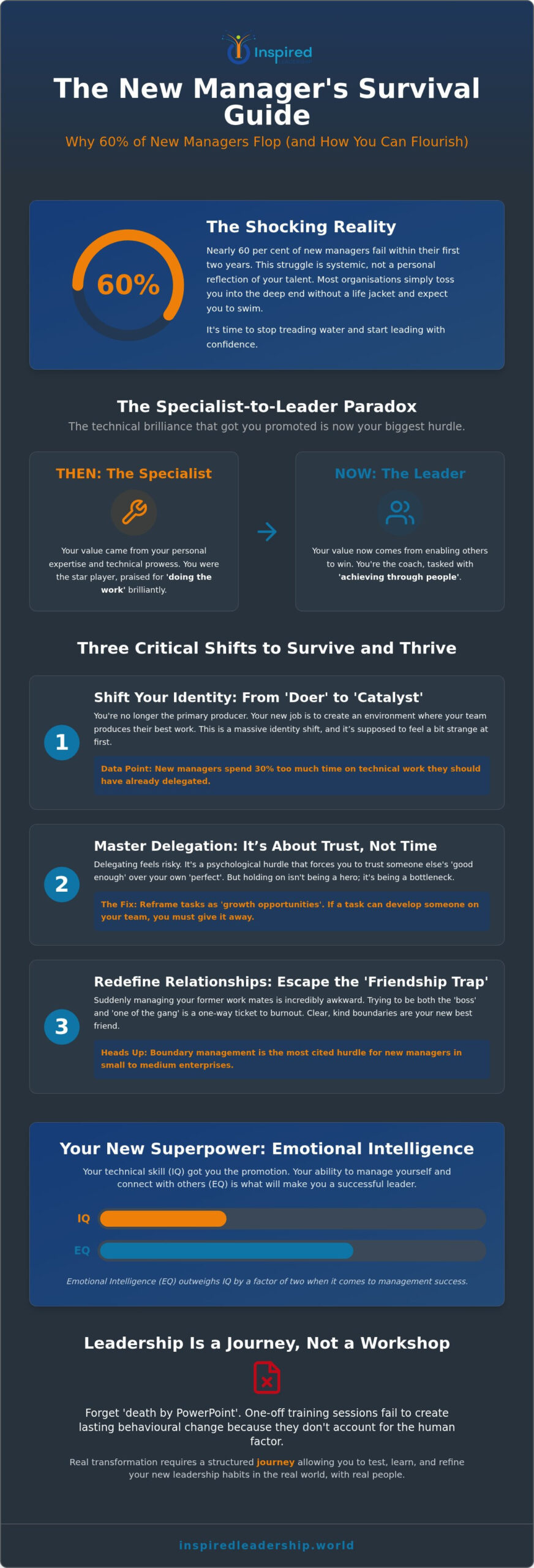
Nearly 60 per cent of new managers fail within their first two years in the role, according to 2026 research from SHRM. It turns out that being brilliant at your old job is actually one of the biggest first line manager transition challenges you’ll face. You’ve likely spent years perfecting your craft, only to find yourself feeling like a glorified admin assistant whilst drowning in tasks.
It’s exhausting to balance high-stakes performance with the sudden anxiety of managing your former work besties. You might feel like you’re failing, but this struggle is systemic rather than a personal reflection of your talent. Most organisations simply toss you into the deep end without a life jacket and expect you to swim like an Olympian.
This article provides the latest evidence-based insights to help you navigate this career jump without losing your sanity. You’ll discover a clear roadmap for your first 90 days and practical tools to help you stop “doing” and start “leading” with confidence. We’re going to look at how to transform your technical expertise into true leadership impact.
Key Takeaways
- Learn why your technical brilliance might actually be your biggest roadblock and how to avoid becoming part of the 60 per cent failure statistic.
- Master the art of boundary management to tackle common first line manager transition challenges, especially when you are suddenly the boss of your best work mates.
- Discover how to shift your professional identity from “doing the work” to “achieving through people” without losing your mind in the process.
- Get a practical roadmap to turn these insights into a sustainable leadership journey that creates a lasting impact for your whole organisation.
The Specialist-to-Leader Paradox: Why Your Technical Brilliance Might Be Your Biggest Hurdle
You were likely promoted because you were the best at what you did. Whether you were the sharpest coder or the most efficient analyst, your technical prowess was your superpower. Now, that same expertise is ironically one of the most significant first line manager transition challenges you will face.
This creates a massive identity crisis known as the specialist-to-leader trap. Research from SHRM indicates that 60 per cent of new managers fail within their first two years. They struggle because technical skills no longer drive success; instead, they often lead to a frantic urge to micromanage everything.
When you’re a star performer, it’s tempting to jump in and “fix” things yourself. However, your role has shifted from being the star player to being the coach who enables others to win. If you keep trying to score all the goals, your team will never learn how to play the game.
The Psychology of the Inflection Point
Why Traditional Training Fails the Research Test
Most companies try to fix this with a one-off workshop, but longitudinal studies prove these don’t work. These “death by PowerPoint” sessions fail to create lasting behavioural change because they don’t account for the human factor. Real transformation requires a structured journey to overcome first line manager transition challenges, allowing you to test and refine your leadership habits in the real world.
Decoding the 2026 Research: The Three Critical Inflection Points
Shifting your focus from “I do” to “We achieve” often feels like trying to write a novel while wearing oven mitts. This identity shift requires a complete overhaul of your professional self-image. You are no longer the primary producer; you are now the catalyst for everyone else’s output.
Research indicates that new managers spend 30 per cent too much time on technical work they should have delegated. This “technical clinginess” is one of the most common first line manager transition challenges we see in medium-sized enterprises. Developing an ownership mindset, where you prioritise the team’s collective results over your personal task list, is the primary predictor of your long-term success. For professionals looking to apply this mindset to their own business ventures, TrendHijacking offers a specialised programme for acquiring and scaling established e-commerce stores.
The Human Factor in Technical Transitions
Your IQ got you the promotion, but it won’t help you survive the first year. Emotional intelligence (EQ) outweighs IQ by a factor of two when it comes to management success. In the context of 2026 performance metrics, EQ is the ability to regulate your own expert ego to create psychological safety and space for your team’s collective growth. If you are finding the people side of things a bit messy, you can always connect with us to discuss how to smooth out the bumps.
Mastering the Art of Delegation
Delegation is a psychological hurdle that forces you to trust someone else’s “good enough” over your own “perfect.” It’s not a time-management issue; it’s a control issue. To overcome this, look for “growth opportunities” by asking if a task requires a skill someone else needs to develop. If the answer is yes, then keeping it for yourself isn’t being a hero; it’s being a bottleneck that prevents your team from evolving.
Surviving the Friendship Trap: Research-Backed Strategies for Leading Former Peers
It’s incredibly awkward when you suddenly become the boss of the person you used to complain about the boss with over a Friday afternoon pint. Research suggests that boundary management is the most frequently cited hurdle amongst first line manager transition challenges within SMEs. You’re navigating a minefield where your old social life and new professional responsibilities collide, and it requires more than just a new job title to fix.
The Perils of the “Player-Coach” Myth
Trying to be everyone’s best mate whilst also being their manager is a one-way ticket to burnout city. You simply cannot be “one of the gang” and hold people accountable at the same time without things getting messy and resentment building. Try establishing authority gently with phrases like, “I value our friendship, but in this context, I need to prioritise the team’s output,” or “Let’s look at this from a business perspective for a moment.”
Setting the New Social Contract
You need to have an intentional “reset” conversation with your team to align on how things are going to work moving forward. This isn’t about becoming a corporate robot; it’s about transparency and setting a new social contract that protects both your sanity and their performance. Using a leadership assessment early on can help you understand these team dynamics and avoid the “guessing game” that usually leads to conflict.
Managing conflict amongst people you used to vent with requires a delicate blend of professional distance and radical honesty. If you don’t address the shift in your relationship openly, it will eventually undermine your authority and create a toxic atmosphere. Be the leader who is brave enough to set the tone, even if the first few chats feel a bit clunky.
From Insight to Action: Designing a Sustainable Leadership Journey for Long-Term Impact
Knowing what needs to change is only half the battle. To truly overcome first line manager transition challenges, you must integrate new leadership habits into your daily routine until they become second nature. This isn’t about ticking a box; it’s about building a sustainable way of working that scales across your whole organisation.
Medium-sized enterprises operate with an agility that traditional, bloated training programs simply can’t match. You need a bespoke approach that respects your pace and focuses on turning every manager into someone who thinks like an owner. Choosing a structured manager to leader journey ensures your results are measurable and long-term.
When every leader in your business speaks the same language, the friction of daily operations starts to melt away. You move from a culture of “that’s not my job” to one of collective responsibility and high performance. It’s about creating a ripple effect where your growth as a leader inspires everyone around you to step up too.
Translating Insight into Action
Our philosophy at Inspired Leadership focuses on building capability at scale. We don’t believe in one-off workshops that are forgotten by Monday morning. Instead, we use coaching and peer support to ensure you are supported as you navigate the messy reality of leading people.
This approach ensures that you aren’t just learning theory in a vacuum. You are applying real-world solutions to your actual team problems whilst having a safety net of experts to guide you. It’s the difference between reading a book on swimming and actually getting in the pool with a coach.
Your Next Practical Steps
Ready to stop guessing and start leading? You can download the brochure for our beyond command journey to see exactly how we map out this transition. This roadmap is designed for those who are tired of superficial training and want something that actually sticks.
If you’d rather have a chat about your specific team or organisational needs, book a call at our contact page. We can discuss how to customise a journey that fits your unique culture and goals perfectly.
Take Command of Your Leadership Future
The data is clear; technical expertise alone won’t protect you from the 60 per cent failure rate facing first-time leaders. Navigating first line manager transition challenges requires a total identity overhaul and the grit to set new boundaries with your former work besties. It’s about moving from the person who does the work to the one who inspires it.
We’ve spent 20 years turning deep corporate insight into tangible organisational outcomes, so you don’t have to learn these lessons the hard way. You can even read our leadership coaching testimonials to see how others have successfully navigated this jump. Real leadership isn’t a one-off event; it’s a deliberate practice.
You don’t have to figure this out alone whilst drowning in a sea of admin. It’s time to stop “doing” and start leading with the confidence and clarity your team deserves.
Frequently Asked Questions
What is the biggest mindset shift when moving from employee to first-line manager?
The biggest shift is moving from being a “player” to being the “coach” who finds joy in other people’s successes. You are no longer paid for your personal output; your value now lies in how effectively you enable your team to perform. It’s about letting go of the technical tools you love and picking up the much messier tools of human connection and strategic influence.
How long does it usually take to feel confident as a new manager according to research?
Research from Soar Lead indicates that only 35 per cent of new managers feel confident in their leadership abilities from the start. For most, that feeling of being an imposter lasts well into the first year as they navigate unfamiliar territory. You can speed this up by committing to a structured journey that provides the practical tools and peer support needed to build genuine, lasting competence.
Can I still be friends with my team after I become their manager?
You can certainly stay friendly, but your “work bestie” status has to change into a professional partnership based on mutual respect. Being a manager means you can no longer join in on the office gossip or complain about the “higher-ups” over lunch. It requires a new social contract where your team understands that your primary responsibility is now their collective performance and professional growth.
What are the top three skills research says new managers must master first?
Research points to delegation, emotional intelligence, and clear communication as the primary skills needed to overcome first line manager transition challenges. You must learn to trust your team with tasks you once owned while managing the complex emotional dynamics of a group. Mastering these three allows you to stop being a bottleneck and start being the strategic leader your organisation actually needs you to be.
Why do so many high-performing technical experts fail when they are promoted?
High performers often fail because they rely on technical expertise that is largely irrelevant to their new leadership responsibilities. They fall into the trap of micromanagement because they don’t trust others to meet their own high standards. Without a deliberate journey to rewire their habits, they end up doing the work of their team instead of leading them, which is a recipe for total burnout.