

Promoting your top technical specialist is often the fastest way to lose a brilliant expert and gain a frustrated, micromanaging boss. It’s a classic corporate blunder that leaves teams demotivated and your best talent eyeing the exit. If you’ve watched productivity dip whilst a newly minted manager struggles to let go of the “doing,” you certainly aren’t alone.
You probably already know that a fancy new title and a desk move aren’t enough to change a person’s professional DNA. This guide reveals exactly how to support specialist to manager transition by facilitating a deep psychological identity shift rather than just ticking boxes on a HR checklist. We are moving well beyond the surface-level training that usually fails to stick.
By the end of this journey, you will have a strategic roadmap for 2026 to transform technical wizards into leaders who empower others. We’ll explore how to build a scalable leadership capability that keeps your high-performers engaged and your turnover low. It’s time to stop hoping for the best and start architecting real, lasting growth.
Key Takeaways
- Understand why your top talent gets stuck in the “Expert Trap” and how to guide them toward becoming an architect of team performance.
- Find out how to support specialist to manager transition through systemic scaffolding that validates leadership as a separate, critical skill set.
- Master the art of the first 90 days by prioritising human connection and transparent conversations over rigid corporate processes.
- Discover why long-term leadership journeys outperform one-off workshops when it comes to building scalable capability and retaining your best people.
Why the Specialist-to-Leader Shift is a Psychological Journey, Not a Job Change
Promoting your best technical wizard because they’re “good at their job” is the fastest way to see The Peter Principle play out in real-time. We often mistake individual brilliance for leadership potential. It’s a bit like asking your star striker to manage the football club just because they can score goals.
Understanding how to support specialist to manager transition requires looking past the new job description. It’s not about giving them a bigger laptop or a seat in the “grown-up” meetings. It is about facilitating a total identity overhaul from an “Expert” to an “Architect of Performance.”
The “Expert Trap” and the loss of the dopamine hit
For a decade, your specialist has built their entire self-worth on being the person with all the answers. They are addicted to the dopamine hit that comes from fixing a bug or closing a complex deal. Now, you’ve taken their favourite toys away and told them to lead instead.
This creates a massive psychological void. If they don’t learn how to get their kicks from the team’s success rather than their own output, they will inevitably start micromanaging. They aren’t being difficult; they’re just trying to feel useful again in the only way they know how.
Moving from “Doing” to “Enabling”
Leadership is a service, not a status symbol. Whilst the specialist mindset is all about depth and precision, the manager mindset is about breadth and systems. You are no longer the one doing the work; you are the one ensuring the work can happen beautifully.
This shift is often terrifying, especially when it involves being “other” amongst former peers. It’s a lonely transition that requires a structured journey to navigate safely. Without this support, they’ll likely retreat into their technical comfort zone, leaving the team rudderless and frustrated.
Building the Organisational Scaffolding: How to Support Your New Managers Systemically
It’s all well and good telling a new manager to “be more strategic,” but if your organisational systems are still rewarding individual heroics, you’re setting them up to fail. You can’t expect a specialist to flourish in a leadership role if the “scaffolding” around them is made of wet cardboard. Leadership is a distinct discipline.
When considering how to support specialist to manager transition, we have to look at the structural obstacles that have plagued technical fields for decades. Even a classic NASA report on specialist-to-manager transition highlights that technical experts often feel like they’re losing their professional identity. Your job is to create a safety net that makes this “messy middle” feel like a promotion rather than a punishment.
Aligning the executive team on leadership standards
Your executive team must be singing from the same hymn sheet before you even think about promoting your next specialist. If the board hasn’t defined what “good” leadership looks like, how on earth is a first-time manager supposed to figure it out? Consistency at the top is the only way to translate broad organisational insight into local, meaningful action.
Creating a culture of ownership
Shifting the culture is a massive part of how to support specialist to manager transition effectively. We need to ditch the dusty old command-and-control habits that stifle innovation and turn managers into glorified babysitters. You want a team that thinks for itself and owns its results, which is precisely why we created the Beyond Command Journey.
If your current organisational setup feels more like a hindrance than a help, it might be time for a fresh perspective. You can always reach out to us to discuss how to shore up your leadership foundations. Let’s make sure your systems are as high-performing as the people you’re trying to promote.
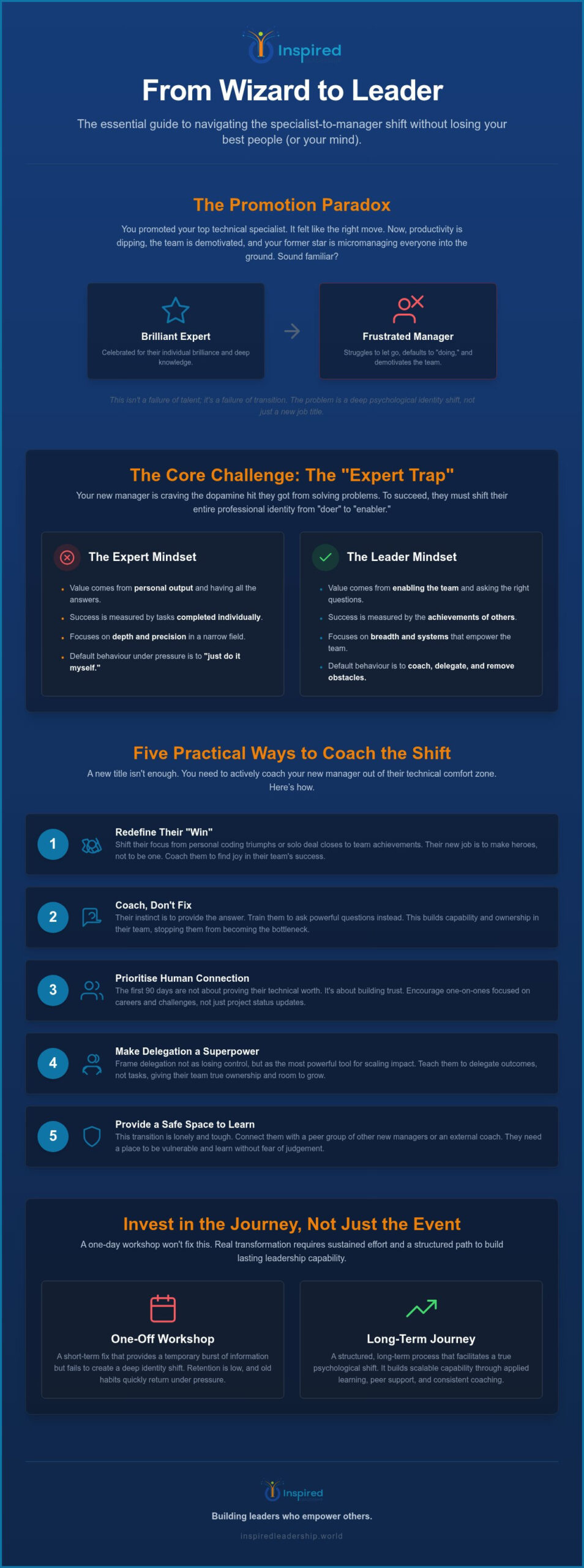
Five Practical Ways to Coach the Specialist out of the Mindset of a Technical Expert
The “I can do it better myself” mantra is the death knell of effective leadership. When you are looking at how to support specialist to manager transition, your first task is to break their addiction to the technical tools. They need to understand that their hands-on brilliance is now a barrier to their team’s growth.
A structured first 90 days should prioritise people over processes. This is about navigating what Harvard Business Review calls the seven seismic shifts for new leaders. It’s a period where they must swap their magnifying glass for a compass, moving from micro-details to macro-direction.
Building trust requires a heavy focus on the human factor. If your new manager doesn’t create psychological safety, their team will simply stop sharing the “bad news” until it’s far too late. We want managers who own their results, not ones who hide behind spreadsheets when things go pear-shaped.
Mastering the Peer-to-Manager conversation
Ignoring the fact that your new manager used to go for drinks with the team they now lead is a recipe for disaster. This conversation is a vital part of how to support specialist to manager transition because it sets the tone for the new professional relationship. A cheeky but honest script works best: “Look, I know this is a bit weird, but my role has changed and I’m here to make sure you have what you need to win.”
Transparency kills the resentment that often bubbles up during these transitions. If they try to act like a “boss” overnight without acknowledging the history, they’ll lose the room. It’s about being human first and a manager second, which is a core skill in our 20 years of corporate experience.
The art of the Support/Challenge balance
Technical high-performers need a specific kind of coaching that balances high support with high challenge. If you only support, you get a “nice” but stagnant team; if you only challenge, you get burnout. You can find out more about this dynamic by downloading the brochure for our Manager to Leader Journey.
Investing in the Journey: Moving Beyond Traditional Leadership Training
Most leadership training is about as effective as reading a book on swimming whilst sitting in a desert. You might learn the theory, but you’ll still drown the moment you hit the water. True transformation requires a sustained commitment to growth, not a one-off workshop that everyone forgets by Friday afternoon.
When considering how to support specialist to manager transition, you need a results-driven strategy that scales with your business. For medium-sized firms, the ROI isn’t found in fancy certificates; it’s found in managers who actually own their results and keep their teams engaged. Utilising frameworks like Dream Management Consulting and Certification can help these new managers connect with their team’s personal aspirations, driving both engagement and performance. We act as the pragmatic architects of this change, ensuring that your technical talent doesn’t just survive but thrives.
Traditional methods often fail because they treat leadership like a software update you can just “install” in an afternoon. Real change is messier and requires a structured approach that accounts for the human element. We focus on building leadership capability that is both sustainable and measurable, moving beyond the “hype” of typical motivational speaking.
Why “Journeys” outperform “Programs”
A “program” suggests a fixed start and end, whereas a journey acknowledges that behavioural change takes time and consistent practice. Our methodology focuses on translating deep psychological insight into immediate, local action over several months. Our Emerging Leader Journey is specifically designed for high-potential technical talent who need to bridge that gap between expert and leader.
Measuring the impact on your organisation
You cannot fix what you haven’t measured, and guessing your team’s capability is a risky game to play in 2026. Use our Leadership Assessment to baseline where your people are right now. This data-driven approach ensures your investment is targeted exactly where it’s needed most, rather than wasting budget on generic training.
It’s time to stop tick-box training and start building a leadership culture that lasts. Download our brochure or book a consultation to see how we can help you transform your technical wizards into high-performing leaders. We’ve spent 20 years in the corporate trenches, so we know exactly what it takes to make this shift stick.
Future-Proof Your Technical Leadership
You’ve seen that managing technical experts requires far more than just a shiny new job title. It demands a total identity shift from the technical “doing” to the strategic “enabling” that defines high-performing organisations. Successfully learning how to support specialist to manager transition means building the right scaffolding and coaching your people through the messy psychological middle.
We bring 20 years of corporate expertise to help you bridge this gap with results-driven transformational journeys. We don’t do one-off workshops that fizzle out after a week; we build lasting leadership capability. Our focus is on moving your technical talent into leadership roles where they can actually thrive.
Your specialists already have the brilliance. Now, let’s give them the map and the mindset they need to lead your team into 2026 and beyond.
Frequently Asked Questions
How do I identify if a specialist actually wants to be a manager?
You identify a specialist’s desire for management by observing their interest in team outcomes over individual tasks. Don’t just look at their technical output; look for the person who naturally mentors juniors or improves team workflows. Ask them directly if they’d rather be the best coder in the room or the person who builds the best coding team.
What is the biggest mistake organisations make during the peer-to-manager transition?
The biggest mistake is the “sink or swim” approach that assumes technical brilliance naturally translates to people management. Many organisations provide a new title but zero scaffolding, leaving the new manager to flounder in a sea of awkward peer dynamics. It’s a recipe for high turnover and a very grumpy team.
How long does it typically take for a specialist to feel comfortable as a leader?
It typically takes six to twelve months for a specialist to feel truly settled in a leadership role. This timeline depends heavily on how to support specialist to manager transition within your specific culture. Without a structured journey, that “settling in” period can drag on for years of painful trial and error.
Should I provide a technical expert with a mentor or a coach during their transition journey?
You should ideally provide both, but a coach is essential for navigating the psychological identity shift. A mentor tells them what they did, whilst a coach helps the new manager discover their own leadership style. If you want to support your staff through this transition, you can find out more about Professional Therapy and Business Coaching Services to help them manage the psychological shift. This is a vital part of how to support specialist to manager transition because it builds long-term resilience.
How can I support a new manager who is struggling to delegate technical tasks?
Support them by reframing delegation as an act of generosity toward their team’s growth. If they are hoarding the “fun” technical tasks, they are actually stealing development opportunities from their former peers. Show them that their new value comes from building a high-performing system, not from being the hero who saves the day.