
Promoting your top technical expert to a management role without a clear strategy isn’t a reward; it’s often a recipe for a cultural bottleneck. You’ve likely felt the frustration of a command-and-control culture where every tiny decision ends up back on your desk, leaving you exhausted while your team waits for permission to act. Mastering how to develop leaders at every level is the only way to stop being the single point of failure in your own business.
It is a common struggle across SMEs, especially since a 2026 Robert Walters survey revealed that 84% of workers are now scrutinising leadership decisions more closely than they were two years ago. You deserve managers who take genuine ownership of their results rather than just ticking boxes or waiting for the next instruction. We know you’re over the fluffy corporate workshops that yield nothing but a pile of dusty binders and zero behavioural change.
This guide offers a pragmatic roadmap to transforming your workforce into a proactive leadership pipeline without the usual nonsense. We’ll show you how to move from a culture of bottlenecks to one of self-sustaining growth and measurable ROI. It’s time to build a team that leads itself so you can finally focus on the horizon instead of the fires in the breakroom.
Key Takeaways
- Ditch the dusty “command-and-control” relics and learn to define leadership as a shared mindset of ownership across your whole shop.
- Discover how to develop leaders at every level by replacing one-off training days with continuous “Leadership Journeys” tailored for everyone from grads to senior execs.
- Identify the sneaky systemic friction points that turn your best technical specialists into frustrated, bottleneck-creating managers.
- Apply a pragmatic 4-step framework to align individual personal growth with your actual business outcomes for a pipeline that finally pays off.
- Visit our First Line Manager Program journey page to learn how we turn technical stars into people leaders and download the brochure to start your transformation.
Table of Contents
Redefining Leadership Beyond the Corner Office
Forget the idea that leadership is a fancy title or a mahogany desk. It’s not a badge you get for surviving ten years in the same cubicle or a reward for being the loudest voice in the Zoom room. Leadership is a systemic mindset of ownership and collaborative action that should hum through every part of your business.
Leadership at every level is the distributed capacity to translate insight into collective action. In our volatile 2026 economy, waiting for the "boss" to make every call is a death sentence for growth. You need to understand what leadership development is in a modern context, moving away from the dusty silos of the past. Mastering how to develop leaders at every level means building a team that doesn’t need to be told how to tie their own shoelaces every morning.
The High Cost of the Command-and-Control Relic
Command-and-control is a fossil from the industrial age that has no place in a modern SME. It creates massive bottlenecks where every decision, no matter how small, has to go through one person. This setup doesn’t just slow you down; it kills momentum and drains your energy.
I once worked with a brilliant founder who insisted on approving every single invoice and client email. His team was talented, but they were completely disengaged because they had zero agency. The business stalled because the founder became the lid on his own jar. That’s the reality of disengagement: when your people lack agency, they stop caring about the outcome and eventually walk out the door.
Why Leadership is an Organisational Property
Stop thinking of leadership as a solo performance. It’s actually an "output" of your entire system, much like profit or culture. When you distribute leadership, you aren’t just one person trying to carry the whole load on your back. This systemic approach is a magnet for talent retention because people stay where they feel their contributions actually matter.
Creating this environment requires a structured approach rather than a few random "rah-rah" speeches. Take a look at our Senior Leadership and Executive Journeys page and download the brochure to see how we help you build this systemic strength. It’s about moving from a single point of failure to a robust, self-sustaining leadership pipeline.
Structuring Your Leadership Journeys for Scalable Impact
One-off workshops are usually where good intentions go to die, often leaving behind nothing but a pile of participation certificates and a bill for lukewarm hotel coffee. To see real change, you need to move toward "Leadership Journeys" that weave development into the actual fabric of the workday. Understanding how to develop leaders at every level requires a tiered approach that respects the different pressures your team faces at every stage of their career.
This isn’t about rigid academic courses that feel like a chore. According to SHRM’s guide to developing leaders, a structured framework is essential for identifying and empowering talent before you actually need them in a higher role. You want a system where insight is immediately translated into action, ensuring your investment doesn’t just evaporate the moment everyone leaves the training room.
The First-Line Manager: Your Organisational Engine Room
The jump from "doing the work" to "enabling the work" is the hardest transition any professional will ever make. This is your engine room, and if it’s clogged with technical experts who don’t know how to lead, your whole business will stall. You can read more about this in our leadership development for medium sized companies guide.
We see this often: a brilliant engineer gets promoted and suddenly has to handle a teary performance review or a team conflict. Without a proper first line manager development program, they’ll likely retreat into their technical comfort zone and micromanage everyone into oblivion. It is about giving them the tools to step back so their team can step up.
High-Potential Talent and Graduate Accelerators
Don’t wait for a title to start building a leader. Spotting potential early means looking for the people who naturally take ownership of outcomes, even when it isn’t "their job." Using stretch assignments is a cheeky but effective way to build early-career confidence without the risk of a full-scale promotion too soon.
Our leadership journey program for graduates focuses on these early wins, helping your newest recruits see themselves as part of the solution from day one. If you’re ready to stop the "sink or swim" approach, head over to our First Line Manager Program journey page and download the brochure to see how we can help you build a pipeline that actually works.
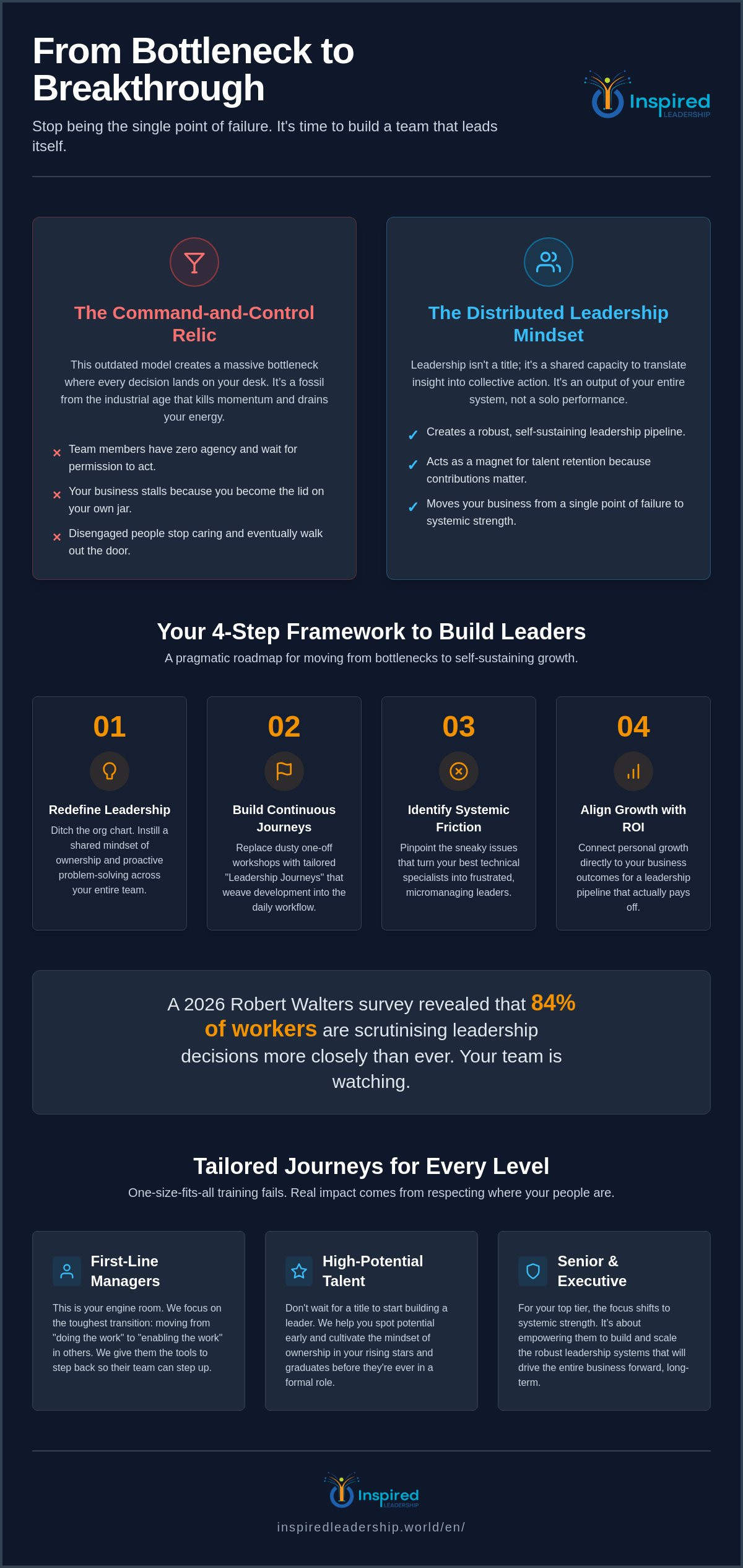
A 4-Step Framework to Build Leaders at Every Level
Building a leadership culture isn’t about throwing spaghetti at the wall and hoping someone feels "inspired." You need a structured approach that moves beyond theory and into the grit of daily operations. Mastering how to develop leaders at every level requires a 4-step framework designed for the pace and agility of an SME.
-
Step 1: Identify the systemic friction points in your current culture, such as that one manager who insists on being cc-ed on every minor email.
-
Step 2: Design journeys that align personal growth with actual business outcomes so that development feels relevant to the daily grind.
-
Step 3: Implement experiential learning that forces action rather than just passive note-taking.
-
Step 4: Measure the shift in ownership and output instead of relying on "smile sheets" that only tell you if the catering was good.
If you are ready to build a scalable leadership framework that actually sticks, you have to stop treating development as an optional extra. It is the core work of growing a sustainable business.
Moving from Insight to Action
Most training fails because it stays in the classroom, tucked away in a binder that will never see the light of day again. Real growth happens when you give a team a high-stakes, real-world challenge, like fixing a broken client onboarding process, and let them lead through it. Without this practical application, trying to get a team to take initiative is like herding cats in a thunderstorm.
Measuring What Actually Matters
Stop asking if people "liked" the training and start measuring decision speed. When leadership capability grows across the board, you’ll see a tangible drop in turnover because people stay where they feel competent and trusted. Research shows that 90% of top performers have high emotional intelligence, which directly impacts your bottom line and team stability.
To see how this works in practice, visit our High-Potential Technical Talent Program journey page and download the brochure. It’s time to stop guessing and start building a pipeline that delivers a real return on your development spend.
Bridging the Gap Between Technical Expertise and Leadership
Promoting your best technical expert to a management role is a classic SME move, but it often lands them straight in the Specialist-to-Leader trap. Your top engineer or accountant is used to being the smartest person in the room, solving problems with logic and data. When they suddenly have to lead people, they find that humans are significantly less predictable than code or spreadsheets.
Learning how to develop leaders at every level means helping these experts shift their identity from "expert" to "facilitator." They need to understand that their value no longer comes from doing the work themselves, but from enabling others to do it brilliantly. It is a massive shift that requires more than just a pat on the back and a fancy new business card. A human-centred talent pipeline development program is what separates businesses that retain their best people from those that watch them walk out the door.
The Identity Crisis of the New Technical Leader
Many new leaders fear they’ll lose their technical edge if they spend too much time in meetings or handling "people stuff." To keep their gravitas, they often try to do both, which leads to burnout and accidental micromanagement. A no-nonsense tip is to block out specific windows for "deep work" while accepting that "people work" is now their most important high-value output.
This transition is exactly what our High-Potential Technical Talent Program was built for. We help your specialists maintain their professional respect while learning the human skills needed to keep a team humming. It is about building confidence in their new role without making them feel like they have abandoned their craft.
Your Next Steps: Building the Pipeline
Stop overthinking the process and start organising your first journey today. You don’t need a massive HR department to begin; you just need a structured leadership development journey that aligns with your business goals. The longer you wait, the more your culture will struggle with those pesky bottlenecks and high turnover rates.
Head to our journey page to see how we can help you transform your workforce. Don’t forget to download the brochure for the full goss on how we turn technical stars into legendary leaders. Let’s get cracking and build a leadership pipeline that actually lasts.
Stop the Bottleneck and Start Scaling Your Impact
You now have a pragmatic roadmap for how to develop leaders at every level that doesn’t involve wasting your life in fluffy workshops. By redefining leadership as a shared mindset and finally bridging that identity gap for your technical stars, you’re building a business that can actually breathe. It is about moving from being the person who has to know everything to being the leader who enables everyone else to step up.
With 20 years of corporate experience, we’ve built a results-driven alternative to traditional training that is specifically designed for the unique pressures of medium-sized enterprises. We are here to help you ditch the decision-making bottlenecks and build a culture where ownership is the default setting. It’s time to stop the "sink or swim" cycle and start organising a journey that yields a tangible return on your investment.
Ready to see the difference for yourself? View our Leadership Journeys and download the brochure to get the full goss on how we can transform your workforce. You’ve already done the hard work of building a great company; now it’s time to build the leaders who will help you take it to the next level.
Frequently Asked Questions
How do I identify potential leaders in my team early?
You spot potential by looking for those who take ownership of outcomes before they even have a title. It isn’t just about who hits their KPIs the hardest; it’s about who asks "how can we fix this?" when a process breaks down. Check out our Graduate and Intern Leadership Journeys journey page to see how we cultivate this early initiative.
Can leadership really be developed in everyone, or is it an innate trait?
Leadership is absolutely a developed skill, much like playing footy or mastering a technical craft. While some people have a natural affinity for communication, the ability to translate insight into action is a muscle that anyone can build with the right framework. Mastering how to develop leaders at every level is about providing that structure across your whole shop.
How do we avoid having "too many cooks" if everyone is a leader?
You avoid the "too many cooks" chaos by defining leadership as ownership of one’s own domain rather than just giving orders. When everyone takes responsibility for their specific patch, you get a self-sustaining pipeline instead of a room full of people arguing over who holds the spoon. It’s about collaborative action, not creating a company full of mini-CEOs.
What is the most effective way to train technical experts for leadership roles?
The most effective way is to address the identity crisis head-on by moving them from "expert" to "facilitator." Our High-Potential Technical Talent Program focuses on this exact shift, giving specialists the human skills to lead without losing their technical gravitas. Don’t just give them a management textbook; give them real-world scenarios that force them to lead through others.
How do I measure the ROI of a leadership development programme?
You measure ROI by looking at tangible shifts like increased decision speed and reduced staff turnover. Since 84% of workers are scrutinising leadership decisions more closely in 2026, better leaders directly correlate to higher retention and lower recruitment costs. Visit our Senior Leadership and Executive Journeys page and download the brochure to learn how we track these performance outcomes.