
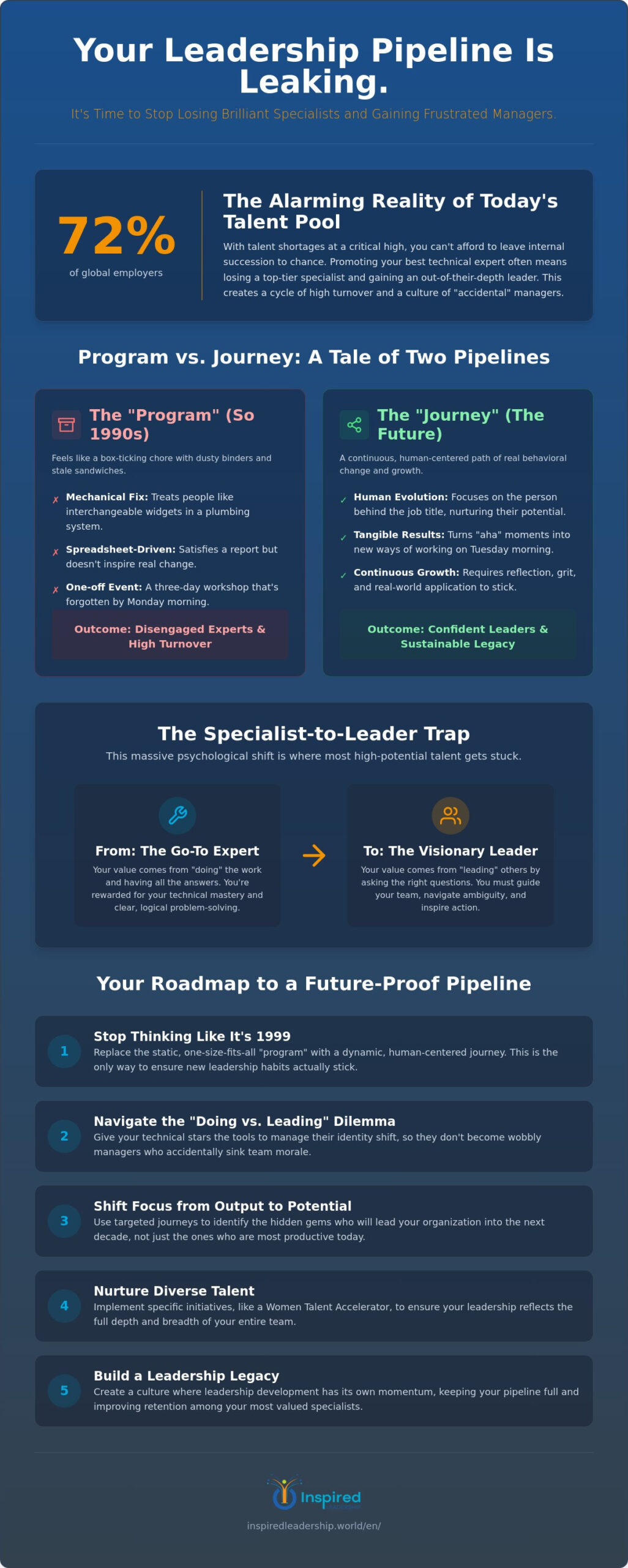
Promoting your most brilliant technical expert to a management role is frequently the fastest way to lose a top-tier specialist and gain a frustrated, out-of-depth leader. With 72% of global employers reporting talent shortages in 2026, you cannot afford to leave your internal succession to chance or a dry, tick-box talent pipeline development program. Most traditional approaches fail because they treat leadership like a mechanical fix rather than a deeply human evolution.
You likely know the frustration of watching high-potential talent struggle with the transition, leading to high turnover and a culture of “accidental” managers. It is exhausting to invest in a generic talent pipeline development program that yields no tangible organisational results whilst your best people eye the exit. We promise to help you transform these experts into confident leaders who build a sustainable leadership legacy that actually sticks.
This guide moves beyond the corporate plumbing to offer a pragmatic, human-centred roadmap for your talent pipeline development program. We will explore how to foster a culture where people own their actions and create a steady stream of ready-to-lead talent. It is time to stop filling boxes and start developing the visionary architects your organisation deserves.
Key Takeaways
- Stop thinking like it’s 1999; replacing a static talent pipeline development program with a human-centred journey is the only way to ensure leadership habits actually stick.
- Learn to help your technical stars navigate the “doing versus leading” dilemma so they don’t become the wobbly managers who accidentally sink team morale.
- Shift your focus from current output to future potential, using targeted journeys to find the hidden gems who will lead your organisation into the next decade.
- Discover how to nurture diverse talent through specific initiatives like the Women Talent Accelerator, ensuring your leadership reflects the depth of your entire team.
- Build a leadership legacy that creates its own momentum, ensuring your pipeline remains full of ready-to-lead talent whilst improving retention amongst your most valued specialists.
What is a Talent Pipeline Development Journey (and Why the Word ‘Program’ is So 1990)?
Let’s be honest. When you hear the word “program,” you probably think of dusty binders, stale sandwiches, and a three-day workshop that everyone forgets by Monday morning. A traditional talent pipeline development program often feels like a box-ticking chore rather than a strategic investment in your people.
We prefer the word “journey” because leadership isn’t a destination you reach after a single PowerPoint presentation. It’s a continuous, human-centred path of behavioural change that requires time, reflection, and a bit of grit to get right. We aren’t just teaching people how to fill out forms; we’re helping them evolve into the leaders your business actually needs.
In South Africa, where the skills gap can feel more like a canyon, organisations are shifting away from the high costs and risks of external recruitment. They are finally realising that succession planning is most effective when you nurture the brilliance already sitting in your office. This shift moves the focus from merely filling vacancies to building long-term leadership capability that lasts.
The Problem with Dry Corporate Plumbing
If you treat your talent pipeline like literal plumbing, you end up viewing your team as interchangeable widgets or inventory to be moved around a system. This mechanical approach is exactly why so many high-potential experts feel disengaged and start looking for the exit. They don’t want to be a “resource” in a pipe; they want to be seen as individuals with potential.
A tick-box exercise might satisfy a spreadsheet, but it won’t give you leaders who can navigate a crisis or truly inspire a team. You need a transformational experience that prioritises the human behind the job title. When you focus on people over processes, you create a culture where talent actually wants to stay and grow.
Translating Insight into Action
Real growth happens when theory hits the pavement of your actual daily operations. Our journeys, such as the First Line Manager Journey, focus on moving beyond head-knowledge and into tangible organisational results. It’s about taking that “aha” moment from a session and turning it into a new way of working on Tuesday morning.
We want your people to own their actions and their outputs, creating a culture of accountability that doesn’t require constant hovering from senior executives. If you’re ready to see how this works in practice, you should download the brochure for a full breakdown of our approach. This isn’t just about filling a vacancy; it’s about building a legacy of capability that sustains your business for years. You can even start by taking our leadership assessment to see exactly where your pipeline might be leaking.
The Specialist-to-Leader Trap: Why Great Experts Often Make Wobbly Managers
You’ve spent years becoming the go-to person for every complex technical problem. Suddenly, you’re promoted, and your reward is a calendar full of meetings and a team that needs your guidance instead of your code or calculations. This is the classic specialist-to-leader trap that often breaks even the most well-intentioned talent pipeline development program.
It’s a massive psychological shift that many organisations completely underestimate. You go from being the expert who has all the answers to the leader who asks the right questions. Many new managers feel like they’re losing their edge, fearing that if they aren’t “doing” the work, they’re no longer adding value to the business.
Whilst a Talent Pipeline Management (TPM) framework provides a solid high-level structure for managing your talent supply, it doesn’t always account for the internal wobbles of a human being trying to find their new identity. You need a way to help your people bridge that gap without them feeling like they’ve abandoned their hard-earned credibility. It is about evolving, not erasing, what made them great in the first place.
From Technical Pro to People Leader
Your best specialists are used to clear, logic-based outcomes. People, however, are messy, unpredictable, and rarely follow a perfectly written script. If you don’t support this transition, your experts will likely quit management out of pure frustration, leaving you with a double vacancy and a bruised culture.
To stop the rot, you must help them see that leadership is a new craft to be mastered, not a distraction from their “real” work. It’s about shifting their sense of accomplishment from their own output to the success of their team. Understanding why leadership development programs fail is the first step to ensuring your investment in this transition actually delivers lasting results. If you’re seeing these cracks appear in your team, it might be time to chat with us about a more human approach to development.
Supporting the First-Line Transition
This is where a structured manager to leader journey becomes vital. It provides the psychological safety for technical pros to experiment with their new “people power” without feeling like they’re flying blind. Building confidence takes time, but it starts with acknowledging that leading is a skill just as complex as any engineering or financial discipline.
You can’t expect someone to change their professional identity overnight just because they have a new title. Practical support, like peer coaching and real-world application, helps them realise that being a leader is actually the highest form of being an expert. When they stop trying to do everyone’s job and start leading, the whole pipeline begins to flow much more smoothly.
Identifying the Right Travellers for Your Leadership Journey
Picking the right people for your leadership journey shouldn’t feel like a high-stakes game of “eeny, meeny, miny, moe.” Many businesses fall into the trap of promoting the person with the highest output, only to realise that being a brilliant coder or accountant doesn’t magically bestow people skills. You need to look beyond current performance and start identifying the latent potential that actually fuels a successful talent pipeline development program.
Removing bias is a critical part of this process, especially if you want a leadership team that doesn’t just look like a carbon copy of the current board. By using data-informed tools like our leadership assessment, you can spot the quiet influencers and strategic thinkers who might otherwise be overlooked. This objective approach aligns with best practices found in NIST’s guide to talent pipelines, which emphasises a structured, evidence-based method for workforce development.
Diversity isn’t just a tick-box for your annual report; it’s the secret sauce for innovation. Nurturing diverse talent through specific initiatives like the Women Talent Accelerator ensures you aren’t leaving half your potential on the table. It’s about creating a path that allows every traveller to bring their unique perspective to the leadership table.
Nurturing High-Potential Technical Talent
When you’re looking for high-potential technical staff, keep an eye out for curiosity and a willingness to help others succeed. These are the people who naturally mentor juniors or find ways to improve team workflows without being asked. Engagement starts long before they get a manager title, so give them small leadership “missions” now to see how they handle the responsibility.
Building the Graduate Pipeline
Think of your graduates and interns as the ultimate insurance policy for your firm’s future. In South Africa, where youth employment is a critical focus, building a robust graduate pipeline is both a strategic necessity and a vital contribution to the economy. Instilling a culture of ownership from day one ensures that your new starters don’t just wait for instructions but actively look for ways to add value. If you want to close the gap between raw academic talent and workplace-ready professionals, explore our practical guide on improving graduate employability in your business to see how a human-centred approach transforms new hires into high-impact contributors.
If you’re tired of guessing who your future leaders are, it’s time to get intentional about your selection process. Contact us today to discuss how we can help you identify and develop the right travellers for your organisational journey.
Building a Sustainable Leadership Legacy in Your Organisation
You shouldn’t have to start from scratch every time a senior manager decides to move on. A well-executed journey creates a self-sustaining cycle where your current leaders naturally mentor the next generation. This turns your talent pipeline development program from a static list of names into a living, breathing part of your organisational culture.
Medium-sized enterprises need a bespoke approach because you don’t have the luxury of a thousand-person HR department or the rigid structures of a massive global corporation. You need a strategy that scales with your growth and builds genuine resilience. It’s about ensuring your business thrives even when the unexpected happens and key roles need filling at short notice.
If you are ready to stop reacting to vacancies and start building a legacy, you should contact Inspired Leadership to start your own journey. We help you move beyond the plumbing and into the heart of what makes your people stay and lead.
Measuring the Impact of Your Journey
We all love a “happy sheet” at the end of a session, but those feedback forms rarely tell the full story of behavioural change. The real ROI of a leadership journey is seeing a pipeline of leaders who actually think for themselves and own their outcomes without being micromanaged. You’ll notice the difference when you spend less time fire-fighting and more time on high-level strategic growth.
You can track tangible success through improved retention rates amongst your technical specialists and the speed at which internal vacancies are filled by ready-to-lead talent. These are the metrics that prove your leadership capability is actually growing. When your people feel invested in, they invest back into the business with their loyalty and their best work.
Your Next Steps to Leadership Excellence
Waiting to build your pipeline is a risk your business simply cannot afford to take in 2026. Every month you delay is another month where your best talent might be looking for an organisation that values their growth more than you currently do. It is time to take a bold, confident step toward a more sustainable leadership future.
We encourage you to download our brochure to see exactly how we structure our journeys to translate insight into real-world action. This is your roadmap to transforming technical experts into the confident leaders your organisation deserves. Let’s make sure your leadership legacy is one that actually sticks and carries your business forward for years to come.
Your Roadmap to a Lasting Leadership Legacy
You now have the roadmap to help your technical stars stop wobbling and start leading with genuine confidence. By shifting from a mechanical mindset to a human-centred journey, you are building a culture where ownership and resilience are the default settings. It’s about more than just filling gaps; it’s about creating a self-sustaining cycle of growth that keeps your best people right where they belong.
Ditching the dry, tick-box talent pipeline development program for a bespoke journey is the smartest move you will make for your team this year. We bring a human-centred approach with a bit of sass to ensure your technical experts don’t just survive management but actually thrive in it. Our results-driven alternative to traditional training is built specifically for medium enterprises that are serious about sustainable growth. To further professionalise your internal development, you may find out more about Professional Certification and Program Enrollment Fees to see how formal qualifications can benefit your leadership team.
Ready to build your legacy? Download our journey brochure and let's get started. We cannot wait to help you transform your workplace into a hub of confident, ready-to-lead talent. Your leadership legacy starts the moment you decide to prioritise your people and their potential.
Frequently Asked Questions
What is a talent pipeline development journey?
A talent pipeline development journey is a strategic, human-centred path designed to identify and prepare your employees for future leadership roles. This approach replaces the dry, old-school talent pipeline development program with a process focused on real behavioural change. You can see how this works in practice on our Emerging Leader Journey page, where you can also download the full brochure.
How do you identify high-potential leaders?
You identify high-potential leaders by spotting individuals who demonstrate a natural ownership mindset and high emotional intelligence. Look for the people who can translate technical brilliance into team actions without breaking a sweat or losing their cool. It’s about finding those who want to help others succeed rather than just being the smartest person in the room with all the answers.
Why do technical experts struggle in management?
Technical experts often struggle because they get stuck in the “doing” trap, trying to fix everything themselves instead of leading their team. This leads to massive burnout and a team that feels micromanaged, undervalued, and completely frustrated. They need help to find a new professional identity where their success is measured by the team’s output, not their own individual technical tasks.
What is the ROI of a leadership journey?
The ROI of a successful talent pipeline development program is found in reduced turnover and a significant boost in productivity across your teams. You’ll save a fortune on external recruitment costs and build a resilient legacy of leaders who are ready to act when it matters most. It’s the pragmatic difference between constantly fire-fighting and actually growing your business with absolute confidence and clarity.
How do you support women in leadership?
Supporting women in leadership requires specialised journeys, like the Women Talent Accelerator, that tackle the specific challenges women face in the corporate world. These journeys build confidence and authority, helping women navigate their careers with a supportive network behind them. You should download the brochure to see how we help your female talent reach their full leadership potential.