
Your latest one-off leadership workshop didn’t fail because the catering was bad or the slides were dull. It failed because you can’t fix a systemic culture problem with a single day of post-it notes and forced bonding. If you want to stop your best technical experts from handing in their notice, it’s time to embrace a structured leadership development journey that outlasts the morning tea.
You likely feel the frustration of watching talented managers do all the heavy lifting while their teams sit idle, waiting for direction. It’s a common trap where training budgets are treated like a tick-box exercise rather than a strategic investment. We’ve all been there, watching “accidental managers” struggle because they weren’t given the right roadmap to lead.
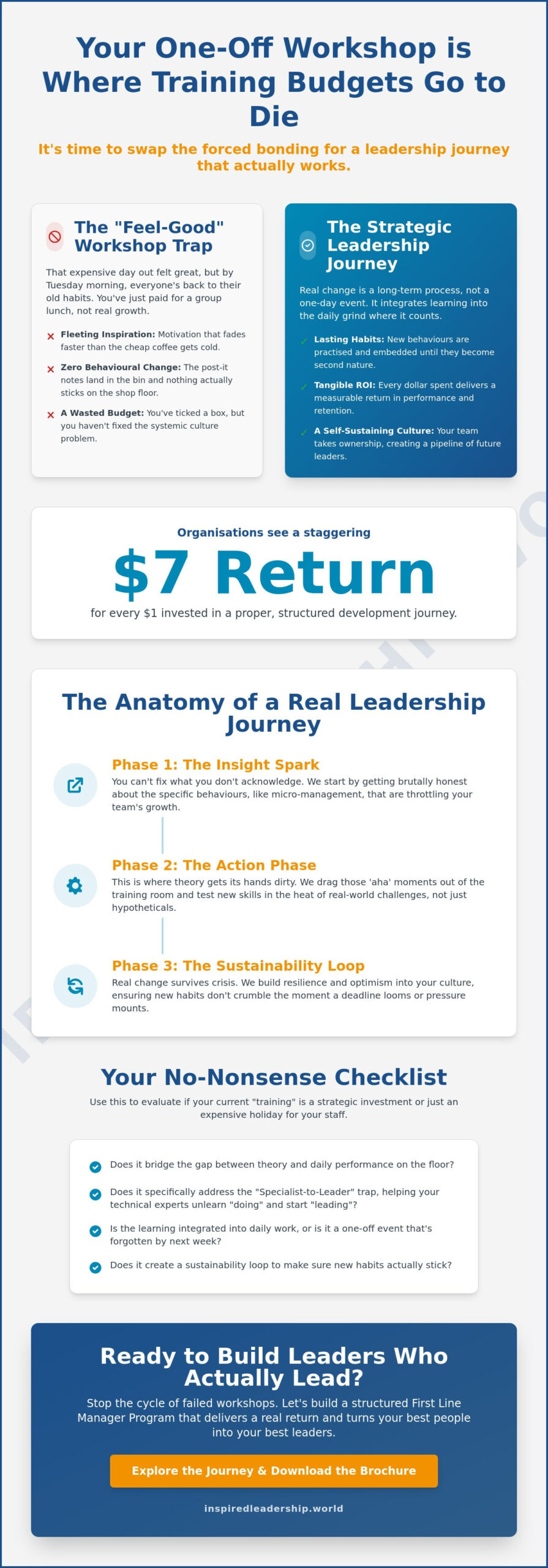
Research shows that organisations see a $7 return for every $1 spent on proper development, but that only happens when the learning is integrated into the daily grind. This guide provides your 2026 checklist to build a self-sustaining pipeline that actually delivers a tangible ROI. We’ll explore how to move away from “one-and-done” training and towards a system where your team finally takes real ownership.
Key Takeaways
- Stop wasting your budget on one-off workshops that offer plenty of inspiration but zero long-term behavioural change.
- Discover how to build a structured leadership development journey that bridges the gap between theory and daily performance.
- Learn how to move your team from initial insight to consistent action where new habits actually stick on the shop floor.
- Use our executive checklist to ensure your training, especially your First Line Manager Program, is a strategic investment rather than a holiday.
Why One-Off Workshops are Where Your Training Budget Goes to Die
Let’s be honest. That fancy workshop with the lukewarm coffee and the colourful butcher’s paper was probably a total waste of your time. If your team is back to their old habits by Tuesday morning, you didn’t invest in growth; you just paid for a very expensive group lunch. Real change doesn’t happen in a single afternoon of forced bonding and “trust falls”.
A structured leadership development journey is a long-term, systemic shift in behaviour rather than a fleeting moment of inspiration. While a 24-hour burst of motivation feels great, it usually fades faster than a cheap tan by Monday morning. You need a journey that integrates learning into the actual work your people do every single day.
In many Australian SMEs, the biggest friction point occurs where technical brilliance meets management incompetence. You promote your best “doer” and suddenly they’re drowning in people problems they aren’t equipped to handle. Without a clear path forward, their “insight” remains just an expensive chat in a hotel conference room that never reaches the office floor.
If you want to see a real return on your investment, head over to our First Line Manager Program journey page. You can download the brochure there to see how we turn those “aha” moments into permanent habits.
The Specialist-to-Leader Trap
Your best engineer is often your most stressed-out, micro-managing new boss. They are terrified of letting go of the technical tools that made them successful, so they end up doing the work instead of leading the team. This creates a bottleneck that stifles your growth and burns out your most valuable talent.
A structured leadership development journey provides the safety net these experts need to unlearn “doing” and start “leading” with genuine confidence. By understanding leadership development as a continuous process, you give them the space to fail, learn, and eventually thrive. The transition from being a brilliant doer to an effective leader is the most critical pivot your business will ever make during a growth phase.
The Anatomy of a Real Leadership Journey: From Insight to Action
You don’t wake up one morning with a “Leader of the Year” trophy just because you sat through a PowerPoint presentation. Real growth is messy and requires a structured leadership development journey that actually respects how humans learn. It isn’t about ticking boxes; it’s about shifting the way your people think and act when nobody is watching.
The first step is the Insight Spark. This is where we identify the specific behaviours currently throttling your growth, such as micro-management or a fear of healthy conflict. You can’t fix a bottleneck if you don’t know where the blockage is, so we start by getting honest about what’s holding you back.
Then comes the Action Phase. This is where those “aha” moments are dragged out of the training room and onto the shop floor or into the office. It’s about translating theory into daily habits, ensuring that new skills are tested in the heat of real-world challenges rather than just discussed over a coffee.
Finally, we establish the Sustainability Loop to ensure the new culture survives. The Psychology of the Leadership Journey highlights that resilience and optimism are vital for long-term success. This loop ensures your new culture doesn’t crumble the moment a deadline looms or a crisis hits.
Your organisation has its own unique DNA, so your journey must be tailored to fit your specific team. We don’t believe in generic corporate templates that ignore the reality of your business. We build the structure around you.
Moving Beyond Passive Learning
Watching a video on management while eating a meat pie isn’t development; it’s just entertainment. To move from passive consumption to owning the outcome, your managers need to follow a “see it, do it, master it” rhythm. This parallel construction builds genuine muscle memory, turning awkward new skills into second-nature leadership.
We act as the pragmatic architects for this behavioural change, providing the structure your leaders need to thrive. If you want to see how this looks in practice, our First Line Manager Program offers a clear roadmap for your emerging talent.
The Executive Checklist: Evaluating Your Leadership Pipeline
Does your current training last longer than a week? If the answer is no, you haven’t bought a structured leadership development journey; you’ve bought your staff a mid-year holiday. Real change requires time for new behaviours to be tested, failed, and refined in the pressure cooker of your daily operations.
You need to evaluate if your curriculum focuses on the First Line Manager Development Programme or just offers generic platitudes about “synergy”. High-potential technical talent doesn’t need fluff; they need concrete tools to manage the chaos of people who don’t think in code or blueprints. Generic advice is easy to find, but it rarely survives the first contact with a disgruntled client or a missed deadline.
Stop measuring ROI by “smiles per hour” on a feedback form. True success is found in increased team output and a shift where managers actually take ownership of their results. When developing a leadership development plan, it must be anchored in the reality of your balance sheet, not just a feel-good sentiment.
Assessing the Sustainability of the Programme
For a programme to stick, you need peer accountability and active executive involvement. It’s about creating a culture where leaders hold each other to a higher standard long after the facilitator has left the building. Without this peer-driven support, even the best intentions will eventually drown in the “business as usual” swamp.
Here is a cheeky question for you. Would you trust this programme’s graduates to run your business while you are on holiday in Port Douglas? If you’re still checking your emails every ten minutes because you’re worried the wheels will fall off, your leadership pipeline is leaking. Understanding how to develop leaders at every level is the only way to stop being the single point of failure in your own business.
We want to see an “ownership mindset” where your leaders think like founders. When they start treating the company’s resources and reputation as their own, you know you’ve moved beyond simple training and into a genuine structured leadership development journey. If you’re ready to stop guessing and start building, head over to our journey page to download the brochure and see how we fix the pipeline for good.
The Inspired Leadership Difference: Bespoke Journeys for SMEs
We don’t do “sage on a stage” teaching because we know it doesn’t work for busy executives who need results yesterday. Instead, we partner with you to build a team that actually thinks for itself, freeing you up to focus on the big picture. It’s about creating a structured leadership development journey that scales across your entire organisation, not just a lucky few in the corner office.
Building leadership capability at scale means translating those initial insights into massive action across the whole shop. We’ve spent 20 years in the corporate trenches, so we know that a results-driven alternative is the only way to see a return on your training spend. You can choose to have a trained team that stays, or keep a talented team that eventually leaves because they felt stagnant; the choice is yours.
To further explore how to support your growth ambitions, you can check out Full Potential for more expert advice on SME development.
Why Medium Enterprises Need a Different Map
The Australian SME sector is a unique beast, defined by incredible agility and intense pressure that big corporates just don’t understand. You need a map that respects your speed, which is why our specific programmes, such as the Women Talent Accelerator, are designed for tangible outcomes. These aren’t generic modules; they are battle-tested strategies for growing firms that need their leaders to step up now.
If you’re tired of training that feels like a tick-box exercise, it’s time for a change. Head over to our journey page right now to see how we do things differently. You can download the brochure there and start building a structured leadership development journey that actually sticks.
Stop the Workshop Waste and Start Scaling Your Impact
You’ve seen the data and you’ve likely felt the sting of a training budget that vanished into thin air. It’s time to stop the cycle of one-day wonders and start investing in a structured leadership development journey that respects your time and your bottom line. We’ve spent 20 years in the corporate trenches, so we know exactly how to cut through the rubbish and build something that actually sticks.
Our bespoke designs for medium enterprises ensure your technical experts don’t just become managers; they become leaders who think like owners. You get our no corporate jargon guarantee, ensuring every lesson is pragmatic, actionable, and human-centred. We’re here to help you move from “aha” moments to daily habits that transform your culture for good.
Ready to stop the workshop waste? Explore our Leadership Journeys and download the brochure today. You already have the talent; now it’s time to give them the roadmap they deserve to truly thrive and lead your business into 2026 and beyond.
Frequently Asked Questions
What exactly is a structured leadership development journey?
A structured leadership development journey is a long-term roadmap designed to shift behaviours across your entire organisation. It moves beyond the “one-and-done” workshop model by integrating learning into daily habits and real-world challenges. Instead of a single day of inspiration, you get a systemic process that builds genuine leadership muscle over several months.
How much time do my managers actually need to commit to a journey?
Your managers will spend more time applying new skills on the job than sitting in a classroom. While the exact commitment depends on your specific needs, it’s designed to fit into the busy flow of an Australian SME. Think of it as a marathon of small, consistent steps rather than a soul-crushing sprint that leaves your team exhausted and behind on their actual work.
Can a leadership journey really fix a high turnover of technical staff?
Yes, because most technical experts quit when they feel like they’re failing as managers. By providing a structured leadership development journey, you give your engineers and specialists the safety net they need to unlearn “doing” and master “leading”. When people feel competent and supported in their roles, they don’t look for the exit the moment a recruiter calls.
For those managing technical teams in the automotive sector, you can visit AutoMentor Enterprise to see how their specialized learning platform can help streamline professional training.
What is the difference between a leadership journey and a standard training course?
Standard training is often just an expensive chat in a hotel conference room that everyone forgets by Monday morning. A journey is a bespoke architect for behavioural change, involving peer accountability and executive involvement. It’s the difference between watching a video about swimming and actually getting in the pool with a coach who won’t let you drown.
How do we measure the ROI of a leadership development journey in an SME?
You measure success by tangible changes in team output, reduced turnover, and how often you can actually take a holiday without the wheels falling off. Research indicates that organisations see an average return on investment of $7 for every $1 spent on proper development. If your leaders are taking ownership and thinking like founders, your training budget is finally doing its job.
If you’re ready to see these results in your own business, head over to our journey page and download the brochure to get started.