

If you are the only person in your scale-up who feels a genuine pit in their stomach when a target is missed, you do not have a leadership team. You have a collection of expensive assistants. Developing ownership mindset in leaders is the only way to stop being the “Chief Everything Officer” and finally scale with the confidence that your vision is being executed by people who actually care.
I know it is soul-crushing to watch smart people play it safe or wait for your nod before solving a glaring issue. In my 20 years of corporate experience, I have realised that passivity is usually a systemic failure, and with 37% of Australian employees planning to job hunt in 2026, it is a failure your culture cannot afford. You deserve a leadership team that treats your business results like their own reputation is on the line.
This guide provides a no-nonsense checklist to move your managers from mere activity to genuine, proactive accountability. We will explore the systemic shifts needed to ensure your leaders solve problems before they reach your desk and actually give a toss about the bottom line. To see how we structure this transformation, visit our Senior Leadership and Executive Journeys page and download the brochure to begin the process.
Key Takeaways
- Identify the “Founders Trap” and learn how to stop your leaders from constantly seeking permission for every minor decision.
- Discover the psychology of accountability and why fostering an “Internal Locus of Control” is the engine behind every high-performing scale-up.
- Use our 10-question audit during your next 1-on-1 to see if you are actually developing ownership mindset in leaders or just supervising glorified project managers.
- Learn how to celebrate “owning the 2%” to create a safe environment where your team feels bold enough to make the tough calls.
- Move from theory to measurable results by exploring our Senior Leadership and Executive Journeys and downloading the brochure to start your team’s transformation.
The Scale-up Stall: Why Your Leaders Wait for Permission
Scaling a business in Australia is a bit like trying to change a tyre while the car is doing 100km/h on the M1. You need a team that grabs the jack without being told. Developing ownership mindset in leaders is the difference between a business that glides and one that grinds to a halt because everyone is waiting for the boss to say “go”.
An ownership mindset is the internal drive to deliver an outcome regardless of the hurdles. It is rooted in psychological ownership, where a person feels the business results are a direct reflection of their own character. If your managers have an “employee mindset,” they focus on doing their job; if they have an “owner mindset,” they focus on the result.
Many founders fall into the “Founders Trap,” where they accidentally train their team to be passive. By swooping in to save the day or demanding a final sign-off on every minor detail, you turn smart leaders into glorified order-takers. In a 2026 economy where GDP growth is slowing to 1.8%, having a leadership team that waits for permission is an expensive luxury you cannot afford.
The Difference Between Responsibility and True Ownership
Responsibility is about the task. Ownership is about the impact. I once saw a project lead deliver a “perfect” software update on time and under budget, only for it to be completely useless to the sales team. He was responsible for the code, but he didn’t own the business solution. This is a common trap for technical experts who get promoted but keep their “expert” blinkers on.
Why Traditional Training Fails to Build This Muscle
A one-day workshop is about as effective at building ownership as a single gym session is at building a six-pack. Real change requires a structured journey that addresses psychological safety and systemic habits. If you are relying on generic, off-the-shelf solutions, you may want to explore why bespoke leadership development programs deliver far better results for scale-ups than one-size-fits-all training. Our First Line Manager Program is designed to bake these habits in over time.
Mindset shifts don’t happen in a vacuum. To see how we build these capabilities across your organisation, visit our Senior Leadership and Executive Journeys page and download the brochure to explore our approach.
From Task-Takers to Outcome-Owners: The Psychology of Accountability
If your leaders behave like they are just along for the ride, it is likely because they lack an “Internal Locus of Control.” This psychological engine is what drives a person to believe they have the power to influence results rather than being a victim of circumstance. Developing ownership mindset in leaders requires shifting this internal narrative from “this happened to me” to “I made this happen.”
A massive part of this shift is encouraging your team to “own the 2%.” Even if a project goes pear-shaped due to factors outside their control, a true owner finds the small slice of the situation they could have influenced and takes responsibility for it. This practice is a core element of a successful organisational leadership transformation because it replaces defensiveness with proactive problem-solving.
Fear of failure is the ultimate handbrake on ownership. When leaders are terrified of being hauled over the coals for a mistake, they retreat into a passive state of “just following orders” to protect themselves. You can find more strategies on this in 5 Ways to Build an Ownership Mindset, which highlights how psychological safety is the foundation of a high-performance culture.
The Power of Outcome-Based Leadership
Stop letting your managers report on activities and start demanding outcomes. Instead of measuring how many “meetings were held,” ask how many “strategic bottlenecks were cleared.” This simple reframe forces leaders to stop asking “what do I do next?” and start obsessing over the commercial result they need to deliver.
Creating a ‘No-Blame’ Zone for High-Stakes Decisions
Psychological safety is not about being soft; it is about being brave enough to let people make calls without fear of retribution. Punishing honest mistakes is the fastest way to kill an ownership mindset and ensure your team never takes a calculated risk again. If you want a team that acts like owners, you have to treat them with the respect that owners deserve.
Building this level of psychological resilience is a journey, not a quick fix. If you are ready to see this shift in your own team, head over to our Senior Leadership and Executive Journeys page and download the brochure to see how we can help.
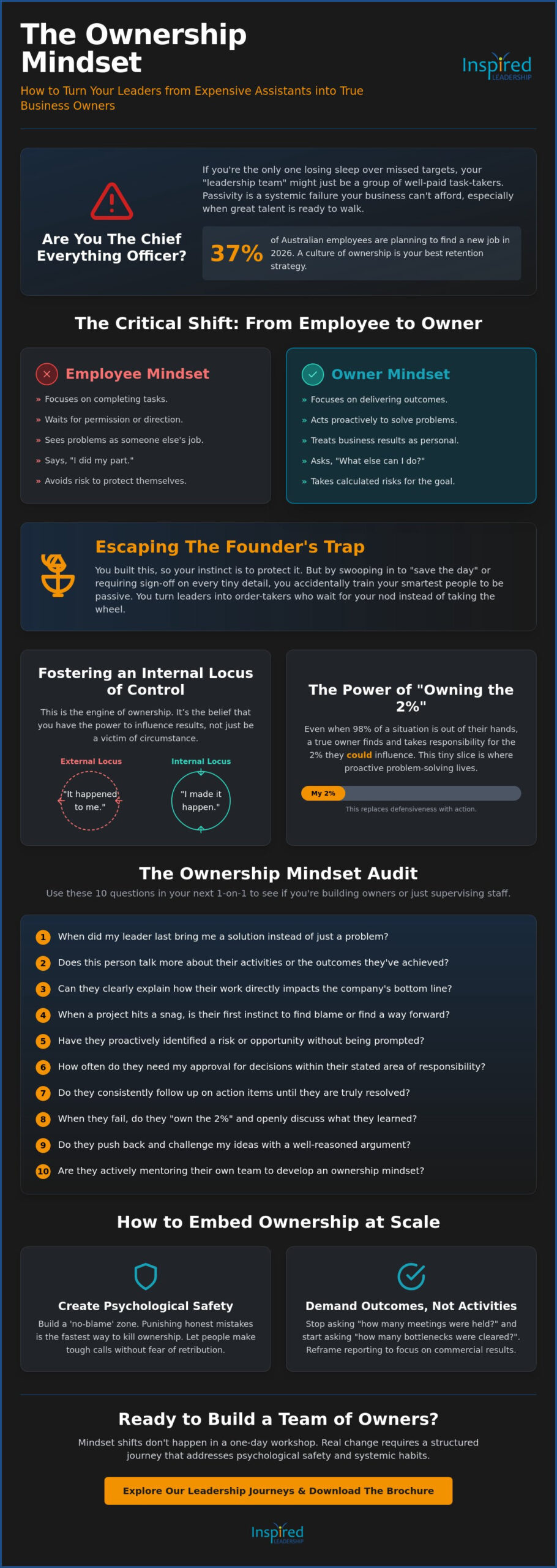
The Ownership Mindset Checklist: 10 Questions to Audit Your Leadership Style
It is time to be fair dinkum with yourself. Developing ownership mindset in leaders is not a passive process; it requires a mirror and a healthy dose of radical honesty. If you are tired of being the only person who stays awake at night worrying about the quarterly targets, use this checklist to see where your team actually sits on the spectrum between “renter” and “owner.”
This diagnostic tool is perfect for your next round of 1-on-1s or as a self-reflection exercise for your executive team. It will help you identify the specific gaps in your leadership development for medium sized companies. After all, you cannot fix a culture of passivity if you haven’t pinpointed exactly where the initiative is leaking out of the building.
The Diagnostic: Are You an Owner or a Renter?
Renters just live in the house; they call the landlord when the tap leaks. Owners, however, grab a spanner and fix it because they know the water bill is coming out of their own pocket. Ask yourself and your leaders these three critical questions to start:
- Question 1: Do you bring problems to your boss, or do you bring solved problems?
- Question 2: When a project fails, do you look at the external factors or your own internal contribution to that result?
- Question 3: Do you wait for a formal “go-ahead” on things you know are objectively right for the business, or do you take the lead?
If the answer to these involves a lot of “but” and “because,” you have a renter problem. True ownership means moving past excuses and into the realm of commercial results.
How to Use This Checklist with Your Direct Reports
Do not use this list as a “gotcha” tool to beat people over the head. Instead, frame it as a coaching exercise to help them step into more senior, influential roles. You might say: “I’ve noticed you’re waiting for my nod on things you’re more than capable of handling. Let’s look at this checklist together and see how we can move you from managing tasks to truly owning the outcomes.”
Transforming your culture from order-taking to outcome-owning is a deliberate shift. To see how we facilitate this change at scale, head over to our Senior Leadership and Executive Journeys page and download the brochure to begin the journey.
Embedding Ownership at Scale: Moving from Theory to Action
Developing ownership mindset in leaders is not a project with a start and end date. It is a continuous, structured journey that requires more than just a single “aha” moment in a boardroom. If you expect your managers to act like owners while you still micromanage their every move, you are dreaming.
Real transformation happens when you move from talking about accountability to embedding it into your daily operations. At Inspired Leadership, our journeys are designed to translate deep psychological insights into measurable action on the ground. We help your team move past the “employee mindset” by creating a system where taking initiative is the default, not the exception. This is precisely why investing in bespoke leadership development programs tailored to your scale-up consistently outperforms generic training that fails to address your organisation’s unique culture and challenges.
Senior leaders must be the ones to model this behaviour first. If you are still the “hero” who swoops in to solve every crisis, you are accidentally training your team to be passive. To build a team of owners, you have to be brave enough to step back and let them carry the weight of the results.
This shift allows you to focus on your evolving role as a representative of your vision, a concept explored by Victoria OHare for leaders aiming to build both impact and personal freedom.
The Strategic Advantage of an Ownership Culture
In an Australian market where 37% of employees are planning to look for a new job in 2026, agency is your best retention tool. People who feel like they truly own their outcomes are far less likely to burn out because they have a sense of control over their work. This culture of ownership leads to faster execution and the kind of innovation that only happens when people feel they have a genuine stake in the success of the business. The data backs this up — research shows that the ROI of first line manager training can reach a remarkable 415% annualised return, making it one of the most commercially sound investments a scale-up can make.
Next Steps: Download the Journey Brochure
The shift from a culture of permission-seeking to one of proactive ownership starts with a deliberate choice. You need to decide if you want a team of task-takers or a team of outcome-owners who can drive the business forward without you holding their hand. Stop being the bottleneck and start building the leadership capacity your scale-up deserves.
To see how we can help you build this culture, visit our Senior Leadership and Executive Journeys page. Download the brochure today to explore how a structured journey can transform your leaders into the proactive owners your business needs to thrive.
Stop Being the Hero and Start Building Owners
You cannot scale a business if you are the only person who actually gives a toss about the bottom line. Developing ownership mindset in leaders is the single most effective way to ensure your Australian scale-up does not stall under the weight of its own success. We have covered why the “Founders Trap” is a productivity killer and how a simple diagnostic checklist can reveal who is truly in the driver’s seat.
At Inspired Leadership, we do not do fluffy workshops that people forget by Friday afternoon. With 20 years of corporate leadership experience, we provide a results-driven alternative specifically designed for medium-sized enterprises. We help you move past the “hero” phase and build a team that proactively solves problems before they ever reach your desk.
Ready to turn your managers into owners? Explore our Leadership Journeys and download the brochure today. It is time to build a culture where accountability is not just a buzzword; it is the way you do business every day. You have got this.
Frequently Asked Questions
What is the primary difference between a manager and someone with an ownership mindset?
A manager focuses on the “how” and the checklist; an owner focuses on the “why” and the commercial result. If a project hits a wall, a manager says “I did my bit,” while an owner finds a way over or around the wall. Ownership is about taking the initiative to fix things before they break because you feel the results are a reflection of your own character.
Can you actually teach someone to have an ownership mindset, or is it innate?
It is absolutely a skill that can be developed; it is a muscle that grows with use. Developing ownership mindset in leaders is about shifting their internal narrative from being a passenger to being the driver of the business. This requires a structured journey and a culture that rewards initiative rather than just compliance.
How do I encourage ownership without making my leaders feel overwhelmed?
Start by giving them clear outcomes instead of a long list of tasks. When you provide the “what” and “why” but let them own the “how,” they feel empowered rather than burdened. Overwhelm usually comes from a lack of clarity or being given responsibility without the authority to make calls.
What should I do if a leader takes ownership but makes a massive, costly mistake?
Treat a costly mistake as an expensive training course you have already paid for. If you haul them over the coals, you will instantly kill any future initiative and send them back into “passive mode.” Instead, run a “no-blame” review to see how the system failed and what the leader has learned to prevent a repeat.
How does an ownership mindset impact employee retention in medium-sized businesses?
Developing ownership mindset in leaders is the ultimate antidote to the high attrition rates we are seeing in 2026. When leaders feel they have genuine agency, they are far less likely to join the 37% of Australian workers planning to job hunt this year. People don’t leave businesses where they feel like a vital, trusted part of the commercial success.
If you are ready to stop being the only person who cares about the bottom line, explore our Senior Leadership and Executive Journeys. Download the brochure today to see how we can help you build a team of proactive owners.