
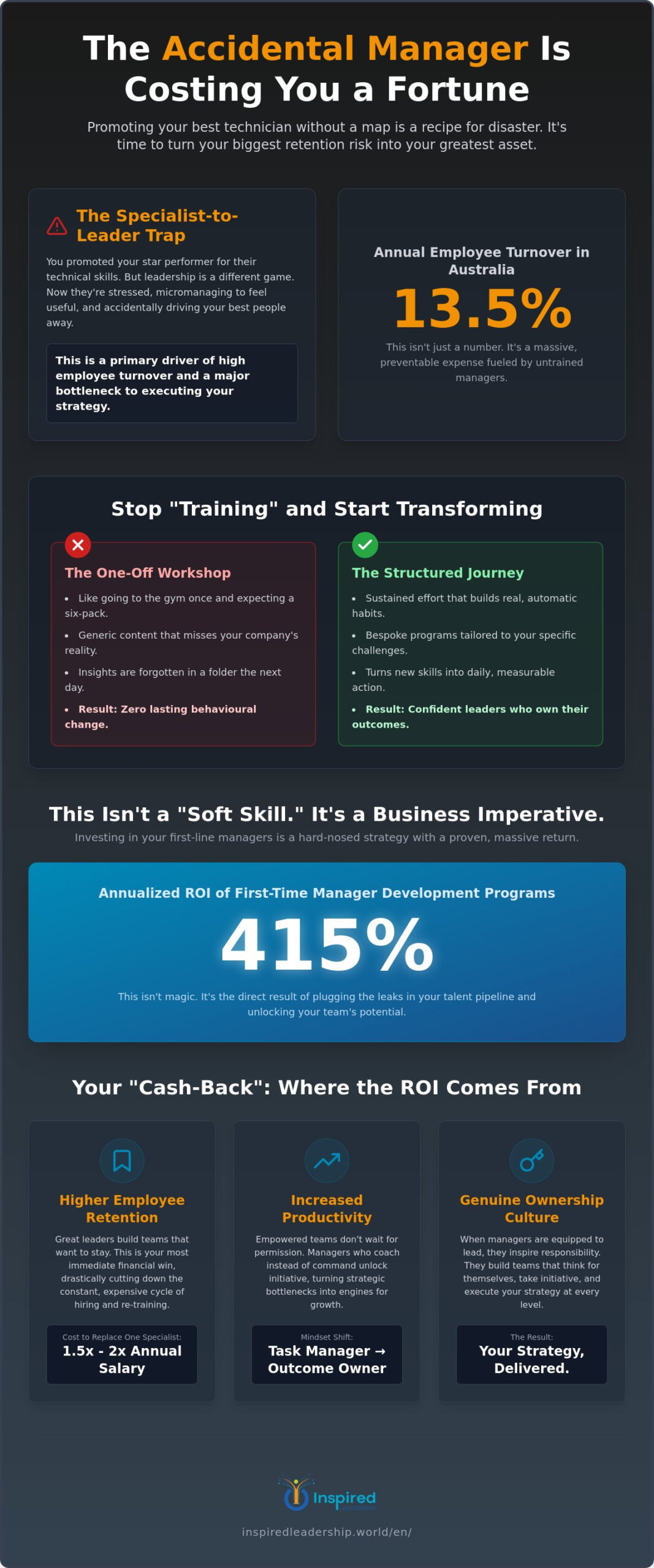
What if your biggest recruitment expense isn’t the headhunter’s fee, but the "accidental manager" who’s currently driving your best talent toward the exit? Promoting your best technician without a map is like asking a pilot to perform heart surgery just because they’re great at flying. Recent data shows that first-time manager leadership development programmes offer a massive 415% annualised ROI, proving that the roi of first line manager training is a hard-nosed business strategy rather than a soft HR initiative.
You probably know the frustration of a middle management layer that still acts like individual contributors instead of leaders who own their outcomes. With the annual employee turnover rate in South Africa sitting at 15.5%, you can’t afford to have managers who haven’t made the mental leap to leadership. This article explores how a structured leadership journey transforms these technical experts into a team that thinks for themselves and stays for the long haul.
We will break down the specific ways a capability-led approach lowers recruitment costs and boosts productivity across your entire organisation. You’ll get a clear view of how to build a leadership bench that doesn’t just manage tasks, but actually drives your bottom line in 2026; for those looking to scale their business visibility, check out Tools N Tactics | Local SEO & Digital Marketing Solutions. Let’s look at how to turn your managers into a genuine asset that pays for itself.
Key Takeaways
- Stop the “accidental manager” syndrome by helping your technical stars trade their tools for leadership skills that actually stick.
- Learn how to calculate the roi of first line manager training by focusing on employee retention as your most immediate cash-back metric.
- Shift from one-and-done workshops to structured leadership journeys that ensure your team translates new insights into daily action.
- Use a 360-degree feedback framework to get clear, measurable evidence that your managers are finally thinking and owning like leaders.
- Discover how building leadership capability at scale reduces your recruitment headaches and fosters a genuine ownership culture across your organisation.
The Specialist-to-Leader Trap: Why Leadership Capability at Scale Starts with the First Line
You’ve seen it happen. You promote your most brilliant software engineer or most efficient site foreman because they’re the best at the "doing" part of the job. Suddenly, your star performer is a stressed-out manager who’s more comfortable fixing bugs than fixing team dynamics. This is the primary friction point for calculating the real Return on Investment (ROI) of your people strategy.
Leadership capability at scale isn’t some fancy corporate buzzword. It’s simply the ability for your organisation to execute a strategy through every single layer, not just the top floor. When your first-line managers don’t know how to lead, your strategy gets stuck in a bottleneck. This is where the roi of first line manager training becomes obvious, as it turns those bottlenecks into conduits for growth.
This growth is fundamental to increasing a company’s enterprise value, a process that 41 Legacy supports through strategic advisory and value protection.
The primary metric for a successful first-line leader is "ownership." We want managers who think for themselves and take responsibility for their team’s output rather than just waiting for instructions. Technical brilliance is great, but it doesn’t automatically translate into the emotional intelligence needed to inspire a team. Without a structured transition, you’re just setting your best people up to fail. Developing human skills as competitive advantage is what separates organisations that scale from those that stagnate.
The Cost of the Accidental Manager
A poor manager can drive away a team of high performers in less than six months. When an "accidental manager" misses their old technical role, they often resort to micromanagement to feel useful again. This creates a ripple effect where your best talent feels stifled and starts looking for the exit. The Specialist-to-Leader Trap is a systemic friction point in scale-ups where technical expertise is mistakenly equated with the ability to lead people.
Why One-off Workshops Fail to Build Capability
Expecting a one-day workshop to create a leader is like going to the gym once and expecting a six-pack. Real behavioural change takes time, practice, and a bit of a nudge. We find that bespoke leadership development programs are the only way to ensure that insights actually turn into habits. Off-the-shelf training usually misses the specific cultural nuances of your business, leaving your managers with a folder full of notes they’ll never look at again. This sustained effort is what actually delivers the roi of first line manager training by shifting long-term habits.
Calculating the Real ROI of First Line Manager Training
Calculating the roi of first line manager training isn’t just a job for the bean counters with their fancy spreadsheets. It’s about looking at your bank balance and seeing fewer massive holes where recruitment fees used to be. While some returns are as clear as day, others are the quiet wins that keep your business from grinding to a halt.
In the market, the most immediate "cash-back" metric is employee retention. When managers learn to actually lead, teams stop looking for the exit. This isn’t just a feel-good sentiment; it’s a direct hit to your bottom line that saves you from the constant cycle of hiring and firing.
Tangible Returns: Retention and Productivity
I once worked with a manager named Sarah who was a technical wizard but terrified of giving feedback. After learning how to have a real conversation, she saved two senior devs from walking out the door in a single month. When you consider that replacing a specialist usually costs 1.5 to 2 times their annual salary, Sarah’s new skills just saved the company a six-figure sum.
Productivity also skyrockets because teams stop waiting for permission to breathe and start getting work done. Our First Line Manager Program focuses on these exact shifts to ensure your investment pays for itself before the year is out. If you’re ready to stop the bleeding, you might want to explore our First Line Manager Program journey page and download the brochure for the full breakdown.
Intangible Returns: The Ownership Mindset
The real magic happens when you hear a manager say, "I’ll find a solution," instead of "That’s not my job." This shift from passive observer to active owner is the secret sauce for scale-ups looking to grow without the drama. It reduces rework and silly errors because leaders start coaching their teams to think rather than just correcting their mistakes like a school teacher. In a world where every competitor has access to the same technology, leveraging human skills as a strategic competitive advantage is what truly differentiates high-performing teams from the rest.
Measuring What Matters: A Framework for Scale-ups
Stop measuring the wrong things. Most companies tick a box by checking if the catering was good or if the trainer was "nice," but that’s not how you calculate the roi of first line manager training. You need to look at whether your leaders are actually behaving differently when things get messy on a Tuesday afternoon.
The most effective way to track this is through 360-degree feedback both before and after the leadership journey. This gives you a clear, evidence-based snapshot of behavioural shifts that subjective "happiness scores" simply can’t capture. It turns "I think they’re doing better" into "the team reports a 30% increase in clear communication."
Step-by-Step Measurement Framework
- Step 1: Identify Friction. Pinpoint exactly where the gears are grinding, whether it’s high turnover in your tech team or engagement scores that are lower than a 4 PM Friday meeting.
- Step 2: Establish the Baseline. You can’t claim a victory if you don’t know where the starting line was. Get your hard data sorted before the first session begins.
- Step 3: Monitor During the Journey. Don’t wait until the end to see if it’s working. Watch for small wins and behavioural tweaks while the program is actually running.
The Cost of Inaction (COI) Calculation
Sometimes the most compelling metric for an executive isn’t what you gain, but what you’re currently losing. We call this the Cost of Inaction (COI). COI is the hidden tax on every business that neglects its front line, manifesting as lost productivity and high-level executive burnout.
When your first-line managers can’t lead, they end up dumping every minor drama back on your desk. This sucks up precious executive time that should be spent on strategy, not babysitting. If you’re ready to stop paying this hidden tax, head over to our First Line Manager Program journey page and download the brochure to see how we fix it.
Finally, keep an eye on "promotion readiness." A healthy ROI means your talent pipeline is actually moving. If your middle management layer is stagnant because nobody is ready for the next step, your current training approach is likely failing you.
Moving from Training Workshops to Transformational Journeys
Stop thinking about training as a one-day event where people eat lukewarm sandwiches and forget everything by Tuesday morning. To see a genuine roi of first line manager training, you need a journey that actually shifts how people behave when the pressure is on. It is about building a partnership that supports your leaders through the messy bits of real-world management.
Real organisational leadership transformation happens in the gaps between sessions. This is where managers try new things, occasionally trip over, and learn to pick themselves up with a better strategy. By moving away from one-off events, you ensure your leadership pipeline becomes a strategic asset rather than just another overhead cost on your profit and loss statement.
We don’t do transactions; we do long-term development. A workshop is a transaction where you trade cash for a few hours of someone’s time, but a journey is an investment in your company’s future. It’s about making sure your team doesn’t just "she’ll be right" their way through leadership challenges, but actually possesses the tools to drive results.
Building a Sustainable Talent Pipeline
Your first-line managers today are your senior executives in 2030. If you don’t start them on the right path now, you’ll be paying a massive premium for external hires further down the track. A strong program feeds your senior leadership pipeline for 2027 and beyond, ensuring you have a bench of talent ready to step up.
Many savvy businesses are even starting this process earlier. Implementing a leadership journey program for graduates allows you to bake an ownership mindset into your talent pool from day one. This proactive approach ensures your roi of first line manager training starts compounding the moment a new hire walks through the door.
Your Next Step: The First Line Manager Journey
Don’t settle for superficial training that leaves your team exactly where they started. You deserve a leadership team that thinks for themselves, owns their results, and actually enjoys the challenge of leading people. It is time to trade the "accidental manager" syndrome for a structured, capability-led approach.
Visit our First Line Manager Program page and download the brochure to see the roadmap for your team. Let’s build a leadership layer that actually delivers for your business.
Let’s Build a Leadership Team That Actually Owns It
You’ve seen the map; now it’s time to stop letting your best technical talent flounder in the deep end. We’ve explored how to dodge the Specialist-to-Leader Trap and why your bottom line depends on managers who possess a genuine ownership mindset. It turns out that measuring the roi of first line manager training is less about ticking boxes and more about reclaiming your executive time and finally ending the daily game of herding cats.
At Inspired Leadership, we bring 20 years of corporate experience to the table to build customised journeys that actually stick. We don’t do boring workshops or generic advice; we focus on translating insight into the kind of action that transforms your culture. It’s about creating a leadership layer that thinks for itself so you don’t have to do their jobs for them.
Ready to turn your middle management into a strategic powerhouse instead of a bottleneck? Download the First Line Manager Journey Brochure to see how we can partner with you to build capability at scale. You’ve got the vision, and we’ve got the roadmap to help your team finally own their outcomes.
Frequently Asked Questions
How do you calculate the ROI of management training in a medium-sized company?
You calculate it by tallying up the cold, hard savings from reduced staff turnover and the measurable jump in team output. If you stop just one $100k specialist from walking out the door, you’ve likely saved $150k in recruitment fees and lost-opportunity costs. This doesn’t even account for the "saved" executive time that’s no longer spent fixing junior-level dramas.
What is the average return on investment for first-line manager development?
Industry benchmarks show that first-time manager programmes can deliver an annualised return of 415%. This isn’t magic; it’s the natural result of having leaders who know how to coach rather than just barking orders. The roi of first line manager training comes from fewer operational errors and a team that actually wants to show up on Monday morning.
Can you measure leadership capability at scale using financial metrics?
Yes, you can measure it by tracking the "Cost of Inaction" and the decrease in executive time spent on operational escalations. When your middle layer starts "owning" their outcomes, your revenue per employee tends to climb as the bottlenecks disappear. This financial shift is the clearest evidence that your leadership capability is actually scaling with your business growth.
What happens if we don’t invest in training our new managers?
You’ll likely face a "talent exodus" as your best technical stars get fed up with managers who don’t know how to lead. Without training, you’re stuck with "accidental managers" who micromanage everything and kill the very productivity you promoted them for. It’s a fast track to high recruitment costs and a culture of "that’s not my job."
How long does it take to see a return on a leadership development journey?
Behavioural changes usually pop up within the first 90 days, but the full roi of first line manager training really starts to shine over a 6 to 12-month period. Real leadership is a slow-cooked journey, not a microwaveable workshop. You’ll see the initial "ownership" shift quickly, but the compounding financial returns happen as those new habits become your team’s standard operating procedure.