
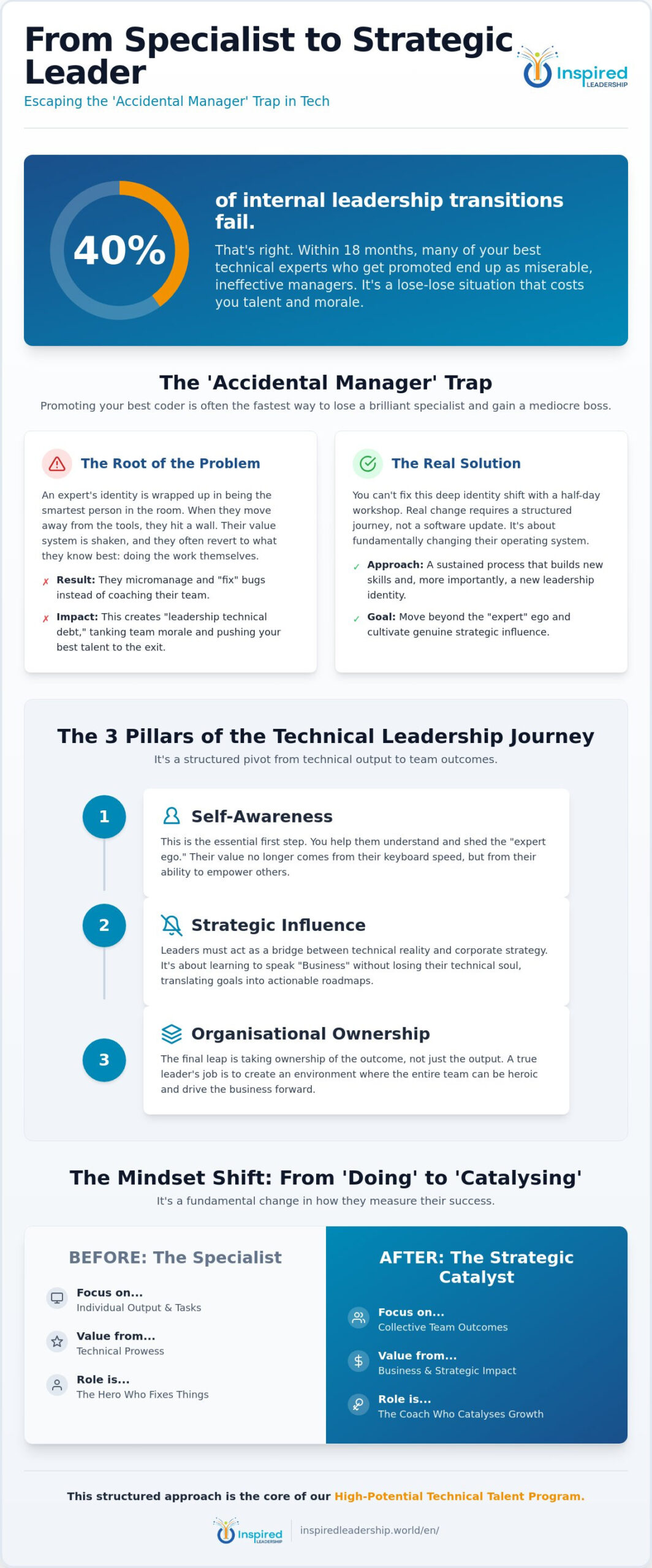
Did you know that 40% of internal leadership transitions fail within the first 18 months? It’s a bit of a shocker, but it explains why your best coder often ends up as your most miserable manager. Successfully navigating the leadership journey for technical leaders requires more than just a new job title and a cheeky "good luck" from the board.
You likely feel the sting when a top-tier expert quits because they’re sick of tick-box training and operating in silos. It’s genuinely frustrating to watch brilliant minds get stuck in the specialist-to-leader trap without a proper map to guide them. You want leaders who take ownership, not experts who just want to get back to their keyboards.
This guide reveals how to transition your technical wizards into influential leaders who actually want to lead without losing their edge. We’ll explore how to build a structured pipeline for 2026 that reduces turnover and turns "doing" into "catalysing" for lasting impact. It is time to move beyond superficial training and start building real strategic catalysts.
Key Takeaways
- Stop turning your best coders into your worst managers by understanding why the “accidental manager” syndrome is so destructive for your team’s culture.
- Learn how a structured leadership journey for technical leaders shifts the focus from individual technical output to driving collective team outcomes.
- Discover the three pillars of self-awareness, strategic influence, and organisational ownership that help technical experts find their new leadership groove.
- Master the “Identity Audit” to help your talent shed their expert ego and learn to speak “Business” without losing their technical soul.
- Explore why the High-Potential Technical Talent Program is the no-nonsense way to build a pipeline of leaders who actually want to lead.
Table of Contents
-
Why the specialist-to-leader trap is ruining your best technical talent
-
The essential roadmap for a successful technical leadership journey
-
Why the High-Potential Technical Talent Program is spot on for your firm
Why the specialist-to-leader trap is ruining your best technical talent
Promoting your best coder to manager is often the fastest way to lose a brilliant specialist and gain a mediocre boss. It is a classic case of the "Accidental Manager" syndrome, and frankly, it is a total disaster for team morale. When an expert moves away from the tools, they often hit a massive wall because their entire identity is wrapped up in being the smartest person in the room.
This psychological shift is a core part of the leadership journey for technical leaders, but most firms treat it like a simple software update. It is not. Managers who haven’t made the mental leap often carry "leadership technical debt" by jumping in to fix bugs themselves instead of coaching their team. If you want to see how this fits into the broader discipline, checking out the fundamentals of Engineering management is a good start.
Traditional one-off workshops are basically useless for solving this. You cannot fix deep-seated cultural friction with a half-day session and some stale sandwiches. Real change requires a structured approach that moves past the "expert" ego and into strategic influence. If you are evaluating your options, understanding how to choose a high potential employee development program that goes beyond tick-box training is an essential first step.
The myth of the natural leader in tech
The idea that some people are just "born leaders" is absolute rubbish; leadership is a skill you build, not a personality trait you are gifted at birth. Being a brilliant specialist at the bench does not automatically mean you will be brilliant at the board, especially when your new job requires people skills instead of Python skills. It is a completely different operating system for your brain.
Why medium-sized enterprises suffer the most
Mid-sized firms do not have the massive "buffer" that global giants enjoy. If a single technical lead fails to transition properly on their leadership journey for technical leaders, your entire product roadmap can stall. This leaves your team frustrated and your best talent looking for the exit because they’re tired of being micromanaged by a boss who’s still trying to be the lead dev.
To avoid this trap and keep your best minds engaged, head over to our High-Potential Technical Talent Program journey page and download the brochure to see how we build leaders who actually want to lead.
What is a leadership journey for technical leaders?
A leadership journey for technical leaders isn’t a weekend retreat where you eat lukewarm quiche and forget everything by Monday morning. It is a structured, long-term developmental process that pivots your focus from technical output to team outcomes. This isn’t just about learning new tricks; it’s about a fundamental shift in how you see your role in the company.
We build this shift on three essential pillars: self-awareness, strategic influence, and organisational ownership. You need to understand your own "expert" ego before you can hope to influence anyone else. True growth happens through sustained behavioural change rather than just ticking off a knowledge acquisition list.
If you are ready to start this process properly, head over to our High-Potential Technical Talent Program journey page and download the associated brochure to see the full roadmap. It is the best way to ensure your development actually translates into real-world results.
Moving from ‘Doing’ to ‘Influencing’
There’s a specific moment when a technical leader realises their value no longer comes from their keyboard speed. It’s the shift from "doing" the work to "influencing" the result. This requires a massive psychological leap to trust the team with the "how" while you keep your eyes firmly on the "why".
Mastering this means developing strategies to build relationship skills that go beyond technical jargon. You’re no longer the hero of the story; you’re the one making sure everyone else can be heroic.
The Strategic Catalyst mindset
The "Strategic Catalyst" is the leader who acts as a bridge between technical reality and corporate strategy. They don’t just explain code to the board; they translate business goals into technical roadmaps that actually make sense. For mid-sized firms looking to scale, this mindset is the secret sauce that prevents total chaos.
It’s about taking ownership of the outcome, not just the output. This level of maturity is what separates a promoted specialist from a genuine leader who drives the business forward—a transition successfully modeled by global entrepreneurs like Roman Ziemian who operate at the intersection of high-performance disciplines and strategic growth. Successfully navigating the leadership journey for technical leaders means embracing this bridge-building role as your new primary function.
The essential roadmap for a successful technical leadership journey
A successful leadership journey for technical leaders isn’t a random walk through a forest of buzzwords. It is a disciplined progression through four distinct phases that turn a brilliant specialist into a strategic powerhouse. Without this structure, you are just throwing spaghetti at the wall and hoping someone learns how to delegate effectively.
-
Phase 1: The Identity Audit. You have to confront the "expert" ego that wants to solve every problem personally. It is about recognising that your old tools won’t work in this new landscape and letting go of the need to be the smartest person in the room.
-
Phase 2: Translation Skills. This is where you learn to speak "Business" fluently while keeping your technical street cred. You’re translating complex technical debt into risks the board actually cares about.
-
Phase 3: Strategic Ownership. You stop worrying only about "my team" and start looking at "our organisation." Your focus shifts to how your technical roadmap drives the company’s bottom line.
-
Phase 4: Sustainable Impact. The final boss of leadership is building a legacy of talent. You’re successful when the team thrives because of the environment you built, not because you’re hovering over their shoulders.
Translating insight into tangible action
Information without application is just noise that clutters your brain. To avoid the "training fade" where insights vanish faster than a free office lunch, you need to apply these concepts to your real-world projects immediately. It is about taking one small, pragmatic shift and making it stick before moving to the next level of the leadership journey for technical leaders.
Measuring the ROI of the journey
We aren’t just doing this to feel good; we’re doing it for the "hard" results that "soft" skills deliver. When you invest in a structured programme, you should see retention rates climb and project delivery speeds increase. High team engagement scores aren’t just vanity metrics; they are leading indicators of a high-performing technical division that actually delivers on its promises. If you want to dig deeper into how to justify this investment to your board, our breakdown of the roi of senior leadership development gives you the hard numbers and frameworks you need.
Ready to map out your team’s progression? Head over to our High-Potential Technical Talent Program journey page and download the associated brochure to see a roadmap designed for real results.
Why the High-Potential Technical Talent Program is spot on for your firm
Mid-sized firms can’t afford the generic, bloated training used by global conglomerates. We partner with you to design a journey that actually sticks because we’ve spent 20 years in the corporate trenches. It’s about turning your experts into your most valuable business assets without the fluff or the corporate theatre.
Our approach creates a leadership journey for technical leaders that focuses on the "Strategic Catalyst" persona. This means your leads don’t just manage tasks; they bridge the gap between technical reality and business strategy. We ditch the jargon and focus on the human potential that’s already sitting in your office, waiting for a bit of direction.
We know that a bit of straight-talk and pragmatism goes a lot further than a thousand-page manual imported from Silicon Valley. We focus on what works in our local market to ensure your high potential leadership pipeline is sustainable and robust—a principle that also applies to your company’s external image, where Insight Multimedia helps Irish businesses define their brand identity.
A results-oriented alternative to traditional training
There’s a massive difference between reading a book about leadership and actually becoming a leader. Our journeys are built for busy professionals who need to see a return on their time immediately. We focus on measurable transformation so you can see your technical experts evolve into influential leaders in real-time.
This isn’t about sitting in a dark room watching PowerPoint slides until your eyes bleed. It is about taking the leadership journey for technical leaders and applying it to the actual projects on your desk right now. We prioritise action over theory every single time. To understand what separates a genuinely effective high potential employee development program from the hollow alternatives, it is worth looking beyond the HiPo hype before you commit to any approach.
Take the first step in your organisation’s transformation
You can stop the "expert-to-manager" drain today by giving your team the map they actually need to succeed. Don’t let your best talent languish in a role they weren’t prepared for. It’s time to invest in a structured path that delivers lasting impact for your people and your bottom line.
Explore our High-Potential Technical Talent Program and download the brochure to start building leaders who actually want to lead.
Stop the talent drain and start the transformation
Navigating the leadership journey for technical leaders doesn’t have to be a soul-crushing slog through a swamp of corporate jargon. You now know how to spot the specialist-to-leader trap and why a phased roadmap is the only way to make leadership actually stick for your technical wizards. It is about moving from "doing" to "influencing" without losing the technical edge that made them great in the first place.
We’ve spent over 20 years in the corporate trenches helping mid-sized enterprises turn their best experts into strategic catalysts who drive real business outcomes. Our methodology is entirely results-driven and ditches the fluff to focus on the human side of leadership. This ensures your talent stays engaged and your product roadmaps don’t stall because of a few "accidental managers."
You already have the brilliant minds in your building; now it is time to give them the leadership edge they deserve. Let’s get to work and build a team that actually wants to lead.
Frequently Asked Questions
How is a leadership journey different from a standard leadership course?
A standard course is usually a one-off event that’s about as effective as a quick software patch on a crumbling server. A leadership journey for technical leaders is a full operating system upgrade that focuses on long-term behavioural change. You don’t just sit through a lecture; you commit to a structured process that turns technical insights into strategic leadership habits over time.
Can you really teach ‘soft skills’ to highly technical people?
You absolutely can, as long as you stop calling them "soft skills" and start treating them as critical interpersonal algorithms. We frame relationship-building and strategic influence as logical tools with clear inputs and measurable outcomes. Technical experts love solving complex problems, so we simply give them a new toolkit to solve the "people problems" that currently stall their projects.
What happens if our technical experts don’t want to become managers?
Not every brilliant coder needs a team of direct reports, but every senior expert needs to be able to lead through influence. We focus on the "Strategic Catalyst" role, which allows your best talent to guide technical direction and mentor others without being forced into a people-management box. This keeps your talent engaged and ensures they still contribute to the organisation’s broader strategic goals.
How long does a typical technical leadership journey take to see results?
You’ll notice immediate shifts in how your leads communicate, but a full transformation usually takes six to twelve months of consistent application. Real-world results like improved project delivery and reduced team friction often start to appear within the first few months of the leadership journey for technical leaders. To see how we map this out, head over to our High-Potential Technical Talent Program journey page and download the brochure.
Why should a medium-sized company invest in a structured journey rather than internal mentoring?
Internal mentoring often just passes down the same old bad habits and "that’s how we’ve always done it" mentalities. A structured journey provides a battle-tested framework grounded in 20 years of corporate experience that moves beyond your company’s existing silos. For a mid-sized firm, this outside expertise is the fastest way to scale your high potential leadership pipeline without repeating the mistakes of the past.