

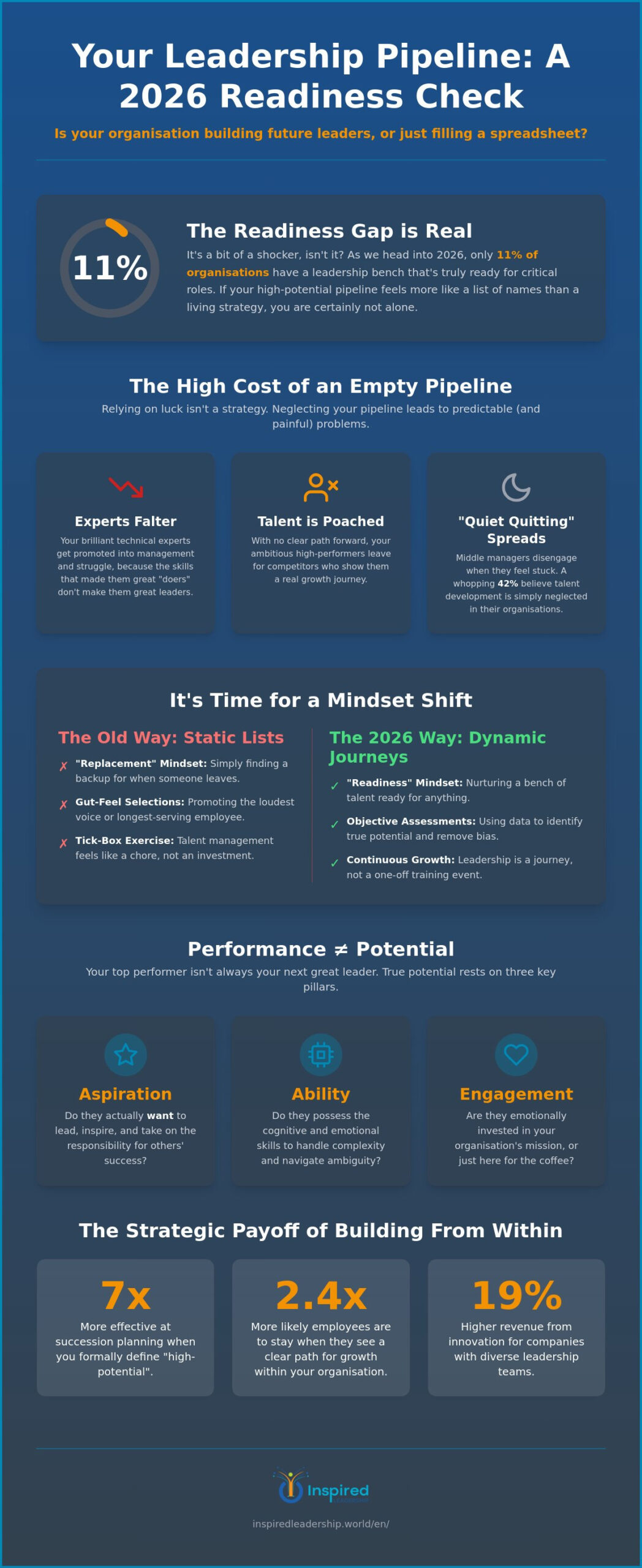
Did you know that whilst we are well into 2026, only 11% of organisations have a leadership bench truly ready for critical roles? It is a bit of a shocker, isn’t it? If your high potential leadership pipeline currently looks more like a dusty spreadsheet than a living strategy, you are certainly not alone.
You have likely felt the sting when a brilliant technical expert fails after a promotion or your top talent gets poached by a larger competitor. It is exhausting to watch potential wither because there is no clear path forward. We all know that traditional talent management often feels more like a tick-box exercise than a genuine investment in human potential.
I am here to help you transform that static process into a dynamic leadership journey that secures your future and keeps your best people engaged. You will discover how to identify true leaders early and ensure they have the tools to succeed when they finally step up.
We will explore the shift towards data-driven readiness and the practical steps to foster a culture of ownership and action. It is time to move past the corporate jargon and start building a pipeline that actually delivers results.
Key Takeaways
- Understand why a high potential leadership pipeline must be a proactive journey rather than just a list of names to survive the 2026 landscape.
- Learn how to stop the “quiet quitting” trend by opening up leadership paths to a more diverse group of future-ready talent.
- Discover how to remove bias from your selection process by using objective assessments instead of relying on gut feel.
- Find out how to transform your technical experts into confident managers through a journey that prioritises an ownership mindset.
- Learn why building leaders from within is a strategic necessity that keeps your best people from running to your competitors.
What is a High Potential Leadership Pipeline?
Think of a high potential leadership pipeline as your organisation’s oxygen supply. It is a proactive system designed to identify and nurture the people who will steer the ship when the current captains move on. In the 2026 market, simply having a list of names tucked away in a drawer won’t cut it.
You need to move from a “replacement” mindset to a “readiness” mindset. Succession planning used to be about who takes over if the CEO retires, but today it is about having a bench of talent ready for anything. Research shows that organisations that actually define high-potential employees are 7 times more effective at this process.
When your team sees a clear path, they are 2.4 times more likely to stay with you. It is the ultimate ROI for your retention efforts. Plus, it keeps you from panicking when a senior leader suddenly decides to go and “find themselves” in the mountains.
The Difference Between Performance and Potential
Here is a little secret: your top salesperson might be a total disaster as a manager. High performance in a current role is fantastic, but it doesn’t guarantee leadership success. We often confuse being great at a task with being great at leading people who do that task.
True potential rests on three pillars: aspiration, ability, and engagement. Do they actually want to lead? Can they handle the complexity of the role? Are they emotionally invested in your mission, or are they just here for the coffee?
Why Medium Enterprises Often Struggle with Pipeline Strategy
Most growing firms suffer from “accidental manager” syndrome. You promote the person who has been there the longest or speaks the loudest, usually based on a “gut feeling” that often backfires. It is a bit messy, isn’t it?
Relying on luck is not a strategy, especially when your best technical talent is itching for a real leadership journey. You can explore how to bridge this gap with our Manager to Leader Journey. Moving away from informal promotions might feel awkward at first, but it is the only way to build a sustainable future.
The 2026 Shift: Why Traditional Succession Planning is Failing
Traditional succession planning is feeling a bit dusty. We are seeing The 2026 Shift move away from rigid hierarchy towards a more fluid, human-centric model. Many middle managers are currently “quiet quitting” because they don’t see a clear future, whilst 42% believe talent development is simply neglected in their organisations.
To fix this, your high potential leadership pipeline needs to look beyond the “usual suspects” and the loudest voices in the room. Inclusive pipelines are a strategic power move; organisations with diverse leadership teams see 19% higher revenue from innovation. It is about finding the hidden gems who possess the emotional intelligence to lead in our increasingly tech-driven world.
Leadership should never be treated as a one-off training event or a certificate on a wall. It is a continuous journey that requires constant nurturing and a deep focus on the “human factor” of business. If you want to keep your best people, you must show them that their growth is a priority, not an afterthought.
The Specialist-to-Leader Trap
Your best technical experts often feel like they are “losing” their craft when they get promoted. They worry that leading means they will never get their hands dirty with the work they actually love. This psychological shift from “doing” to “leading” is where most new managers stumble and fail. You can help them make this transition smoothly with our Manager to Leader Journey.
The SME Advantage: Agility over Bureaucracy
Medium-sized firms have a secret weapon that global giants lack: agility. You don’t need to wait for a global board in another timezone to approve your talent strategy. You can implement bespoke, results-driven leadership journeys that actually fit your unique culture and pace. If you are ready to stop the talent drain and start building a legacy, it might be time to chat with us about your talent strategy.
Building Your Pipeline: From Spotting Potential to Curating Journeys
Building a high potential leadership pipeline is a bit like gardening; you can’t just throw seeds at a spreadsheet and hope for the best. You need clear benchmarks that reflect your actual culture, not some generic corporate template. If you don’t know what “good” looks like in your specific context, you’ll end up promoting the wrong people for the right reasons.
Objective assessment methods are your best friend here because they strip away the “I like their vibe” bias that ruins so many teams. High potentials are 3.7 times more likely to leave if they don’t see growth opportunities, so the stakes are incredibly high. It is time to stop guessing and start measuring the traits that actually lead to success.
Once you’ve identified your talent, don’t just dump them into a boring training journey. Design a developmental path that actually stretches them, incorporating coaching and mentoring to provide the safety net they need to take risks. Real growth happens when people are challenged, supported, and given the space to fail safely. If you want to ensure your high potential employee development program drives real behavioural change rather than just ticking boxes, it is worth exploring what a truly effective journey looks like in practice.
Identifying the Hidden Gems
Stop looking for the person who talks the most in meetings. Often, your future leaders are the ones quietly solving problems whilst others are busy performing. A proper Leadership Assessment helps you find these quiet powerhouses before your competitors do.
Creating a Culture of Ownership
A pipeline only works if people feel they truly own their actions. I once saw a brilliant manager freeze because they were never taught to “think and own” without checking in first. Senior leaders, this is on you; you’ve got to stop micromanaging and start supporting the next generation of talent if you want them to stick around.
Translating Potential into Action: Your Next Steps
Building a high potential leadership pipeline is not a luxury for the HR department to play with on a Friday afternoon. It is a strategic necessity for any organisation that wants to still exist in five years. You cannot just hope that a “natural” leader will walk through your door with all the answers and a cape to match.
Leadership is a skill that is forged through experience and intention, not something people are simply born with. By taking a human-centred approach, you acknowledge that your people are your greatest asset and your biggest competitive advantage. You have to build them with purpose, providing the structured support they need to actually deliver results whilst they learn.
Accelerating Specific Talent Pools
We need to be intentional about who we are developing if we want a truly resilient organisation. Targeted journeys for women and graduates ensure you aren’t leaving brilliant talent on the table just because they don’t fit a traditional corporate mould. Our Ignite Her Leadership Journey is specifically designed to accelerate female talent into the senior roles where they are needed most.
Moving Beyond Command and Control
The days of “do it because I said so” are long gone, and frankly, good riddance. The future of leadership is entirely about influence and connection rather than just raw authority. It requires a level of emotional intelligence that old-school managers often find a bit daunting, but it is the only way to lead a modern, diverse workforce effectively.
If you are ready to shift your culture from compliance to commitment, our Beyond Command Journey provides the roadmap for this transition. You can download the full journey brochure to see how we help your leaders trade their ego for genuine impact. Stop looking for leaders in the wild and start building them in your own backyard.
Secure Your Leadership Legacy Today
You now understand that a high potential leadership pipeline is the difference between an organisation that thrives in 2026 and one that merely survives. It is about moving from a reactive replacement mindset to a proactive journey of readiness that puts your people first.
We bring 20 years of corporate insight to help you build bespoke journeys that translate raw potential into measurable action. By focusing on the human factor, you create a culture of ownership where your leaders don’t just follow orders; they lead with influence and integrity.
It is time to stop crossing your fingers and start building a future that is as bold and ambitious as your team. You already have the talent; now let’s give them the journey they deserve.
Frequently Asked Questions
What is the difference between a high-potential employee and a high-performer?
High performance is about how well someone does their current job, whilst high potential is about their capacity to succeed in a more complex, future role. A brilliant software engineer might be a high performer but could lack the desire or emotional intelligence to lead a team. Distinguishing between the two is vital if you want your high potential leadership pipeline to actually deliver results.
How do I identify high-potential leaders in a small or medium-sized team?
Look for the individuals who naturally take ownership of problems and influence their colleagues without needing a formal title to do so. In smaller teams, you have the advantage of seeing these behaviours in real-time during daily challenges. Back up your observations with objective assessments to ensure you aren’t just picking the person who is most like you.
Why do technical experts often struggle when moving into the leadership pipeline?
Technical experts often derive their professional identity from “doing” and being the person with all the answers. Moving into leadership requires a massive psychological shift from individual output to enabling the success of others. It is a bit of a shock to the system when they realise they can’t just dive in and fix every technical glitch themselves anymore.
Is a formal leadership pipeline necessary for a medium-sized enterprise?
Yes, because without a formal structure, you are essentially leaving your organisation’s future to chance. Medium enterprises are particularly vulnerable to talent poaching, so a structured journey is your best defence against losing your future stars. It turns talent management from a guessing game into a strategic advantage that keeps your best people engaged.
How can we measure the ROI of a high-potential leadership journey?
You measure it through tangible metrics like improved retention of top talent, higher internal promotion rates, and increased employee engagement scores. When your leaders step into new roles with confidence and an ownership mindset, you save a fortune on recruitment fees and external hire failures. The real win is seeing your culture transform as your team starts to “think and own” their actions.