
Your last leadership workshop was likely a lovely day out with fancy catering, but it almost certainly failed to change how your team actually works. It is incredibly frustrating to watch your most brilliant technical experts get promoted only to see them drown in daily tasks rather than leading with purpose. If you have invested in a strategic leadership development program only to see the same old strategy-execution gap, you are definitely not alone.
We have all fallen for the trap of thinking a one-off event can magically fix systemic culture issues. Research from February 2026 shows that while 45 per cent of the market still clings to traditional workshops, 65 per cent of leadership content has shifted to digital and blended journeys because they actually stick. You need a leadership team that takes genuine ownership of outcomes and stays aligned with your long-term vision.
This article explores why a continuous development journey beats a one-off workshop every single time. We will show you how to transform your managers into strategic visionaries who finally get out of the weeds. It is time to stop wasting your budget on temporary fixes and start building a leadership legacy that reduces turnover and drives real results.
Key Takeaways
- Stop throwing money at “sheep dip” workshops that offer fancy catering but zero behavioural change. You will learn why a sustained journey is the only way to make leadership skills actually stick.
- Discover how a strategic leadership development program moves your team beyond daily tasks and into a mindset of genuine ownership and systems thinking.
- Learn how to use action-learning projects to solve real-world business problems while your managers develop their skills on the fly.
- Find out how to bridge the strategy-execution gap so your organisational vision finally translates into everyday action across all levels.
- Visit our Senior Leadership and Executive Journeys page to see how we build visionaries and download the brochure to get started.
Table of Contents
-
Why Most Strategic Leadership Development Programs Fail to Leave the Classroom
-
What to Look for in a Strategic Leadership Journey (Not Just a Workshop)
-
Translating Strategic Insight into Action Across Your Entire Organisation
Why Most Strategic Leadership Development Programs Fail to Leave the Classroom
Let’s be honest. Most leadership training feels like a corporate holiday where the only thing that actually changes is your waistline from the fancy buffet lunch. You spend two days in a windowless hotel room, nodding at PowerPoint slides, only to return to a mountain of emails and the same old fires to put out.
To understand what is strategic leadership, you have to look past the buzzwords. It is simply the ability to translate a grand organisational vision into everyday action that actually moves the needle. If your team cannot bridge that gap, your strategy is just a very expensive document gathering dust.
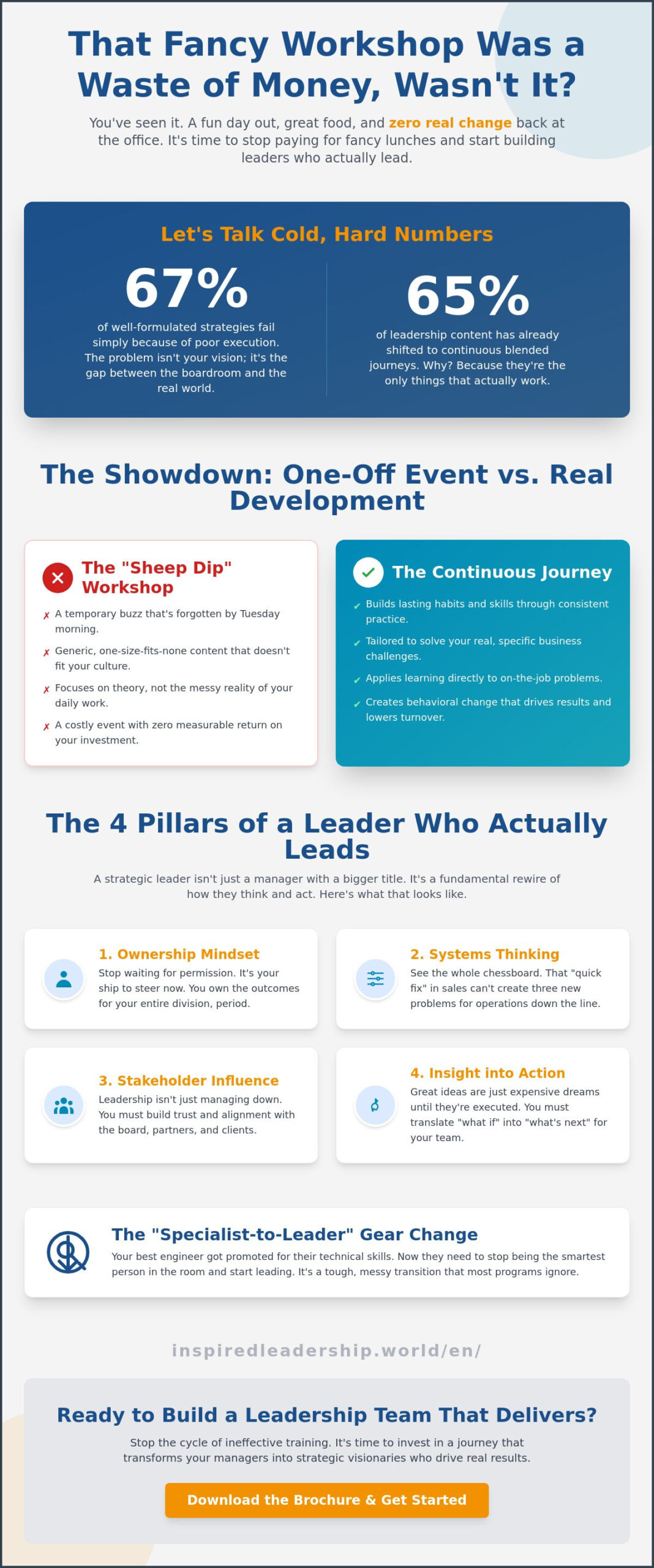
Research shows that a staggering 67 per cent of well-formulated strategies fail because of poor delivery. This strategy-execution gap happens when leaders know the theory but cannot execute it under pressure. A one-off strategic leadership development program that focuses on a weekend information dump just won’t cut it.
Leadership is a muscle, not a trivia category. You don’t get fit by watching a two-day documentary on marathons; you get fit by running every morning. Real change requires a journey of consistent practice, feedback, and refinement over time.
The Workshop Trap: Why One-Offs are a Waste of Your Budget
We have all seen the Monday Morning Reality where the inspiration of a workshop evaporates the moment a client screams or a server goes down. There is a massive difference between knowing leadership theory and actually doing it when you are in the trenches with a frustrated team.
Many generic programs are designed for massive global conglomerates, leaving medium-sized businesses with advice that doesn’t fit their unique culture. If you are ready for something that actually sticks, head over to our Senior Leadership and Executive Journeys page and download the brochure to see how we do things differently.
The Core Pillars of a Strategic Leadership Mindset
Strategic leadership is not just a fancy title you get when your office moves to a higher floor. It is a fundamental rewire of how you see your role and your impact on the business. A proper strategic leadership development program should focus on four non-negotiable pillars that turn managers into visionaries.
First is the Ownership Mindset. You have to stop being a passenger waiting for instructions and start owning the outcomes of your entire division. It is the shift from saying "I did what I was told" to "I am responsible for making this vision a reality."
Next is Systems Thinking. You need to realise that a "quick fix" in the sales department might cause a massive headache in operations three months later. Leaders must recognise how every decision ripples across the whole organisation to avoid creating new problems while solving old ones.
Then there is Stakeholder Influence. You have to learn to lead "up and out" to boards, partners, and clients, much like the curriculum in a high-level Global Strategic Leadership program. It is about building trust and alignment beyond your immediate team.
Finally, you must master the habit of translating leadership insight into action. This means constantly asking, "So what does this actually mean for my team today?" Without this bridge, your strategy is just a collection of nice ideas that never actually happen.
The Specialist-to-Leader Gear Change
We see it all the time with technical experts. Your best engineer or accountant gets promoted and immediately tries to be the smartest person in the room. They often struggle with the ambiguity of leadership because, unlike code or spreadsheets, people don’t always follow a logical formula.
This gear change is exactly why we designed our First Line Manager Development Program to help experts stop doing and start leading. It provides the tools to navigate the messy reality of human dynamics while keeping a firm eye on the big picture. If you want to see how we help your stars make this jump, visit our journey page and download the brochure to explore the curriculum.
Investing in a strategic leadership development program that addresses these pillars ensures your leaders aren’t just busy; they are actually effective. It is about moving from technical brilliance to strategic influence, which is where the real value is created for your business.
What to Look for in a Strategic Leadership Journey (Not Just a Workshop)
If you want results that actually show up on your balance sheet, you need to stop buying "events" and start investing in a process. A high-impact strategic leadership development program isn’t a two-day retreat where everyone holds hands; it is a sustained journey that forces real behavioural change. You need a model that integrates into the daily flow of work rather than interrupting it.
First, look for duration. Science tells us it takes months, not days, for new habits to stick in a high-pressure environment. You need a program that stays with your leaders as they navigate the messy reality of their day-to-day work, providing support when things inevitably get pear-shaped.
Second, insist on action-learning projects. Your leaders should be solving actual business problems in real-time, not dissecting a dusty case study about a defunct company from the eighties. Even top-tier examples like Wharton’s Global Strategic Leadership program emphasise the importance of formulating and executing strategy in a practical, global context.
Third, ditch the "sage on the stage" who just talks at you for eight hours. Leadership is a social sport, so your team needs peer coaching where they can challenge each other and share what is actually working on the ground. Choosing a strategic leadership development program that prioritises social learning ensures your team builds the collective grit needed for long-term success.
Why Human-Centricity is the Secret Sauce
Empathy and psychological safety aren’t just "nice to have" soft skills; they are strategic tools for high performance. If your team is too scared to speak up about a failing project, your strategy is already dead in the water. We have to move past the idea that being a "tough" leader means being a robot.
The way we approach leadership development for executives is shifting towards the whole person. We don’t want corporate clones who speak in buzzwords; we want authentic humans who can build real trust. This human-centric approach is what allows a strategy to actually breathe and survive in the real world.
Ready to stop the workshop madness and start a real transformation? Visit our Senior Leadership and Executive Journeys page and download the brochure to see how we can help your team lead with heart and head.
Translating Strategic Insight into Action Across Your Entire Organisation
Scaling strategy isn’t about sending a mass email and hoping for the best. For a strategic leadership development program to actually work, that visionary mindset has to filter down from the top floor to the front-line staff. When everyone understands how their daily grind connects to the big picture, you stop being a group of individuals and start being a high-performance team.
You need a culture of accountability where people own their results instead of pointing fingers when things go sideways. This means every team member knows exactly what the strategy is and, more importantly, what their specific role is in making it happen. It turns a vague boardroom document into a living, breathing set of behaviours that everyone can get behind.
Let’s talk about the money. Stop measuring success by "smile sheets" that only tell you if the catering was decent during a training session. Data from 2026 suggests the average ROI for an effective strategic leadership development program is between 3 and 5 times the initial investment. We want to see those tangible organisational outcomes, not just a folder full of feedback forms that nobody ever reads again. For a practical framework on translating leadership insight into action without losing momentum, our no-nonsense guide walks you through exactly how to make it happen.
For those looking to drive these outcomes through the latest technological advancements, check out Business With AI Strategist to learn how AI can be strategically integrated into your operations.
None of this works if the senior team doesn’t lead the charge. If you aren’t modelling the new behaviours and sponsoring the journey, your staff will smell the hypocrisy from a mile away. Leadership starts at the top, but it only succeeds when it is felt at every level of the business.
Your Next Step: From Strategy to Transformation
Stop looking for a "quick fix" or a transaction that ends when a trainer leaves the room. A real executive leadership development program should feel like a genuine partnership. You need a guide who is as invested in your long-term transformation as you are.
Check out our Senior Leadership and Executive Journeys page and download the brochure to see how we do things differently. We are ready to help you move from just having a strategy to actually living it every single day.
Ready to Stop the Workshop Carousel and Start Growing?
You have seen the data and you have felt the frustration of the Monday morning reality. It is time to ditch the one-off training events that leave your managers stuck in the weeds and instead embrace a strategic leadership development program that actually sticks. By focusing on ownership, systems thinking, and long-term behavioural change, you can finally close that strategy-execution gap for good.
We bring 20 years of corporate experience to the table with a no-nonsense, jargon-free approach that prioritises real results over fancy slides. Our results-driven ‘Journey’ methodology ensures your leaders aren’t just learning theory; they are practicing it in the trenches where it counts. We don’t do corporate fluff; we do genuine transformation that helps your technical experts become the visionaries your business needs.
Ready to transform your team? Explore our Senior Leadership Journey and download the brochure today. It is the first step toward building a leadership culture that actually owns its outcomes and stays aligned with your vision. You have got the talent; now let’s give them the journey they deserve to truly shine.
Frequently Asked Questions
What is the difference between a leadership workshop and a leadership journey?
A workshop is a one-off event that usually ends the moment you walk out the door, whereas a journey is a sustained process designed for long-term behavioural change. Think of it like the difference between a crash diet and a lifestyle overhaul. A strategic leadership development program built as a journey allows you to practice new skills in the real world with ongoing support and feedback.
How do you measure the ROI of a strategic leadership development program?
You measure ROI by looking at tangible business outcomes like reduced staff turnover and the successful delivery of strategic projects rather than just participant feedback. Research from February 2026 suggests effective programs deliver a return of 3 to 5 times the initial investment. Visit our Senior Leadership and Executive Journeys page to see how we track these results and download the brochure for more details.
Can you really teach a technical expert to think strategically?
Absolutely, though it requires a fundamental gear change from being the smartest person in the room to being a systems thinker who owns outcomes. We specialise in helping brilliant engineers and accountants stop micromanaging the how and start leading the why. It is about giving them the tools to navigate ambiguity without losing their technical edge.
How long does it take to see results from a leadership development program?
You will often see an immediate shift in awareness and language, but deep behavioural integration typically takes between six and twelve months of consistent practice. Real transformation isn’t an overnight miracle; it is a steady build-up of better habits and smarter decisions. This is why our journeys are structured to support your team long after the initial sessions end.
Why is strategic leadership important for medium-sized enterprises specifically?
In a medium-sized business, you don’t have the luxury of endless middle management layers to hide behind, so every leader’s decision has a massive ripple effect. Strategic leadership ensures your team isn’t just busy but is actually moving the needle on your most important goals. It bridges the gap between a great idea in the boardroom and real-world execution on the front line.