
Why is your C-suite still acting like the world’s most expensive department heads instead of the strategic architects you actually hired? It’s a common frustration when leadership development for executives feels more like a polished badge of honour than a catalyst for real organisational change. You aren’t alone if you feel like you’re paying for super-specialists who still wait for permission to lead.
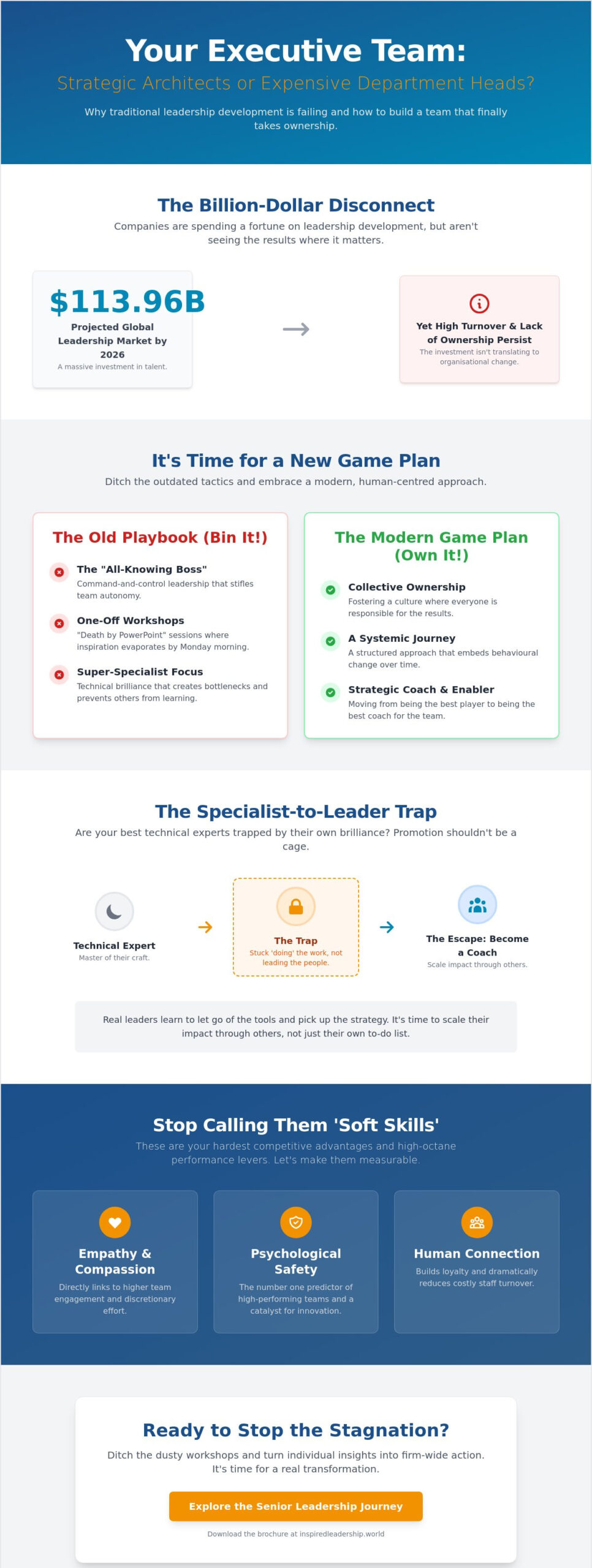
With the global leadership market projected to hit USD $113.96 billion in 2026, it’s clear companies are spending big. Yet, many organisations still struggle with high turnover and a lack of ownership in the management ranks. You likely agree that throwing money at generic workshops isn’t working, especially when the tech sector alone now commands 21.1% of the market share.
I promise to show you how to transform this tactical slog into a strategic, human-centred journey that delivers tangible results. We will explore how to build a sustainable talent pipeline and ensure your development spend finally shows a measurable ROI. If you’re ready to see what a real transformation looks like, head over to our Senior Leadership and Executive Journeys page and download the brochure to start your team’s evolution.
Key Takeaways
- Ditch the “all-knowing boss” persona and learn how to foster a culture where your team actually takes ownership of the results.
- Stop burning cash on dusty, one-off workshops and discover why effective leadership development for executives requires a systemic approach that actually sticks.
- Turn “soft” concepts like psychological safety into measurable performance metrics that provide a genuine competitive edge for your organisation.
- Learn the no-nonsense framework for translating individual executive insights into firm-wide action to ensure your development spend isn’t just a box-ticking exercise.
- Ready to stop the stagnation? Head over to our Senior Leadership and Executive Journeys page and download the brochure to start your transformation.
The Great Leadership Reset: Why Executive Does Not Mean What It Used To
In 2026, being an executive isn’t about having the corner office or the loudest voice. It’s about fostering collective ownership across your entire team. The old command and control model is officially in the bin.
Leaders used to be expected to know every answer. Now, the most effective executives are the ones asking the right questions. This shift is vital for modern leadership development because it moves the focus from individual ego to organisational agility.
In Australia, we often grapple with Tall Poppy Syndrome, which can make leaders hesitate to truly stand out. This is especially tricky for medium-sized enterprises. These businesses need a bespoke approach to leadership development for executives that prioritises connection over the rigid, cold hierarchies of multinational giants.
The Death of the Super-Specialist Executive
Technical brilliance is often the very thing holding you back. I once worked with a brilliant CFO named Sarah who could spot a decimal error from across the room. She was so busy doing the numbers that her team never learned to think for themselves.
Human-Centred Leadership as a Competitive Advantage
Empathy and compassion aren’t just nice to have traits for your HR manager. In the current market, they are high-octane strategic performance levers. If you can’t connect with your people, you won’t keep them.
Calling these soft skills is a bit of a joke. They are the hardest skills to master, but they deliver the biggest results. If you want to see how we build these capabilities, check out our Senior Leadership and Executive Journeys page and download the brochure to see the full framework.
The Performance Gap: Why Your Top Talent Stagnates at the Top
You’ve seen it happen. A brilliant manager gets promoted to the executive suite and suddenly, they’re stuck in second gear. This stagnation isn’t usually about a lack of brains, but rather systemic friction points that keep your best people tethered to the weeds instead of soaring at thirty thousand feet. Effective leadership development for executives isn’t just about acquiring new skills; it’s about shifting an entire mindset.
The biggest roadblock is the traditional three-day workshop. Let’s be real. These sessions are often just death by PowerPoint, where executives sit in a dim room being pelted with bullet points until their eyes glaze over. It’s like trying to learn to surf by reading a manual in a bathtub. You might feel inspired for five minutes, but without a long-term approach to leadership development for executives, that inspiration evaporates the second you see fifty unread emails. Understanding why a strategic leadership development program built around sustained journeys outperforms workshops is the first step to closing this gap for good.
Isolation is another silent killer. When leaders feel they have to carry the world on their shoulders, strategic alignment goes out the window. This is why many executive development programs fail to bridge the gap between individual talent and collective performance. Without a shared language of ownership, your top tier becomes a collection of silos rather than a unified team.
The Insight-Action Paradox
Knowing what to do is easy. Actually doing it while the business is screaming for your attention is the hard part. Breaking old management habits requires a deep dive into organisational psychology, not just a few catchy slogans. This is why we advocate for a structured leadership development journey that focuses on behavioural change over time.
The Cost of Misaligned Leadership
In the SME world, a misaligned leadership team is a growth killer. If the folks at the top aren’t on the same page, that confusion trickles down to the front line faster than a spilled flat white. It creates a culture of “waiting for permission” that stifles innovation and burns out your best people. If you’re ready to fix the rift, take a look at our Senior Leadership and Executive Journeys and download the brochure to see how we help teams act like owners.
The Three Non-Negotiable Trends for Modern Executive Development
If you’re still treating leadership development for executives like a weekend retreat with some nice catering, you’re doing it wrong. In 2026, the real magic happens through a sustained journey rather than a one-off course. We’ve moved past simple mentoring and into the world of systemic coaching where we look at how the whole team interacts.
Building Psychological Safety That Actually Works
Let’s clear something up. Psychological safety isn’t about everyone being “nice” or avoiding tough conversations. It’s actually the opposite. It’s about creating a space where people can disagree without fear of being sidelined.
I once saw a CEO admit she was terrified about a new competitor’s launch. That bit of vulnerability gave her team the green light to suggest bold, risky solutions that actually saved the company’s market share. “Psychological safety is not a soft luxury; it is the bedrock of high-stakes innovation.”
Digital Fluency and Human-AI Synergy
You don’t need to be a coder, but you absolutely must lead the AI conversation. With the technology sector now holding 21.1% of the leadership development market, it’s clear that digital fluency is no longer just for the IT department. It’s about Human-AI Synergy, using tech to sharpen your strategic decisions while keeping the human element front and centre.
This human element is underpinned by the ability to communicate with clarity and influence. For leaders operating in global hubs like Singapore, or those managing diverse teams, English Explorer provides the professional language training required to ensure that strategic vision is communicated effectively and impactfully.
These trends aren’t optional extras. They are the core of a modern leadership development for executives strategy. If you want a team that can actually handle the complexity of the next few years, you need to stop thinking about “training” and start thinking about “transformation”. For a deeper look at why executive leadership programs for medium sized companies must be structured as sustained journeys rather than one-off events, explore our dedicated guide on building a leadership development program that actually delivers results.
Ready to move beyond the basics? Visit our Senior Leadership and Executive Journeys page and download the brochure to see how we integrate these trends into our programs.
Moving from Insight to Action: Your Leadership Journey Starts Here
Insight is like a fancy coffee. It feels great for twenty minutes, but if you don’t actually do anything with the energy, you’re just left with the jitters. For leadership development for executives to actually work, that new wisdom must move out of the notebook and into the daily operations of your firm.
Measuring the ROI of these programmes shouldn’t rely on those useless “happy sheets” handed out at the end of a seminar. Real success looks like a measurable shift in team ownership and a visible reduction in the “wait for permission” culture. With the global market for these programmes hitting USD $113.96 billion in 2026, you deserve better than a participation trophy for your investment.
We position our approach as the pragmatic alternative for SMEs that don’t have time for academic fluff. We focus on the systemic ripple effect where one leader’s change transforms the whole department. It’s about building a team that thinks and acts like owners, ensuring your organisation is ready for whatever the market throws at it next.
Selecting the Right Partner for Your Journey
Don’t get dazzled by a provider’s glossy slides. Ask the tough questions instead. Do they actually understand the SME landscape, or are they just recycling content for multinational giants? Is this a one-off hit or a sustained journey? Avoid the “one-size-fits-all” trap; your business isn’t a carbon copy of a Fortune 500 company, so don’t let a provider treat you like one.
Your Next Steps to Strategic Ownership
Stop settling for superficial training that leaves your leaders exactly where they started. It’s time to move toward genuine strategic ownership that delivers a sustainable talent pipeline. Explore the Senior Leadership Development Journey to see how we do things differently. Download our brochure to see how we organise transformation at scale.
Time to Stop Playing Boss and Start Leading
The days of the all-knowing executive are officially behind us. Real impact in 2026 comes from fostering psychological safety and collective ownership rather than just being the smartest person in the boardroom. We’ve distilled 20 years of corporate experience into pragmatic journeys that act as a results-driven alternative to those dusty, traditional workshops.
Effective leadership development for executives isn’t a box you tick; it’s a sustained transformation of how you show up every day. You now have the framework to bridge the performance gap and turn technical experts into strategic owners who don’t need to be told what to do. It’s about building a culture where questions are more valuable than answers.
If you’re ready to embrace the agility required for medium-sized enterprises, it’s time to take the next step. Explore our Senior Leadership Development Journey and download the brochure to see how we help you lead with heart and high-level strategy. You’ve got the talent; now let’s give it the room to grow.
Frequently Asked Questions
What is the difference between executive coaching and leadership development?
Executive coaching is usually a one-on-one deep dive into personal blind spots, while leadership development for executives is a systemic journey for the whole team. Think of coaching as a surgical strike and development as a full-scale cultural upgrade. One fixes the individual; the other transforms how everyone interacts to drive results.
How long does a typical executive leadership journey take to show results?
You’ll see small shifts in awareness within weeks, but genuine cultural change usually takes six to twelve months to really stick. This isn’t a microwave dinner; it’s a slow-cooked transformation that requires consistency and real commitment. If you want a quick fix, buy a self-help book; if you want a legacy, start a journey.
Can leadership development really improve our bottom line?
Absolutely, because a team that takes ownership doesn’t waste time waiting for permission. When you invest in leadership development for executives, you’re actually reducing the massive costs of high turnover and strategic misalignment. Companies aren’t spending billions globally just for the fun of it; they’re doing it because effective leaders are a massive competitive advantage.
Why do technical experts often struggle when promoted to executive roles?
Technical experts struggle because the skills that made them great at “doing” are often the opposite of what’s needed for “leading.” They get stuck in the weeds trying to be the smartest person in the room instead of the most enabling. It’s hard to let go of the tools when those tools are what gave you your identity for twenty years.
How do we measure the success of a leadership development programme?
We look at hard data like internal promotion rates and retention figures rather than just those useless “happy sheets” handed out after a workshop. Success is measured by how often your team takes the initiative without being asked. If you’re ready to see real metrics, head to our Senior Leadership and Executive Journeys page and download the brochure to see how we track progress.