
Moving your fresh talent through a series of departments is often just a fancy way of watching them walk out the door. You’ve likely invested heavily in your graduate leadership development program only to find that rotations feel more like a polite tourist excursion than a strategic foundation. It’s exhausting to watch bright minds tick boxes whilst failing to develop the actual grit required to lead your organisation.
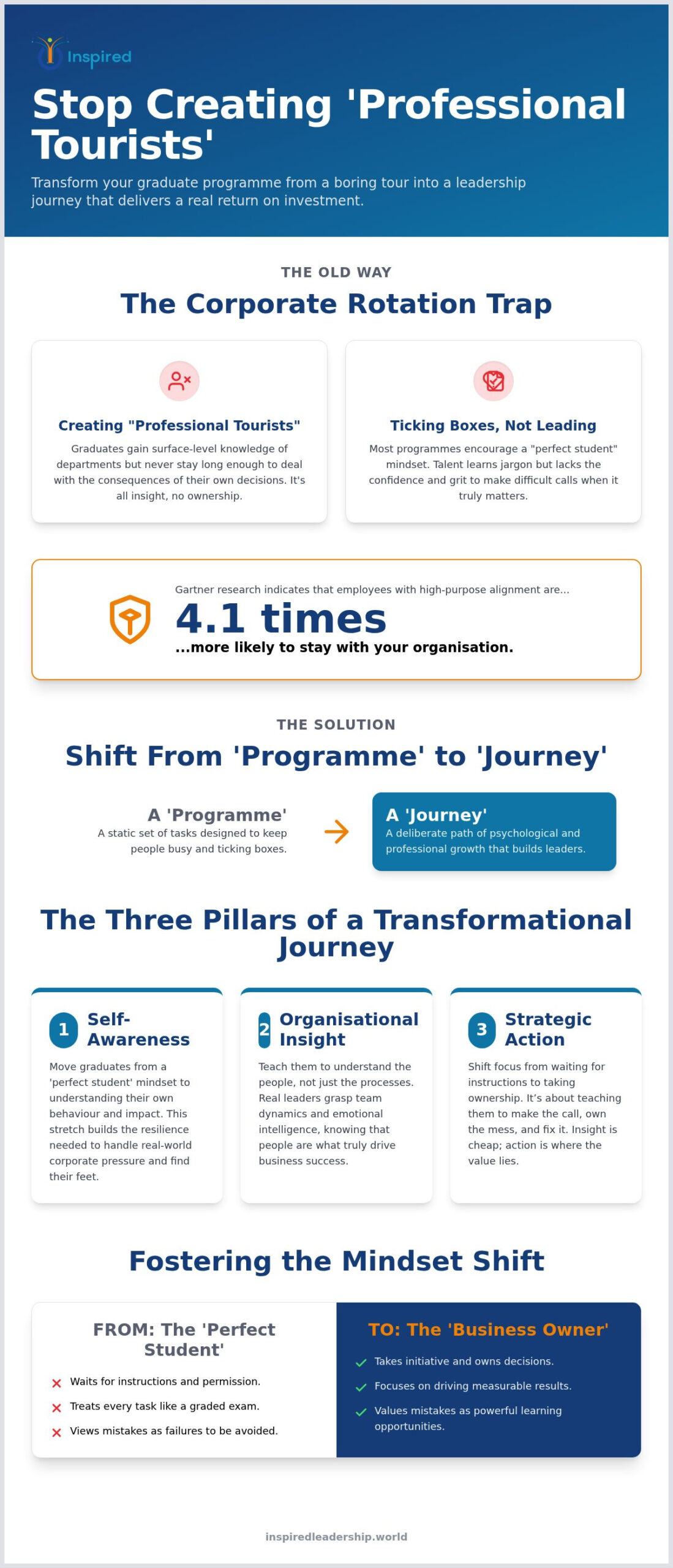
I’ve spent 20 years in the corporate world watching companies repeat the same mistakes with their talent. Gartner research indicates that employees with high-purpose alignment are 4.1 times more likely to stay, yet most training ignores this human element entirely. This article promises to show you how to transform those passive rotations into a structured journey that prioritises accountability and measurable results.
We’ll dive into the mechanics of behavioural change and why the human factor is your most valuable asset. You’re about to learn how to build a self-sustaining leadership legacy that finally delivers the ROI you were promised. It’s time to stop training and start developing.
Key Takeaways
- Stop creating “professional tourists” with endless department swaps and learn how to transform a standard graduate leadership development program into a journey of genuine ownership.
- Discover the three pillars of self-awareness, organisational insight, and strategic action needed to move your graduates from ticking boxes to thinking like business owners.
- Stop trying to mimic the big players; leverage your status as a medium-sized enterprise to provide the visibility and speed that corporate giants simply cannot match.
- Master the art of selecting for “leadership DNA” rather than just high grades to ensure your new talent actually sticks around and delivers a real return on your investment.
The corporate rotation trap: Why most graduate programs fail to build leaders
Let’s be honest. Most of what passes for a graduate leadership development program is actually just a glorified tour of the office, complete with a standard corporate slide deck that could put a toddler on a sugar rush to sleep. You’re hiring bright, ambitious people, yet you’re treating them like observers rather than owners. It’s no wonder they start looking for the exit the moment their initial training ends.
There is a fundamental difference between a “program” and a journey. A program is a static set of tasks designed to keep people busy, whilst a journey is a deliberate path of psychological and professional growth. If your graduates are merely ticking boxes, they aren’t leading; they’re just surviving the curriculum you’ve set for them.
By shuffling graduates between departments every six months, you risk creating “professional tourists.” These individuals gain surface-level knowledge of how things work but never stay long enough to deal with the consequences of their own decisions. According to foundational Leadership development principles, true growth requires deep accountability that short rotations simply cannot provide.
The myth of the ‘perfect’ rotation
Exposure to marketing, finance, and operations is lovely on paper. However, without a central focus on leadership behaviour, your graduates become jacks-of-all-trades who are masters of absolutely nothing. They might understand the jargon of each department, but they lack the confidence to make a difficult call when the stakes are high.
Why ‘insight’ is not the same as ‘action’
Traditional training focuses on giving people knowledge, yet it rarely changes how someone actually behaves in a high-pressure meeting. Insight is cheap; action is where the value lies for your organisation. Leadership is a series of intentional behaviours that drive results, not a fancy title on a business card.
From ‘doing’ to ‘owning’: The anatomy of a transformational graduate journey
Most graduates arrive at your door still stuck in “perfect student” mode. They wait for instructions, ask for permission, and treat every task like it’s being graded for a final university exam. To build a real leader, you have to disrupt this pattern within the first 90 days of their journey. A truly effective graduate leadership development program shifts the focus toward three core pillars: self-awareness, organisational insight, and strategic action.
Growth doesn’t happen in a warm bath of constant praise. It happens when graduates are pushed into situations that feel slightly beyond their current reach, forcing them to find their feet. This stretch creates the resilience needed to handle real-world corporate pressure. By moving them from a student mindset to a contributor mindset early on, you turn them into active assets rather than passive observers.
Building the habit of accountability
Leaders aren’t people who never mess up; they’re the people who own the mess and fix it. You must teach your graduates to value their mistakes as much as their wins, which is often a shock to their high-achieving systems. This requires a shift in your management style from polite, safe praise to growth-oriented critique. If you’re curious about how to foster this culture without breaking their spirits, let’s have a chat about your current strategy.
The Human Factor in early careers
Understanding a spreadsheet is a basic technical skill, but understanding the person behind the data is where the real magic happens. Future leaders need to grasp the nuances of team dynamics and emotional intelligence before they ever get a formal “Manager” title. This is why we prioritise The Human Factor Journey in our development paths. It helps graduates realise that people, not processes, are what actually drive your business success.
Designing for impact: How medium-sized enterprises outpace the giants
You might think your lack of a multi-million pound training budget is a disadvantage. It isn’t. Whilst the corporate giants are busy drowning their recruits in generic e-learning, you have the visibility to offer something far more potent. A graduate leadership development program in a medium-sized enterprise allows for a bespoke feel because you actually know the names of your new hires and can tailor their growth accordingly. You’re not just another cog in a machine here; you’re a vital part of the engine.
Research by the South African Graduate Employers Association (SAGEA) indicates that graduates increasingly value “meaningful work” over pure brand prestige. In South Africa, as in many global markets, the ability to see the direct results of your actions is a massive retention tool. This shift towards purpose-driven work is why smaller organisations are winning the talent war, particularly when they leverage the support of Unashamedly Ethical NPC to integrate moral values into their culture. Measuring ROI in a smaller firm is straightforward; simply track the speed at which your graduate makes their first cost-saving or revenue-generating decision.
Agility over bureaucracy
Forget the endless layers of red tape. In your organisation, a graduate can be a “Strategic Catalyst” who actually moves the needle on business-critical goals. You have the unique ability to give them real responsibility for projects that matter, which effectively turns them into architects of change rather than just expensive observers waiting for a promotion. You can bypass the three-year “waiting period” that usually plagues entry-level roles in larger firms.
Creating a culture of ownership
You don’t just need people to “do”; you need them to “own” every outcome. This starts with identifying who has the right internal wiring to handle that level of responsibility. Using a Leadership Assessment early in the journey helps you pin-point the high-potential talent who are ready to think like business owners from the very beginning. It’s about finding the grit behind the grades.
Starting the journey: Identifying and nurturing your future leaders
High grades are a lovely starting point, but they won’t tell you if a candidate can handle a crisis at 4:30 PM on a Friday. You need to look for “leadership DNA”, that rare blend of curiosity, resilience, and the willingness to own an outcome regardless of the obstacles. In your graduate leadership development program, selection should feel less like a tick-box exercise and more like a search for future business partners who can handle the weight of responsibility.
The first 12 months are critical for retention and long-term impact. If your graduates spend that year doing data entry or shadowing meetings without a voice, they’ll likely be on LinkedIn looking for a new role by month thirteen. Structure the year around high-impact projects where the stakes are real and the feedback is frequent, direct, and growth-oriented.
The role of senior leadership in the graduate journey
Your current leaders must step up as mentors, not just supervisors who sign off on holiday requests. If your senior team still operates with a “command and control” mindset, they will inadvertently crush the very initiative you’re trying to build in your new hires. This is why we often recommend our Manager to Leader Journey to ensure your existing leadership layer is ready to support and nurture fresh talent effectively.
Next steps for your organisation
It’s time to stop “training” and start transforming your graduates into the leaders your business deserves. If you are ready to move beyond standard rotations and start building a self-sustaining talent pipeline, contact Inspired Leadership for a consultation. You can also download the brochure for our Emerging Leader Journey to see how we structure these transformational paths for maximum impact.
Building your leadership legacy today
Stop letting your bright new hires drift through the office like polite tourists waiting for their next itinerary. We’ve explored how genuine growth happens only when you swap passive rotations for a structured journey of ownership. By leveraging your natural agility as a medium-sized enterprise, you can create a graduate leadership development program that delivers a measurable return on your investment whilst keeping your best talent engaged.
My approach is built on 20 years of corporate insight and a refusal to accept traditional training that doesn’t work. We focus on results-driven behavioural transformation that turns graduates into architects of change. You don’t need the multi-million pound budget of a global giant to build a world-class pipeline; you simply need a partner who understands how to translate potential into professional excellence.
It is time to stop ticking boxes and start building the resilient, accountable leaders your organisation deserves to have at its helm. I’m here to help you make that happen.
Frequently Asked Questions
What is a graduate leadership development program?
A graduate leadership development program is a transformational journey designed to turn your fresh talent into accountable leaders who own their actions. Whilst most people treat it as a tick-box exercise, it’s actually about shifting the focus from simply doing tasks to driving results. You aren’t just hiring a pair of hands; you are developing a brain that thinks like a business owner from day one.
How long should a graduate leadership journey last?
A meaningful journey typically spans 12 to 24 months to ensure behavioural shifts become permanent habits. Anything shorter is usually just a glorified orientation that fails to build real resilience. You need this extended timeframe to allow your graduates to face real challenges, make mistakes, and learn how to fix them. It’s about sustainable growth, not a quick-fix workshop that everyone forgets by Monday morning.
Can medium-sized companies afford a leadership journey?
You absolutely can, and frankly, you can’t afford to skip it. The cost of hiring the wrong leader or losing top talent to a competitor is far higher than the investment in a structured journey. Smaller firms often have a advantage where development happens faster because the impact is visible. It’s an investment in your company’s future stability rather than just another line item on the budget.
What is the difference between an internship and a graduate journey?
An internship is usually a short-term “taster” of corporate life, whilst a graduate journey is a strategic commitment to your long-term talent pipeline. Think of an internship as a first date and a journey as a serious commitment to your future leadership team. You are moving beyond simple work experience and into a phase of deliberate, high-impact growth that prepares them to lead your organisation.
How do I measure the success of my graduate leadership journey?
Success is measured by your graduate’s ability to take on complex projects and demonstrate an ownership mindset that hits your bottom line. Look for tangible shifts in how they handle conflict, lead meetings, and make decisions without needing their hand held. If they’re thinking like business owners and solving problems before they reach your desk, you’ve achieved a real return on your development investment.