
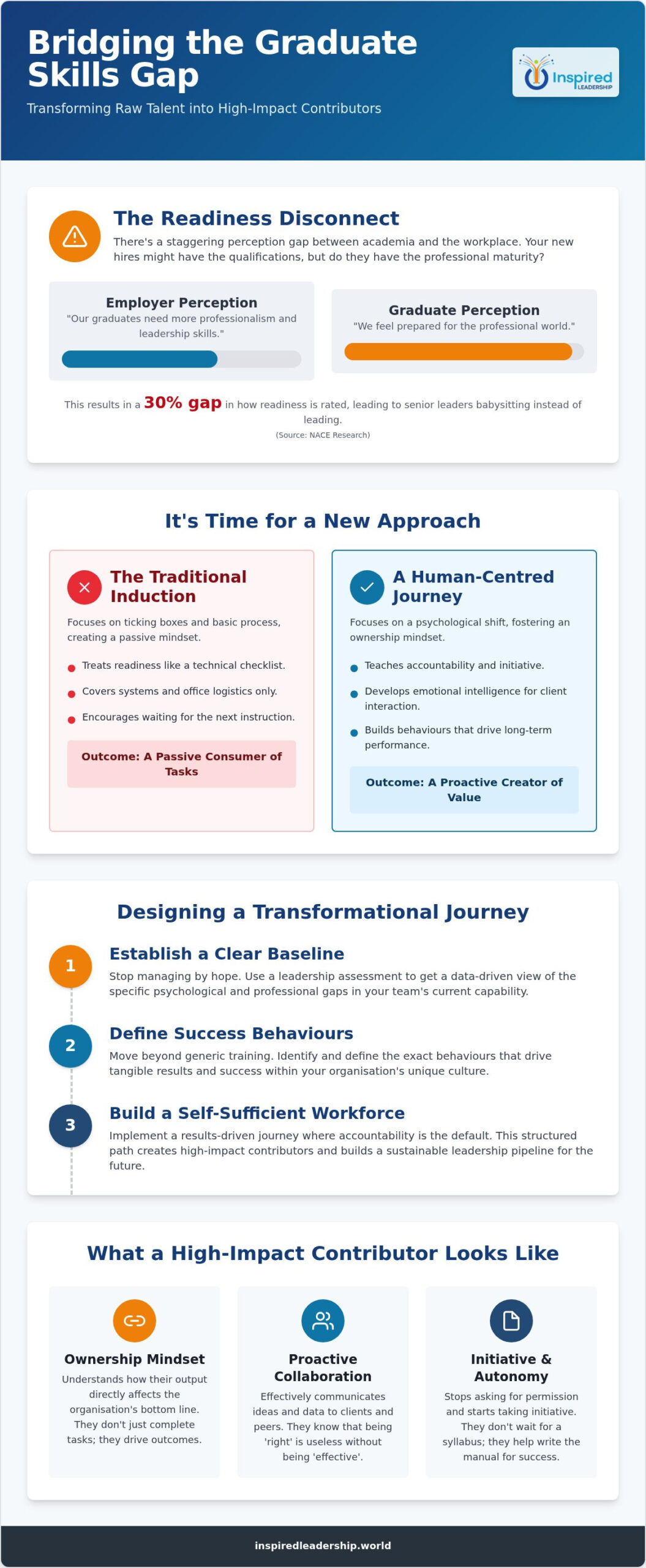
Did you know there is a staggering 30% gap between how graduates and employers rate professionalism and leadership skills according to NACE research? It’s a bit of a nightmare when your new hires have the technical brilliance but still need their hands held for every basic client interaction. You didn’t spend decades building your career just to become a full-time babysitter for the latest intake.
I know you want a team that thinks for itself and understands that “showing up” is not the same as “delivering value.” Whilst traditional work readiness programs often focus on ticking boxes, we believe in a more human-centred approach. I’ll show you how to transform raw talent into high-impact contributors by prioritising ownership over mere attendance.
By the end of this article, you’ll discover how a structured developmental journey reduces the management burden on your senior leaders. We’re going to map out a clear path to a self-sufficient workforce and a sustainable leadership pipeline. It’s time to stop managing mediocrity and start cultivating excellence.
Key Takeaways
- Understand why a standard induction isn’t enough and how modern work readiness programs must focus on translating technical knowledge into tangible results for you.
- Discover how to foster an ownership mindset so your graduates stop waiting for instructions and start acting as high-impact contributors to your team.
- Explore how to design a developmental journey that uses a leadership assessment to ensure your early talent is actually ready for the real world.
- Find out why your medium-sized business needs a unique strategy to build a self-sufficient workforce without the fluff of generic corporate training models.
Beyond the CV: Why Traditional Work Readiness Programs Often Miss the Mark
You’ve seen the CVs; they’re sparkling with first-class degrees and impressive extracurriculars. Yet, when these star graduates land in your office, they often lack the ability to translate that academic brilliance into actual organisational value. Work readiness programs should bridge this gap, but most treat it like a technical checklist rather than a psychological shift.
It’s incredibly frustrating for your senior leaders who find themselves babysitting new hires rather than leading them. A standard induction that covers where the coffee machine is and how to use the CRM isn’t a work readiness journey. It doesn’t teach accountability or how to handle a difficult client call without a script.
This is where The Human Factor comes in. It’s the hidden engine of early career success that turns a passive consumer of tasks into a proactive creator of value. We need to move beyond the surface level to address the underlying behaviours that drive long-term performance.
The Graduate Skills Gap in Medium-Sized Enterprises
Medium-sized enterprises don’t have the luxury of massive HR budgets or “bench strength” to wait eighteen months for a graduate to become useful. Improving graduate employability within your business is a commercial necessity, not just a nice-to-have. When a transition fails, the cost to your bottom line and team morale is immense.
There is a massive difference between technical competence and professional readiness. Concepts like Work-integrated learning (WIL) show us that real-world application is the only way to build these durable skills. Whilst technical skills are the entry ticket, high-impact work readiness programs focus on the behaviour that keeps people in the game.
The Human Factor: What Real Workplace Readiness Looks Like in 2026
In 2026, being “ready” for work isn’t about knowing the theory; it’s about the psychological shift from being a consumer of information to a creator of value. Most graduates enter your business expecting a syllabus, but you need them to write the manual. Effective work readiness programs must facilitate this transition to ensure they don’t just sit and wait for the next lecture.
This transition is more effective when educational institutions discover Rise to track student activity and performance through a real-time analytics dashboard, ensuring they are truly prepared for the professional world.
High-impact contributors possess an ownership mindset that is vital in a medium-sized organisation where there is nowhere to hide. They understand that their output directly affects the bottom line. This level of accountability is often missing in those who have spent years being graded on compliance rather than contribution.
Technical experts often find this the hardest because they’ve been taught that being “right” is the same as being “effective.” They might have the best data, but if they can’t communicate it to a client or collaborate with a peer, that data is functionally useless. The Employability Skills Framework highlights that critical thinking and teamwork are just as essential as technical prowess.
Moving from Academic Theory to Organisational Ownership
You need new hires who stop asking for permission and start taking initiative. This requires a level of emotional intelligence that simply isn’t taught in a lecture hall. Our Human Factor journey focuses specifically on these nuances of behavioural change.
If you are tired of seeing brilliant technical minds struggle with basic professional dynamics, it’s time to rethink your approach. We can help you build a workforce that actually understands how to navigate the messy reality of business. Feel free to reach out for a chat to discuss your specific team needs.
Designing a Transformational Journey for Your Early Talent
Stop managing by hope and start managing by design. You shouldn’t just cross your fingers and pray your new hires eventually “get it.” Moving beyond tactical training requires a deliberate shift toward a results-driven journey where accountability is the default setting.
First, you must establish a clear baseline. Use a leadership assessment to identify the specific psychological and professional gaps in your team’s current capability. Once you have this data, you can define the exact behaviours that drive success in your unique culture.
Effective work readiness programs require a structured path that mandates regular feedback, deep reflection, and immediate action. It’s about creating a loop where learning is instantly applied to real-world problems. Finally, you must measure the impact on your senior management time to ensure the burden of “babysitting” is actually lifting.
Whilst broad government initiatives like WIOA Workforce Programs provide a solid foundation for entry-level employment, your business requires a more surgical focus. Traditional work readiness programs often miss the nuance of your specific organisational needs. You aren’t just looking for warm bodies to fill desks; you’re looking for future architects of your company. A well-considered graduate recruitment strategy 2027 ensures you are attracting candidates who are aligned with the capabilities your organisation will actually need.
In technical sectors like construction and industry, this surgical focus is even more critical. Partnering with a consultancy like DL Safety can provide the specialised support and technical services necessary to ensure your new talent understands the safety implications of their work from day one.
Integrating Accountability into the Onboarding Process
Practical responsibility should be baked into the very first 90 days of the experience. You can set high standards immediately by using real stories of past failures and successes to illustrate what “good” actually looks like. Prioritising early career development is a strategic move that pays dividends in long-term self-sufficiency.
Selecting a Work Readiness Journey that Delivers Tangible Results
Medium-sized businesses are often the “forgotten middle” in the world of professional growth. You don’t have the time or the budget for the bloated, one-size-fits-all corporate models that massive firms use. Work readiness programs for your team must be agile, focused, and immediately applicable to your specific operational reality.
We position ourselves as a “Strategic Catalyst” for your business. This persona isn’t just about teaching; it’s about being a pragmatic architect of change who understands the hidden dynamics causing your organisation to stagnate. We help you build a talent pipeline that is both resilient and results-oriented from day one.
Whilst you might think that investing in a leadership journey is a luxury for when you are “bigger,” the reality is quite different. Waiting until you’ve scaled to fix your culture is a recipe for expensive, systemic failure. Consider the long-term ROI of a graduate leadership journey that turns a hesitant junior into a self-sufficient contributor who actually understands your bottom line.
Why the Inspired Leadership Approach Beats Traditional Training
Unlike generic work readiness programs, our approach is informed by 20 years of hard-won corporate experience. We don’t do fluff or superficial workshops that people forget by Friday afternoon. Every journey we design focuses on translating psychological insight into tangible organisational action that you can actually measure.
It’s time to stop settling for “good enough” from your early talent intake. You deserve a workforce that takes ownership and drives your business forward without constant intervention from senior leaders. Take a bold step today to professionalise your workforce and secure your future leadership pipeline.
Stop Managing Mediocrity and Start Scaling Success
You’ve seen how traditional inductions fail to turn technical experts into self-sufficient contributors. Real Work readiness programs focus on the psychological shift towards ownership and the “Human Factor” that academic theory simply cannot touch. By building a structured journey, you stop the endless cycle of babysitting and start scaling your business with a team that actually thinks for itself.
I’ve spent 20 years in the corporate trenches, so I know that a results-driven methodology beats a fancy PowerPoint every single day. My approach is highly personal and direct because your medium-sized enterprise doesn’t have time for the fluff that big consultancies love to sell. You need high-impact contributors who don’t need their hands held every time a client asks a tricky question.
It’s time to stop crossing your fingers and start designing the workforce you deserve. I’m here to help you turn that raw graduate talent into your company’s future leaders. I’m ready to help you secure a sustainable leadership pipeline that actually delivers.
Frequently Asked Questions
What is the difference between an induction and a work readiness journey?
An induction is a tactical orientation focusing on logistical necessities like office tours and IT logins. In contrast, work readiness programs are structured journeys designed to facilitate a psychological shift from a passive student to an active creator of value. Whilst an induction tells you where to sit, a journey teaches you how to think, own your actions, and deliver results for your team.
How long does a typical work readiness journey take to show results?
You will usually see initial behavioural shifts within the first few weeks as the new hire begins to grasp the concept of ownership. However, a full transformation into a self-sufficient contributor typically takes several months of structured feedback and active reflection. This deliberate pace ensures that new habits are sustainable and that your graduates don’t just revert to old patterns once the pressure mounts.
Can technical experts benefit from work readiness journeys or is it just for graduates?
Technical experts often benefit the most because high-level technical brilliance doesn’t automatically translate into effective communication or client management. Many brilliant developers or engineers struggle with the professional nuances required in a medium-sized enterprise. By focusing on the “Human Factor,” we help these specialists move beyond their technical silos to become influential contributors who can translate complex data into strategic action for you.
How do you measure the ROI of a work readiness journey in an SME?
ROI is measured by the reduction in management time required from your senior leaders and the increased speed of graduate productivity. You will also notice improved retention rates, as employees who feel professionally prepared are less likely to experience early-career burnout. Success is ultimately defined by a workforce that takes initiative and requires far less “babysitting” to deliver high-quality organisational value every single day.
Why should I choose a bespoke journey over a standard online course?
Standard online courses are typically passive, tick-box exercises that fail to address the specific cultural dynamics or challenges of your business. A bespoke graduate development program is tailored to your unique organisational needs and focuses on translating insight into immediate, tangible action. This direct approach ensures that development isn’t just another task to complete, but a transformative experience that builds a genuine leadership pipeline for your future.