

What if your graduate recruitment strategy 2027 attracts talented people but doesn’t build the capabilities your organisation will need next? A strong hiring campaign can spark interest, but it’s only the beginning. Without a clear link to what happens after graduates join, even a promising intake can become a missed opportunity.
Future skills needs shift, and graduates want an honest picture of the work and culture they’re choosing. The challenge is to connect business priorities, candidate experience and early development, rather than treating them as separate tasks.
This guide will help you plan attraction and selection around the capabilities you need, show candidates what working in your organisation is really like, and connect recruitment to purposeful development. You’ll also see how a graduate leadership journey can support the next step, helping new graduates turn potential into contribution and build capability over time.
Key Takeaways
- Build your graduate recruitment strategy 2027 around the capabilities your organisation needs, not assumptions about future roles.
- Make your employer proposition credible by checking that role descriptions and recruitment promises match graduates’ day-to-day experience.
- Turn planning into clear decisions: identify capability needs, define roles, shape your proposition, select candidates and review what you learn.
- Connect hiring with onboarding and early-career development. Recruitment alone won’t secure long-term contribution.
Why your graduate recruitment strategy for 2027 must start with future capability
You’re expected to attract graduates while the work your organisation needs to do, and the skills required to do it, keep changing. That makes it tempting to begin with vacancies and deadlines. A stronger graduate recruitment strategy 2027 starts earlier, with a practical question: what does your organisation need to be able to do in the future?
Graduate recruitment connects identifying future capability needs with attracting and selecting early-career talent, then planning how graduates will develop once they join. It’s broader than an annual campaign to fill entry-level roles. As the overview of Graduate recruitment illustrates, hiring can involve different approaches, from campus events to virtual activity. The right mix depends on your roles, audience and organisation.
Start with the work your organisation expects graduates to do
Look at emerging work, capability gaps and where graduates could make a meaningful contribution. For example, a team introducing new digital tools might need people who can interpret information, work across teams or improve processes, as well as people with relevant technical knowledge.
Separate evidence from assumption. Ask leaders what work is changing, review current capability gaps and identify tasks graduates could realistically take on with support. Don’t mistake a fashionable skill or a vague wish for “fresh thinking” for a clear workforce need. Be specific about the work, the capability required and the support new starters will need to contribute.
Plan for people, not just vacancies
Your proposition should reflect the work graduates will actually do, the support they can expect and the opportunities available to develop. If recruitment promises meaningful responsibility but the role offers little clarity or feedback, the gap will be felt quickly. An honest picture helps candidates decide whether the opportunity suits them.
Consider the candidate experience from the start, rather than polishing it after roles are set. For broader foundations, look for the related article, “Graduate Recruitment and Development: A Strategic Guide”, alongside your planning. The aim is to connect business needs with a credible experience for the people you hope will help meet them.
Design a 2027 graduate recruitment strategy around a credible candidate experience
A credible proposition isn’t a list of shiny benefits. It gives candidates a clear picture of the role, the team they’ll join, the contribution they can make and the support available as they learn. In your graduate recruitment strategy 2027, make sure those details reflect the work graduates will actually encounter, not an idealised version of it.
Make the employer proposition specific and believable
Describe a real role in plain language. Explain what a graduate might work on, who they’ll collaborate with and how their manager will help them understand priorities. Check your messaging with people who know the role and working environment, including recent graduates where possible. They can flag a promise that sounds impressive on paper but doesn’t match daily work.
Candidate experience begins before the first application and continues after hiring, through every interaction and the reality of the work itself. Clear information, accessible communication and timely updates show respect for candidates’ time. NACE’s guidance on recruiting best practices also highlights the value of relationships and communication in graduate recruitment.
Choose selection methods that reveal relevant capability
Selection should give candidates a fair chance to show capabilities that matter in the role. Structured interviews help you ask comparable questions, while a practical, role-relevant assessment can show how a candidate approaches a realistic task. Neither method is useful just because it looks polished.
Before using a method, ask whether it assesses a capability the role needs. Check that candidates can understand what’s expected and that the effort is proportionate. Decide how assessors will apply consistent criteria, and consider accessibility. Review the process from the candidate’s perspective as well as what it tells you about them.
Explore the Emerging Leader Journey and download its brochure to consider how leadership development could support graduates after hiring.
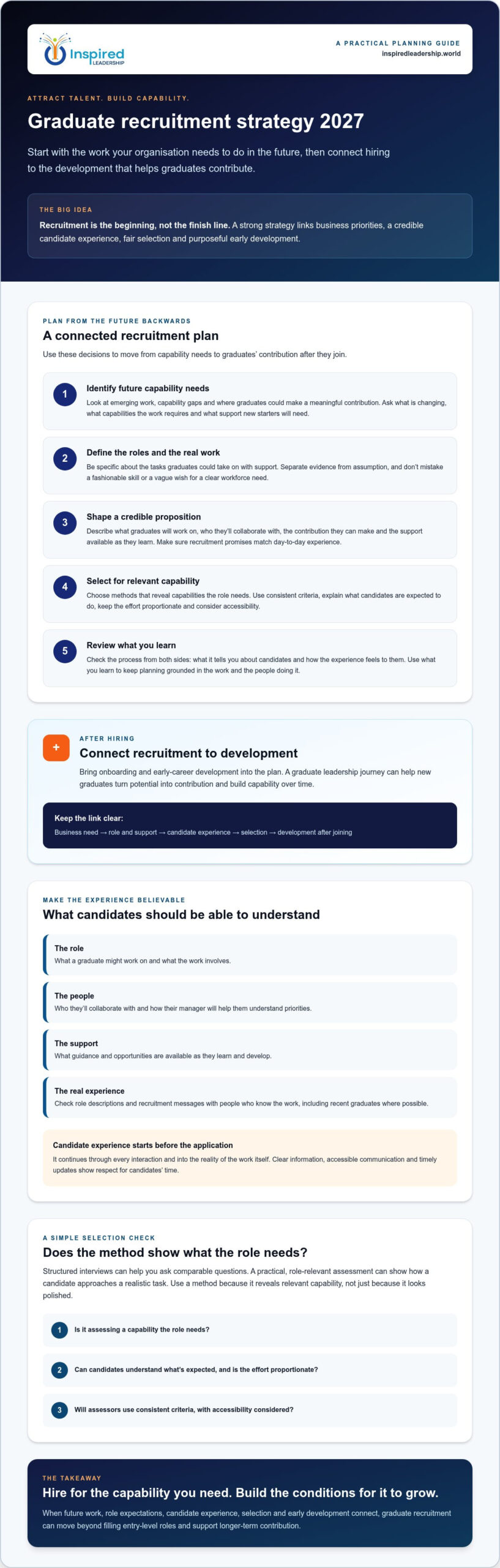
Turn graduate recruitment planning into a practical 2027 action plan
Turn your priorities into a short decision record that teams can use, rather than a document that gathers dust. For each stage, capture the decision, who owns it and what evidence will inform it:
- Clarify capability needs: record the future work and capability gaps your graduate intake is intended to address.
- Define roles: agree the responsibilities, learning expectations and manager support attached to each role.
- Shape the proposition: check that role descriptions reflect the team’s actual work and working environment.
- Select: document why each assessment method is relevant and how assessors will apply it consistently.
- Review: choose measures for candidate feedback, hiring quality and early retention, then set a point to discuss what they show.
Coordinate the people who shape the graduate experience
Bring together the people who will make these decisions, often HR, hiring managers and teams working closely with graduates. Agree who communicates with candidates, who supports new starters and what a realistic first contribution looks like in each role. Clear ownership helps prevent a mismatch between the experience promised during hiring and the one delivered after someone joins.
Connect recruitment to early-career support
Use your review to identify where graduates need clearer guidance or a more visible development path. Compare their feedback with what managers observe, then choose one improvement to test in your own context. If building leadership capability is part of the next step, the Emerging Leader Journey may be relevant.
Explore the Emerging Leader Journey and download its brochure
Make your graduate recruitment strategy lead to capability that lasts
Recruitment can bring graduates into your organisation, but it can’t ensure they’ll stay, contribute or become future leaders. Those outcomes are shaped by what follows: how people are welcomed, supported in their roles and given opportunities to develop. Hiring is a starting point, not a guarantee of what comes next.
Keep the responsibilities connected but distinct. Recruitment identifies capability needs and sets expectations. Onboarding helps new starters understand their role and build relationships. Ongoing development supports growth over time. When you’re clear about how these parts fit together, you can spot gaps without expecting a recruitment team to solve every retention or leadership challenge.
Recognise when graduate leadership development is the next step
Consider a development journey if graduates can’t see how their contribution might grow, or if your organisation wants to build leadership capability earlier in people’s careers. First, define the leadership behaviours and responsibilities that matter in your context. A structured journey can then give development a clear purpose, rather than adding activity for its own sake.
Inspired Leadership offers Graduate and Intern Leadership Journeys designed to connect leadership development with practical action and organisational capability. Explore the Emerging Leader Journey and download its brochure to consider whether it fits your graduates’ development needs.
Review the strategy and decide what to improve next
Compare what you intended graduates to experience with what candidates and new starters say actually happened. Look for one gap worth addressing, such as unclear expectations or development that feels disconnected from the work. The right measures depend on your roles and organisation, so focus on useful learning rather than promising a particular result.
That’s how your graduate recruitment strategy 2027 can support lasting capability: by treating recruitment as the beginning of a considered relationship between people, meaningful work and development.
Build the capability your organisation will need next
A strong graduate recruitment strategy 2027 starts with the work your organisation needs graduates to do, then connects clear roles and credible recruitment promises with thoughtful selection. It doesn’t stop when someone accepts an offer. Onboarding and ongoing development help turn early potential into contribution over time.
Review the experience from both sides. Compare your intentions with feedback from candidates and graduates, then choose one practical improvement to make. If building future leadership capability is a priority, a graduate leadership journey can help connect development with real organisational needs. Inspired Leadership designs and delivers leadership development journeys, including Graduate and Intern Leadership Journeys, with an approach focused on translating insight into action and building capability across organisations.
You don’t need to solve every workforce question at once. Start by making a clearer connection between the people you recruit, the work they’ll do and the capability you want to grow.
Frequently Asked Questions
What is a graduate recruitment strategy?
A graduate recruitment strategy is a coordinated approach to attracting, selecting and supporting graduates in line with your organisation’s capability needs. It goes beyond vacancy advertising: you decide what graduates will contribute, what candidates are told about the role and how new starters will be supported after joining. The details should reflect your actual roles and priorities, not a template copied unchanged from another employer.
How do you create a graduate recruitment strategy for 2027?
Start by identifying the capabilities and roles your organisation expects to need, then define realistic graduate opportunities and explain them clearly. Choose selection methods that relate to the work, and plan how onboarding will support new starters. A practical graduate recruitment strategy 2027 also includes a way to review candidate feedback and early outcomes. Check current research before making claims about emerging skills or candidate preferences.
What should a graduate recruitment strategy include?
It should connect workforce needs with role design, attraction, selection and the experience graduates have after joining. Make clear who is responsible for key decisions, how candidates will receive information and what support new starters can expect. Include a review process, too. Your channels and measures will depend on your organisation—for instance, employers targeting specific regional talent pools can discover SavannahJobs.com for dedicated local advertising—so use evidence from your roles, candidates and teams rather than relying on generic trend lists.
How can employers attract graduates in 2027?
Describe the opportunity clearly. Explain the work, the contribution expected and the support available, using language that reflects the real role. Then make sure the selection process and early work experience match what candidates were told. Research can help you understand changing preferences, but don’t assume every graduate wants the same things. Specific, honest information gives candidates a better basis for deciding whether the role suits them.
How can graduate recruitment support future leaders?
Graduate recruitment can help you identify potential, but hiring alone won’t build leadership capability. Define what future leadership means in your organisation, then connect clear expectations with suitable support and development after graduates join. If a structured development approach fits your needs, Inspired Leadership offers Graduate and Intern Leadership Journeys. These journeys are intended to connect leadership development with practical action and organisational capability, rather than treating recruitment as the whole solution.