

What if the problem isn’t virtual leadership development, but expecting a single online session to change how someone leads? Trust, thoughtful conversations and good judgement don’t grow just because people log in. And when the day’s work is waiting, another screen session can quickly become background noise.
Virtual learning can build practical leadership capability, but it needs more than polished slides. Make room for participation, reflection and practice, then help people use what they’ve learned in real conversations and decisions at work.
In this article, you’ll learn what makes virtual leadership development effective, which design features help people take part and how to connect individual growth with the capabilities your organisation needs. We’ll look beyond the online event to a sustained learning journey, where leaders practise new behaviours and turn insight into action. No magic buttons, just thoughtful development connected to the work people do every day.
Key Takeaways
- Make virtual leadership development more than an online presentation by combining interaction, reflection and practice.
- Choose the delivery format around the leadership skills people need to build, not the assumption that one format suits everyone.
- Start with observable behaviours linked to organisational priorities, then design learning that helps people practise them at work.
- Look beyond attendance and satisfaction to assess learning transfer, using a small set of indicators tied to the outcomes you want.
What Is Virtual Leadership Development, Beyond Moving Training Online?
Virtual leadership development is a structured process that uses digital spaces to help people build leadership skills, practise new behaviours and apply them at work. It is more than a presentation delivered through a screen. As part of the broader field of leadership development, it still depends on people learning with and from one another.
Virtual leadership development turns digital learning into opportunities to reflect, practise and lead differently in real situations. That might mean discussing a leadership challenge live, reflecting on a recent conversation and choosing one practical action to try before the next session. The screen is simply where some of the learning happens, not what makes it meaningful.
How does virtual leadership development differ from online training?
One-way online training shares information; development gives people a chance to question, test and apply it. The design matters more than the platform. After exploring how to give clear feedback, for example, a manager might prepare for a real conversation with a team member, try the approach and reflect on what happened.
Leadership capability grows through human relationships, feedback and opportunities to use new skills. Without those, even a polished online presentation can remain just another item on the calendar.
Who benefits from a virtual leadership journey?
Organisations developing managers and leaders across roles or locations can use shared learning to build a common language around expectations, communication and ownership. That doesn’t mean everyone faces the same challenges: one leader may be strengthening delegation, whilst another is working out how to guide a technical team through change.
A leadership assessment can help clarify development needs and shape a useful starting point. If you’re developing new managers, explore the Manager to Leader Journey and download its brochure to see how it can support their development.
Can Virtual Leadership Development Build Trust and Change Behaviour?
Yes, but the screen itself won’t build trust or change behaviour. Virtual leadership development doesn’t guarantee meaningful learning, but it doesn’t rule it out either. The difference lies in whether people have the safety, attention and opportunity to practise what they’re learning.
Delivery format shapes where learning happens; trust, purposeful interaction and practice shape whether behaviour changes. In-person settings can make spontaneous connection easier, whilst virtual sessions can bring people together across locations and support reflection between discussions. Neither is automatically better. Choose based on the people, the leadership challenge and how learning connects to their work.
What helps virtual leadership groups feel human?
Good facilitation makes space for people to speak, listen and reflect, rather than leaving the quickest voices to dominate. Clear expectations help too: agree how participants will contribute, treat colleagues’ experiences with care and give feedback constructively.
Smaller discussions can make it easier to share a real challenge, such as rebuilding trust after a team restructure, and hear how others might approach it. Digital tools can support the conversation, but they can’t manufacture openness. People need to see that honest contributions are welcomed and handled thoughtfully.
How can leaders make time for development alongside work?
Keep learning connected to responsibilities leaders already have. After a discussion about delegation, for example, a manager could try a clearer handover with a colleague, then reflect on what helped or got in the way before the next session. Small, relevant actions are easier to carry into a full working week than a stack of extra tasks.
A sustained leadership journey gives participants a reason to return, compare experiences and build on earlier practice. If you’re developing new managers, explore the Manager to Leader Journey and download its brochure to see how it can support their development.
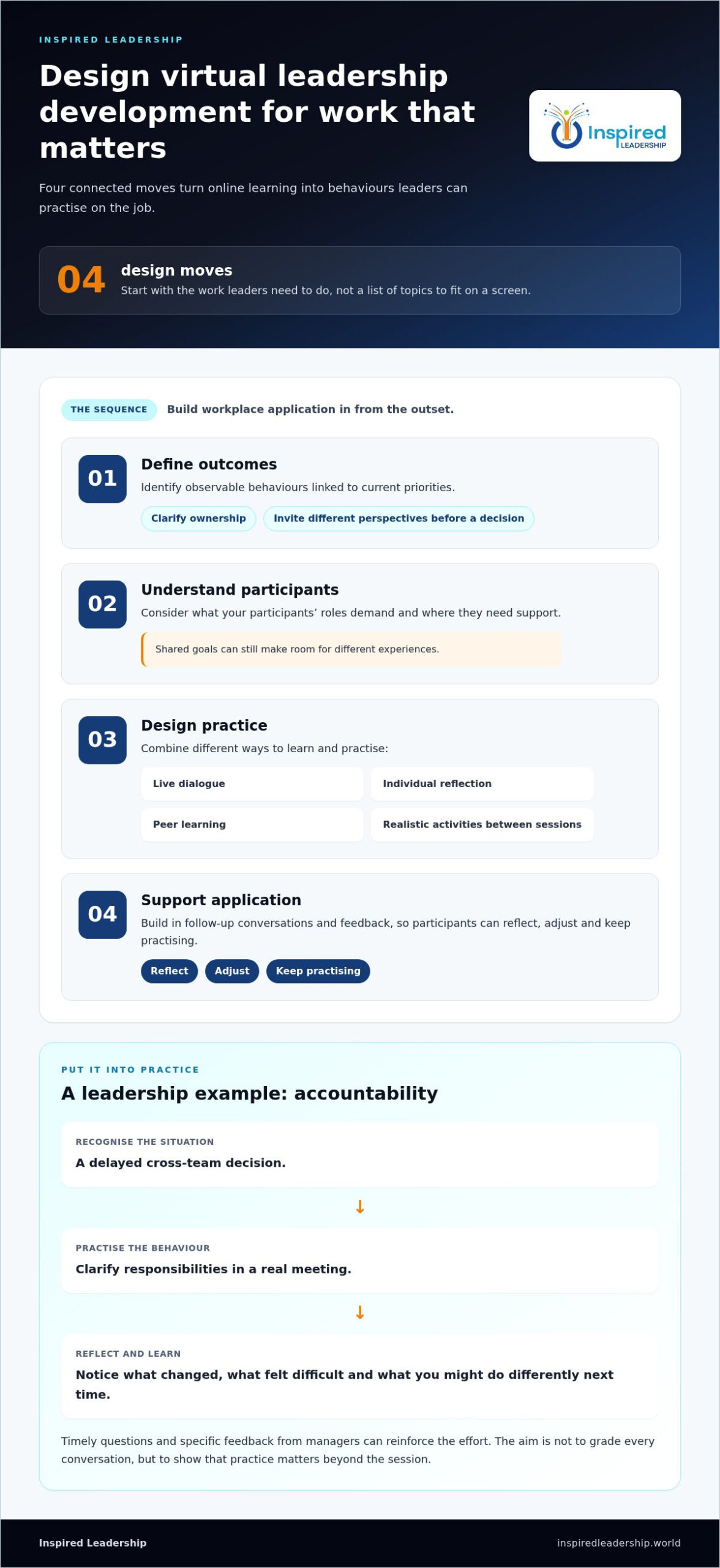
How to Design Virtual Leadership Development for Workplace Application
Start with the work your organisation needs leaders to do, not a list of topics to squeeze onto a screen. Build workplace application in from the outset, so each learning activity points towards a behaviour leaders can practise on the job.
Use this four-step sequence:
- Define outcomes: Identify observable behaviours linked to current priorities, such as clarifying ownership or inviting different perspectives before a decision.
- Understand participants: Consider what their roles demand and where they need support. Shared goals can still make room for different experiences.
- Design practice: Combine live dialogue, individual reflection, peer learning and realistic activities between sessions.
- Support application: Build in follow-up conversations and feedback so participants can reflect, adjust and keep practising.
How do you connect learning activities to real leadership work?
Use situations participants recognise. A discussion about accountability might start with a delayed cross-team decision; participants can practise clarifying responsibilities, then try that behaviour in a real meeting. Ask them to reflect on what changed, what felt difficult and what they might do differently next time.
Managers can reinforce the effort with timely questions and specific feedback. The aim isn’t to grade every conversation, but to show that practice matters beyond the session.
How can you keep virtual participation purposeful?
Give each session a clear outcome and focused structure. Alternate short explanations with discussion, quiet reflection and practice. A run of presentations is still a run of presentations, even with excellent slides.
For a leadership journey focused on decision-making, accountability and how leaders show up, explore the Beyond Command Journey and download its brochure.
How to Evaluate Virtual Leadership Development and Choose a Sustainable Next Step
Attendance and satisfaction tell you whether people joined and how they felt about the experience. They don’t show whether leaders learned something useful or changed how they work. To evaluate virtual leadership development, connect a small set of observable indicators to the outcomes you wanted in the first place.
What should you measure after a virtual leadership journey?
Choose behaviours that matter to your organisation. If the aim is clearer accountability, for example, look for evidence that leaders are agreeing who owns decisions and following up on commitments. Reflective feedback from participants, alongside observations from managers, can help show whether the behaviour is being used and where it still feels difficult.
Review the evidence over time, rather than relying on a single end-of-session survey. Compare feedback and observations across the journey, then consider them alongside relevant organisational indicators, such as progress on a team priority. These indicators provide useful context, but they don’t prove that learning alone caused a particular result.
Keep the measures manageable. Ask participants and managers what they’re noticing, what’s helping and what needs adjusting, then use those insights to refine the learning journey.
When is a structured leadership journey the right next step?
A sequence of learning, practice and reflection can be more useful than a single online event when leaders need sustained support to build capability and apply it consistently. For medium-sized enterprises, connecting development across roles can help turn individual insight into action across the organisation, while keeping attention on the work leaders are responsible for.
If you’re ready to explore a tailored leadership journey for your organisation, discuss your leadership development priorities and request the relevant brochure.
Make leadership learning part of the work
Virtual leadership development creates lasting change when learning moves beyond attendance and into everyday leadership practice. Start with behaviours your organisation needs, give leaders opportunities to try them at work, then look for evidence of progress over time.
Keep the focus practical: learning should connect to current priorities, and evaluation should look beyond satisfaction to what leaders are doing differently. Small, observable indicators and honest feedback from participants and managers can help you refine the journey without claiming that one learning experience caused every organisational result.
Inspired Leadership designs leadership journeys for medium-sized enterprises, connecting individual development with action across the organisation. The focus is on building leadership capability that supports the work ahead.
You don’t need another online event for its own sake. You can create the conditions for leaders to learn, practise and make a difference, one meaningful behaviour at a time.
Frequently Asked Questions
What is virtual leadership development?
Virtual leadership development is a structured learning journey delivered through digital channels, designed to help leaders build skills and apply them in their work. It goes beyond watching presentations online: participants might discuss a leadership challenge live, reflect independently and try a new approach with their team. The essential measure is not time spent on screen, but whether learning supports useful action at work.
Is virtual leadership development as effective as face-to-face development?
It can be, but neither format is automatically more effective. Virtual sessions can bring together leaders in different locations and make it easier to reflect between discussions, whilst face-to-face development may suit some kinds of interaction or practice better. Your choice should reflect the skills people need to develop and the conditions that help them participate, receive feedback and use learning in their role.
How do you keep participants engaged in virtual leadership development?
Give every session a clear purpose and involve participants throughout. Mix concise input with discussion, reflection and practice based on real leadership situations, rather than asking people to sit through a long run of presentations. Set expectations for participation, invite quieter voices into the conversation and make space for peer learning. Engagement is more likely when activities feel relevant, focused and manageable alongside work.
How do you measure the impact of virtual leadership development?
Look beyond attendance and satisfaction to whether participants have learned and changed specific behaviours. Choose indicators linked to your intended outcomes, such as whether leaders clarify ownership or invite input before decisions. Reflective feedback from participants and observations from managers can help you assess progress over time. Consider these findings alongside relevant organisational priorities, without assuming that development alone caused every change.
How long should a virtual leadership development journey last?
There’s no single ideal duration. The journey should give participants enough opportunity to understand an idea, practise it in their work, reflect on what happened and build on that experience. A single session may introduce a topic, but sustained behaviour change often needs follow-up and support. Set the timing around the outcomes, participants’ responsibilities and the space they need to apply learning between sessions.