

What if your executives’ development showed up not in their notes, but in the decisions they make on Monday morning? If you’re searching for a “sme executive development programme”, you likely want more than fresh insights: you want leadership that responds to the challenges your organisation is actually facing.
That distinction matters in a medium-sized enterprise, where generic development can feel detached from pressing priorities, and a useful conversation can fade once leaders return to full diaries. Insight matters, but it becomes useful when people can see it shaping everyday decisions and behaviour.
This article explores how to shape an executive development journey around the work that matters: agreeing organisational priorities, turning reflection into practical leadership action, and reviewing progress without claiming more than the evidence supports. You’ll also find questions to help assess whether a development approach fits your organisation and how to adjust it as needs evolve.
Key Takeaways
- Distinguish executive development from first-line manager development by identifying the leadership challenges your senior team needs to address.
- When considering a sme executive development programme, look for a structured journey that links strategic priorities with practice in real decisions and working relationships.
- Shape the journey by clarifying priorities, identifying leadership needs, creating opportunities to apply learning and agreeing how you’ll review progress.
- Before development begins, agree a starting point and useful review questions so you can look for evidence of change without overstating results.
What should SME executive development change in your organisation?
Executive development is the sustained growth of leaders’ capacity to guide organisational priorities and turn them into considered action. That’s the test for any sme executive development programme you’re exploring: not how much content leaders receive, but whether their judgement and behaviour become more useful to the organisation. For a wider overview of the field, see Leadership development.
How is executive development different from management training?
Executive development focuses on the wider organisation. It helps senior leaders connect strategic choices with relationships and leadership culture, including how people share responsibility and make decisions together.
Management training may focus on practical skills for leading a team’s day-to-day work, such as setting expectations or delegating tasks. Those skills still matter. The right emphasis depends on the need you’re addressing: executive development works at organisational scope, while management training may target specific responsibilities or skills.
What does your organisation need leaders to do differently?
Start with a recurring challenge, not a list of activities. Perhaps decisions keep returning to the same executive, teams aren’t clear about who owns the next step, or senior leaders communicate priorities differently. These are prompts to investigate, not assumptions about your organisation.
Look at the decisions and working relationships where progress tends to stall. Then ask: Which leadership behaviours would make the greatest difference here? For example, you might want executives to invite challenge before settling a decision, name who is responsible for follow-through, or explain how a choice connects to organisational priorities.
That answer gives your leadership journey a practical starting point. It also helps separate a real development need from an activity that sounds impressive but doesn’t address the issue. If you’d like to discuss your organisation’s priorities, you can contact Inspired Leadership.
How an SME executive development journey connects strategy with behaviour
A strategic priority becomes meaningful through the choices leaders make each day. A useful sme executive development programme therefore connects the organisation’s direction with reflection, practical experiments at work and regular review. Learning is most relevant when it is part of leadership responsibilities, rather than separate from them.
Turn organisational priorities into development themes
Start with a priority, then name the leadership behaviour that could help move it forward. If accountability is a focus, for example, executives might examine how they clarify ownership and follow up. If cross-functional decisions are slow, they could practise bringing different perspectives together and making the decision-making process clearer.
These are prompts, not universal SME problems. Wharton’s executive development offering provides an example of connecting areas such as strategy, finance and leadership. Your themes should still reflect your organisation’s own priorities and working relationships.
Make reflection useful in day-to-day leadership
Reflection earns its place when leaders use it to test a different response in real work. An executive might invite challenge before a decision, then consider whose perspective changed the discussion, what remained difficult and what to try next time. Small, deliberate experiments help make learning relevant without pretending that one conversation will fix everything.
A leadership assessment can help clarify development needs. Agree what you want to understand before reviewing the findings, use them to guide reflection, then return to the relevant themes as leaders practise and review their approach.
Repeated leadership behaviour helps shape the culture people experience. Executives can model ownership by making responsibilities clear and following through, while inviting thoughtful challenge rather than treating disagreement as disloyalty. To make this practical, identify a real decision or relationship where leaders can try a different approach and agree how they will reflect on it afterwards.
If you’re considering how to connect leadership development with your organisation’s priorities, talk with Inspired Leadership about your executive development needs.
How to shape an SME executive development journey around your context
A useful journey starts with your organisation, not a ready-made set of activities. If you’re weighing up a “sme executive development programme”, look for a clear connection between the challenges you need to address, the leaders involved and the opportunities they’ll have to apply their learning.
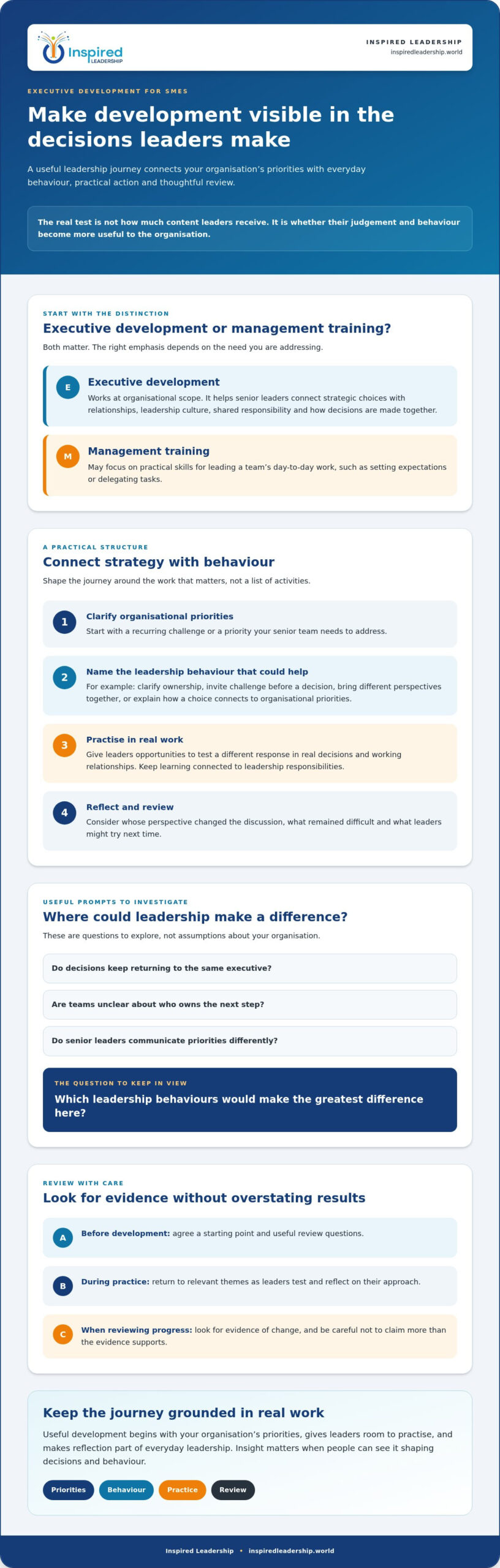
A practical checklist: clarify the priority, identify the leadership need, design real-work application and agree how you’ll review progress. Use these steps to test whether a proposed journey has a clear purpose and a way to learn from what happens:
- 1. Clarify organisational priorities. Name the strategic issues that need senior leaders’ attention, such as accountability, alignment or decisions that cross team boundaries. Be specific about where the issue appears in day-to-day work.
- 2. Identify leadership needs. Ask which capabilities and behaviours could help, and who needs to take part. Consider what the executive team needs to practise together as well as the different responsibilities of individual leaders.
- 3. Design application. Identify real decisions and working relationships where leaders can use the learning. Agree how they will make time to reflect on what worked, what was difficult and what they might change.
- 4. Review progress. Decide what you’ll revisit, what evidence may help and when you’ll adjust the approach. Keep the review questions tied to the original priorities.
Which questions help you assess fit before committing?
Ask whether the proposed journey addresses your actual priorities and how leaders will practise what they learn once a session ends. Find out how progress will be revisited, who will support that reflection and whether the approach can adapt as organisational needs change. Also ask what participation will involve and how learning will connect to work already on executives’ agendas.
How can you keep development relevant to senior leaders?
Use current organisational decisions and working relationships as learning material, while agreeing what can be discussed and keeping sensitive details appropriately confidential. A shared experience can build common language and expectations, whilst tailored reflection recognises that executives don’t all hold the same responsibilities. Choose examples that are current enough to be useful, but ensure participants are comfortable discussing them.
Inspired Leadership designs leadership journeys for medium-sized enterprises. Consider whether a journey shaped around your organisation’s priorities could address the needs you’ve identified.
How to recognise progress and choose a leadership-development partner
If you’ve searched for an sme executive development programme, look beyond attendance and positive feedback. These can tell you whether people took part and found the experience useful, but they don’t show on their own whether leaders applied what they learnt.
What evidence can you review without overstating impact?
Before the journey begins, agree a starting point and a few review questions. For example: are decisions being made with clearer ownership, are priorities communicated consistently, and are executives inviting relevant challenge?
Later, consider participant reflections alongside relevant observations from colleagues or the organisation, where appropriate and available. Look for specific examples of changed practice, such as a leader making responsibilities clearer or responding differently to disagreement. Treat these as evidence to discuss, not proof that development alone caused a wider organisational change.
What makes a development partner relevant to your organisation?
A relevant partner will take time to understand your context, explain how organisational needs connect to leadership practice, and describe how reflection and application continue beyond facilitated sessions. Ask how the approach can accommodate executives’ different responsibilities whilst strengthening shared leadership capability.
If a partner shares participant perspectives, use them to inform your questions about fit and approach. Treat individual accounts as examples, not a promise that your organisation will experience the same results.
Choosing well doesn’t mean finding a partner with a polished answer to every question. It means being able to discuss your priorities openly, understand how learning will be applied and agree what you’ll review as the journey progresses.
Make your next leadership step count
Executive development is most useful when it starts with the priorities your organisation needs to address, then gives leaders ways to practise new behaviours in real decisions and relationships. Before choosing a sme executive development programme, clarify what needs to change, who should be involved and how you’ll recognise signs of application without claiming more than the evidence shows.
That’s the thinking behind Inspired Leadership’s work with medium-sized enterprises. Its transformational leadership journeys focus on building leadership capability and translating insight into action across the organisation, helping you shape development around your context rather than simply filling a calendar.
You don’t need to have every answer before taking a first step. A thoughtful conversation can help you explore the leadership challenges you’re facing and what a relevant journey might involve.
Your priorities are a practical place to begin. With clarity, reflection and room to apply learning, you can help your leaders move forward with greater purpose.
Frequently Asked Questions
What is an SME executive development journey?
An SME executive development journey is sustained growth in senior leaders’ ability to guide organisational priorities and action. Rather than treating a sme executive development programme as a set of isolated activities, connect reflection with opportunities to practise in real decisions and working relationships. Inspired Leadership designs transformational leadership journeys for medium-sized enterprises, with an approach focused on translating insight into action across the organisation.
How is executive development different from leadership training?
Executive development typically focuses on how senior leaders guide the wider organisation, whilst leadership training may address particular skills or knowledge. The two can work together: an executive might develop strategic judgement while also strengthening practical communication or delegation. What matters is the need you’re addressing. Choose development that helps leaders apply learning in the decisions, relationships and responsibilities they actually hold.
How do you measure the impact of executive development?
Review both participation and signs that leaders are applying their learning at work. Attendance and participant feedback can show engagement, but they don’t establish that behaviour has changed. Before the journey begins, agree a starting point and review questions, such as whether responsibilities are clearer or leaders are communicating priorities differently. Combine participant reflection with relevant organisational observations where available, and avoid attributing wider changes to development alone.
Can a small or medium-sized enterprise tailor executive development to its needs?
Yes. You can shape a journey around your organisation’s priorities, the leadership needs you’ve identified and the decisions executives need to make. A shared experience can strengthen common understanding, while reflection can account for differences in leaders’ roles. Inspired Leadership designs journeys specifically for medium-sized enterprises, connecting leadership insight with practical application without assuming every organisation needs the same approach.
What should you look for in an executive development partner?
Look for a partner who takes time to understand your context and can explain how the journey connects organisational priorities with leadership practice. Ask how participants will apply learning in their work, how reflection and progress will be revisited, and what evidence you can reasonably expect to review. A clear, thoughtful answer is more useful than a promise of guaranteed results. To discuss your organisation’s priorities and a potential leadership journey, contact Inspired Leadership.