
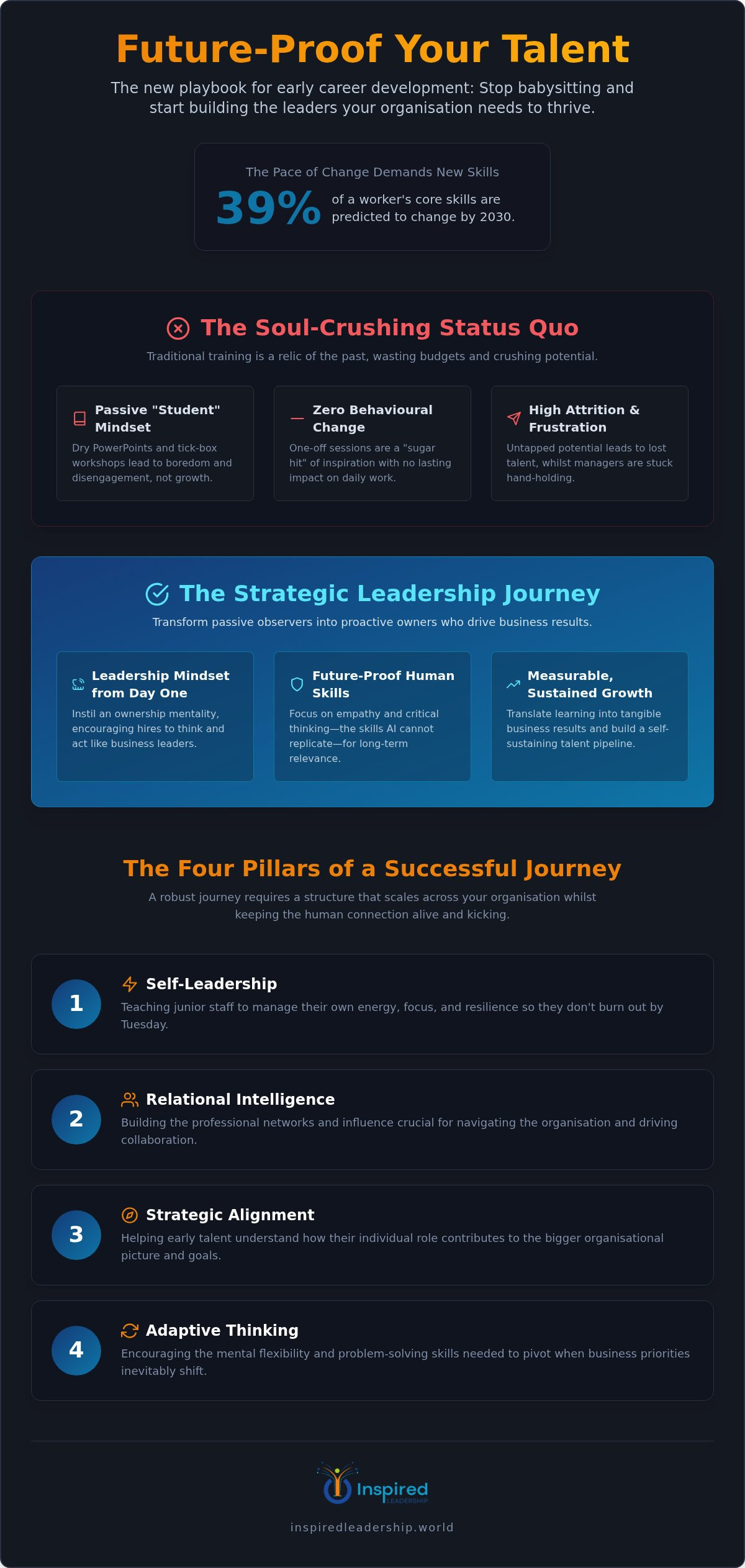
What if your junior hires started thinking like business owners before they even finished their first month? Most organisations treat early career development as a passive induction phase, yet research suggests that 39% of a worker’s core skills will change by 2030. You cannot afford to wait for talent to settle in when the pace of modern work demands immediate agility.
You probably know the feeling of watching a bright graduate cohort slowly lose its spark whilst your managers spend far too much time on basic hand-holding. It’s frustrating to invest heavily in recruitment only to see high attrition rates or a lack of the human skills needed to thrive in an AI-augmented world.
We’re here to show you how to flip that script and transform passive observers into proactive leaders who own their results. You’ll discover how to build a journey that moves beyond superficial training to create a self-sustaining talent pipeline with measurable ROI.
We’ll explore how to activate a leadership mindset from day one and why shifting your focus to high-potential technical talent is the smartest move you can make this year. It’s time to stop babysitting and start building the future of your organisation.
Key Takeaways
- Stop treating your new hires like students and start treating them like future leaders by ditching tick-box workshops for a strategic leadership journey.
- Discover how to optimise early career development by focusing on practical application that turns theoretical knowledge into tangible business results.
- Future-proof your talent against AI by doubling down on human skills like empathy and critical thinking, which are the only things a bot cannot replicate yet.
- Build a self-sustaining pipeline that slashes your recruitment costs whilst creating the kind of loyalty that keeps your best people from jumping ship.
Reimagining Early Career Development for the Modern Organisation
You’ve likely seen it before: a room full of bright-eyed graduates sitting through a dry PowerPoint presentation on “professionalism”. That isn’t career development; it’s a soul-crushing box-ticking exercise that leaves everyone bored and unchanged. We need to stop treating our newest team members like passive students and start treating them like the strategic assets they are.
In 2026, early career development must be viewed as a strategic leadership journey. Your junior talent is entering an AI-augmented world where basic tasks are automated, meaning they need high emotional intelligence to navigate complex human dynamics from day one. Every junior hire you bring in is a future leader in waiting, provided they have the right map to follow.
The Shift from ‘Work-Ready’ to ‘Leadership-Ready’
Being “work-ready” used to mean knowing how to use Excel and showing up on time. Now, that’s the bare minimum because AI handles the heavy lifting of data and admin. In a medium-sized enterprise, you need people with an ownership mindset who can contribute to the bottom line immediately.
Success isn’t about just doing the job; it’s about having the confidence to influence and lead from the bottom up. When your team acts like owners, your managers can finally stop babysitting and start strategising. It’s a win for their growth and a massive relief for your sanity.
Why Traditional Training is a Relic of the Past
One-off workshops are the corporate equivalent of a sugar hit. They give you a temporary buzz of inspiration but result in zero behavioural change once the Monday morning emails pile up. It’s a waste of your budget and their potential.
A structured journey embeds learning into the daily flow of work. It turns insight into action, ensuring that new skills aren’t just memorised but actually lived. This is how you build a pipeline that sustains itself without you having to constantly intervene. Understanding how work readiness programs bridge the graduate talent gap is a critical first step in designing a journey that moves beyond box-ticking to genuine behavioural change.
Designing a Journey That Translates Insight into Action
Designing a journey for your early talent isn’t about dumping a pile of textbooks on their desks. It’s about creating a roadmap that turns theoretical “knowing” into practical “doing” through immediate application. Effective early career development requires a structure that scales across your organisation whilst keeping the human connection alive and kicking.
You want your junior staff to walk away from every session with actionable insights they can implement before their next coffee break. This isn’t just about learning; it’s about shifting behaviours in real-time. By focusing on practical tasks, you ensure the development feels relevant rather than like another chore on their to-do list.
The Four Pillars of a Successful Early Talent Journey
To build a truly robust journey, you need to focus on four critical areas that go beyond basic job training. These pillars ensure your talent is equipped for the long haul:
- Self-Leadership: Teaching junior staff to manage their own energy and focus so they don’t burn out by Tuesday.
- Relational Intelligence: Building the professional networks crucial for graduate employability and influence.
- Strategic Alignment: Helping early talent understand how their role contributes to the bigger picture.
- Adaptive Thinking: Encouraging the mental flexibility needed to pivot when business priorities shift.
Measuring What Actually Matters
Forget the “happy sheets” filled out at the end of a training day; they tell you nothing about actual growth. You need to measure tangible performance improvements and retention rates that prove your investment is paying off. Using a leadership assessment tool allows you to track early career development with hard data rather than just a hopeful gut feeling.
This structured approach to tracking growth mirrors the high standards found in elite paths like NSF’s CAREER Program, but with a sharp focus on corporate results. If you’re ready to stop guessing and start seeing real change in your cohort, it might be time to chat with us about your strategy. We can help you build a journey that actually sticks and delivers the ROI you deserve.
Bridging the Gap Between Technical Brilliance and Human Skills
AI is the big bogeyman of 2026. Many fear it will swallow entry-level roles whole, but the reality is that it simply automates the routine, data-heavy tasks. This shift makes early career development more about human connection than technical proficiency.
Let’s be honest: your smartest graduates are often the ones who need the most help with people. They can solve a complex algorithm in their sleep but might crumble when they have to give constructive feedback to a peer or influence a senior stakeholder. Investing in early career development that prioritises these human skills is your new competitive advantage in a world of bots.
The Human Factor in an Automated World
Technical skills are now just the entry ticket to the corporate world. To thrive in high-stakes collaboration, early talent needs the emotional resilience to handle rapid organisational pivots and the pressure of modern work. The Human Factor Journey is designed specifically to prepare them for these complex, high-pressure interactions.
Why Technical Talent Needs Leadership Early
We often see brilliant specialists fall into the “specialist-to-leader trap” where they are promoted based on technical output alone. They suddenly find themselves managing people without a single leadership tool in their belt, leading to frustration and high attrition. You can prevent this by building leadership muscle long before that first promotion letter is signed.
The Emerging Leader Journey provides a structured way for high-potential technical staff to develop these critical skills early. It ensures they don’t just know their craft but can also lead the people who perform it with confidence and clarity. This proactive approach saves you from the expensive headache of a failing first-line manager in the future.
Securing Your Future Pipeline: The Case for Scalable Leadership Journeys
Building a self-sustaining leadership pipeline isn’t a luxury reserved for global giants with bottomless pockets. For medium-sized enterprises, early career development is the ultimate survival tool for maintaining agility and slashing recruitment costs. You don’t want to be the leader who constantly hunts for external senior talent whilst your internal stars are polishing their CVs for your competitors.
A structured journey creates a culture of loyalty where your people see a clear path forward. When they feel invested in, they stay, which means you stop leaking money into the recruitment void. It’s about turning your organisation into a magnet for top-tier talent who are hungry for growth rather than just a paycheque.
The ROI of Investing Early
The data doesn’t lie: developing graduates is significantly cheaper than the high-stakes gamble of hiring senior managers externally. With corporate training spend rising by 4.9% in 2025, the smart money is on building capability from within. You’re not just saving on headhunter fees; you’re building a team that already understands your DNA and is ready to drive results.
A reputation for genuine development makes you the first choice for the Class of 2026. You’ll find that your recruitment marketing does itself when word gets out that you aren’t just another faceless firm using graduates as cheap labour. It’s the difference between being a temporary stepping stone and a long-term destination. A well-structured approach to graduate recruitment and development is what separates organisations that retain top talent from those that constantly haemorrhage it to competitors.
Your Next Steps for 2026
Move beyond the stale concept of “training” and start a transformational journey that actually sticks. The world is moving fast, and your team needs more than just a pat on the back and a generic webinar. You need a partner who understands the clinical dynamics of organisational stagnation and offers a battle-tested alternative.
If you’re ready to stop the talent drain and start building a pipeline that delivers, let’s talk about your specific needs. You can contact Inspired Leadership to discuss your organisational goals and discover how we turn potential into performance without the usual corporate fluff.
Building Your Future Leadership Legacy
You’ve seen how moving beyond tick-box exercises can turn your junior staff into proactive owners who drive results. By prioritising human skills like empathy and influence, you ensure your talent thrives whilst AI handles the routine admin. We’ve spent 20 years delivering results-driven outcomes for medium-sized enterprises, so we know exactly how to scale these journeys without losing that vital human connection.
Optimising your early career development isn’t just an HR project; it’s a strategic necessity for your organisation’s survival in 2026. Our specialised journeys for technical and graduate talent are designed to bridge the gap between academic brilliance and corporate leadership. You now have the roadmap to build a self-sustaining pipeline that keeps your best people from looking elsewhere.
It’s time to stop babysitting and start building a legacy of leadership that lasts. You’ve got this.
Frequently Asked Questions
What is the difference between an early career program and a leadership journey?
A leadership journey is a sustained, transformational experience that embeds learning into daily work, whilst a traditional program is often just a series of disconnected workshops. We focus on long-term behavioural change rather than short-term knowledge dumps. This approach ensures that your early talent develops an ownership mindset from day one, turning passive observers into proactive leaders who actually drive your organisation forward.
How do I measure the ROI of early career development in a medium-sized company?
You measure ROI by tracking tangible metrics like reduced recruitment costs, lower attrition rates, and the decrease in time managers spend hand-holding junior staff. In a medium-sized enterprise, every hire’s output matters significantly. By using structured assessments to track skill acquisition, you can prove that your early career development spend is delivering a more capable, self-sufficient workforce that hits targets faster than untrained peers.
Can early career development help with graduate retention rates?
Yes, providing a clear development journey is one of the most effective ways to slash high attrition rates in graduate cohorts. When young talent sees a concrete path for their growth and feels the organisation is invested in their human potential, they are far less likely to jump ship for a rival. It turns your firm into a destination rather than a temporary stepping stone on their CV.
What are the most important human skills for graduates to learn in 2026?
In 2026, the most critical skills are those that AI cannot replicate, specifically empathy, critical thinking, and the ability to influence stakeholders. As automated tools handle routine technical tasks, your graduates must excel at high-stakes collaboration and complex problem-solving. Developing these human-centred capabilities ensures your team remains relevant and effective in a rapidly changing corporate landscape where emotional intelligence is the new competitive advantage.
How do I convince my board to invest in early talent development?
To convince your board, present the case for a self-sustaining talent pipeline that reduces the need for expensive external senior hires. Highlight the strategic risk of the specialist-to-leader trap and show how early investment prevents future management failures. Boards love data, so focus on how a scalable graduate recruitment and development strategy delivers measurable performance improvements and long-term organisational agility whilst protecting your most valuable human assets.