

What if your succession chart gives you a reassuring picture of the future, but doesn’t prepare anyone to lead it? A future-leader talent pipeline should do more than label promising names. Potential can be judged by who gets noticed, development can miss the real demands of leadership, and readiness can remain difficult to demonstrate.
You already know people need more than a place on a chart. They need chances to make decisions, take ownership and learn from the consequences, with support that doesn’t turn every stretch assignment into sink-or-swim.
This article shows you how to identify leadership needs and potential through relevant evidence, create meaningful opportunities to practise and reflect, and connect progress with organisational priorities and succession decisions. You’ll also see how a structured Emerging Leader Journey can support people before or alongside their first formal leadership role, because a chart can’t do the leading for them.
Key Takeaways
- Build a future-leader talent pipeline around the capabilities your organisation will need, not just the roles that may become vacant.
- Assess potential against clear, role-relevant behaviours, and bring in varied perspectives to reduce the influence of visibility or familiarity.
- Turn development goals into practical stretch experiences, with clear ownership and time to reflect on what each experience reveals.
- Review feedback and observed behaviour regularly so you can connect people’s development with changing organisational priorities and succession decisions.
Future-leader pipelines: why a list of names is not enough
You can name likely successors and still have no clear picture of whether they’re ready for what comes next. A leadership need may change, a person’s interests may shift, and a role may require capabilities no one has had the chance to practise yet. A list records a decision; it doesn’t develop anyone.
A future-leader talent pipeline is a continuing system that connects the organisation’s changing leadership needs with emerging talent, relevant development and evidence of growing readiness. It makes space for regular conversations and real experiences, rather than treating potential as a label that lasts forever.
How a talent pipeline differs from succession planning
Succession planning focuses on continuity: who could step into a particular role if it became vacant? A pipeline looks more broadly at who may grow into leadership, what capabilities they need to build and what opportunities will help them practise. As the overview of Succession Planning explains, succession planning has a specific role-continuity focus; a pipeline can provide useful evidence without being confined to named vacancies.
For example, a colleague listed as a possible successor might lead a cross-team initiative. Their decisions, collaboration and response to setbacks can inform future discussions. That evidence is more useful than a name on a chart, and one assignment should not become the final word on someone’s potential.
Why future-leader pipelines need to include people, not just roles
Roles tell you what the organisation may need; people bring their own strengths, motivations and development needs. Your pipeline should hold both in view. Someone with deep technical expertise, for instance, may be interested in leading a team, shaping specialist practice or influencing work across departments. Those possibilities call for different experiences, not one standard ladder.
That doesn’t mean promising anyone a promotion or a particular position. It means being honest about needs and choices, then agreeing practical ways to build capability. An Emerging Leader Journey can support development before or alongside a first formal leadership role, while meaningful work gives people the chance to apply and reflect on what they’re learning.
How to identify future-leader potential fairly, beyond visibility and job title
Your most reliable performer isn’t automatically your next leader, and the person who speaks most confidently in meetings isn’t automatically ready either. Strong performance shows what someone can do in their current role; potential asks what they might learn to do with the right support and opportunity.
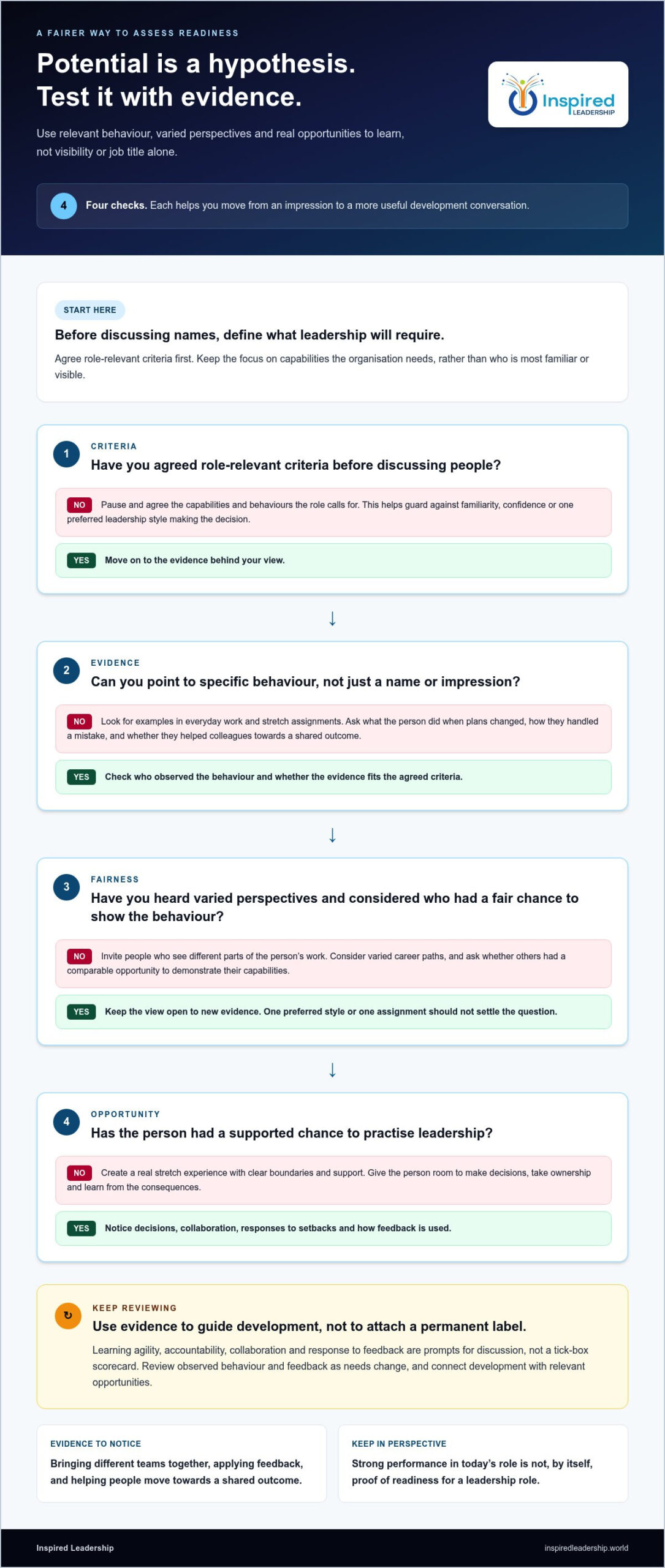
Leadership potential is a hypothesis to test through opportunity, not a fixed label to attach to a person. In a fair future-leader talent pipeline, look for relevant evidence, then give people a chance to practise and learn before drawing firm conclusions.
What evidence can indicate readiness to grow?
Use learning agility, accountability, collaboration and response to feedback as prompts for discussion, not as a tick-box scorecard. Ask what the person did when a project changed direction, how they handled a mistake, and whether they helped colleagues move towards a shared outcome.
Look for examples from everyday work as well as stretch assignments. Someone who quietly brings different teams together may show influence without a prominent title; someone who asks for feedback and applies it may show a capacity to grow. Evidence matters more than polish.
How to reduce bias in talent discussions
Agree role-relevant criteria before discussing names. For each judgement, ask: what behaviour supports this view, who has observed it, and have we given others a comparable chance to demonstrate it? These questions make it easier to spot when familiarity, confidence or one preferred leadership style is doing the deciding.
Invite perspectives from people who see different parts of someone’s work, and consider varied career paths rather than treating a traditional route as the only route. A skills-focused lens, such as the one explored in Skills-Focused Succession Planning, can help keep attention on capabilities rather than job titles alone.
Structured assessment can add another perspective and help turn insight into development priorities. Explore how leadership assessment can inform that conversation, then use the evidence to guide meaningful opportunities. If you’re preparing emerging talent for greater responsibility, explore the Emerging Leader Journey and download its brochure to consider how it could support your priorities.
How to build a future-leader talent pipeline in five practical steps
A practical future-leader talent pipeline turns priorities into decisions, then decisions into opportunities to learn. Give each step a clear owner and an output you can revisit, so development stays connected to the work instead of becoming another spreadsheet with excellent formatting and little follow-through.
- Clarify future needs. The executive team and relevant business leaders identify capabilities the organisation will need. Output: a short list of leadership priorities grounded in likely business challenges.
- Identify potential fairly. Managers and HR apply agreed criteria and share examples of behaviour, not just names. Output: an evidence-based view of strengths and areas to develop.
- Agree individual goals. The person and their manager choose one or two role-relevant behaviours to practise. Output: a specific development goal linked to a business need and the person’s interests.
- Create stretch experiences. The manager assigns a real piece of work, with clear boundaries and support. Peer learning and feedback can help the person test new approaches. Output: an assignment brief with responsibilities, check-ins and reflection questions.
- Review the evidence. The manager and person discuss what happened, what changed and what to practise next. Output: a brief reflection with examples and a next step.
Turn leadership priorities into meaningful development experiences
Choose work that matters, such as coordinating a cross-team handover or leading a discussion about a recurring service issue. Before it begins, agree what decisions the person can make, where they should seek guidance and what success might look like. Afterwards, ask: what felt difficult, what feedback changed your approach, and what would you try next time?
An Emerging Leader Journey can support development before or alongside a first formal leadership role; a Manager to Leader Journey may fit when someone is moving into management. Whichever fits, connect the development to real work so new ideas have somewhere to land.
Review progress without mistaking activity for readiness
Attending development sessions shows participation; changed behaviour in relevant work offers evidence of growth. Review examples, feedback and learning with the person, then agree what they need to practise next. That keeps readiness a considered judgement, not a certificate for being busy.
To connect structured development with practical experience, explore the Emerging Leader Journey and download its brochure.
How to sustain the future-leader pipeline through journeys, feedback and review
A future-leader talent pipeline stays useful when review is a conversation, not an annual verdict. Bring business leaders, managers and emerging leaders together regularly to compare changing capability needs with each person’s aspirations and development evidence. Ask what’s shifted, what they want to take on next and what support would help them grow.
What to review as the organisation and its people develop
Look for practical signs of movement, rather than a magic score or invented benchmark. For example, review:
- Which stretch experiences have been completed, and what the person learned from them.
- Feedback themes and examples of behaviour observed in real work.
- Whether development opportunities are reaching people with varied backgrounds and career paths.
- Which critical capabilities are growing, and where a different experience or support is needed.
Use what you learn to adjust the next development experience. An assessment is a starting point for conversation, not a permanent verdict on someone’s capacity.
When a structured emerging-leader journey can help
A structured journey can connect insight with practice and action over time, especially for people preparing to take greater responsibility before or alongside their first formal leadership role. The Emerging Leader Journey can sit within a wider pipeline, alongside real work, feedback and manager support. It supports development, not a promise of promotion.
As a next step, consider how an Emerging Leader Journey can support your organisation’s priorities and pipeline.
Explore the Emerging Leader Journey and download its brochure.
Make your next leadership decision a development opportunity
A future-leader talent pipeline becomes more resilient when you treat readiness as something to build together, not a verdict handed down from above. The next useful move isn’t to add another name to a chart. Choose a capability your organisation will need, then create a real opportunity for someone to practise it, with support and space to learn.
That shift can change how people experience their potential, too. They see a path to contribute and grow, while you gain clearer evidence about what the organisation can develop from within. Inspired Leadership’s leadership journeys support first-line managers and other leadership groups, translating insight into action across the organisation.
You don’t need to have every future role mapped before you begin. Start with a meaningful development opportunity and a conversation about what it could help someone learn.
To discuss how the journey could support your priorities, contact Inspired Leadership.
Build thoughtfully, and the future starts taking shape in the work people do today.
Frequently Asked Questions
What is a future-leader talent pipeline?
A future-leader talent pipeline is an ongoing approach to preparing people for leadership capabilities an organisation may need. It connects future priorities with people’s development, and changes as both evolve. Unlike a fixed succession chart, it doesn’t promise anyone a specific role. For example, if a team expects more cross-functional work, the pipeline might create opportunities for emerging leaders to practise influencing colleagues across teams.
How do you identify future leaders in an organisation?
Begin by defining what leadership will involve in the roles or situations you’re preparing for, then look for evidence of those behaviours in people’s work. A technical specialist who helps colleagues solve a difficult problem may show influence without managing anyone. Ask people who have worked closely with them what they observed, and give the person room to show how they learn from a new responsibility.
Is a talent pipeline the same as succession planning?
No. Succession planning considers continuity for key roles, while a pipeline develops leadership capability across a broader group and range of possible needs. The two can inform each other: a future vacancy may reveal a capability gap, while development experience may help clarify who could take on particular responsibilities. Neither process should be presented as a promise of promotion or a guaranteed route to a named role.
How can you measure whether a leadership pipeline is working?
Use indicators that help you make better decisions, rather than relying on a single score. You might record which capabilities have been practised, where people have applied learning and what managers notice changing in day-to-day work. Compare those observations with the organisation’s current priorities, and note where access to development differs across teams. The most useful measures are those you can discuss and act on.
Can a future-leader pipeline include people who are not managers yet?
Yes. People can practise leadership before they receive a management title, through responsibilities such as coordinating a handover, guiding a project discussion or helping colleagues adopt a new process. Choose an opportunity that matches the capabilities needed next, and agree what support is available. This lets you explore someone’s interest and growth in practice, without assuming they want a management role or promising that one will follow.