
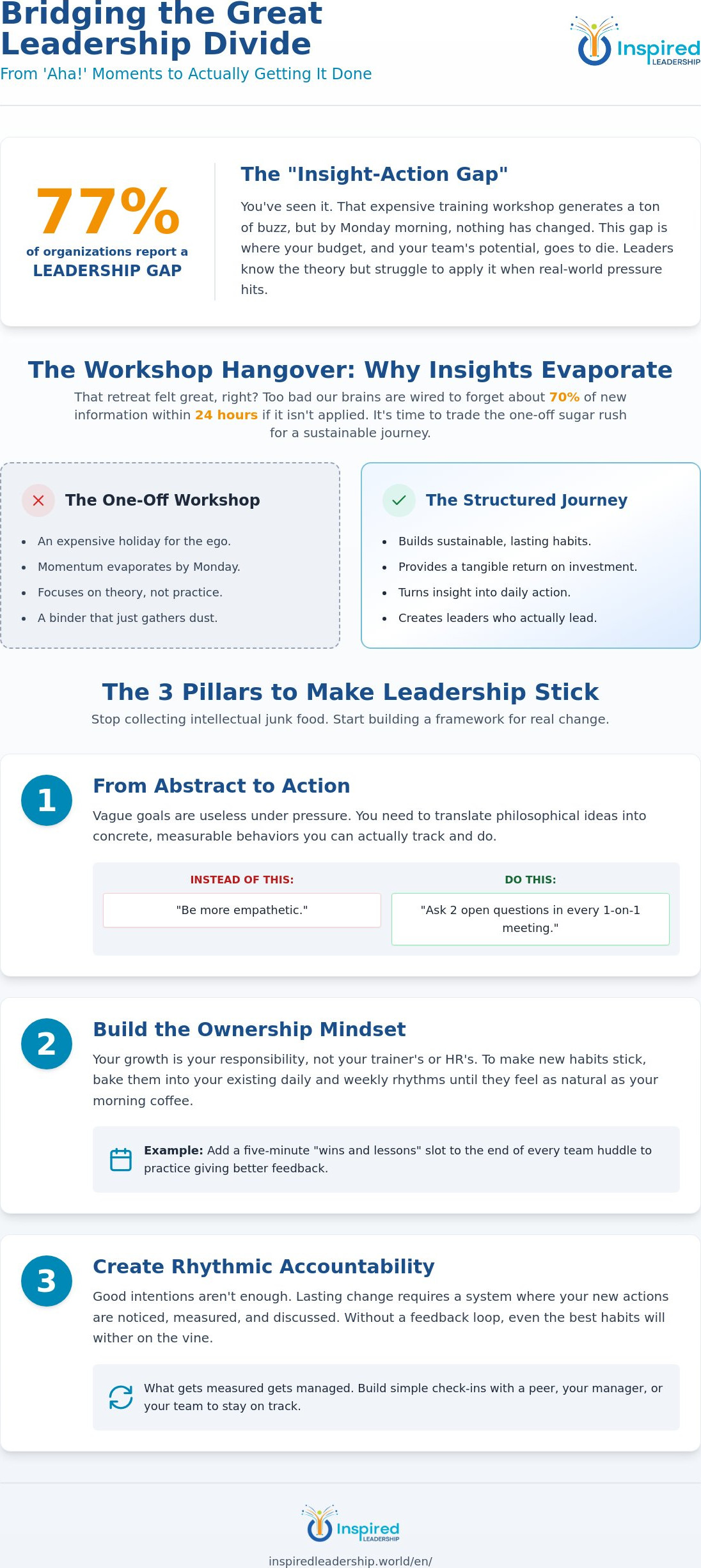
77% of organisations globally report a leadership gap, a statistic that highlights the systemic failure of many traditional training models. You’ve likely sat through those high-energy workshops where everyone nods and feels inspired, only to watch that momentum evaporate by the time the first Monday morning coffee is poured. It’s the classic case of leaders who “know” the theory but struggle with translating leadership insight into action when the real-world pressure hits.
We understand the frustration of seeing your budget vanish into a training void while your organisational culture stays stubbornly stagnant. You want managers who actually lead instead of just doing, and you want to see a tangible ROI from every dollar of your development spend. It’s time to stop treating leadership training like intellectual junk food and start building something that lasts.
This guide offers the practical, human-centred steps you need to turn boardroom realisations into results without the usual corporate fluff. We’ll show you how to move from “aha” moments to sustainable habits that your team actually owns. If you’re ready to see this in motion, visit our First Line Manager Program journey page and download the brochure to see how we bridge the gap between knowing and doing.
Key Takeaways
- Identify the “Insight-Action Gap” where your expensive training goes to die and learn how to stop the rot in your organisation.
- Master the three pillars of translating leadership insight into action by stripping away the fluff and focusing on radical clarity.
- Learn to implement micro-habits that fit into your busy schedule so that leading becomes a natural part of your day.
- Discover why a structured journey beats a one-off workshop if you want your managers to actually lead instead of just “doing”.
- Visit our Senior Leadership and Executive Journeys page to download the brochure and start turning your boardroom realisations into tangible results.
Why Your Leadership Insights Are Collecting Dust (and How to Stop the Rot)
The “Insight-Action Gap” is the expensive space where your training budget goes to die. It’s that awkward silence between a brilliant boardroom realisation and the actual, messy reality of the shop floor. Your brain is partly to blame; it absolutely loves the dopamine hit of a fresh “aha” moment but treats the actual work of behavioural change like a root canal.
Most leaders experience the “Monday Morning Meltdown”. You leave a Friday workshop feeling like a visionary, but by 9:00 AM Monday, your inbox has steamrolled your best intentions. This is why strategic leadership development must be treated as a structured journey rather than a one-off destination.
Old habits are incredibly efficient at keeping us in our comfort zones. To break that cycle, you need more than just a notebook full of ideas. You need a system that supports translating leadership insight into action while you’re actually in the thick of it, not just when you’re sitting in a quiet conference room.
The Myth of the One-Off Workshop
Let’s be real: a three-day retreat is often just an expensive holiday for the ego. While the catering might be top-notch, the “Forgetting Curve” is a brutal reality. Research by Hermann Ebbinghaus suggests we forget about 70% of new information within just 24 hours if we don’t apply it immediately.
Take a manager like Gaz, for example. Gaz absolutely nailed the theory of “empathetic listening” during a weekend seminar. Come Monday morning, he was back to barking orders because the pressure of a looming deadline felt more real than a laminated worksheet. He knew the theory, but he lacked the structure to turn that knowledge into a habit.
If you’re tired of seeing your development spend vanish into thin air, it’s time to change the model. Head over to our Senior Leadership and Executive Journeys page and download the brochure to see how we help leaders bridge the gap between knowing and doing.
The Three Pillars of Translating Leadership Insight into Action
Turning a lightbulb moment into a lasting habit requires more than just good intentions. It demands a structured framework that moves beyond the initial excitement of a workshop. These three pillars provide the foundation for leadership development for executives that actually sticks in the real world.
The core of translating leadership insight into action lies in radical simplicity. We often overcomplicate change by trying to overhaul everything at once. Instead, focus on these three non-negotiable elements to ensure your growth doesn’t stall at the first sign of a busy week.
Pillar One: From Abstract Insight to Concrete Action
Abstract concepts like “be more empathetic” are essentially useless in a high-pressure environment. You need to strip the insight back to a single, measurable behaviour that you can actually track. For example, swap the vague goal for a specific rule: “I will ask two open-ended questions in every 1-on-1 meeting this week.”
Focus on verbs over nouns in your leadership planning. “Empowerment” is a noun that feels heavy and hard to grasp; “delegate one decision-making task today” is a verb that you can cross off a list. This shift from the philosophical to the practical is what makes change feel achievable rather than exhausting.
Pillar Two: Building the Ownership Mindset
The responsibility for your growth doesn’t belong to a trainer or a HR manual; it belongs entirely to you. You must own the output of your development journey just as much as you own your quarterly targets. After all, leading isn’t about having the fanciest title; it’s about not being the person everyone dreads seeing in their calendar.
Bake your new actions into your existing meeting rhythm to make them stick. If your goal is to provide better feedback, add a five-minute “wins and lessons” slot to the end of every team huddle. To see how this ownership works in practice, visit our Senior Leadership and Executive Journeys page and download the brochure to start your transformation.
Finally, Pillar Three is Rhythmic Accountability. This is about creating a system where your actions are noticed and measured. Without this loop, translating leadership insight into action becomes nearly impossible as old habits reclaim the driver’s seat.
Practical Tactics to Make Leadership Action Your Daily Bread
Forget the grand gestures and the dramatic corporate overhauls. Real change happens in the tiny, almost invisible gaps of your day through what we call micro-habits. These are small adjustments that require zero extra time but are essential for translating leadership insight into action without losing your mind.
Think about your morning stand-up. Instead of just listing tasks, spend sixty seconds acknowledging one person’s specific contribution. It’s a tiny shift, but it’s the difference between being a boss and being a leader who actually gives a toss about their team’s morale.
Stop “managing” the life out of your people and start mentoring them instead. When you focus on development over task-tracking, you create a culture where action translation happens naturally. Our first line manager development program is built on this exact principle, turning green managers into confident leaders who know how to get things done.
The Power of the Leadership Cohort
Nobody wants to be the “lone ranger” of change, especially when the rest of the office is stuck in their old ways. Leadership cohorts act as a peer-to-peer pressure valve, keeping the momentum alive when things get tough. Sharing your struggles with a group of peers isn’t just “soft” stuff; it’s a strategic way to ensure everyone stays accountable.
Vulnerability is actually a superpower here. When you admit that you struggled to implement a new feedback technique, you give others permission to be honest about their own hurdles. This collective honesty is the secret sauce that turns an individual insight into a team-wide habit.
Measuring What Matters (Hint: It’s Not the Quiz Score)
Let’s be honest: those “Level 1” feedback forms that ask if you liked the lunch are completely useless. A leader’s success isn’t measured by a quiz score or how many slides they sat through. It’s measured by behavioural evidence and 360-degree feedback loops that prove things are actually changing on the ground.
If you want to see real results, you have to look at the outcomes. Are your team members more engaged? Is the work getting done more efficiently with less friction? To see how we track these tangible results, visit our First Line Manager Program journey page and download the brochure today.
Moving Beyond the Workshop: Designing a Journey That Sticks
The traditional “event-based” model of training is a bit like a New Year’s resolution. It starts with a massive burst of energy and ends with a gym membership you never use. For translating leadership insight into action to actually work, you need a journey-based model that respects how humans actually learn and change.
Medium-sized enterprises are in a unique position because they have the agility that large corporates can only dream of. You don’t need a bloated, off-the-shelf program that treats your managers like interchangeable parts. You need executive leadership programs for medium sized companies that are bespoke, human-centric, and built for your specific culture.
Inspired Leadership doesn’t just “deliver training”; we partner with you to build a culture that thinks and owns its outcomes. We help you move past the “event” and into a sustained rhythm of growth. This is about creating a legacy of leadership that survives the next quarterly crunch or market shift.
The Results-Driven Alternative
Our “Strategic Catalyst” approach is designed for organisations that are tired of the status quo. We act as both a visionary mentor and a pragmatic architect of change to ensure your development spend isn’t just an expense. We don’t just teach you what to do; we help you build the systems to ensure you actually do it.
Just as a successful leadership journey requires meticulous planning and delivery, so does a high-profile live event. To learn more about how Lar&Co delivers world-class entertainment experiences, click here.
How do you know if your team is ready for a real leadership journey? If you’re seeing stagnant culture despite previous training or wasted budget on one-off workshops, the answer is a resounding yes. It’s time to stop ticking boxes and start seeing a tangible ROI from your development spend.
The real work begins when the workshop ends. If you’re ready to move beyond the fluff and start translating leadership insight into action, visit our Senior Leadership and Executive Journeys page. Download the brochure today and let’s start designing a journey that actually sticks.
Stop Training and Start Transforming Your Leadership
You’ve seen how the “Insight-Action Gap” swallows even the best intentions. By focusing on radical clarity and building micro-habits into your daily rhythm, you move from just knowing the theory to actually leading with impact. The secret isn’t a fancier workshop; it’s a structured journey that respects your time and your team’s humanity.
Translating leadership insight into action is the only way to ensure your development spend isn’t just an expensive line item on a spreadsheet. We bring 20 years of corporate experience to the table, specifically tailored for the agility of medium-sized enterprises. Our results-oriented approach prioritises human potential over corporate jargon, ensuring your managers lead with confidence and authenticity.
If you’re ready to see a real ROI and build a team that truly owns its outcomes, it’s time to take the next step. Explore our transformational leadership journeys and download the brochure today. You already have the insights; now let’s build the habits that make them stick. Your team is ready for the real you to show up and lead.
Frequently Asked Questions
How can I ensure my team actually applies what they learn in leadership training?
You ensure application by converting abstract ideas into one specific, measurable behaviour before the training session even ends. If your team doesn’t practice a new skill within the first 24 hours, the “Forgetting Curve” suggests they’ll lose about 70% of that knowledge. Visit our First Line Manager Program page to see how we build practical application into every step of the process.
Can leadership insight be translated into action without a formal program?
While you can technically try solo, the reality is that daily fires usually consume your best intentions by Tuesday lunch. Most leaders find translating leadership insight into action nearly impossible without an external framework to keep them accountable. For a more reliable path, check out our Senior Leadership and Executive Journeys and download the brochure to see our structured approach.
How much time does it realistically take to see behavioural change in leaders?
Real behavioural change takes time; usually six to twelve months for a new habit to become second nature. While you’ll notice small “micro-wins” in the first few weeks, the deep neural rewiring required for lasting impact needs a sustained journey. We focus on long-term sustainability rather than quick fixes that evaporate as soon as the pressure mounts.
What are the most common reasons leadership development fails to deliver ROI?
Leadership development fails when it lacks a follow-up system and treats leaders as passive students rather than active owners. When there is no rhythmic accountability, your budget essentially funds an expensive holiday for the ego rather than organisational growth. 77% of organisations report a leadership gap because they prioritise one-off events over long-term behavioural transformation.
Is a “leadership journey” better than a series of one-off workshops for my managers?
A leadership journey is vastly superior because it focuses on habit formation rather than just information delivery. Workshops provide a temporary “high” that rarely survives the first Monday morning crisis; journeys build the resilience needed for real change. Download the brochure on our High-Potential Technical Talent Program page to see how a journey-based model delivers a far better return on your investment.