
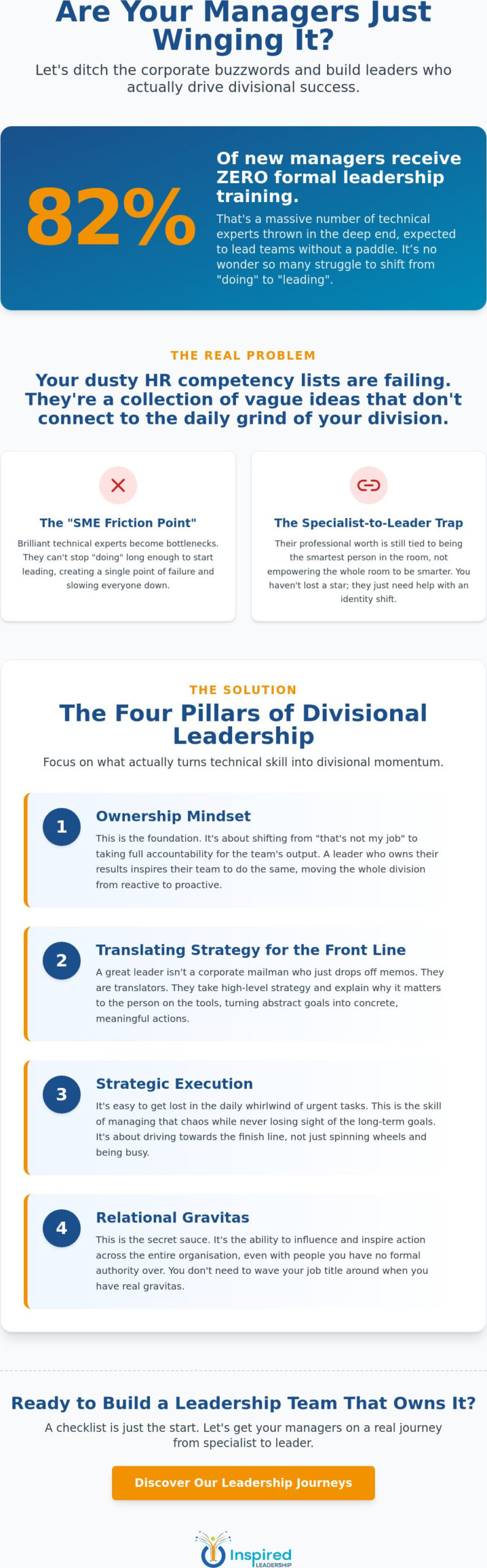
Did you know that 82% of new managers are essentially winging it without a lick of formal training? It is a staggering figure from the Chartered Management Institute that explains why so many technical experts crumble the moment they are asked to lead a team. This is exactly why a robust divisional leadership development program is no longer a luxury; it is a strategic necessity for 2026.
We all agree that standard HR competency lists are often just a collection of vague buzzwords that mean nothing in the real world. You need managers who take full ownership of their results, not people who treat leadership like a tedious chore they have to finish before lunch. The good news is that driving performance does not require a $95,000 Harvard degree or a corporate dictionary to decode.
This article provides a clear, no-nonsense framework to audit your leadership team and identify the behaviours that actually drive divisional success. We will explore how to bridge the gap between technical brilliance and leadership impact in a rapidly changing, AI-augmented landscape. Get ready to ditch the jargon and start seeing some real, measurable momentum in your division.
Key Takeaways
- Stop wasting time on dusty HR competency lists that no one actually uses. You will learn how to build a real-world bridge between high-level strategy and your team’s daily output.
- Shift your managers from the “not my job” excuse to total accountability. We will show you how to cultivate an ownership mindset so they start owning results instead of just ticking off tasks.
- Use our no-nonsense audit to identify brilliant technical experts who are currently stuck in “doing” mode. You will get three specific questions to help you assess the “Ownership Gap” in your division.
- Discover why a simple checklist is just the beginning of a divisional leadership development program that delivers lasting change. To see how this looks in practice, visit our First Line Manager Program journey page and download the brochure.
Why Traditional Leadership Competencies are Failing Your Division
Most HR competency lists look like they were written by a robot trying to pass a corporate Turing test. They usually sit in a digital drawer gathering dust because they lack any local relevance to the actual chaos of a busy division. These off-the-shelf frameworks fail because they treat leadership like a generic skill rather than the essential bridge between high-level strategy and daily execution.
A truly effective divisional leadership development program needs to move beyond these vague buzzwords. It should focus on building a collective capacity for leadership development that actually shifts the needle on performance. Divisional competence is the ability to lead an organisation that thinks and owns its actions.
We often see the “SME Friction Point” where technical expertise becomes a massive bottleneck for growth. This happens when your managers are so brilliant at their old technical jobs that they cannot stop “doing” and start leading. They become the single point of failure, creating a divisional flow that is constantly interrupted by their need to have a hand in every minor detail.
The Specialist-to-Leader Identity Trap
It is a classic move to promote your best technical expert and then wonder why the team is falling apart. You haven’t lost their talent; they are simply caught in the specialist-to-leader identity trap. Their sense of professional worth is still tied to being the smartest person in the room rather than the person who empowers the room to be smart.
The problem isn’t a lack of potential, but a lack of a structured, transformational journey to help them let go of their tools. If you want to stop the “super-doer” cycle, head over to our High-Potential Technical Talent Program journey page. You can see how we facilitate that identity shift and download the brochure to get started on a real solution. For a practical guide on navigating this exact transition, our resource on new manager leadership development: how to move from expert to leader walks through the specific steps to make this shift with confidence.
The Four Pillars of Divisional Leadership Excellence
Forget those massive, 27-category lists that look like they were written by a committee of bored bureaucrats. If you want to see actual movement in your division, you need to focus on the four pillars that actually matter. A high-impact divisional leadership development program centres on building an ownership mindset, translating insight into action, strategic execution, and relational gravitas.
These aren’t just fancy words to put on a slide; they are the gears that turn technical skill into divisional momentum. Strategic execution is about managing the daily whirlwind without losing sight of long-term goals. Meanwhile, relational gravitas allows a leader to influence others without needing to wave a formal job title; for those who apply this same strategic mindset to personal wealth, you can find out more about diversifying with Land Invest Corp’s residential land opportunities.
Ownership: The Foundation of Every Successful Division
Ownership is probably the most undervalued competency in Australian medium-sized enterprises. I remember a manager named Gaz, a top-tier tech expert who initially thought his job was just “fixing things” when his team got stuck. Once he realised his job was to be accountable for the output rather than the individual tasks, the whole division’s energy shifted from reactive to proactive.
He stopped being the “super-doer” and started being the catalyst for his team’s success. If you want your managers to make this same leap, check out our First Line Manager Program and download the brochure to see the full journey. It is designed to turn specialists into leaders who actually own their results.
Translating Strategy for the Front Line
Your leaders shouldn’t be mailmen who simply drop off board-level memos and run for cover. A competent leader acts as a filter and a translator for complex corporate goals. They take that high-level strategy and explain exactly why it matters to the person on the tools, turning abstract ideas into concrete actions.
Compare that to the manager who just “passes the buck” when an unpopular decision comes from above. Saying “don’t blame me, it’s just what corporate wants” is a massive leadership fail. It kills trust and makes the leader look like a powerless bystander in their own division.
Your Divisional Leadership Audit: A Practical Checklist
Most audits feel like a military inspection; they are rigid, punitive, and frankly a bit soul-crushing. We aren’t here to play “gotcha” with your managers. Instead, we want to identify where the gears are grinding so you can get the division humming again. A practical divisional leadership development program starts with a clear-eyed look at who is actually leading and who is just very busy.
Step one is identifying the high-potential technical talent currently stuck in the “doing” phase of their career. These are your brilliant experts who still think their value lies in their technical output rather than their team’s performance. Step two involves assessing the “Ownership Gap” by watching how they handle accountability when things go pear-shaped. Finally, you must measure the speed of execution from initial insight to tangible output while checking the “Relational Health” of their team to ensure no cultural rot is setting in.
The “No-Nonsense” Audit Questions
To cut through the noise, ask these three questions of every manager in your division. First, does this leader talk about what they “did” or what the team “achieved” during the last quarter? If it’s all about their personal task list, they are still a specialist, not a leader. Second, when a project fails, do they look in the mirror to take responsibility or out the window for someone to blame?
The third test is the simplest but often the hardest. Can they explain the company strategy to a new graduate in under two minutes without using a single bit of corporate jargon? If they can’t make it make sense to a rookie, they don’t truly understand it themselves. This lack of clarity is exactly what a divisional leadership development program is designed to fix.
Organising the Results
Once you’ve done the rounds, you can categorise your leaders into three groups. “The Specialists” are your tech wizards who need help letting go of the tools. “The Maintainers” are steady hands who keep the lights on but rarely drive growth. “The Catalysts” are your gems; they possess high relational gravitas and naturally move the needle on divisional performance.
You should prioritise development for those with the highest potential for relational gravitas, as they will provide the best return on investment. If you have identified technical experts who are ready to make this leap, visit our High-Potential Technical Talent Program journey page. You can download the brochure there to see how we help them transition from “doing” to “leading” with confidence.
From Competency Checklists to a Leadership Journey
A checklist is a fantastic starting point, but let’s be real. Ticking a box on a piece of paper is about as effective for leadership growth as staring at a salad is for weight loss. Real organisational transformation requires more than a one-off event; it demands a shift in how your people actually show up every single day.
One-off workshops are essentially the “thoughts and prayers” of the corporate world. They feel warm and fuzzy for a few hours, but those new skills usually evaporate the moment a manager walks back into a chaotic office. To see lasting results, you need a divisional leadership development program that’s built on a systemic, long-term approach rather than superficial training days.
We believe the best vehicle for this change is a structured, journey-based model. The First Line Manager Development Program provides exactly that, moving your team from “doing tasks” to “owning results.” It’s about building a culture where leadership is a shared responsibility, not just a line item in an HR budget.
Scaling Leadership Capability in Your SME
As your business grows, you can’t simply keep hiring your way out of a leadership void. You need to build a robust leadership pipeline that supports your entire division as it scales. This is particularly vital for Australian businesses trying to stay competitive in a market that moves faster than a kookaburra after a sausage.
Building this internal strength is the only way to ensure your growth is sustainable. For a deeper dive into how to navigate these choices, take a look at our guide on Leadership Development for Medium Sized Companies. It’ll help you avoid the common traps that catch out growing organisations.
Your Next Steps for Divisional Success
Stop settling for a leadership team that’s merely “good enough” or just “getting by.” You deserve an organisation that thinks for itself and takes proactive ownership of its divisional outputs. It’s time to swap the vague competency lists for a divisional leadership development program that actually works.
Your next step is simple. Head over to our First Line Manager journey page to see the full curriculum and download the brochure today. Let’s stop the guesswork and start building the high-performing team your division actually needs.
Building an Organisation That Thinks
You now have a clear-eyed framework to move your division beyond the “specialist-to-leader” identity trap. By focusing on the four pillars of excellence and using our no-nonsense audit, you can identify which managers are ready to stop doing and start leading. It is about ditching the generic lists and focusing on the behaviours that actually drive divisional momentum.
Real results require more than a checklist; they demand a structured divisional leadership development program that turns technical brilliance into collective capability. This isn’t about fluffy training events that are forgotten by Friday afternoon. It is a results-driven alternative grounded in 20 years of corporate experience delivered with a pragmatic lens.
If you are ready to turn your technical experts into genuine leaders, explore the First Line Manager Journey and download the brochure here. We have designed this specifically for the unique needs of medium-sized Australian enterprises. You can build a division that takes ownership and delivers real results; let’s get started.
Frequently Asked Questions
How do I identify the most important leadership competencies for my specific division?
Start by looking at your current bottlenecks and working backwards from the results you actually need. If your team is missing deadlines, focus on strategic execution; if your best people are quitting, prioritise relational gravitas and trust building. You don’t need a list of fifty traits; you just need the three behaviours that will stop the bleeding and get things moving again.
Can technical experts actually learn to be competent people leaders?
They certainly can, but they have to be willing to stop being the smartest person in the room. The transition is less about learning new tricks and more about a fundamental identity shift from “doing” to “leading.” It is a journey of letting go of the tools to pick up the people, which is exactly what we facilitate in our High-Potential Technical Talent Program.
How long does it take to see a shift in divisional performance after starting a program?
You will likely notice a change in the way your managers talk and take ownership within the first few weeks. However, a divisional leadership development program usually takes three to six months to deliver measurable, bottom-line results. Real change isn’t a software update; it is a systemic process that requires time to bed in and become the new normal.
What is the difference between a skill and a leadership competency?
A skill is a specific task you can perform, like running a meeting or reading a balance sheet. A competency is the ability to use that skill, along with your judgment and attitude, to drive a specific organisational outcome. Think of a skill as knowing how to swing a bat and a competency as the ability to actually win the cricket match.
Is it worth investing in a divisional leadership development program for junior managers?
It is the best investment you can make because junior managers have the biggest daily impact on your team’s culture and productivity. Developing them early prevents the “accidental manager” syndrome that leads to high turnover and divisional stagnation. The research is clear on this point: according to our employee to first-line manager transition research overview, 60% of new managers fail within their first 24 months precisely because they were not given a structured roadmap for this critical shift. Visit our First Line Manager Program journey page and download the brochure to see how we turn your junior leaders into a competitive advantage.