

Developing women leaders takes more than building confidence. A women leadership development programme can strengthen leadership skills, but if workplace barriers remain untouched, individual growth may not lead to fairer opportunities or lasting change.
You may have seen the pattern: a motivating event, a notebook full of ideas, then a return to the same pressures and expectations. That’s not a lack of ambition or ability. It’s a sign that development needs to connect learning with the conditions people face at work.
So what should an effective women’s leadership development journey include? This article explains how to assess its structure, check whether it supports behaviour change and consider the workplace conditions that influence women’s progression.
We’ll look at how individual development, practical workplace action and wider leadership capability fit together. Lasting progress doesn’t ask women to do all the adapting. It helps organisations create opportunities for their growth to translate into impact.
Key Takeaways
- A women leadership development programme is more effective when it builds leadership capability and addresses the workplace conditions that shape progression.
- Look for opportunities to reflect, practise, receive feedback and apply new skills to real leadership responsibilities.
- Assess whether the development journey fits participants’ needs and has practical support from managers and the wider organisation.
- Connect participant learning with sponsorship, meaningful assignments and organisational accountability to help turn growth into lasting change.
Women leadership development programmes: what are they designed to change?
A women leadership development programme is a structured process that supports women to build leadership capability and progress into, or grow within, leadership roles. The most useful definition is also the simplest: it develops a person’s leadership while helping create the conditions for that leadership to be used.
That distinction matters. A standalone event or generic leadership course may offer useful ideas, but a development journey gives participants time to reflect, practise and apply learning. It also involves the people and systems around them, so new approaches can be used in day-to-day work.
Who benefits from a women’s leadership development journey?
Participants may be preparing for their first leadership role, stepping into one now or strengthening their impact as experienced leaders. Their ambitions, identities and barriers won’t all be the same. A thoughtful journey makes room for different experiences instead of assuming one approach fits everyone.
Managers, sponsors and senior leaders matter too. They can help participants apply new skills by giving specific feedback, backing them for meaningful assignments and making leadership opportunities visible. Without that support, even valuable learning can struggle to travel beyond the room.
Why individual capability is only part of the picture
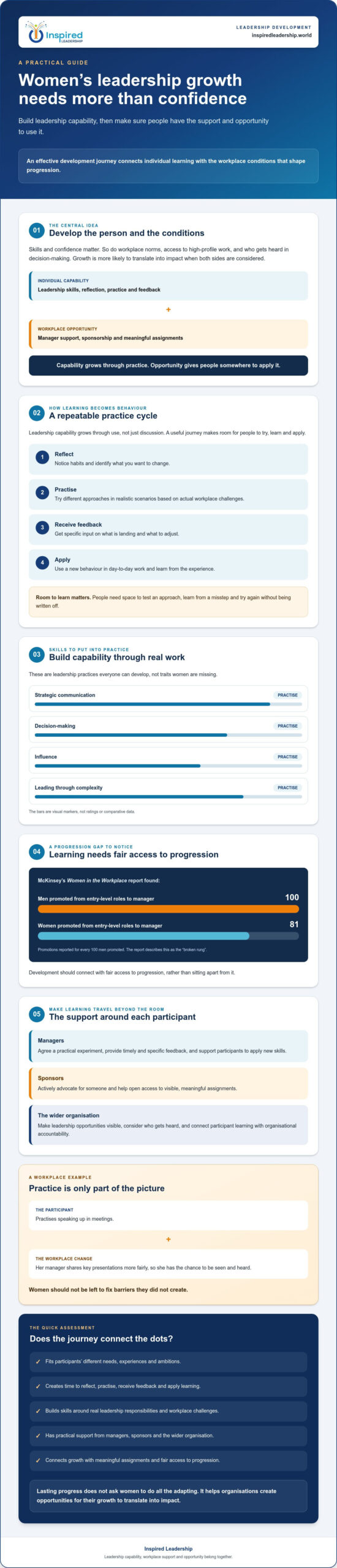
Confidence and skill don’t operate in a vacuum. Workplace norms, access to high-profile work and who gets heard in decision-making all affect whether someone can put their capability into practice. For broader context on understanding women’s leadership, consider how representation and stereotypes can influence expectations of leaders.
Illustrative example: A participant practises speaking up in meetings, but her manager continues to give key presentations to the same colleagues. Her development matters, but so does changing who gets the chance to be seen and heard. Women shouldn’t be left to fix barriers they didn’t create.
If you’re considering what support might fit your organisation, you can discuss your leadership development priorities with Inspired Leadership.
How women’s leadership development connects skills with opportunity
Leadership capability grows through use, not just discussion. Reflection helps participants notice their habits; practice lets them try different approaches; feedback shows what is landing; and application turns an insight into a workplace behaviour. Psychological safety matters: people need room to test an approach, learn from a misstep and try again without being written off for it.
A women leadership development programme can build capabilities such as strategic communication, decision-making, influence and leading through complexity. These aren’t traits women are missing and need to acquire. They’re leadership practices everyone can develop, best explored through realistic scenarios based on the organisation’s actual challenges.
How do sponsors and managers help learning transfer?
A sponsor does more than offer advice. They actively advocate for someone and help open access to visible, meaningful assignments where leadership can be demonstrated. Managers can support that transfer too: agree a practical experiment, such as leading a cross-team discussion, then give timely, specific feedback on what worked and what to adjust.
Capability develops through practice, but workplace support and access to meaningful opportunities give people somewhere to apply it. McKinsey’s 2025 Women in the Workplace report found that for every 100 men promoted from entry-level roles to manager, 81 women were promoted. That “broken rung” finding is a reminder that development needs to connect with fair access to progression, not sit apart from it.
To decide where to focus, identify the leadership behaviours participants need to practise and the opportunities available to use them. Harvard’s women’s leadership programme is another example to explore when considering how leadership learning can address skills and workplace challenges together.
If you’re looking to connect participant development with real opportunities in your organisation, you can discuss your leadership development priorities with Inspired Leadership.
How to assess a women leadership development programme before choosing one
A polished brochure can make almost any development offer sound transformational. Look beyond the promises and ask how the learning fits participants’ roles, the work they need to do and the organisation they’ll return to.
Use this checklist to guide the conversation:
- Purpose: Which leadership capabilities and organisational priorities should the journey support?
- Participant needs: How does the design reflect participants’ roles, experience and working context, without assuming every woman needs the same thing?
- Workplace support: How will managers and sponsors reinforce the learning and help participants access relevant opportunities?
- Application: How will participants practise, receive feedback and use what they learn between facilitated activities?
Questions to ask about the design
Ask for examples of how learning connects to real leadership responsibilities, such as making decisions, influencing stakeholders or leading a team through change. Find out how managers can agree practical opportunities to apply new approaches, then discuss what feedback and support will help participants learn from the experience.
Also ask who is expected to change. A credible women leadership development programme should build participants’ capability while encouraging the organisation to examine its own norms and access to opportunity. If the answer is simply “the women”, keep asking.
How to tell whether learning is being applied
Agree in advance what progress could look like, without treating it as a guaranteed return on investment. You might look for observable changes in leadership behaviour, access to meaningful assignments or shifts in relevant workplace practices, where evidence is available.
Combine participant reflection with appropriate organisational evidence. For example, participants could describe how they applied a new approach, while managers share specific feedback. Neither view tells the whole story on its own. The aim is to assess what’s changing, identify what still gets in the way and decide what support comes next.
Turn women’s leadership development into an organisational journey
A women leadership development programme is more likely to translate into workplace change when it connects participant learning with what happens before and after the programme. Treat development as shared work: participants build capability, managers make room to apply it, and senior leaders stay accountable for the conditions around progression.
A cohort-based journey can give participants space to compare experiences, reflect together and learn from one another’s practical approaches. It shouldn’t assume everyone faces the same barriers or wants the same next step. Peer learning is most useful when it relates to participants’ actual work, rather than relying on discussion alone to create change.
What to do before development begins
Start with a clear purpose. Identify the leadership capabilities you want to strengthen and the organisational challenges the development should address. Then consider:
- Which participants and roles the development is intended to support.
- Who will sponsor participants and help them access opportunities to practise new behaviours.
- What realistic signs of learning application you’ll look for, before making claims about outcomes.
These decisions help keep responsibility in the right place. Participants have a role in applying their learning, but they can’t change workplace expectations or access to opportunity on their own.
Explore a women-focused leadership journey
Inspired Leadership’s Women Talent Accelerator is a women-focused offering to consider alongside your organisation’s priorities. It forms part of the firm’s leadership development work, which aims to translate insight into action and build capability across organisations. As with any development journey, assess how its focus and design fit the leadership needs you have identified rather than assuming one programme is a guaranteed solution.
Make women’s leadership development part of how your organisation grows
An effective women leadership development programme does more than build individual capability. It connects learning to real leadership responsibilities, gives participants support to practise and asks the organisation to make opportunity and progression part of the work too.
As you assess your options, look for a clear purpose, learning that fits participants’ needs and practical support from managers and sponsors. Agree how you’ll recognise learning being applied, without promising outcomes no one can guarantee. That’s how development can become part of wider leadership capability, rather than a one-off event with a very nice notebook.
Inspired Leadership offers a Women Talent Accelerator as part of its leadership development journeys. Explore whether a women-focused journey fits your organisation’s priorities and how it could connect participant learning with practical action.
Your organisation can help create the conditions for women’s leadership to grow. Start with a clear purpose, shared responsibility and opportunities to put learning into practice.
Frequently Asked Questions
What is a women leadership development programme?
A women leadership development programme is a structured approach to strengthening women’s leadership capability and supporting progression into or within leadership roles. It should connect individual learning with the workplace conditions that influence whether new skills can be used. For example, participants might practise decision-making while their managers create opportunities to lead meaningful work and provide feedback.
Why do organisations invest in women’s leadership development?
Organisations invest in women’s leadership development to build leadership capability and support fair access to progression. A thoughtful approach can help identify where participants need development while also examining workplace norms and access to influential assignments. The responsibility for change shouldn’t sit with women alone. Managers and senior leaders have a part to play in supporting learning and advancement.
What should a women’s leadership development journey include?
A useful journey should reflect participants’ roles, experience and organisational context. It may include reflection, practice, feedback and opportunities to apply learning to real responsibilities, alongside support from managers or sponsors. Look for clear learning aims and links to workplace priorities. A cohort can also support shared reflection and peer learning, provided different experiences and ambitions are respected.
How can organisations measure whether leadership development is working?
Agree what you’ll look for before development begins, and avoid promising results that haven’t been demonstrated. Useful indicators might include participants’ reflections on applying new skills, specific feedback from managers, or evidence of changed leadership behaviours and access to relevant assignments. Where suitable organisational information is available, consider it alongside participant feedback. No single measure tells the whole story, so look for patterns and practical next steps.
How can managers support women applying what they learn at work?
Managers can help by discussing where a participant could practise a new approach, agreeing a realistic opportunity and giving timely, specific feedback afterwards. That might mean leading a meeting, contributing to a decision or taking responsibility for a meaningful assignment. They can also make learning safer by treating early attempts as practice, not a pass-or-fail test. Support matters most when it leads to real opportunities, not just encouraging words.