
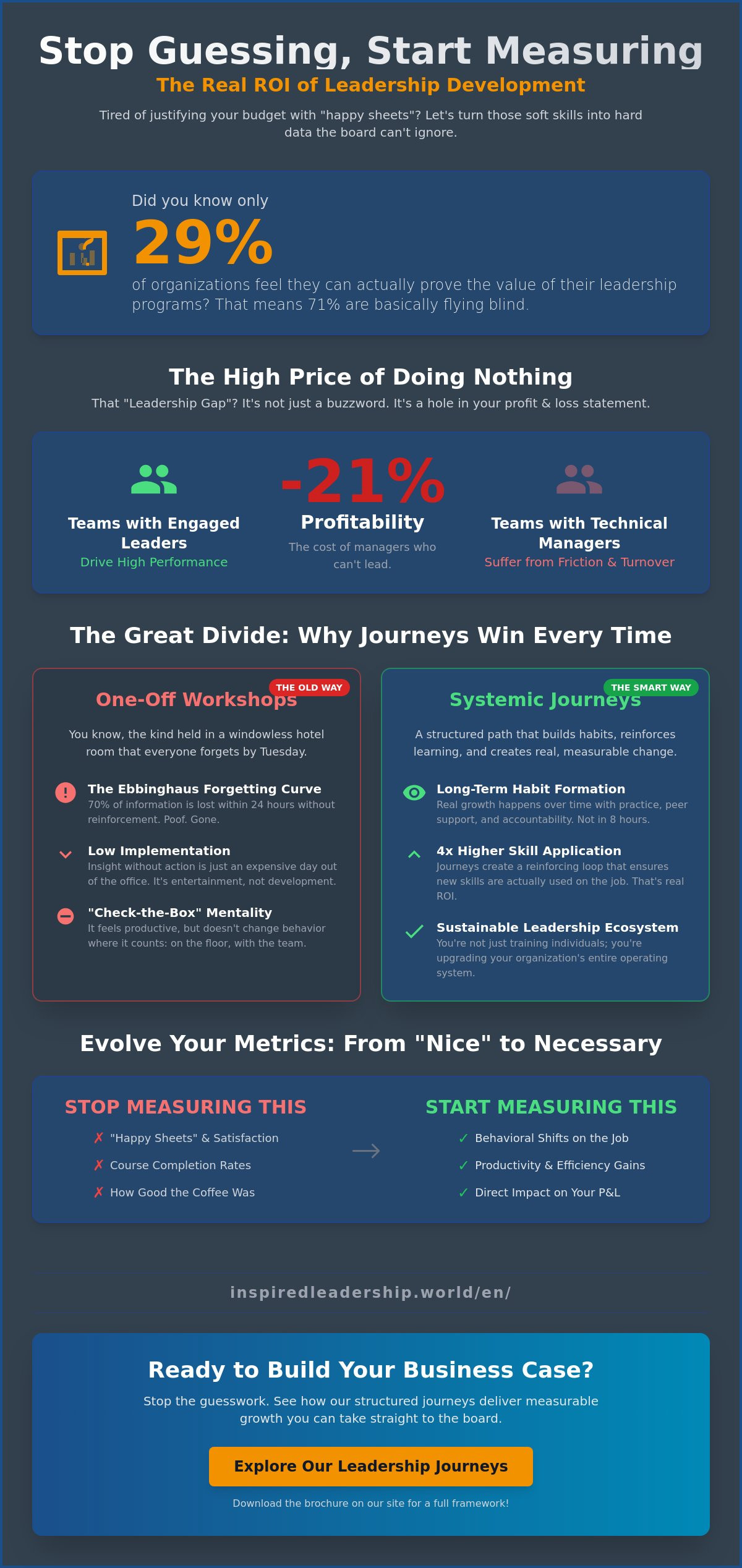
Did you know that only 29% of organizations believe they can actually demonstrate the value and leadership development ROI of their programs? That’s a staggering number of leaders essentially flying blind while trying to justify their budgets to a skeptical board. It is time to stop guessing and start measuring what actually moves the needle.
You probably feel the heat when the board asks why you’re spending money on soft skills while technical turnover stays high. It is incredibly frustrating to know your people are your greatest asset but struggle to prove it on a spreadsheet. We have all been there, nodding along in meetings while secretly wishing for a magic calculator to justify the spend.
This guide will show you how to turn those intangible moments into hard data that even the most cynical CFO will respect. You’ll discover a framework to quantify growth and build a business case that secures your budget for the long haul. We are exploring the specific metrics that matter for 2026, from the 21% profitability boost seen in high-engagement teams to tangible retention wins.
To see how this works in practice, head over to our leadership journey page to explore our specialized programs. You can also download the associated brochure to get the full breakdown of how we drive measurable results for your organization.
Key Takeaways
- Learn how to ditch the “check-the-box” mentality and measure the behavioral shifts that actually impact your bottom line.
- Stop wasting 70% of your budget on one-off workshops that your team will forget before their next coffee break.
- Discover a simple way to quantify the cost of losing your top talent and present a winning leadership development ROI case to your board.
- Get a practical framework to baseline your team’s current friction and identify the success indicators that drive real productivity gains.
- Learn how a structured leadership journey translates complex organizational psychology into measurable growth you can see on a spreadsheet.
Defining Leadership Development ROI in the 2026 Economy
Let’s be honest. If you are still gauging success by how many people clicked “complete” on a video or how tasty the muffins were at the seminar, you are stuck in the past. In 2026, the board does not care about “completion rates.” They want to see how Leadership development actually changes how people show up on Monday morning.
We are talking about leadership development ROI as a tangible business driver, not a “nice-to-have” expense. The “Leadership Dividend” is how a manager’s ability to coach a team member—a discipline mastered at institutes like Intact Academy—compounds across your P&L. If your metrics are stuck on NPS or satisfaction, you are missing the business outcomes that actually pay the bills.
Doing nothing has a very real price tag. We call it the “Leadership Gap.” It is that expensive friction when technical managers can’t lead, resulting in teams that are 21% less profitable than those led by engaged leaders. You aren’t just losing morale; you are losing money through high turnover and missed deadlines.
The Evolution of Measurement
Executive expectations have shifted from “Happy Sheets” to hard data. You need to focus on systemic impact rather than just individual skill-building. While “Soft ROI” like improved culture is lovely, “Hard ROI” is the direct link between behavioral change and your revenue growth. It is about moving from “did they like it?” to “did it work?”
The Strategic Urgency of Leadership Capability
Leadership capability acts as a massive multiplier for all your other business assets. When your leaders are mature and resilient, your entire organization handles market volatility without breaking a sweat. Leadership Development ROI is the net financial gain derived from improved management efficacy.
To see how this capability is built from the ground up, explore our Senior Leadership and Executive Journeys page. You can also download the associated brochure to see the full framework we use to drive these results.
The Journey Advantage: Why Systemic Development Outperforms Workshops
Let’s stop pretending that a one-day workshop in a windowless hotel basement actually changes how your business operates. Science tells a different story through the Ebbinghaus Forgetting Curve, which shows that humans forget about 70% of new information within just 24 hours if it isn’t reinforced. If you are still relying on isolated training events, you are essentially flushing your leadership development ROI down the drain before the first coffee break is over.
Real growth requires a structured journey that facilitates “Learning Transfer” and long-term habit formation. When you move from isolated events to systemic development, you build an ownership mindset that acts as an invisible driver of commercial performance. This is why our First Line Manager Program is so effective at reducing early-career attrition; it gives new leaders the time to actually practice leading.
Journeys vs. Workshops: A Comparative Analysis
Implementation rates tell the real story of why traditional workshops fail to stick. Journeys typically lead to 4x higher application of skills because they rely on peer-group learning to create a self-reinforcing loop. By focusing on talent accelerators rather than quick fixes, you are investing in a sustainable leadership ecosystem that pays dividends long after the program ends.
Translating Insight into Action
Insight without action is just a sunk cost for medium-sized enterprises. To truly capture value, you need an evidence-informed framework for ROI that bridges the gap between a classroom and the real world. This mechanism of change is what turns behavioral shifts into operational efficiency, ensuring that every lesson learned translates directly to your P&L results.
If you are ready to move past the superficial and start driving real impact, head over to our Senior Leadership and Executive Journeys page. You can also download the associated brochure to see the exact methodology we use to guarantee lasting transformation.
Key Performance Indicators: Quantifying the Impact on Medium-Sized Enterprises
You have likely seen the recruitment bills lately. They are eye-watering. Losing a high-potential technical manager isn’t just a blow to team morale; it is a direct hit to your leadership development ROI because you are essentially watching years of institutional knowledge walk out the door.
The “Technical Expert Trap” is where most medium-sized businesses stumble. You promote your best engineer to lead the team, but without a structured transition, you lose a great coder and gain a struggling manager. Research shows that 72% of high-potential employees would leave their jobs for better development opportunities elsewhere.
Quantifying the impact means looking at the data that actually hits the spreadsheet. Teams led by highly engaged leaders are 21% more profitable and see 17% higher productivity. When you invest in a program like our Women Talent Accelerator, you aren’t just filling a quota; you are expanding your leadership pipeline and ensuring your best talent has a reason to stay. If you want to understand the full commercial case for this investment, explore the ROI of women in leadership programs and why it has become a strategic imperative for 2026.
Retention and Talent Sustainability
Replacing a mid-level manager in 2026 can cost up to double their annual salary when you factor in hiring fees and lost output. Leadership journeys reduce “quiet quitting” by giving people a clear path forward within your organization. Promoting from within is almost always more cost-effective than gambling on an external hire who might not fit your culture. If your current women leadership development program corporate strategy isn’t keeping pace with the demands of 2026, you risk losing high-potential women at exactly the moment they are ready to step up.
Operational Excellence and Efficiency
High-quality leadership directly correlates to faster project delivery and fewer expensive mistakes. When executives can delegate effectively, they regain the bandwidth needed for high-level strategy instead of putting out daily fires. Our First Line Manager Program stabilizes team performance during scaling by ensuring new bosses actually know how to lead people rather than just managing tasks.
To see how we help technical experts make this leap, visit our High-Potential Technical Talent Program page. You can also download the associated brochure to see the specific metrics we track to prove your investment is working.
Constructing Your Business Case: A Practical Framework for Measuring Returns
Walking into a board meeting with nothing but “good vibes” and a few positive survey comments is a fantastic way to get your budget slashed. To win over a skeptical CFO, you need a rock-solid business case that proves your leadership development ROI is a strategic asset, not a discretionary expense. It is time to stop being the “culture person” and start being the “results person.”
Building this case starts with baselining your “Leadership Friction” metrics. You need to identify exactly where poor management is currently leaking cash, whether through project delays or high turnover in your technical teams. Once you have a baseline, you can define specific behavioral success indicators that show your leaders are actually applying what they’ve learned.
The final step is calculating the Net Leadership Value by subtracting your total investment from the total financial benefit. When you present this to the board, speak the language of strategy and risk mitigation. Show them how an ownership mindset is the ultimate insurance policy against organizational stagnation.
Financial Modeling and the “Attribution” Trap
We suggest using the Phillips ROI Methodology to keep your financial modeling grounded in reality. This approach helps you account for intangible benefits like improved employer branding while ensuring your claims remain credible. Always remember to discount for “Attribution” by acknowledging that other factors, like a market shift, might have contributed to your wins. Credibility is your greatest currency when asking for investment.
Addressing the #1 Board Objection
When the board complains that they don’t have time for a six-month journey, remind them of the staggering opportunity cost of doing nothing. Budget savings from cheap, one-off workshops are a total myth because they rarely result in lasting behavioral change. Proving the value of a systemic approach means showing that the cost of a failed leader is always higher than the cost of a proper journey.
If you are ready to build a business case that wins every time, head over to our Senior Leadership and Executive Journeys page. You can also download the associated brochure to get the exact templates and data points you need to convince your board.
Partnering for Impact: The Inspired Leadership Approach to ROI
We don’t do boring workshops. If you want a trainer to read off a PowerPoint while your team secretly checks their emails, you are in the wrong place. We focus on transformational journeys because we know that real leadership development ROI happens over time, not in a single afternoon.
Our methodology translates deep organizational psychology into actual P&L results that your CFO will actually care about. We have designed our approach specifically for medium-sized enterprises, meaning you get high-level consultancy expertise without the suffocating corporate bloat. We act as a Strategic Catalyst, which is just a fancy way of saying we don’t just teach; we guide you through the actual mess of transformation.
We aren’t here to hold your hand and sing songs. We are here to help you build a disciplined, battle-tested leadership pipeline that can handle whatever 2026 throws at you. This isn’t just about professional distance; it is about being deeply invested in your human potential while staying grounded in corporate reality.
The Inspired Leadership Difference
Our First Line Manager Program and High-Potential Technical Talent Program are built to deliver immediate impact through Action Learning. This means your people are solving real business problems while they learn, ensuring that the work gets done while they grow. Our Senior Leadership and Executive Journeys focus on “Thinking and Owning” outcomes, ensuring your top tier is actually driving the business forward instead of just managing the status quo.
By focusing on systemic impact rather than individual skill-building, we help you create a self-reinforcing culture of excellence. This approach ensures that the behavioral changes we spark actually stick, preventing the usual slide back into old, expensive habits. It is about creating a sustainable leadership ecosystem that keeps your best people from jumping ship.
To further bolster this ecosystem, organizations can integrate specialized executive benefits; for instance, The 4th Wish / DP Wealth Builders offers private banking methods that help high-value leaders build lasting wealth, adding a layer of financial security that complements their professional growth.
Your Next Step in the Leadership Journey
It is time to move from generic training to genuine transformation. You can initiate a pilot journey with measurable KPIs to see the results for yourself before committing to the whole shebang. Explore our First Line Manager Program to see how we can stabilize your team during your next growth spurt.
To get started, visit our Senior Leadership and Executive Journeys page to see how we can help your top team excel. You can also download the associated brochure to see our full results-driven methodology in action and start your journey today.
Securing Your Organization’s Future Through Strategic Growth
You now have the framework to stop guessing and start proving the value of your people. Real growth in 2026 isn’t about ticking boxes or serving nice muffins at a seminar; it is about driving behavioral shifts that stick. By focusing on systemic journeys rather than one-off events, you are building a resilient culture that can handle any market shift.
We have explored how to quantify the impact of technical-to-leader transitions and how to build a business case that makes your CFO smile. Maximizing your leadership development ROI requires a partner who understands the unique pressures of medium-sized enterprises. We offer a results-driven alternative to traditional workshops that turns your managers into strategic assets.
It is time to stop playing it safe with “check-the-box” training and start investing in transformation that actually hits the bottom line. Partner with Inspired Leadership to build a results-driven leadership pipeline today. Head over to our Senior Leadership and Executive Journeys page and download the associated brochure to see how we can guide your next breakthrough.
You have the data and the plan. Now, go make it happen.
Frequently Asked Questions
What is a typical ROI for a leadership development program?
Research indicates that effective programs typically return 3 to 5 times the initial investment. Organizations with mature development strategies are also 3.5 times more likely to outperform their industry peers. It is a profit multiplier that compounds over time rather than a one-off expense.
How do you measure the ROI of soft skills like empathy or communication?
You measure these by mapping behavioral shifts to concrete operational outcomes like project delivery speed or team retention. Empathy isn’t just a feeling; it is a strategic tool that prevents the staggering cost of replacing technical talent. Track the reduction in team friction and the increase in productivity to find your answer.
How long does it take to see a return on investment from a leadership journey?
You can expect to see initial shifts in team engagement and application of skills within three to six months. While deep behavioral transformation takes time, our use of Action Learning ensures that leaders apply new insights to real business problems immediately. Long-term financial compounding usually becomes evident on the P&L within the first year.
Is leadership development ROI higher for new managers or senior executives?
Both levels offer significant returns but solve different financial problems. Investing in a First Line Manager Program prevents early-career attrition and stabilizes performance during rapid scaling. Senior Leadership and Executive Journeys drive leadership development ROI through high-level strategic decision-making and better risk mitigation at the organizational level.
How can medium-sized companies afford high-level leadership journeys?
The real question is whether you can afford the cost of inaction. Medium-sized enterprises often see higher relative returns because they lack corporate bloat, meaning every behavioral shift has a direct impact on the bottom line. Starting with a pilot journey is a pragmatic way to prove the value before committing to a full-scale rollout.
What are the biggest mistakes companies make when measuring leadership ROI?
The most common blunder is relying on completion rates and “Happy Sheets” instead of tracking actual behavioral changes. Many businesses also fail to baseline their current “Leadership Friction” metrics before they begin. Without a clear starting point, you are essentially flying blind when it is time to justify your budget to the board.
Can you calculate ROI for technical talent leadership programs specifically?
Yes, you do this by tracking the reduction in turnover and the successful transition of experts into management roles. Our High-Potential Technical Talent Program focuses on these metrics to stop the expensive cycle of losing your best engineers. You calculate the leadership development ROI here by comparing program costs against the astronomical expense of recruitment and lost institutional knowledge.
Why do most leadership training programs fail to deliver a positive ROI?
Most fail because they rely on one-off workshops that ignore how the human brain actually learns. Humans forget about 70% of new information within 24 hours if it isn’t reinforced through a structured journey. Programs fail when they offer insight without action, turning potential growth into a sunk cost for your business.
To see how we avoid these pitfalls and drive real results, visit our Senior Leadership and Executive Journeys page. You can also download the associated brochure to see the specific frameworks we use to guarantee your investment pays off.