

You didn’t just get a promotion; you actually started an entirely different career, and it’s likely nobody gave you the manual. Most technical experts find themselves drowning in people problems whilst still trying to be the hero who fixes every technical glitch. Embarking on a structured managerial development journey is the only way to stop the spiral and start leading with genuine authority.
Based on 20 years of corporate experience, I’ve seen far too many talented specialists feel like they’re babysitting former peers instead of driving the high-level strategy they were promised. You’ve probably sat through dry workshops that felt like a waste of time, leaving you still clutching your spreadsheets for comfort. We’re going to change that by focusing on a human-centred approach that prioritises impact over pointless paperwork.
This guide will show you how to let go of the expert identity to become a leader your team actually wants to follow. We’ll break down the roadmap from technical specialist to strategic catalyst, ensuring your team takes ownership whilst you regain your sanity. It’s time to trade the overwhelm for a clear, actionable path toward high-performance leadership.
Key Takeaways
- Identify the “Specialist-to-Leader Trap” to understand why your expert skills might be making you a bit of a bottleneck in your new role.
- Explore the four critical stages of a successful managerial development journey to move from a “doing” mindset to a “leading” one.
- Solve the delegation dilemma so you can trust your team to deliver excellence whilst you focus on the big-picture strategy that actually matters.
- Discover why honest feedback is much kinder than being “nice” and how it prevents a toxic culture from taking root in your organisation.
- Learn how to choose a development journey that actually works for growing businesses instead of settling for stale, one-size-fits-all corporate training.
Why Your Managerial Development Journey Often Feels Like a Wrong Turn
You finally got the fancy new title, but suddenly everything feels a bit off. Most people assume that being brilliant at your technical job naturally makes you brilliant at leading others. This is the first hurdle in your managerial development journey because management isn’t just a promotion; it’s a total career change that requires a completely different set of muscles.
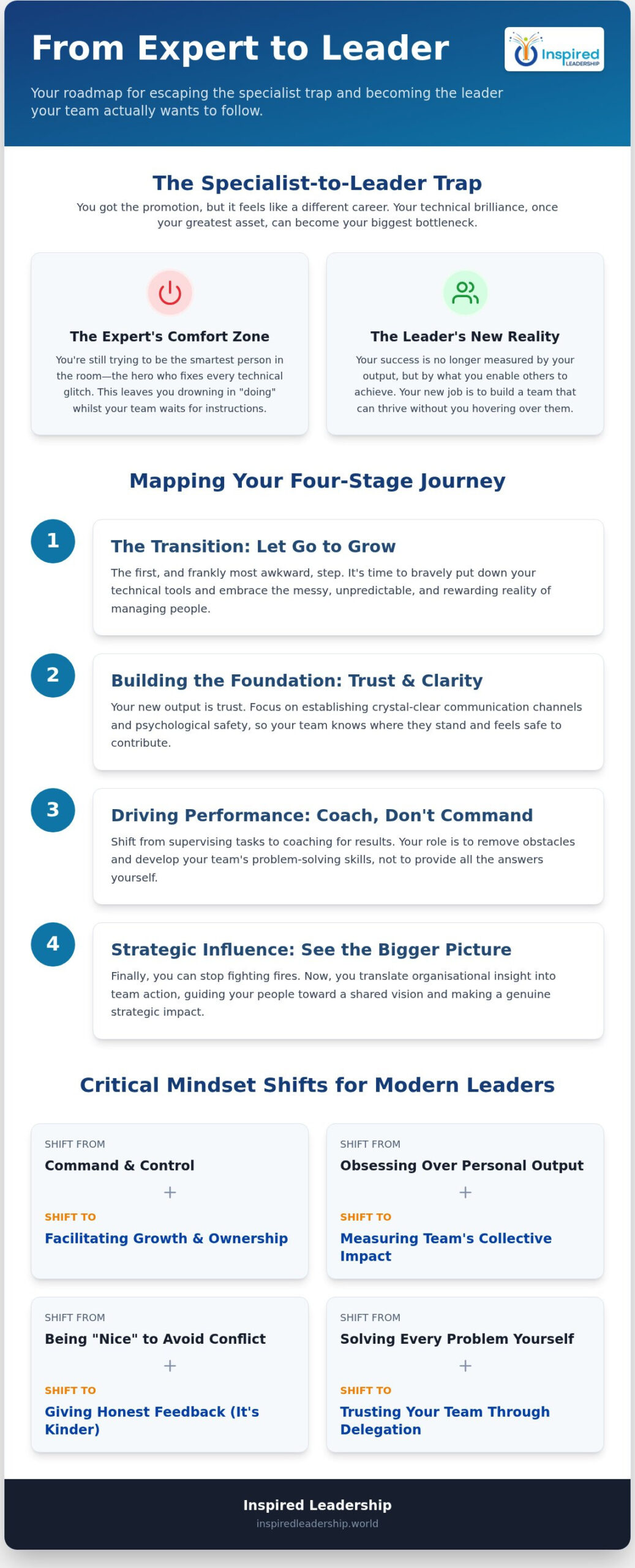
You’re likely stuck in the Specialist-to-Leader Trap, where you’re still trying to be the smartest person in the room. It’s tempting to keep doing the technical work yourself because it’s familiar, safe, and frankly, you’re good at it. However, every hour you spend “doing” is an hour you aren’t “leading,” which leaves your team waiting for instructions like lost puppies whilst you drown in spreadsheets.
Traditional one-off workshops are often the culprit for why managers feel unprepared. They offer a temporary high but fail to tackle the deep-seated behaviours that keep you tethered to your old role. Real transformation happens through a sustained journey that builds leadership capability at scale, especially within medium-sized organisations where every person’s impact is magnified.
The Identity Crisis of the New Manager
Managing former peers is arguably one of the most awkward experiences in corporate life. One day you’re complaining about the office coffee together, and the next, you’re the one responsible for their performance reviews. It’s a strange shift that can make you feel isolated if you don’t handle the transition with care.
Your technical brilliance, which is exactly what got you here, can actually become your biggest barrier. If you keep jumping in to “save the day” with your expertise, you stop your team from learning how to solve problems themselves. This creates a bottleneck where you are the only person who can get things done, leading to burnout for you and boredom for them.
Moving Beyond Command and Control
The days of the “command and control” boss are long gone, and quite frankly, good riddance. Modern leadership is about creating an environment where your team takes full ownership of their results without you hovering over their shoulders. If you’re still relying on a “because I said so” mentality, you’ll find yourself exhausted and unsupported very quickly.
To truly thrive, you must transition into a role that facilitates growth rather than just overseeing tasks. You can explore how to make this vital shift through our beyond command journey. It’s about building an organisation that thinks for itself, finally allowing you to step back from the daily fires and focus on the bigger picture.
Mapping the Roadmap: The Four Stages of an Effective Journey
Every successful managerial development journey follows a logical progression, even if it feels like a chaotic scramble at the start. You don’t just wake up one morning with a “Leader” hat on; you evolve through specific stages of maturity. This roadmap serves as the backbone of any effective managerial development journey, providing a clear path through the fog of new responsibilities.
Stage 1 is the Transition, which requires you to bravely put down your technical tools to embrace the messy reality of people. Stage 2 focuses on Building the Foundation by establishing trust and clear communication channels as your primary output. Stage 3 shifts to Driving Performance, moving from supervising tasks to coaching for results, whilst Stage 4 centres on Strategic Influence where you translate organisational insight into team action.
If you’re feeling a bit stuck in the middle of these stages, get in touch with us to talk about your specific situation. We’ve spent 20 years helping people navigate these exact hurdles without losing their minds.
The First 90 Days: Landing with Impact
Just as a pilot ensures every detail is correct before touchdown, your transition into management requires careful positioning. For aviation professionals, My Flight Deck Prep offers the specialised career preparation needed to successfully navigate the jump from technical expert to leader.
Resist the urge to fix everything in your first week. Spend your time listening to your team and observing the existing dynamics before you start rearranging the furniture. It’s also incredibly helpful to take a leadership assessment to understand your natural baseline and avoid common blind spots.
From Individual Contributor to People Architect
You need to stop obsessing over your personal output and start caring about the team’s collective performance. Your success is no longer measured by what you do, but by what you enable others to achieve. A truly successful manager is one who makes themselves redundant through radical team empowerment.
Navigating the Friction Points of Modern Management
You have moved past the initial 90 days, but now the real work begins. This middle phase of your managerial development journey is where most people start to feel the heat. You’re likely wrestling with the delegation dilemma, wondering how to let go without the quality of work falling off a cliff.
Trusting your team doesn’t mean crossing your fingers and hoping for the best. It requires setting clear expectations and then actually stepping out of the way. If you’re still losing sleep over every minor detail, you haven’t delegated; you’ve just outsourced your stress whilst keeping the responsibility.
Then there’s the feedback loop, where many managers fall into the trap of being “too nice.” Avoiding hard conversations doesn’t make you a better person; it just creates a toxic environment of low standards and confusion. Clear, direct feedback is the kindest thing you can give a team member who actually wants to grow.
Managing upwards is your next big hurdle. You must ensure your team’s daily grind actually aligns with the senior leadership’s grand plans. If you don’t connect these dots, you’ll likely hit a wall of burnout by month six because you’re working incredibly hard on things that don’t actually move the needle.
The Human Factor in Management
You cannot lead people effectively if you don’t understand what makes them tick. Empathy isn’t just a soft skill; it’s a strategic tool that helps you figure out the “why” behind frustrating behaviours. If you want to master these psychological dynamics, check out the Human Factor Journey for a deeper dive into team performance.
Translating Insight into Action
Knowing your strategy is one thing, but executing it on a rainy Monday morning is where most managers fail. You need the discipline to turn high-level board goals into something your team can actually get excited about. Use this simple checklist for your next team briefing:
- Identify the one key objective that actually matters this week.
- Explain exactly how this task moves the needle for the whole organisation.
- Assign clear ownership so everyone knows who is holding the ball.
- Ask for potential roadblocks early to avoid mid-week panics.
Choosing a Journey That Delivers Tangible Results
Medium-sized enterprises often get the short straw with “off-the-shelf” corporate courses that feel about as personal as a tax return. You need a bespoke managerial development journey that acknowledges the unique growing pains of your organisation. Generic training doesn’t work because it ignores the specific culture and challenges your managers face every single morning.
Partnering with a Strategic Catalyst means working with someone who understands that growth is messy, loud, and occasionally confusing. This isn’t about lecturing from a podium; it’s about being a pragmatic architect of change who co-creates a path to success. You want a guide who has seen the pitfalls before and knows exactly how to help you sidestep them.
Measuring your ROI shouldn’t involve complex algorithms that nobody understands. Instead, look at your team retention rates and the quality of your collective output. When your managers stop being bottlenecks and start being facilitators, the financial benefits to your business become self-evident.
The Inspired Leadership Difference
Our Manager to Leader Journey is designed to be a results-driven alternative to those dry, slide-heavy workshops. We focus on scale and action, ensuring your technical talent actually makes the psychological shift required for leadership. You should definitely download our brochure to see the full curriculum and how we structure the transformation.
Starting Your Own Journey
If you’re ready to stop the “Specialist-to-Leader Trap” from stalling your business, contact Inspired Leadership for a no-nonsense chat. We’ll help you figure out exactly where your team is stuck and how to get them moving again. It’s time to turn your technical experts into the high-impact leaders your business deserves.
Leadership is a choice you make every day, not a title you were given yesterday.
Take the Lead in Your Leadership Evolution
You have seen that moving from expert to leader isn’t just about learning new skills; it’s about a fundamental shift in how you see yourself and your team. By mastering delegation and embracing honest feedback, you can finally stop being the bottleneck and start being the catalyst for growth. Real leadership happens when you stop doing the work and start building the people who do it.
Your managerial development journey should be as unique as your organisation, especially within the fast-paced world of medium-sized enterprises. We bring 20 years of corporate experience to ensure our human-centred, pragmatic approach actually sticks when the pressure is on. It’s about moving past the theory and getting into the messy, rewarding reality of leading humans.
You already have the technical brilliance, and now it’s time to back it up with leadership that actually delivers results. We’re here to help you turn that potential into a high-impact reality. Go on, your team is waiting for the leader they know you can be.
Frequently Asked Questions
How long does a typical managerial development journey take?
A meaningful managerial development journey typically spans six to twelve months to ensure new behaviours actually stick. You can’t undo years of technical habits in a single afternoon; it takes time to practice leading real people in real situations. This sustained approach allows you to encounter different team challenges whilst having the support to navigate them effectively.
Can a technical expert really become a successful people manager?
Yes, you absolutely can, provided you are willing to trade your spreadsheets for human connection. Most of the best leaders started as specialists who realised that their new “technical” skill was understanding what makes people tick. It’s about leveraging your analytical mind to solve people problems instead of just fixing code or crunching numbers.
What is the difference between a leadership course and a leadership journey?
A course is a one-off event that usually ends up as a dusty manual on your shelf, whilst a journey is a structured, long-term process of transformation. Journeys focus on the messy reality of behavioural change and provide ongoing support as you apply new insights to your daily work. We don’t believe in “one and done” workshops because they rarely result in a team that takes genuine ownership.
How do we measure the success of a manager development journey?
You measure success through tangible shifts in team performance, improved staff retention, and your own newfound ability to actually take a holiday without your inbox exploding. A successful managerial development journey results in a team that functions brilliantly even when you aren’t in the room. If your team is taking more ownership and hitting targets without you hovering, you’re winning.
What are the most common mistakes new managers make during their transition?
The biggest blunders usually involve micromanaging every tiny detail or trying to be the “hero” who fixes everything themselves. You might also find yourself avoiding difficult conversations to stay “liked,” which ironically leads to a culture of confusion and resentment. Learning to step back and let your team fail occasionally is a terrifying but essential part of your growth.