
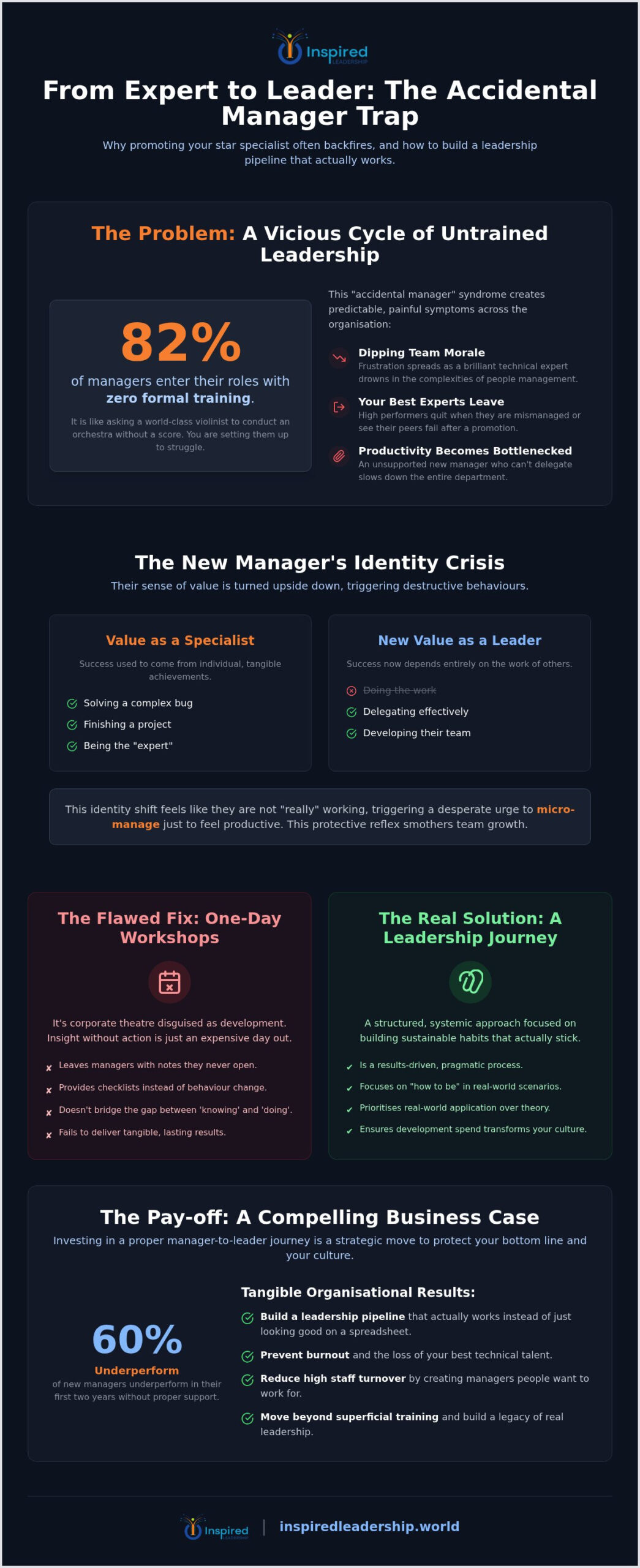
Did you know that 82% of managers enter their roles with zero formal training? Promoting your star specialist might feel like a reward, but without a solid business case for first line manager development, you’re likely setting them up for a spectacular, very public struggle. It’s a bit like asking a world-class violinist to suddenly conduct the entire orchestra without a baton, a score, or a clue.
You probably recognise the symptoms of this “accidental manager” syndrome, from dipping team morale to your best experts handing in their notice. It’s frustrating to watch brilliant technical talent drown in the complexities of people management whilst your productivity takes a hit. You deserve a leadership pipeline that actually works instead of just looking good on a spreadsheet.
This article will show you how to swap ineffective workshops for a structured journey that turns experts into confident, human-centred leaders. We’ll explore the data behind successful leadership transitions and reveal how to ensure your development spend translates into tangible organisational results. It’s time to move beyond superficial training and start building a legacy of real leadership.
Key Takeaways
- Understand why technical excellence often hinders management success and how to help your experts navigate the transition without losing their minds.
- Discover why traditional one-day workshops are often just expensive corporate theatre and why a sustained development journey is required for real behavioural change.
- Learn to leverage the “Human Factor” by treating empathy and compassion as pragmatic business tools that drive measurable team performance.
- Build a compelling business case for first line manager development that aligns your executive team and ensures your training spend delivers actual organisational results.
The Specialist Trap: Why the Transition to First Line Management Often Stalls
You’ve likely promoted your best engineer or top salesperson because they were, quite simply, the best at what they did. It makes sense on paper, but without a structured bridge between technical brilliance and line management, you’re often setting them up to fail. This transition isn’t just a change in job title; it’s a fundamental shift in how they view their daily value.
The real business case for first line manager development lies in preventing the “specialist trap” before it burns out your best people. When a high-performer is promoted, they often struggle to let go of the “doing” part of their job. They feel safe in the technical weeds, which leads to a painful friction point where they try to do their old job and their new one simultaneously.
The Identity Crisis of the New Manager
Your new manager is likely having a bit of a wobble about their worth. They used to get a dopamine hit from finishing a project or solving a complex bug, but now their success depends entirely on other people’s work. When they stop producing individual outputs, they often feel like they aren’t “really” working anymore.
This triggers a desperate urge to micro-manage just to stay connected to the technical tasks they actually understand. It’s a protective reflex, but it smothers team growth and prevents them from becoming the leader you need. They need to learn that leadership is a behaviour you must choose to adopt every single day. For firms in specialised sectors like heavy equipment or construction, SourceLine can help you find individuals who possess both the technical expertise and the potential for this leadership transition.
A single manager who hasn’t embarked on a proper Manager to Leader Journey can become a productivity bottleneck for an entire department. When they can’t delegate, work slows down and team morale takes a nosedive. Research shows that 60% of new managers underperform in their first two years, which is a staggering waste of potential.
If you don’t provide a structured journey, you’ll likely see high staff turnover and a toxic culture of “us vs them.” Investing in their growth isn’t just a nice perk; it’s a strategic move to protect your bottom line and your culture. Without this support, your high-performing experts will likely quit or, worse, stay and continue to struggle.
Why Traditional Training Fails and Why You Need a Leadership Journey Instead
Most businesses waste thousands on one-day workshops that leave managers with a folder full of notes they’ll never open again. It’s essentially corporate entertainment disguised as development. If you’re building a business case for first line manager development, you must acknowledge that insight without action is just a very expensive day out.
A real journey is structured, systemic, and focused on building sustainable habits that stick. At Inspired Leadership, we specialise in building this capability at scale for medium-sized enterprises. We move beyond the superficial to ensure your managers actually take ownership of their team’s outputs.
The Problem with Management ‘Toolkits’
Most managers don’t need another checklist; they already know the theory of good leadership. The real struggle is “how to be” when things get messy on the shop floor. We’ve found that a bit of sass and humour works far better than dry, corporate slide decks to make these lessons stick.
You don’t need more jargon. You need practical, no-nonsense solutions that respect your managers’ intelligence and time.
Moving from Insight to Action
Disillusioned executives are tired of HR fluff that doesn’t deliver tangible results. This is why we offer a results-driven alternative that prioritises real-world application over theoretical knowledge. The Manager to Leader Journey is designed to bridge the gap between knowing and doing.
If you want to see your development spend actually transform your culture, it’s time to reach out for a pragmatic conversation. We’ll help you move from simply ticking boxes to building a leadership pipeline that actually works.
The Core Behaviours for Success: Mastering the Human Factor in Management
The Human Factor isn’t just a fluffy HR concept; it’s the most significant competitive advantage your business has. Empathy and compassion aren’t just “nice-to-haves” for the tea break. They are pragmatic business tools that drive engagement, productivity, and ultimately, your bottom line.
When you’re building the business case for first line manager development, you have to prioritise these human-centric behaviours. A manager who understands people can navigate conflict and change far better than one who only understands spreadsheets. This shift creates a culture where people feel seen, heard, and motivated to do their best work.
Human Skills as a Strategic Advantage
People often call them “soft skills,” but let’s be honest, they’re the hardest ones to master. If you want to keep your graduates and high-performers, you need managers who lead with humanity rather than just authority. You might want to explore The Human Factor Journey to really deepen this capability across your entire leadership team.
Managers who master the human factor see a direct impact on employee retention. Statistics show that 50% of employees who leave their jobs do so because of their manager, so getting this right is a financial necessity. It’s about building an organisation that thinks rather than one that just follows orders.
Building an Ownership Mindset
Your managers need to stop being the “Chief Fixer” who swoops in to save every project at the last minute. This habit creates a team of order-takers who wait for permission to breathe. Instead, they should become facilitators who empower their team to own their actions and outputs through better delegation.
True leadership involves taking full responsibility for team outcomes while giving the team the space to succeed. This ownership mindset transforms the workplace from a series of tasks into a collective mission. It’s about moving from command and control to trust and empowerment.
Implementing Change: How to Organise Your Manager-to-Leader Journey
You’ve built the business case for first line manager development, but now comes the heavy lifting. Transitioning your technical experts into leaders isn’t a “set and forget” task. It requires a deliberate roadmap that starts in your executive suite, not just the HR office.
If you aren’t aligned at the top, your management journey will stall before it hits second gear. Your managers need to see you practising the very behaviours you’re asking them to learn. It’s about creating a culture of accountability where growth is non-negotiable, even if it feels a bit clunky at first.
Look for a partner who offers a battle-tested alternative to generic, off-the-shelf training. You need someone who understands why technical experts struggle with the human side of leadership and people management. A good place to start is a Leadership Assessment to pinpoint exactly where the friction lies in your current team.
Prioritise partners who speak your language and value practical results over theoretical fluff. Your specialists will respect a pragmatic approach that acknowledges their expertise whilst challenging their habits. It’s about finding a guide who has seen the pitfalls and knows the shortcut to success.
Next Steps for Your Future Leaders
The path from specialist to leader is a marathon, not a sprint. You can begin by downloading the brochure for our Emerging Leader Journey to see how we structure this transformation. The best time to invest in your people was yesterday, but the second best time is right now. Don’t wait for your best people to quit before you decide to lead them properly.
Transform Your Technical Stars into Human-Centred Leaders
We’ve explored how to escape the specialist trap by shifting from “doing” to “leading” and why traditional training fails where a structured journey succeeds. You now understand that the human factor is your greatest strategic advantage in a medium-sized enterprise. It’s time to stop crossing your fingers and hoping your experts figure it out on their own.
Building a robust business case for first line manager development is about more than just budget approval; it’s about securing your organisation’s future. With 20 years of pragmatic corporate experience and plenty of glowing leadership coaching testimonials, we know exactly what it takes to make this change stick. You deserve a leadership pipeline that actually delivers results.
Your team is waiting for the leader they deserve, so why not start the journey now? You’ve got this, and we’re here to help you every step of the way.
Frequently Asked Questions
What is the difference between a management course and a leadership journey?
A management course is typically a one-off event that focuses on theory, whereas a leadership journey is a sustained process of building sustainable habits. Think of it as the difference between reading a cookbook and actually learning to be a chef. Journeys prioritise moving from insight to action over several months, ensuring that new behaviours are integrated into the daily reality of your organisation.
How long does it typically take to see real behavioural change in first line managers?
You’ll generally start seeing tangible shifts in behaviour within three to six months of starting a structured journey. Behavioural change is a marathon, not a sprint. It requires time for managers to unlearn old technical habits and replace them with new leadership ones. By the half-year mark, you should notice a measurable improvement in team autonomy and manager confidence.
Why do high-performing technical experts often struggle when promoted to management?
Most experts struggle because their sense of value is tied to doing the technical work they love. When promoted, they often feel like they’ve lost their superpower and try to reclaim it by micro-managing their old team. It’s a protective reflex that smothers productivity. They need a bridge to help them find a new sense of value in leading people.
Can human-centred leadership training really improve my bottom line?
Absolutely, and this is the core of the business case for first line manager development. When you reduce staff turnover and boost engagement, your profitability naturally follows. A human-centred approach ensures your managers are facilitators of success rather than expensive bottlenecks, which significantly improves your overall business outcomes and ensures your best people actually want to stay.
What are the most essential competencies for a first-time manager in 2026?
In 2026, the best managers are those who foster psychological safety and lead with authentic empathy. They must be coaches who empower teams to own their outputs rather than just following orders. This requires mastery of inclusive decision-making and the ability to integrate AI into workflows while balancing human needs with long-term performance outcomes for the business.