

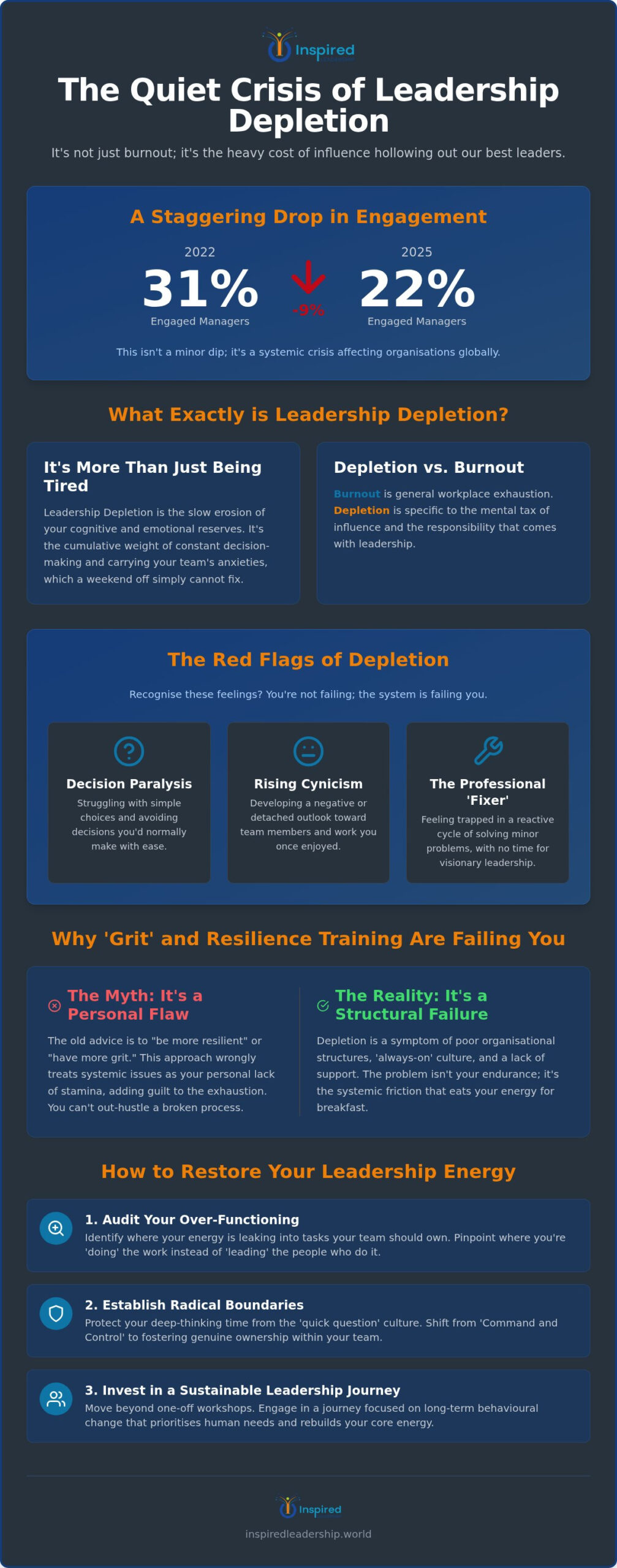
Did you know that global manager engagement plummeted to just 22% in 2025, down from 31% only three years prior? It’s a staggering figure that highlights a quiet crisis currently hollowing out our best workplaces. You likely recognise the feeling of being a professional ‘fixer’ rather than a visionary leader, a common symptom of Leadership Depletion.
It’s perfectly normal to feel drained when you’re constantly battling decision fatigue and watching your brightest stars leave due to burnout. This exhaustion isn’t a personal failure of your stamina; it’s a systemic result of putting processes before people. You deserve a way to lead that doesn’t require you to set your own well-being on fire to keep the organisation warm.
In this article, you’ll discover how to identify the early warning signs of depletion and implement human-centred strategies to restore your energy. We’ll explore practical boundaries that actually stick and show you how to build a leadership culture that supports real human needs. Let’s start the journey toward restoring your passion for leading and your influence within the business.
Key Takeaways
- Identify the specific signs of Leadership Depletion and understand how the heavy weight of influence differs from standard workplace burnout.
- Discover why traditional resilience training and ‘grit’ often fail to solve the systemic issues that drain your most talented leaders.
- Learn how to audit your over-functioning behaviours and establish radical boundaries that finally protect your time for deep, strategic thinking.
- Explore how to design a sustainable leadership journey that prioritises human needs and translates insights into measurable action across the business.
The Quiet Crisis: What is Leadership Depletion?
Leadership Depletion is the slow, silent erosion of your cognitive and emotional reserves. It isn’t just a bad week; it’s the cumulative weight of carrying every decision and every team member’s anxiety on your shoulders. While occupational burnout covers general exhaustion, depletion is specifically about the heavy cost of influence and the mental tax of constant decision-making.
You might notice the red flags creeping in around 2 pm when the brain-fog hits and you suddenly can’t choose what to have for lunch. Common signs include:
- Decision avoidance or ‘analysis paralysis’ on simple tasks.
- A cynical outlook toward team members you usually adore.
- Feeling like a professional ‘fixer’ rather than a leader.
This happens because you care deeply, but you’ve likely been wearing a lack of boundaries like a badge of honour.
Why Your 2026 Strategy is Draining You
In our always-on culture, medium-sized enterprises often expect leaders to be the ultimate problem-solvers at all hours. This constant cognitive load creates a systemic friction point that traditional training simply ignores. When you’re the primary fixer for every minor hiccup, your capacity for high-level strategic thinking evaporates, leaving you reactive rather than proactive.
The Difference Between Tired and Depleted
If you’re tired, a long sleep on Saturday usually does the trick. However, Leadership Depletion is a different beast that requires a fundamental shift in your leadership behaviour. A weekend away won’t fix a system that lacks support, which is why we focus on the Human Factor Journey to restore your core energy.
Why ‘Grit’ and Resilience Training are Failing You
We’ve been told for decades that the answer to workplace stress is more ‘grit’. If you’re feeling the heavy fog of Leadership Depletion, being told to just be more resilient feels like being handed a thimble to bail out a sinking ship. Traditional one-off workshops fail because they treat your exhaustion as a personal flaw rather than a structural failure.
Many of you fell into the ‘Specialist-to-Leader Trap’, where your technical brilliance got you promoted, but you were never actually supported to lead. You can’t pour from an empty cup, regardless of how many ‘productivity hacks’ you try to jam into your calendar. It’s time to stop gritting your teeth and start looking at the system that’s draining you.
The Myth of the Corporate Superhero
Trying to own every single output doesn’t make you a hero; it makes you a bottleneck. To save your sanity, you must move from ‘doing’ the work to ‘leading’ the people who do it. This shift isn’t just about delegation; it’s about reclaiming your mental space from the minutiae of daily tasks.
You can start by taking a leadership assessment to pinpoint exactly where your energy is leaking. Identifying these drain points is the first step toward moving away from the ‘superhero’ complex that is currently hollowing you out. You deserve to lead without feeling like the world’s weight rests solely on your shoulders.
Systemic Friction vs Personal Stamina
Your organisation needs a structured journey, not a quick-fix session that barely scratches the surface of behavioural change. If you’re ready to stop the drain and build something that actually lasts, feel free to get in touch with us. Let’s move beyond the band-aid approach and design a way of leading that actually supports your human needs.
Practical Strategies to Restore Your Leadership Energy
Overcoming Leadership Depletion requires more than just a holiday; it demands a strategic overhaul of how you show up. First, audit your ‘human’ skills to see where you are over-functioning and doing the work your team should actually own. This audit helps you spot exactly where your energy is leaking into tasks that don’t require your seniority.
Secondly, establish radical boundaries that protect your deep-thinking time from the constant ‘quick question’ culture. This shift allows you to move away from ‘Command and Control’ and toward fostering a genuine ownership mindset amongst your staff. When your team owns their outcomes, you finally stop being the primary bottleneck for every minor decision in the office.
Reframing Your Role: From Fixer to Catalyst
Technical experts often quit management because they feel like glorified babysitters rather than strategic leaders. You can change this trajectory by shifting your identity from the ‘fixer’ who has all the answers to the ‘catalyst’ who empowers others to find them. If you’re ready to make that shift, explore our Manager to Leader Journey to see how we help technical talent thrive in leadership.
The Power of Human-Centred Boundaries
Saying ‘no’ isn’t a sign of weakness; it is a strategic leadership competency that protects your most valuable asset: your energy. You can be an empathetic, compassionate leader whilst still maintaining firm limits on your availability for non-essential interruptions. Protecting your headspace ensures you have the emotional reserves to support your team effectively when high-stakes moments actually arrive.
In addition to these boundaries, exploring specialised support like hypnotherapy Dubai can help you reset your emotional baseline and develop the mental resilience needed for sustained high-level performance.
Designing a Sustainable Leadership Journey for Your Team
Medium-sized enterprises often struggle because they lack a scalable way to build leadership capability across the board. You cannot rely on a handful of heroic individuals to carry the entire load whilst everyone else waits for instructions. This imbalance is exactly what fuels systemic Leadership Depletion throughout your management tiers.
Our philosophy at Inspired Leadership is grounded in 20 years of corporate reality, focusing on results-driven journeys rather than theoretical fluff. We believe in building a structured path that translates individual growth into measurable organisational performance. It is time to stop treating leadership as an optional extra and start seeing it as the primary engine of your business.
Translating Insight into Organisational Action
Leadership development only matters if it changes how your people behave when the pressure is on. You need a process that ensures new insights actually lead to tangible outcomes on the shop floor or in the boardroom. For those ready to move past traditional hierarchies, our Beyond Command Journey offers a radical alternative to the old ways of working.
Building the Talent Pipeline of the Future
You can take the first step today by visiting our Manager to Leader Journey page. We encourage you to download the brochure to see how we help your team move from technical experts to confident, human-centred leaders.
Stop waiting for a miracle or a “quiet” month that will never actually arrive. You have the power to build a sustainable path forward right now, so let’s get on with it.
Leadership isn’t a technical endurance test. You’ve seen how relying on grit alone leads to Leadership Depletion, a state that sleep simply cannot cure. Our human-centred approach, backed by 20 years of corporate experience, prioritises your energy as a strategic asset rather than a disposable resource.
By shifting your identity from a ‘fixer’ to a ‘catalyst’, you create the necessary space for your team to own their outcomes. This insight-to-action methodology ensures that your organisational changes are sustainable rather than just temporary sticking plasters. You deserve a leadership culture that respects your humanity whilst delivering high-level results.
Stop setting yourself on fire to keep the office warm. It is time to choose a more disciplined, battle-tested path that restores your passion for leading. You’ve got this, and we are ready to help you navigate the way.
Frequently Asked Questions
What is the primary cause of leadership depletion in 2026?
The primary cause is a systemic failure to support managers, combined with an “always-on” culture. In 2026, Eagle Hill Consulting found that 48% of workers cite overwhelming workloads as their top burnout driver. This constant cognitive load leads to Leadership Depletion because organisations prioritise processes over human needs. It is a direct result of treating leaders like technical output machines instead of people.
How is leadership depletion different from professional burnout?
Burnout is a general state of exhaustion, but leadership depletion is specifically tied to the mental tax of constant decision-making and influence. It is the erosion of your cognitive reserves caused by being the primary ‘fixer’ for everyone else. Whilst a holiday might help with general burnout, depletion requires a fundamental shift in how you lead and protect your mental space from constant interruptions.
Can a leadership journey really fix emotional exhaustion?
Yes, provided the journey focuses on behavioural change rather than dry theory. Our methodology moves you from a reactive ‘fixer’ to a strategic catalyst, which naturally reduces emotional strain. By building an ownership mindset in your team, you stop carrying the emotional weight of every single task. This allows your reserves to refill whilst the organisation continues to thrive and hit its performance targets.
How do I tell my boss that I am feeling depleted without sounding weak?
Frame the conversation around organisational performance and sustainability rather than personal feelings. Explain that your current cognitive load is creating a strategic bottleneck that hinders the team’s growth. You aren’t asking for a lighter load because you’re ‘weak’; you’re suggesting a more effective leadership model. This ensures long-term results and prevents high-potential talent from leaving the business due to avoidable exhaustion.
What are the first signs that my management team is suffering from depletion?
Look for increased absenteeism, a drop in creative problem-solving, and a noticeable retreat into purely administrative tasks. If your managers are constantly ‘firefighting’ instead of planning for the future, they are likely suffering from Leadership Depletion. Other red flags include high-potential talent resigning suddenly or a general sense of apathy during meetings that used to be full of energy and creative spark.