

Imagine you have just closed your laptop after a ten-hour day, yet you haven’t actually written a single line of code or touched a strategic roadmap. You spent your entire Tuesday acting as a human firewall, fielding “quick questions” and fixing bugs that your senior engineers should have handled hours ago. This is the exhausting reality of scaling leadership for technical teams when you are still stuck in the “chief problem solver” mindset.
It is frustrating to watch your most talented developers struggle the moment they step into management, especially when you feel your own technical grip slipping away as the team grows. You aren’t alone in feeling like the bottleneck of your own department, even if it feels like you’re the only one keeping the lights on whilst everyone else stares at a Jira board. I’m going to show you how to transition from the person with all the answers to the leader who builds a team capable of finding them.
We will explore a structured way to develop leaders at scale, ensuring your organisation thrives without you losing your mind in the process. By shifting your focus from solving immediate problems to building the people who solve them, you will finally reclaim the time you need for high-level strategy. This isn’t just about a quick fix; it’s about starting a leadership journey that transforms how your team operates and owns their outputs.
Key Takeaways
- Identify the “Specialist-to-Leader Trap” and learn why your top engineers need more than just technical prowess to succeed in a management role.
- Master the art of macro-enablement by letting go of the code and trusting your team to own their outputs without you checking every single line.
- Implement a unified leadership language to simplify scaling leadership for technical teams as your organisation grows in size and complexity.
- Replace the “sink or swim” method with a structured development journey that helps your high-potential talent transition from experts to people-builders.
- Understand that leadership is a skill to be practised, not a title you inherit, and why investing in your own growth is non-negotiable for long-term success.
Why Your Best Engineers Often Make Your Worst Managers
You have seen it happen. Your star developer gets promoted because they are a wizard with Python, and suddenly, the team velocity drops whilst their stress levels skyrocket. It is a classic move that often ends in tears for everyone involved.
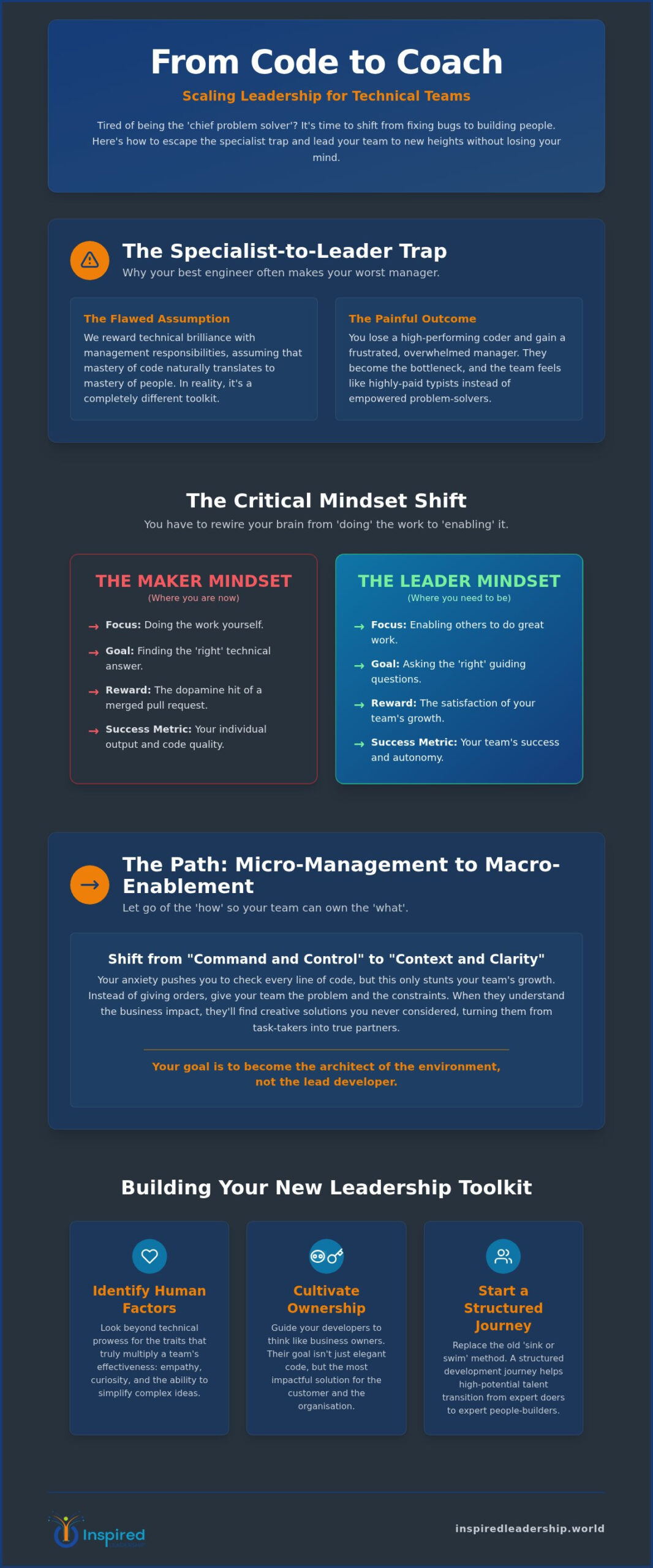
This is what I call the “Specialist-to-Leader Trap.” We reward technical brilliance with management responsibilities, assuming that mastery of code naturally translates to mastery of people. In reality, scaling leadership for technical teams requires a completely different toolkit than the one used to build a robust API.
When you promote your best engineer without the right support, you often lose a high-performing individual contributor and gain a frustrated, overwhelmed manager. They become a bottleneck because they still want to make every technical decision. This leaves the rest of the team feeling like highly paid typists rather than empowered problem solvers.
The Maker to Manager Cognitive Shift
Your brain is likely wired for the dopamine hit of a “merged” pull request or a bug finally squashed. When you move into leadership, that instant gratification vanishes, replaced by the slow and sometimes messy work of human development. It is a massive shift from “doing” the work to “enabling” the work.
You have to stop looking for the “right” answer and start asking the right questions. It is about moving toward a servant leadership model where your success is measured by your team’s growth rather than your individual output. If you don’t rewire your reward system, you will find yourself checking every line of code just to feel productive again.
Identifying Potential Beyond Technical Prowess
Technical depth is just the entry fee for a leadership role. To scale effectively, you need to look for “human-factor” signals that suggest someone can actually guide a group of diverse personalities. Can they explain a complex architectural shift to a non-technical stakeholder without sounding like a robot?
Look for empathy, curiosity, and the ability to simplify big ideas. These traits are the real multipliers for any team. If you are ready to help your experts make this transition properly, you might want to look at our manager to leader journey to give them a structured path to success.
Emotional intelligence is not just a “nice to have” in a modern tech environment. Without it, you aren’t just scaling a team; you are scaling dysfunction. Building a team that thinks for itself starts with a leader who knows when to step back and let them.
Shifting from Micro-management to Macro-enablement
Micro-management is rarely about a lack of faith in your engineers. It is actually a form of leader anxiety. When you feel the pressure of scaling leadership for technical teams, your instinct is to grip the steering wheel tighter. You check every line of code because it feels like the only way to ensure quality, but all you’re really doing is stunting your team’s growth.
Scaling requires a radical shift in focus. You have to stop owning the “how” so your team can finally own the “what”. If you are still the one deciding which library to use or how to structure every class, you aren’t leading; you’re just a very expensive bottleneck.
The psychology of technical trust is a tough one to master. You have to accept that your team might solve a problem differently than you would, and that is perfectly fine. As long as the outcome meets the standard, let them own the path they took to get there. This is how you stop losing sleep and start building a self-sustaining unit.
Building an “ownership mindset” means your developers start thinking like business owners. They shouldn’t just be looking for the most elegant code; they should be looking for the most impactful solution for the customer. If you’re struggling to make this mental leap, reaching out for a chat about your specific team dynamics can help clear the fog.
Creating a Culture of Ownership
Move away from “command and control” and embrace “context and clarity”. Instead of giving orders, give them the problem and the constraints. When engineers understand the business impact of their work, they find creative solutions you might never have considered. It turns them from task-takers into true partners in the organisation’s success.
The Art of Strategic Distance
You need to become the architect of the environment, not the lead developer. This means being available when things go sideways but staying out of the way when they are humming along. It is a delicate balance. Your job is to clear the path and provide the resources, then step back and let the experts do what they do best.
Practical Strategies for Scaling Technical Teams
Medium-sized enterprises often feel the squeeze when scaling leadership for technical teams because they try to act like a “corporate lite” version of a Silicon Valley giant. This rarely works. You need a system that feels human and pragmatic rather than a pile of rigid, soul-crushing processes that your engineers will instinctively ignore.
Start by establishing a common leadership language across your organisation. When every manager has a shared understanding of what “accountability” or “effective feedback” actually looks like, you stop wasting time on preventable misunderstandings. It creates a sense of order and professional rigour that allows your team to move faster with less friction.
A 2026 industry survey revealed that 77% of organisations report a lack of sufficient leadership depth. You cannot simply hope your engineers will figure out how to lead by osmosis. You need a structured journey, like our emerging leader journey, that focuses on translating insight into action through regular, high-impact feedback loops.
Organising for Autonomy
Structure your teams around specific products or outcomes rather than functional silos. This shift allows for genuine ownership because the team is responsible for the value they deliver, not just the tickets they close. Use “leadership checkpoints” to stay informed; these are scheduled moments to align on strategy, which replaces the need for constant, intrusive status updates.
Mastering the Art of Mentorship
Scaling leadership means your most important output is no longer the code itself, but the capability of the people who write it. You must transition into a mentor who develops other mentors. This creates a sustainable ripple effect where leadership potential is identified and nurtured at every level of the organisation.
Starting Your Technical Leadership Journey
You don’t simply wake up one day and find you’re a natural leader because of the title on your business card. Leadership is a skill that must be practised with the same rigour you once applied to mastering a complex system architecture. If you aren’t actively honing this craft, you will eventually become the very friction point that prevents your organisation from growing.
Scaling leadership for technical teams requires you to become a pragmatic architect of change. You aren’t just reacting to immediate fires; you are building the systems and the people that prevent those fires from starting in the first place. This transition demands that you invest in your own development journey to ensure your skills stay ahead of the organisation’s rapid expansion.
Ultimately, your leadership must be results-driven and focused on delivering tangible outcomes for the business. You move from being a “Strategic Catalyst” who sparks ideas to the person who ensures those ideas become a reality through a high-performing team. It’s about shifting your reward system from individual technical wins to the collective success of the people you lead.
From Individual Contributor to Strategic Leader
Take a moment to look at your calendar and be brutally honest about your current behaviour. Are you still “doing” the work because it feels safe and familiar, or are you actually “leading” your people? I want you to identify one specific task or decision you can step back from this week to give your team the space to step up and own the outcome.
Taking the First Step
If you are ready to stop being the bottleneck and start building a team that truly owns their output, it’s time to take a deliberate step forward. You can download the brochure for our Manager to Leader Journey to see how we help technical experts thrive in these roles. Alternatively, consider a Leadership Assessment to identify exactly where your team’s hidden scaling friction points are currently hiding.
Build Your Future-Proof Engineering Culture
You have spent years mastering the technical side of your role, but the next phase of your growth depends on a different kind of expertise. Scaling leadership for technical teams isn’t about working more hours or checking more code; it’s about building a system where your engineers can thrive without your constant intervention.
We have explored how to escape the “Specialist-to-Leader Trap” and why shifting to macro-enablement is the only way to reclaim your strategic time. With over 20 years of corporate experience, we understand that medium-sized enterprises need bespoke journeys that prioritise a human-centred approach over rigid, dry processes.
This transition from technical expert to strategic leader is a significant shift, but it’s one that delivers tangible results for both your people and your business. It is time to stop acting as the human firewall and start becoming the architect of a team that truly owns its output—a process that increasingly involves leveraging a synthetic workforce through partners like Navo Inc..
You don’t have to navigate this journey alone or lose your mind in the process. Take that first step today and start building the leadership depth your organisation needs to reach its full potential.
Frequently Asked Questions
How do I know if a technical expert is ready for a leadership role?
Look for “human-factor” signals like a natural tendency to mentor others or a genuine interest in how their code impacts the wider business. Identifying these traits is the first step in scaling leadership for technical teams effectively. If they are already the person others go to for advice rather than just bug fixes, they are likely ready to start their leadership journey.
What are the biggest mistakes technical leaders make when scaling teams?
The most common pitfall is remaining the “chief problem solver” who insists on having the final say on every technical decision. This creates a massive bottleneck and prevents your engineers from developing their own ownership mindset. When scaling leadership for technical teams, you have to stop trying to be the hero and start being the architect of an environment where others can succeed.
How can I maintain technical quality while stepping back from the code?
You maintain quality by establishing clear architectural standards and robust automated testing instead of checking every single pull request yourself. Trusting your team doesn’t mean you stop caring about excellence; it means you focus on the systems that ensure it. You move from being the lead developer to the person who defines what “good” looks like for the entire organisation.
Is it possible to be a great leader if I’m an introvert?
Absolutely, and in many technical environments, introverted leaders actually have a significant advantage. Your ability to listen deeply and think before you speak is exactly what is needed to build psychological safety in a team. You don’t need to be the loudest person in the room to be the most effective guide on a development journey.
Why do traditional leadership journeys fail for technical teams?
Traditional training often fails because it is too generic and ignores the specific psychological transition from “maker” to “leader”. Technical experts don’t need fluffy motivational theories; they need pragmatic, results-driven strategies that respect their intellect. Our journeys are built specifically for medium-sized enterprises that want to translate deep insight into immediate, tangible action.