
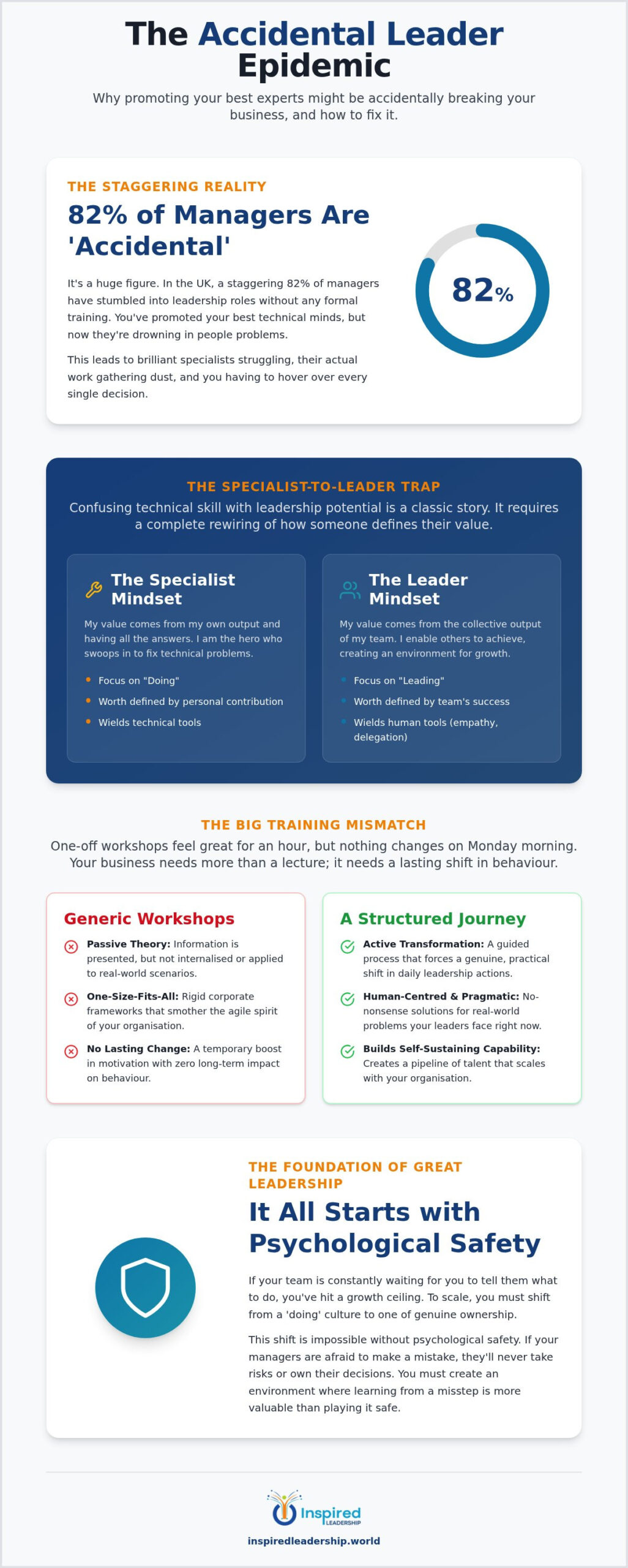
Did you know that 82% of managers in the UK are essentially “accidental” leaders who have never received formal training? It’s a staggering figure that explains why scaling leadership capability in SMEs often feels like trying to build a skyscraper on a foundation of shifting sand. You’ve likely promoted your best technical experts only to find them drowning in people problems whilst their actual work gathers dust.
It’s exhausting to watch brilliant specialists struggle with the transition from doing to leading, especially when traditional, off-the-shelf courses fail to stick. You deserve a self-sustaining leadership pipeline that functions without you having to hover over every single decision or output. This article explores how to transform those experts into confident leaders and build a culture of ownership that scales with your organisation.
We’ll examine why generic training fails and how a structured, human-centred journey creates tangible results that justify your investment. Prepare to move past the “doing” culture and start building the strategic leadership your business actually needs to thrive.
Key Takeaways
- Stop throwing budget at generic workshops and discover why a structured journey is the key to making leadership skills actually stick on a Monday morning.
- Learn how to help your technical wizards navigate the specialist-to-leader trap by embracing the mindset shift required to lead people.
- Master the three-step framework for scaling leadership capability in SMEs to replace a “doing” culture with one of genuine ownership.
- Identify exactly which leadership journey fits your team’s current needs to build a pipeline of talent that grows with your organisation.
Why Traditional Training Fails Your Growing Business
You’ve likely felt that sinking feeling after a team workshop where everyone is fired up for an hour, only to return to their desks and change absolutely nothing. Traditional, off-the-shelf training often feels like wearing a suit three sizes too big; it’s restrictive, awkward, and clearly not made for your specific shape. When scaling leadership capability in SMEs, you need a fit that respects your agility rather than smothering it with rigid corporate frameworks.
There is a massive difference between sitting through a lecture on management theory and embarking on a genuine leadership development journey. Theory is passive, whilst a journey is active, forcing a shift in behaviour that actually lasts. As your business expands, you’ll often find that the very experts who helped you start are now struggling to manage the complexity of a larger team.
By 2026, your most significant competitive advantage won’t be your tech or your pricing, but your human skills. Developing leaders who can empathise, communicate, and inspire is the only way to ensure your growth is sustainable. It’s about moving from a culture of “doing” to a culture of “leading” to unlock your full potential.
The Big Corporate Training Mismatch
Rigid, process-heavy training can accidentally kill the nimble spirit that made your organisation successful in the first place. Your leaders don’t need more corporate jargon or complex charts that look good in a boardroom but fail on the shop floor. They need pragmatic, no-nonsense solutions that solve real-world problems in real-time.
At Inspired Leadership, we bring 20 years of corporate experience to the table to ensure you avoid these common pitfalls. Our manager to leader journey focuses on translating deep insights into immediate action. This ensures your scaling leadership capability in SMEs isn’t just a goal, but a reality.
The Specialist-to-Leader Trap: Why Expertise Is Not Enough
It’s a classic SME story. You have a brilliant engineer or a star salesperson, so you reward their hard work with a promotion to manager. Yet research shows companies fail to choose the right management talent 82% of the time, often because they confuse technical skill with leadership potential.
This happens because the psychological shift from individual contributor to people leader is massive. Scaling leadership capability in SMEs requires more than just a new job title; it demands a complete re-wiring of how someone defines their value. It’s no longer about what they can do, but what they can enable others to achieve.
When you’re a specialist, your worth comes from your own output. As a leader, your worth comes from the collective output of your team. It’s a terrifying transition for high performers who are used to being the smartest person in the room and having all the answers.
From Technical Expert to People Leader
Most new managers suffer from a bit of a hero complex. They think they need to swoop in and save the day whenever a technical problem arises, which is essentially just micromanagement with a cape on. It’s an exhausting way to work and it eventually stifles the growth of everyone involved.
True leadership involves trading your technical tools for human ones like empathy, active listening, and the art of delegation. If you want your managers to stop “doing” and start “leading,” you can chat with us about your team’s needs today. We’ll help you identify where the friction is holding you back.
We’ve designed the Manager to Leader Journey specifically to bridge this gap. It provides the roadmap your technical talent needs to let go of the “doing” and embrace the “owning.” You’ll see them transform from stressed-out specialists into confident, capable leaders.
You can even download the journey brochure to see exactly how we help your experts find their feet. Scaling leadership capability in SMEs doesn’t have to be a gamble if you have a structured, battle-tested support system in place.
Building a Culture of Ownership in Three Steps
If your team is constantly waiting for you to tell them what to do, you’ve hit a growth ceiling. Scaling leadership capability in SMEs requires a shift from a “doing” culture to one of genuine ownership where people take the initiative. It’s the difference between a team that follows orders and a team that solves problems before they even reach your desk.
This shift cannot happen without psychological safety. If your managers are afraid to make a mistake, they’ll never take ownership of their outputs. You need to create an environment where learning from a misstep is more valuable than playing it safe and doing nothing.
Not sure where your team stands? You can use our Leadership Assessment to identify exactly where the ownership gaps are hiding in your organisation.
Moving from Doing to Leading
First, you must define what ownership actually looks like in your specific context. Don’t just use vague buzzwords; tell them exactly what behaviours you want to see. Is it taking charge of a project budget or deciding when to hire a new team member?
Next, equip your managers with the human skills to coach rather than micromanage. It’s tempting to jump in and “fix” things, but that just creates dependency and adds a few unnecessary grey hairs to your head. Teach them to ask “What do you think we should do?” instead of giving the answer.
Finally, align your senior leadership team to model these behaviours. If the top brass doesn’t show ownership, why should anyone else? Scaling leadership capability in SMEs starts at the top and trickles down through every layer of the business. For businesses ready to scale, The Greater Change provides the tailored HR consulting necessary to build these foundations into your organisational structure.
You can’t give a senior executive the same toolkit you’d give a fresh graduate. Scaling leadership capability in SMEs requires a nuanced approach that identifies exactly where your talent pipeline is currently leaking. Whether you’re supporting first-time managers or seasoned directors, the intervention must match the specific challenges of their role.
It’s time to stop thinking in terms of one-off workshops that are forgotten by Tuesday lunchtime. A journey is a transformational experience that allows for sustained behavioural change over time. It’s about building a legacy, not just ticking a box on an HR spreadsheet to make yourself feel productive.
For instance, the Ignite Her Leadership Journey is a specialised accelerator designed to scale diversity and capability simultaneously. This isn’t just about leadership theory; it’s about addressing the specific dynamics that high-potential women face in growing organisations. It provides the support needed to turn potential into tangible impact.
Why a Journey Beats a One-Off Workshop
Scientific research on the forgetting curve shows that we forget nearly 70% of new information within 24 hours if we don’t apply it. A sustained journey overcomes this by integrating learning into the daily workflow and providing space for real-world feedback. You don’t just learn about leadership; you actually start leading in a way that sticks.
The Human Factor in Scalable Growth
Ultimately, prioritising people over rigid processes leads to significantly better commercial outcomes for your business. When you invest in the human side of scaling leadership capability in SMEs, you create a self-sustaining engine for growth. It’s about building an organisation that people actually want to work for and stay with for the long haul.
If you’re ready for a no-nonsense conversation about your team’s future, please contact Inspired Leadership today. We’d love to help you design a path that truly fits your business and your people.
Transform Your Technical Experts into Confident Leaders
It’s time to stop letting your brilliant people drown in the specialist-to-leader trap whilst you hover over every single decision. Genuine success in scaling leadership capability in SMEs comes from moving beyond superficial workshops and focusing on the human skills that actually drive commercial growth. You deserve a team that doesn’t just “do” work but actively “owns” the future of your business.
By ditching the corporate jargon and embracing a structured journey, you equip your managers with the confidence to take full ownership of their results. We bring 20 years of corporate expertise to ensure your team gets practical, results-driven support that sticks long after the first session ends. It’s about building a self-sustaining pipeline of talent that scales as fast as you do.
You’ve worked too hard building this organisation to let a lack of leadership capability hold you back. Let’s build a culture of ownership that allows you to step back and watch your team truly thrive.
Frequently Asked Questions
How do you develop leaders in a medium-sized company?
Developing leaders in a mid-sized firm requires a shift from passive learning to active behavioural change. You must identify high-potential talent early and provide them with a structured journey that focuses on human skills like empathy and delegation. This approach ensures scaling leadership capability in SMEs is sustainable, creating a pipeline of talent that grows alongside your organisational complexity rather than lagging behind it.
What is the difference between a leadership course and a leadership journey?
A leadership course is typically a one-off event where information is delivered but rarely applied, leading to a massive loss of knowledge within 24 hours. In contrast, a leadership journey is a transformational experience that spans several months, allowing for real-world application and feedback. It’s about building lasting habits and shifting mindsets rather than just ticking a box on a training spreadsheet.
How do you stop technical experts from failing as managers?
You stop the rot by addressing the hero complex and helping them trade their technical tools for people-focused ones. Most experts fail because they try to do the work rather than lead the people doing it. By enrolling them in a dedicated journey, you provide the psychological safety and practical framework they need to let go of the tools and embrace their new identity as a leader.
What is the ROI of leadership development for growing businesses?
The ROI of scaling leadership capability in SMEs is found in increased productivity and a culture of ownership that frees up senior executives. Poor management currently costs the UK economy billions in turnover and disengagement, so investing in human skills pays for itself through reduced recruitment fees. When your managers actually manage, you stop wasting money on accidental leaders who are essentially just expensive individual contributors. To further support this growth, businesses in Malaysia can rely on LBCO Advisory Sdn Bhd to handle the technicalities of employer tax compliance and reporting.
Absolutely, because people don’t leave companies; they leave managers who don’t support their growth. Employees working under poorly rated managers are four times more likely to quit, making leadership quality the primary driver of retention. By investing in a leadership journey for your team, you create an environment where people feel valued and challenged, which keeps your best talent from looking elsewhere.