

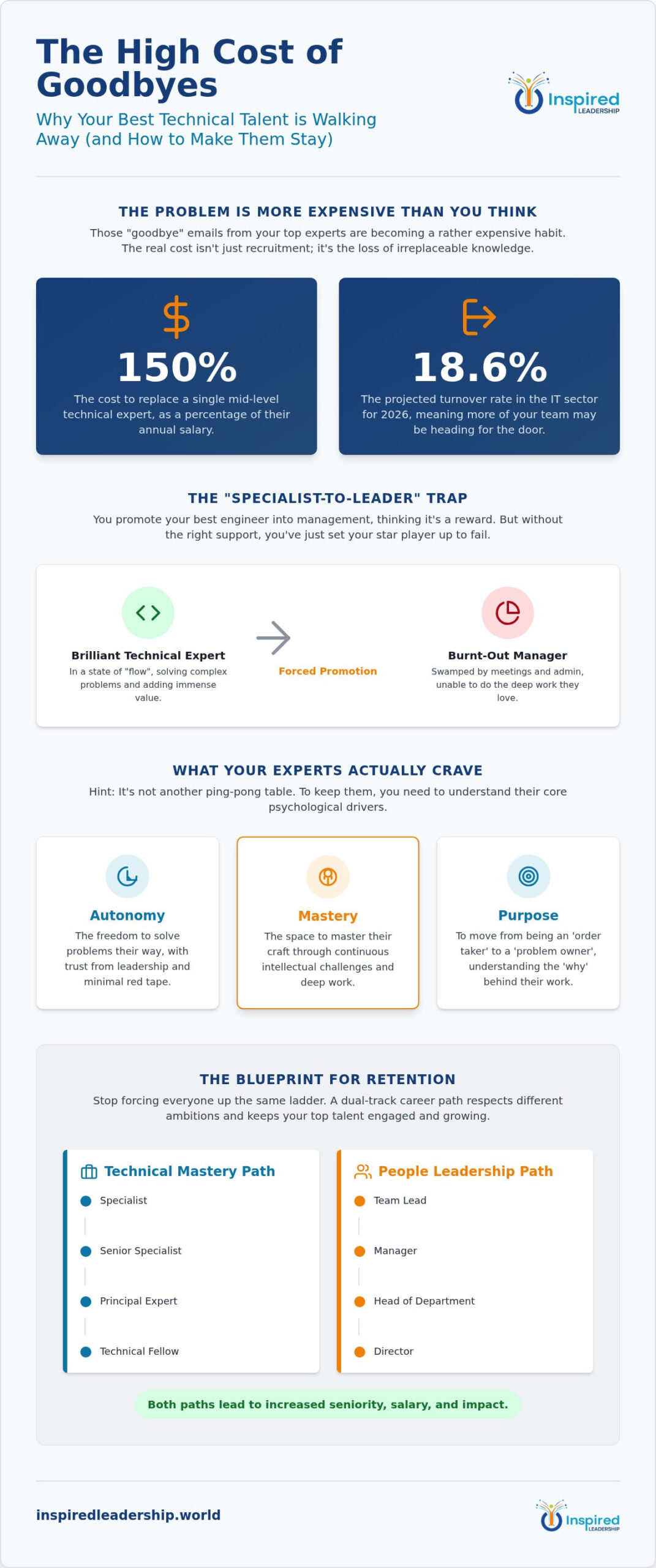
Did you know that losing a single mid-level technical expert can cost your business up to 150% of their annual salary? In 2026, with turnover in the IT sector climbing to 18.6%, those “goodbye” emails are becoming a rather expensive habit you simply can’t afford to keep. It is time to stop the bleeding and look at why retaining high potential technical staff has become such a complex puzzle for even the best-run organisations.
It is incredibly frustrating to watch your most brilliant minds walk out the door just as they become truly indispensable. You have likely felt the sting of losing that deep institutional knowledge, leaving you with a gaping hole that no amount of frantic recruitment can quickly fill. You want a stable, high-performing team, not a revolving door that eats your budget for breakfast whilst you scramble for a replacement.
In this article, you will discover why your best people are actually leaving and how to organise a culture that keeps them engaged and motivated. We will explore the shift from the “specialist-to-leader” trap to a structured journey that turns your experts into the visionaries you need. It is time to move beyond guesswork and start building a team that actually stays for the long haul.
Key Takeaways
- Stop playing the expensive salary arms race and understand why your specialists are your organisation’s most valuable intellectual capital.
- Master the art of retaining high potential technical staff by offering dual-track career paths that respect their need for deep focus and autonomy.
- Learn how to use a Leadership Assessment to spot your future stars and fix the broken feedback loops that are currently driving them away.
- Discover a no-nonsense leadership journey that turns technical experts into effective leaders without making them endure “cringe-worthy” traditional training.
The Real Reason You Are Losing Your High-Potential Technical Staff
Your high-potential technical staff are the brilliant specialists who hold the keys to your organisation’s intellectual kingdom. They aren’t just “good at their jobs”; they’re the people who understand the legacy code and the “why” behind your most complex systems. Losing them means losing years of institutional knowledge that you simply can’t replace with a quick job advert.
The real culprit is often the “Specialist-to-Leader Trap.” We take a brilliant engineer, give them a shiny new title, and expect them to manage people without any real support. It’s a recipe for burnout and resentment, making retaining high potential technical staff almost impossible when they feel set up to fail by traditional HR processes; in such cases, consulting with experts like Pioneer HR can help you redesign these frameworks for better results.
Why Money Is Not the Retention Magnet You Think It Is
Salary is really just a “hygiene factor.” It has to be fair to get people in the door, but it’s rarely the thing that keeps them there when a cheeky recruiter calls. Effective employee retention strategies focus on what actually makes a technical brain tick: autonomy, mastery, and purpose.
These specialists want the freedom to solve problems their way and the space to master their craft. They’re looking for a human factor journey that acknowledges their need for deep work rather than endless, soul-sucking meetings. For a true technical expert, the pure joy of cracking a “near-impossible” problem will always beat a free office ping-pong table.
Cracking the Code: What Technical Experts Actually Need to Stay
Technical experts don’t typically view their careers as a climb up a traditional corporate ladder. They see it as a pursuit of mastery. If your only way to reward brilliance is a promotion into management, you’re effectively punishing your best specialists by taking away their keyboards.
Successful strategies for retaining high potential technical staff require a dual-track career path. This allows your experts to advance in seniority and salary whilst remaining firmly in their technical lane. It respects their specific psychological drivers and keeps them engaged in the work they actually love doing.
This focus on technical career progression is a hallmark of specialist organisations like PLM-Sme FZC, where industrial digitalisation experts are empowered to deepen their skills in Product Lifecycle Management rather than being forced into administrative roles.
Bureaucracy is a silent killer of technical engagement because it increases unnecessary cognitive load. When your experts spend more time navigating red tape than solving problems, they lose their sense of purpose. Creating a culture of psychological safety where they can “fail fast” and experiment is vital for long-term loyalty.
The Need for Continuous Intellectual Challenge
You must provide growth opportunities that don’t involve a spreadsheet or a budget meeting. Stretch assignments that allow specialists to flex their technical muscles on high-stakes projects keep the work fresh and exciting. It’s about ensuring they are on a meaningful journey that prioritises intellectual growth over administrative box-ticking.
Building a Culture of Technical Ownership
Experts thrive when they feel responsible for the “why” and not just the “how” of a project. Moving them from being “order takers” to “problem owners” transforms their relationship with the business. You can explore how to better understand these team dynamics and retaining high potential technical staff through The Human Factor journey.
If you’re struggling to balance these tracks, feel free to get in touch with us for a chat about your team’s specific needs.
Practical Strategies for Organising a Culture Tech Talent Will Not Want to Leave
Creating a culture that sticks requires more than a fancy coffee machine or a Friday afternoon beer fridge. You need a systematic approach to retaining high potential technical staff that actually respects how they work. It starts with identifying who your true stars are before they start polishing their CVs.
Step one is to conduct a Leadership Assessment to pinpoint your high-potentials with surgical precision. Once you know who they are, you must redesign your feedback loops to be frequent and technically grounded. Vague annual reviews won’t cut it for someone who lives for specific, data-driven outcomes.
Instead of one-off workshops that are forgotten by Tuesday, invest in structured journeys that allow for real behavioural change. You should mentor your experts in “soft” skills like communication whilst maintaining absolute respect for their “hard” technical expertise. It’s about adding tools to their belt, not replacing the ones they already value.
Moving from Command and Control to Empowerment
Micromanagement is the fastest way to see your best developer quit in a huff. They need the autonomy to make decisions within their domain of expertise without looking over their shoulder. The Beyond Command journey provides a solid framework for transitioning your managers into modern, empowering leaders.
Creating a Mentorship Pipeline
Pairing your senior technical staff with high-potential juniors builds deep institutional loyalty that money cannot buy. Here’s the cheeky truth: you’re not just building leaders, you’re building a legacy that keeps the business running. It turns your experts into mentors who feel a personal stake in the team’s future success.
Transforming Your Specialists into Leaders Without Losing Their Soul
Let’s be honest: most leadership training feels a bit “cringe” to someone who spends their day in logical, technical systems. Sitting in a circle to discuss abstract “vibes” isn’t exactly high on their priority list. If you want to succeed at retaining high potential technical staff, you need a method that respects their intelligence and speaks their language.
Our approach is unapologetically pragmatic and results-driven. We bridge the gap with the Manager to Leader journey, which focuses on the human mechanics of leadership without the corporate fluff. It is designed specifically for those who value efficiency and evidence-based methodologies over superficial jargon.
The Power of Structured Journeys
After 20 years in the corporate trenches, we have learned that one-off training workshops are a colossal waste of everyone’s time. They provide a temporary spark but rarely lead to lasting change once the Monday morning emails start piling up. Real transformation only happens through “journeys” that allow time for insight to translate into consistent, measurable action.
Our specialised High-Potential Technical Talent journey is a proven method for retaining high potential technical staff whilst preparing them for the next level. You can download the brochure for this specific journey to see exactly how we structure this progression. It ensures your intellectual capital stays right where it belongs rather than walking out the door to a competitor.
Your Next Step in Retention
Every organisation has its own unique talent quirks and specific technical hurdles. You don’t need a generic, off-the-shelf solution; you need a strategy that fits your specific culture and leadership challenges. Let’s have a proper one-on-one conversation to discuss how you can build a stable, high-performing team.
Stop the Revolving Door and Build Your Legacy
You now know that keeping your best people isn’t about winning a bidding war with a global tech giant. It’s about respecting their need for mastery, reducing their cognitive load, and providing a clear path that doesn’t force them into a soul-crushing management role. By focusing on these human drivers, you can transform your culture into one where specialists actually want to stay and lead.
With over 20 years of corporate expertise, we offer a results-driven alternative to traditional training that actually sticks. Our approach is specifically designed for medium-sized enterprises that need a pragmatic way of retaining high potential technical staff without the corporate fluff. You can move beyond quick fixes and start building a stable, high-performing team that carries your institutional knowledge forward.
You have the tools to change the narrative and keep your brilliant minds engaged. It is time to start your own leadership journey and watch your team thrive.
Frequently Asked Questions
How do you identify high-potential technical staff before they decide to leave?
You identify them by looking for those who solve problems before they are asked and mentor others without being told. Use a structured Leadership Assessment to move beyond gut feeling and spot the quiet achievers. Often, the person holding the most intellectual capital isn’t the loudest in the room but the one everyone goes to when things actually break.
Can you retain technical staff without offering the highest salary in the market?
Yes, because whilst money gets people through the door, it rarely keeps them there once the novelty wears off. Focus on retaining high potential technical staff by offering autonomy, mastery, and a sense of purpose. If they feel they are on a meaningful journey and have the freedom to innovate, they’ll stay for the challenge, not just the payslip.
What is the most common mistake managers make when trying to retain engineers?
The biggest blunder is assuming that every great engineer wants to be a people manager. You promote them into a role filled with meetings and spreadsheets, then wonder why they’re miserable and looking for the exit. It’s a classic case of losing a brilliant specialist and gaining a frustrated manager, which is a lose-lose for everyone involved.
How do you balance technical work with leadership development for high-potentials?
You balance it by integrating leadership skills into their daily technical work rather than treating it as a separate chore. Don’t pull them away from their keyboards for a week of boring training. Instead, use a structured journey that allows them to apply new human-centred skills to the technical problems they are already solving in real-time.
Is it possible to keep a high-potential specialist who does not want to manage people?
Absolutely, provided you offer a clear dual-track career path that rewards technical mastery as much as people leadership. You shouldn’t force a brilliant mind to choose between a pay rise and the work they love. By retaining high potential technical staff on a technical fellowship track, you keep their genius in-house without the administrative soul-drain of management.