
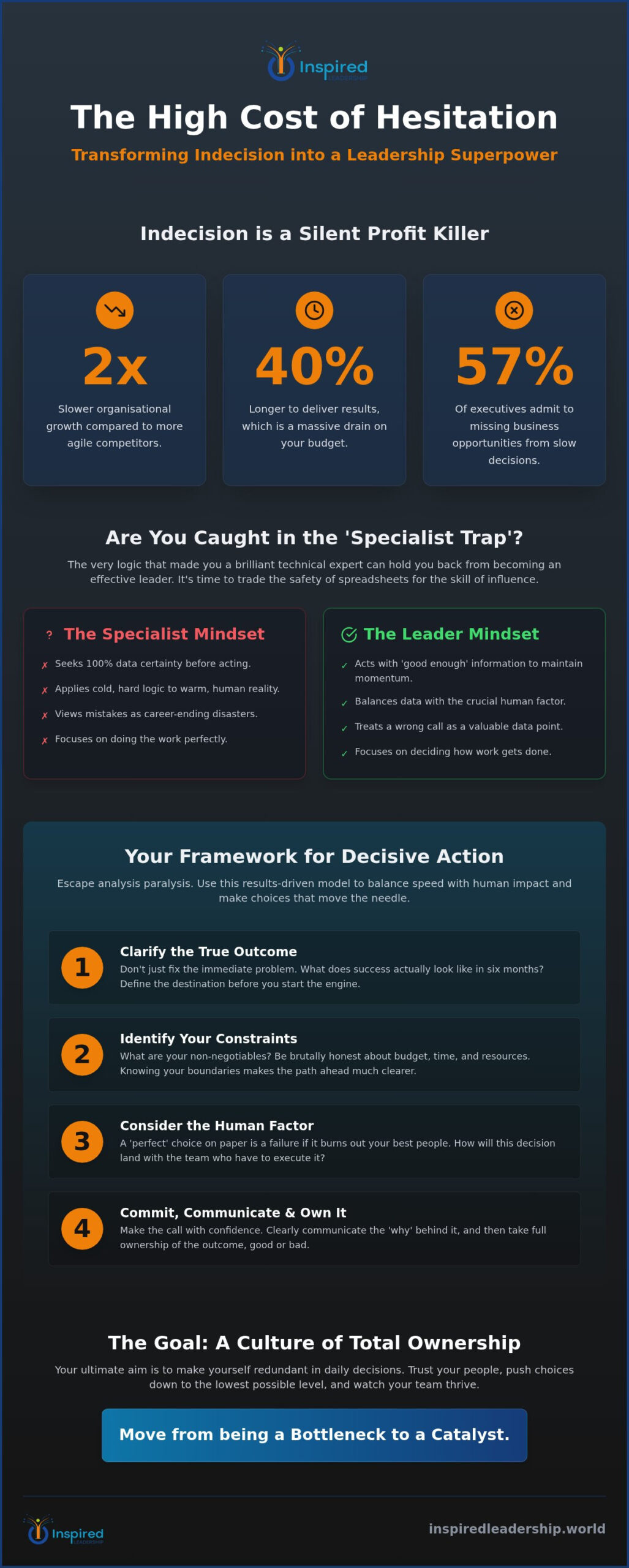
Did you know that organisations with slow decision making cycles underperform in growth by up to two times compared to their agile competitors? According to McKinsey (2025), indecisive teams take 40% longer to deliver results, which isn’t just a bit of a headache; it’s a massive drain on your budget. A PwC Pulse Survey (2025) even found that 57% of executives are currently missing business opportunities because they cannot decide quickly enough.
You likely feel that familiar knot in your stomach when a high-stakes choice lands on your desk, especially with senior executives watching your every move. It’s completely normal to feel trapped by analysis paralysis when the fear of making the wrong call looms large.
We’re going to transform that hesitant management style into the kind of decisive leadership that actually gets things done. This article explores how to master your choices through practical frameworks and a shift in your ownership mindset. You will learn to clear your “decision debt” and build a team that thrives on clarity.
Key Takeaways
- Learn why swift decision making is the true heartbeat of your leadership and how to stop burning cash through analysis paralysis.
- Discover how to escape the “Specialist Trap” by trading your safety blanket of technical logic for the leadership intuition that actually gets results.
- Master a results-driven framework that balances speed with a focus on the human factor, ensuring your choices don’t leave your organisation feeling like a collection of cogs.
- Find out how to build a culture of total ownership, where your team finally stops looking to you for permission to do their jobs.
The Friction of Indecision in Modern Leadership
Think of decision making as the very heartbeat of your organisation. When it stops, everything else flatlines. For medium-sized enterprises, speed isn’t just a luxury; it’s your primary competitive advantage against the slow-moving giants of the industry.
Analysis paralysis is a silent profit killer that stalls momentum and leaves your best people feeling like they’re wading through treacle. Traditional leadership training often focuses on theory but ignores the gritty reality of choosing whilst under intense pressure. You don’t need another textbook; you need a structured journey that turns hesitation into a refined skill.
The Psychology of Choice and Management Fatigue
Ever wonder why your brain feels like a piece of overcooked toast by 3 PM? That is decision fatigue in action. Every tiny choice you make throughout the day eats away at your cognitive reserves, leaving you vulnerable to poor choices later on.
Many managers hide in “data gathering” mode because they are terrified of making a mistake. They think more spreadsheets will provide safety, but they’re actually just creating a bottleneck. Real leadership involves understanding the Decision-making process well enough to act when the data is “good enough” rather than perfect.
If every tiny detail has to pass through your desk, you aren’t leading; you’re a glorified traffic warden. Effective decision making is a muscle that needs regular, disciplined exercise. Moving from a bottleneck to a catalyst is the most liberating shift you will ever make in your career.
Why Technical Experts Struggle with Management Choices
You’ve spent years becoming the go-to person for technical answers. Your spreadsheets are works of art, and your code is usually pristine. But now you’re in a management role, and suddenly, the variables have names, feelings, and a frustrating habit of not following logic. This is the “Specialist Trap,” where you try to apply cold, hard logic to the warm, squishy reality of human behaviour.
In your previous life, you probably wouldn’t ship a product with 30% of the features missing. Now, you’re expected to make a call with only half the information. This obsession with having 100% of the data before acting is a fast track to stagnation. Effective decision making in leadership isn’t about finding the “correct” answer; it’s about making the best choice with the resources you have right now.
The specialist-to-leader friction is essentially a conflict between your desire for technical certainty and your need for organisational influence. You are no longer the person doing the work; you are the person deciding how the work is done. It’s a bit like moving from being the lead guitarist to being the conductor. You have to put down the instrument to pick up the baton.
Moving from Certainty to Influence
Trusting your gut is a key part of decision making when the technical answer isn’t obvious. You need to create an environment of psychological safety where your team knows that a mistake is just a data point, not a career-ending disaster. When people feel safe to fail, they also feel safe to own their choices.
Our manager to leader journey is specifically designed to help technical experts like you bridge this gap. We help you move past the need for perfect data so you can lead with confidence. If you’re feeling stuck in the weeds, why not reach out for a chat about how we can help you transition?
Practical Frameworks to Master Organisational Decision Making
Let’s be honest; a “perfect” decision made three weeks too late is just a very expensive failure. In the fast-paced world of medium-sized businesses, your decision making needs to prioritise momentum over a flawless spreadsheet. You aren’t aiming for a gold star in accuracy; you’re aiming for a result that moves the needle. For businesses looking to optimise their technical data environments with a trusted Microsoft Partner, you can learn more about Momentum Data Labs and their innovative data solutions.
Effective decision making thrives when you use the “Ownership” model, which means pushing choices down to the lowest possible level. If you are still deciding on the office snack budget, you are robbing your team of the chance to grow. Trust your people to own their outcomes whilst you focus on the big-picture strategy. This strategic focus allows you to address larger operational goals, such as reducing non-labour costs with Expense To Profit to drive organisational growth.
This framework ensures you don’t get stuck in the weeds. It’s about balancing speed with human impact.
- Clarify the outcome: Don’t just fix the immediate problem; identify what success actually looks like in six months (not just the immediate fix).
- Identify constraints: Define your non-negotiables, such as budget or time, so you don’t waste energy on impossible solutions.
- Consult the “Human Factor”: Every choice has a ripple effect on your team’s behaviour and morale.
- Commit and communicate: Once you’ve picked a path, share it with absolute clarity so everyone knows their role.
Mitigating Cognitive Bias in the Boardroom
Your brain is a bit of a trickster. It loves confirmation bias, which is just a fancy way of saying you only listen to people who already agree with you. It also gets stuck in the sunk cost fallacy, making you throw more money at a failing project just because you’ve already spent a lot.
You can identify these mental traps by taking a leadership assessment to understand your personal style. Recognising your biases is the first step on your leadership journey toward making choices based on reality rather than habit. It helps you become the “Strategic Catalyst” your organisation actually needs.
Creating a Culture of Ownership and Decisive Action
You have probably realised by now that being the only person in the room who can make a call is utterly exhausting. The ultimate goal is to lead an organisation that thinks and owns its actions without you having to hover over them like a nervous parent. This transition from “Command and Control” to “Empower and Own” is where the magic really happens for a growing business.
Moving away from the old-school boss persona requires a fair amount of trust and a slightly thicker skin. When you empower your team, they will inevitably make a “wrong” decision at some point. Instead of reaching for the metaphorical whip, use these moments to support them and refine their decision making process together.
Supporting your team through a blunder builds more genuine loyalty than a thousand “employee of the month” coffee mugs ever could. If you are a senior leader ready to make this systemic shift, our Beyond Command journey is designed to help you step back so your team can step up. It’s about moving from being the hero to being the architect.
Translating Insight into Organisational Action
We have all seen brilliant ideas get strangled to death by the meeting minutes. To ensure your choices turn into tangible outputs, you need a clear line of accountability that doesn’t get lost in the weekly shuffle. Decisions are only as good as the actions they provoke.
Your First Line Managers are the secret weapon in this process because they are the ones cascading this decision making clarity down to the front line. They are the boots on the ground who turn a strategic “what” into a practical “how” every single day. Without them, your strategy is just a very expensive wish list.
Understanding the subtle human dynamics of your team is vital for making this cultural shift stick. You can download the brochure for our Human Factor journey to see how we help teams move from hesitation to collective action. It is time to build a team that actually owns the room.
Your Journey to Decisive Leadership Starts Now
You don’t have to keep drowning in data or second-guessing every choice that lands on your desk. By moving from technical logic to leadership intuition and using the frameworks we’ve discussed, you can finally clear that decision debt. Effective decision making is a skill you can master; it isn’t a personality trait you’re born with.
Our human-centred, pragmatic approach is built on 20 years of corporate insight and has delivered transformational results for medium enterprises just like yours. It is time to stop being the organisational bottleneck and start being the catalyst for a culture that actually owns its actions. You deserve a team that doesn’t need a permission slip to do great work.
Ready to transform your technical experts into decisive leaders?
You have the tools, the frameworks, and the mindset to change the rhythm of your organisation. Go out there and make the call; we are right here when you’re ready to take the next step on your leadership journey.
Frequently Asked Questions
What is the difference between management and leadership decision making?
Management decisions typically focus on efficiency and following established protocols to keep things ticking along. Leadership decision making, however, is about setting a new direction and weighing the human impact of every choice. You move from simply ticking boxes to architecting the future of your team. It’s a shift from “are we doing things right?” to “are we doing the right things?” for the organisation.
How can I stop second-guessing my decisions as a new manager?
You can stop the second-guessing by accepting that you will never have 100% of the information you want. Aim for the 70% rule; if you wait for total certainty, the opportunity has already passed you by. Focus on owning the outcome rather than clinging to a spreadsheet safety blanket. Trusting your intuition is a muscle that only grows stronger when you actually use it.
Is consensus always the best way to make a team decision?
Consensus is often a trap that leads to “decision debt” and mediocre, watered-down results. Whilst it feels safe to have everyone agree, it usually just hides a lack of accountability. You should consult your team for their insights, but the final decision making responsibility rests with you. Decisive leadership often means making a call that isn’t universally popular but is strategically necessary.
How do I handle a bad decision once it has been made?
Own the blunder immediately and without the usual corporate excuses. Your team will respect you more for admitting a mistake than for trying to bury it under a pile of jargon. Analyse what went wrong, gather the data, and pivot quickly to a new path. Treating a bad choice as a valuable data point helps you refine your leadership journey without the drama.
What are the most common cognitive biases in leadership?
Confirmation bias is the most common culprit, where you only seek out information that supports your existing beliefs. You also need to watch out for the sunk cost fallacy, which makes you keep throwing money at a failing project just because you’ve already spent a lot. Recognising these mental traps is vital for anyone on a manager to leader journey who wants to make objective, results-driven choices.