

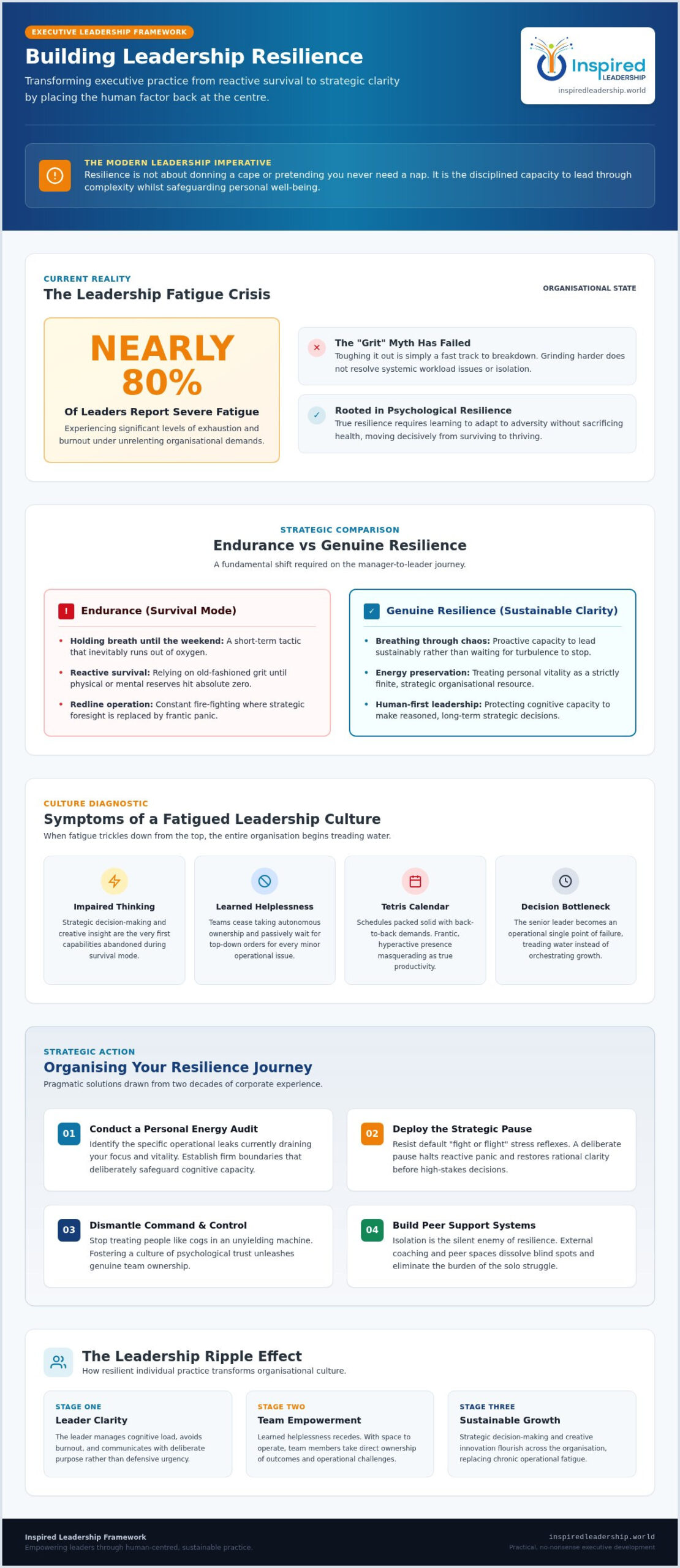
Did you know that nearly 80% of leaders are currently reporting significant levels of fatigue and burnout? It is a staggering figure that suggests the old ways of “toughing it out” simply aren’t working anymore. Building leadership resilience isn’t about donning a cape and pretending you don’t need a nap; it’s about being strategically human.
You’re likely feeling the weight of endless organisational demands and a nagging sense of isolation in your senior role. It’s exhausting to keep up the facade of having all the answers whilst your own energy reserves are hitting zero. Traditional training has probably failed you by offering theoretical fluff instead of real-world solutions that actually stick.
This guide is here to help you move beyond just keeping your head above water by discovering how to transform your approach from surviving to thriving. We will explore practical tools to manage your cognitive load and reignite your professional purpose. You will also learn how to foster a team that takes ownership, allowing you to finally lead with clarity and ease.
Key Takeaways
- Learn why building leadership resilience is no longer a luxury but a vital necessity for navigating the complexities of your professional journey.
- Discover how to conduct a personal energy audit to identify the specific leaks that are currently draining your focus and vitality.
- Redefine your leadership style by putting the human factor first, ensuring you lead with clarity whilst managing your cognitive load effectively.
- Create a ripple effect of ownership across your team by modelling authentic, resilient behaviour that encourages others to take the lead.
Understanding the Fatigue Crisis: Why Building Leadership Resilience is No Longer Optional
Let’s be honest, you’re knackered. The world keeps asking for 110% whilst giving you 20% back, and it’s not a “you” problem; it’s a systemic one. Building leadership resilience isn’t about finding a bigger shovel to dig your way out of the work.
True resilience is the capacity to lead through complexity whilst maintaining your own well-being. It is rooted in psychological resilience, allowing you to adapt to adversity without sacrificing your health. Relying on old-fashioned “grit” is just a fast track to a breakdown.
The Difference Between Endurance and Genuine Resilience
Endurance is often just holding your breath until the weekend, a tactic that eventually runs out of oxygen. Leaders in medium-sized firms often fall into this trap because they are close enough to the coalface to feel every spark.
Genuine resilience is a proactive organisational behaviour that prioritises sustainable energy over reactive survival skills. It means learning to breathe through the chaos rather than waiting for it to stop. This shift is a core part of the manager to leader journey.
Identifying the Symptoms of a Fatigued Leadership Culture
When you’re in survival mode, your strategic decision-making and creativity are the first things to go out of the window. You might notice your team has stopped taking ownership and now waits for your direct orders.
This “learned helplessness” is a clear sign that the fatigue has trickled down from the top. If you find yourself making every single decision, your organisation isn’t growing; it’s just treading water.
The Human Factor: Redefining What Resilience Looks Like in 2026
Resilience is often mistaken for an infinite capacity to absorb punishment, but we’re putting the human factor back at the centre of the conversation. Building leadership resilience starts with a deep understanding of your own cognitive load and how it dictates your decision-making. If you’re constantly operating at redline, you’re not leading; you’re just reacting to the loudest fire.
Moving beyond the old command and control model is essential for fostering a culture of trust where ownership can actually thrive. You can explore this systemic approach in more detail through The Human Factor Journey. It’s time to stop treating people like cogs in a machine that never stops, especially when that machine is you.
Organising Your Internal Compass
Identifying your own triggers is a vital skill before they manifest as reactive or defensive leadership behaviours. High levels of workplace stress and leader fatigue often lead to a “fight or flight” response that shuts down your strategic thinking capacity. If your calendar looks like a game of Tetris played by a toddler, you aren’t being productive; you’re just being frantic.
The most resilient leaders aren’t the busiest ones; they are the ones who have mastered the power of the strategic pause. Taking a moment to breathe isn’t a sign of weakness or a lack of drive. It is a calculated move that allows you to respond with clarity rather than reacting with panic.
Building a System of Support Amongst Peers
Isolation is the silent enemy of resilience, especially when you feel you have to maintain a perfect facade for your team. Creating a safe space amongst peers allows you to process challenges without the fear of being judged by those you lead. Building leadership resilience is a shared endeavour that benefits from multiple perspectives and collective wisdom.
Engaging with leadership coaching provides that necessary external perspective to keep you grounded and objective. It helps you see the blind spots that fatigue often hides from your view. If you’re ready to stop the solo struggle, why not get in touch with us to discuss how we can support your leadership journey?
Practical Strategies for Organising Your Resilience Journey
Building leadership resilience is not a one-time event or a certificate for your wall. It is a journey you organise with intention, moving from reactive firefighting to strategic clarity. After 20 years in the corporate world, I know that effective leaders treat their energy as a finite resource.
Step 1 is to audit your energy leaks to identify what is actually draining your focus. You must then establish firm boundaries that protect your capacity to lead with clarity, even when the office is in a spin. Fostering an ownership mindset in your team is the third step, shifting the heavy lifting off your shoulders.
Finally, commit to continuous learning that feels nourishing rather than like another chore. If a development journey doesn’t leave you feeling inspired, it’s just more corporate noise. Choose paths that offer practical, no-nonsense solutions you can use immediately.
Small Shifts for Massive Organisational Impact
Changing your morning routine can shift your entire leadership behaviour for the day. Instead of diving into your inbox, give yourself twenty minutes of quiet to set your own agenda. This act of reclaiming your morning prevents you from spending the day in a reactive state.
Be a bit cheeky and start saying no to meetings that don’t serve your strategic goals. If you aren’t there to make a decision, you’re just expensive wallpaper. Your time is far too valuable for “updates” that could have been a quick email.
Developing Resilient First-Line Managers
Your manager to leader journey must include resilience as a core competency from the very beginning. New managers often struggle to move from “doing” the work to “leading” the people, which is a classic recipe for early burnout. Helping them manage their own energy ensures they don’t lose their minds whilst trying to find their feet.
Translating Resilience into Action Across Your Organisation
Resilience shouldn’t be a personal cross you carry whilst everyone else watches from the sidelines. It should be a shared organisational behaviour that defines how your entire business handles pressure. Building leadership resilience effectively means showing your team that it’s okay to be human, to pause, and to recalibrate when things get a bit hairy.
When you model resilient behaviour, you create a psychological safety net that allows your team to do the same. If you never take a break, they will assume they can’t either. Celebrate the progress you’ve made and treat setbacks as data points rather than reasons for punishment. It’s about building a culture where people feel safe to own their mistakes and learn from them.
Building Capability at Scale for Medium Enterprises
Off-the-shelf training often feels like a cheap suit; it doesn’t fit anyone quite right and starts to fray under the slightest pressure. Growing firms need bespoke journeys that respect their unique culture and specific scaling challenges. Translating individual resilience into a strategic competitive advantage requires a structured approach that prioritises human potential over tick-box exercises.
By investing in tailored development, you ensure that your managers aren’t just surviving their roles but are actually equipped to lead. This systemic shift turns resilience from a buzzword into a tangible asset. It allows your organisation to pivot quickly without burning out your best people in the process.
Starting Your Journey Today
As you focus on your professional resilience, it is equally important to consider your personal financial resilience. You can find out more about securing exclusive off-market asset investments through high-end consulting tailored for elite leaders.
For those operating within specialised sectors, such as behavioral health, achieving this systemic shift often requires expert guidance that understands the unique pressures of the field. Working with a dedicated partner like Catalyst Behavioral Health Consulting can ensure that your HR and leadership strategies are robust enough to support long-term organisational health.
You don’t have to figure this out in a vacuum. A great starting point is taking a leadership assessment to identify exactly where your organisation stands today. It’s the quickest way to see the gaps between your current reality and the thriving culture you want to build.
If you’re ready to transform your leadership from surviving to thriving, let’s talk. You can contact Inspired Leadership to download a journey brochure and see how we can support your growth. Taking that first step is the only way to ensure your future is as resilient as your ambitions.
Ready to Reclaim Your Leadership Spark?
You’ve spent enough time treading water whilst the corporate machine asks for more. It is time to stop treating endurance as a badge of honour and start prioritising your own well-being as a strategic asset. By building leadership resilience, you aren’t just saving yourself from burnout; you’re creating a sustainable environment where your entire team can thrive.
We have spent over 20 years helping medium-sized enterprises move away from dry, tick-box training. Our human-centred approach offers a pragmatic alternative that actually delivers transformational results. You deserve a leadership journey that respects your humanity and acknowledges the complexity of your role.
The first step toward a more inspired future is just a conversation away. You don’t have to navigate this transition alone, and you certainly don’t have to do it whilst feeling like a zombie. Let’s get you back to leading with the energy and clarity you had on day one.
Frequently Asked Questions
How can I start building leadership resilience if I am already feeling fatigued?
Start with a personal energy audit to identify where you’re leaking focus. Building leadership resilience begins with small, intentional shifts like reclaiming your morning or saying no to non-essential meetings. You can’t fix a systemic issue by just working harder. It requires a structured approach that prioritises your well-being alongside your professional outputs.
What is the difference between leadership endurance and genuine resilience?
Endurance is merely holding your breath until the weekend, which is a recipe for a breakdown. Genuine resilience is a proactive organisational behaviour that allows you to breathe through the chaos. It isn’t about how much punishment you can take; it’s about how well you manage your cognitive load to maintain clarity and strategic focus.
How can I support resilience in my first-line managers without adding to their workload?
Focus on helping them move from “doing” the work to “leading” the people through an intentional development journey. By fostering an ownership mindset within their teams, you actually reduce their individual burden. Our First Line Manager journey integrates resilience as a core competency, ensuring they have the tools to lead without losing their minds in the process.
Is resilience a soft skill or a strategic organisational capability?
It is a strategic organisational capability that serves as a competitive advantage. When building leadership resilience, you’re creating a system where decision-making remains sharp even under pressure. This isn’t just about “feeling better” at work; it’s about ensuring your business can pivot and grow without its leadership team collapsing under the weight of organisational demands.
Can a leadership journey really help me recover from long-term fatigue?
Yes, because a structured journey moves you beyond surface-level tips into genuine behavioural change. It provides a safe space to process challenges and receive an external perspective through tools like leadership coaching. By addressing the hidden dynamics that cause stagnation, you can reignite your purpose and energy whilst building a team that truly takes ownership of its results.