

What if your most brilliant technical expert is actually the worst person to lead your department? It’s a scenario played out in boardrooms every week; you reward a star performer with a promotion, only to watch them wither under the weight of people management. This accidental sabotage turns your best “doer” into a miserable manager, effectively punishing them for being good at their jobs.
You likely feel the weight of this too, worrying that the entire business relies on your shoulders whilst your managers struggle to step up. It’s exhausting to play Chief Firefighter when you should be the Chief Strategist. Establishing a robust leadership pipeline for SMEs is the only way to break this cycle without drowning in corporate fluff.
In this article, you’ll discover how to turn your technical wizards into confident leaders who truly own their outcomes. We’ll explore how to build a clear path for growth that keeps your talent happy and your schedule clear for high-level thinking. Let’s get your people moving on the right journey.
Key Takeaways
- You will learn why the “accidental manager” is the biggest threat to your sanity and how a leadership pipeline for SMEs keeps your unique culture intact whilst you grow.
- Discover how to move beyond quick fixes by treating leadership as a continuous journey that begins long before anyone receives a shiny new job title.
- Stop rewarding the loudest voice in the room and start identifying high-potential talent by observing who your team naturally turns to for guidance and support.
- Gain a practical framework for translating leadership theory into actual Tuesday morning results through action-oriented learning that solves real business problems.
The SME Leadership Crisis: Why Your Pipeline is Currently a Puddle
A leadership pipeline for SMEs isn’t a dusty organisational chart hidden in a drawer. It’s a proactive strategy to grow your own leaders whilst keeping your unique culture intact. Without it, you’re just reacting to gaps, which is a bit like trying to fix a leak whilst the house is flooding.
Many small businesses mistake Succession planning for a simple game of musical chairs. In reality, the “accidental manager” is the biggest threat to your growth and your favourite employees’ sanity. Promoting your best “doer” without a plan often means losing a star performer and gaining a mediocre boss.
Building a pipeline is about developing capability at scale. It ensures that leadership isn’t just a title, but a consistent behaviour that ripples through every level of your business. When you stop filling boxes and start growing people, you protect the talent that made you successful.
The Specialist to Leader Trap
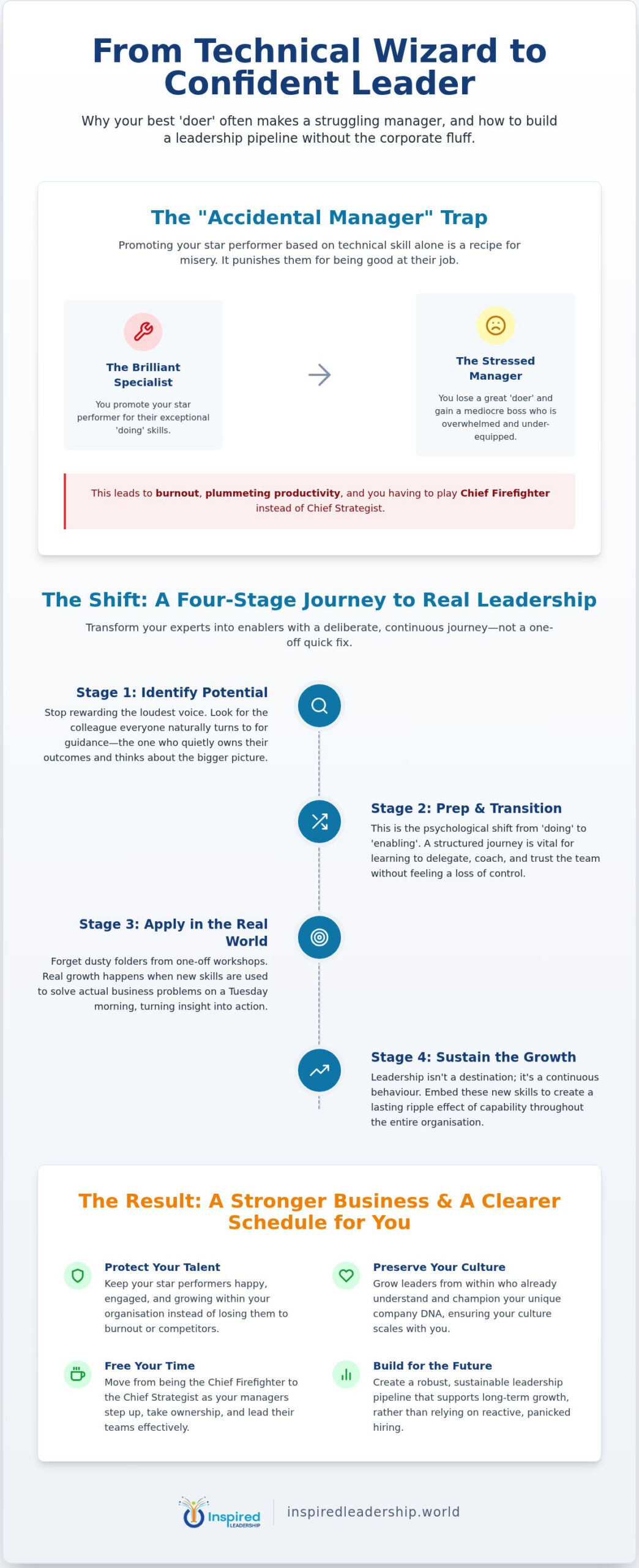
Your top engineer often makes a stressed manager because the skills required are polar opposites. They’ve spent years mastering “doing,” but leadership requires the ability to let go and empower others. Promoting them without support is a recipe for misery.
Trial by fire promotions lead to burnout and dropped productivity. A structured manager to leader journey helps specialists shift their mindset toward collective success. It bridges the gap between individual contribution and strategic oversight.
Why Traditional Training Fails SMEs
One-off workshops are expensive days out that leave everyone with a fancy folder but no change in behaviour. A leadership pipeline for SMEs requires a structured journey that bridges the gap between insight and action. Insight is useless if it doesn’t change how people work on a Tuesday morning.
Real growth happens when managers apply concepts to actual business problems immediately. This ensures your investment translates into measurable results rather than just a feel-good afternoon. It’s time to stop tick-box exercises and start building a sustainable future for your team.
The Specialist to Leader Shift: A Journey, Not a Quick Fix
A leadership pipeline for SMEs isn’t a dry list of names in a spreadsheet. It’s a living journey that transforms your technical stars into people leaders through four deliberate stages: identifying, prepping, transitioning, and sustaining. If you wait until a role is vacant to start this process, you’re already behind the curve.
The hardest part of this transition is the psychological shift from being the “expert” who does the work to the “enabler” who guides others. It requires a fundamental change in identity that many struggle to navigate alone. Using principles of organisational psychology ensures these behavioural changes actually stick for the long term rather than fading after a week.
Step 1: Identify Potential Early
Stop looking for the loudest person and start looking for those who naturally own their actions and think about the bigger picture. You can Build the Leadership Pipeline by spotting these traits before a promotion is even on the table. To take the guesswork out of your talent identification, you might use a leadership assessment to see who is truly ready.
Step 2: The Manager to Leader Transition
Once you’ve found your talent, they need a structured manager to leader journey to build their foundational skills. One of the biggest hurdles is learning how to delegate without feeling like they’ve lost control of the quality. It’s about teaching them to trust the process whilst they focus on coaching their team.
By establishing a clear leadership pipeline for SMEs, you give your specialists a roadmap for their own development. If you’re feeling stuck on how to begin, you can always reach out for a chat about your specific team dynamics. Let’s make sure your next promotion is a celebration, not a crisis.
Identifying High Potentials Without the Corporate Jargon
Stop looking for the loudest person in the room. Often, the real talent is the person everyone naturally goes to for help when things go pear-shaped. Identifying the right high-potential talent is the secret sauce for a successful leadership pipeline for SMEs. You need to evaluate “soft skills” with the same rigour you use for technical skills because behaviour is what ultimately drives performance.
Sometimes your next great leader is a quiet achiever who just needs a little nudge and a proper development journey. It’s also vital to ensure you aren’t overlooking the brilliant women in your business. A dedicated women leadership journey can help unlock that untapped potential and bring much-needed diversity to your decision-making.
The “Think and Own” Mindset
Look for employees who already operate with an ownership mindset. These are the people who don’t just spot problems but actually try to fix them before they reach your desk. Remember that “potential” is about future behaviour, not just a pat on the back for past performance.
Focusing on these traits is essential for building a strong bench of future leaders who can actually carry the weight of the business. You want people who can think critically under pressure. They should be more interested in the “why” than just the “how.”
Building the Emerging Leader Pipeline
Your graduates and technical wizards need a clear path that doesn’t necessarily end in a corner office they never wanted. By offering an emerging leader journey, you keep them engaged and growing within their strengths. You don’t have to force every technical expert into a traditional management role if it’s a terrible fit.
It’s about creating a leadership pipeline for SMEs that respects individual talents whilst securing the company’s future. When people see a future for themselves, they stick around. This reduces your reliance on a few key people and builds a resilient organisation.
Translating Leadership Insight into Actual Results
A leadership pipeline for SMEs only proves its worth when it changes how your team behaves at 9:00 AM on a Tuesday morning. We prioritise action-learning where managers apply new concepts to your specific business problems immediately. This ensures that development isn’t just a theoretical exercise but a pragmatic tool for sustainable growth.
Your role as a senior leader must also shift from being the primary firefighter to becoming a visionary mentor. By actively supporting the pipeline, you create the necessary space for others to lead whilst you focus on high-level strategy. This strategic focus can also extend to how you resource your business; for instance, Sprint Labs enables SMEs to scale efficiently by providing managed offshore staffing across various departments. Stop overcomplicating the process and start with one small, impactful journey to build your team’s confidence.
Measuring the ROI of Your Pipeline
You can measure the success of your efforts through tangible metrics like improved retention rates and higher employee engagement scores. Decision-making speed increases when managers feel empowered to own their outcomes without constantly looking to you for permission. This healthy pipeline significantly reduces the “Key Person Risk” that often keeps SME owners awake at night. To see how professional consulting can further support your operations, you can explore Retainer-based Fractional Executive and Consulting Fees.
It’s far better to build your leadership pipeline for SMEs whilst the sun is shining than to wait for a talent crisis to strike. Taking action now protects your hard-earned culture and secures the long-term future of your organisation. We encourage you to explore our senior leadership journey and download the brochure to see how this bespoke approach can work for you.
If you’re ready to stop firefighting and start focusing on the bigger picture, let’s have a conversation about your team’s specific needs. We can help you transition your technical stars into the confident, capable leaders your business deserves.
Building a Future Where Your Best People Thrive
You didn’t start your business to become a full-time babysitter for stressed-out managers. By establishing a deliberate leadership pipeline for SMEs, you stop the cycle of accidental promotions that ruins your culture and burns out your stars. We’ve distilled over 20 years of corporate expertise into a human-centred approach that actually works for medium-sized businesses.
It’s about moving from the chaos of firefighting to the calm of strategic growth. When you invest in a structured journey, you give your team the tools to lead with confidence whilst you reclaim your own time. Our proven results show that when people feel supported, they don’t just do their jobs; they own them.
You’ve already got the talent right in front of you. Now it’s time to give them the roadmap they deserve so they can step up without falling apart.
Frequently Asked Questions
What is the difference between succession planning and a leadership pipeline for SMEs?
Succession planning is often a static list of names for emergencies, whereas a leadership pipeline for SMEs is an active process of developing talent at every level. It ensures that when a gap appears, you already have someone ready to step in because they’ve been on a development journey. Think of it as the difference between having a spare tyre and maintaining the whole engine.
How do I know if a technical expert is ready for a leadership journey?
Look for the “Think and Own” mindset rather than just high output. If they are the person colleagues naturally go to for advice or if they’ve started suggesting improvements to workflows, they’re likely ready. It’s about spotting the shift from individual achievement to a desire for collective success. A leadership assessment can also remove the guesswork by highlighting their natural behavioural tendencies.
Can a small business with fewer than 50 people really benefit from a leadership pipeline?
Absolutely, because in a small team, one bad management promotion can be catastrophic for your culture. A leadership pipeline for SMEs with fewer than 50 people provides stability by reducing your reliance on just one or two key individuals. It creates a resilient structure where everyone knows how to lead within their own remit, making the business far more sustainable and easier to scale.
What are the most common mistakes SMEs make when promoting from within?
The biggest blunder is promoting based on technical brilliance whilst ignoring people skills. You end up losing your best engineer and gaining a frustrated manager who doesn’t know how to delegate. Another mistake is the “trial by fire” approach, where you throw them into the deep end without a structured journey. This usually leads to burnout and a quick exit for your top talent.
How long does it take to see results from a leadership development journey?
You’ll often see small, immediate shifts in behaviour, like better delegation or clearer communication, within the first few weeks. However, a full transformation typically takes six to twelve months of consistent practice and action-learning. True results aren’t found in a one-off workshop; they emerge when new habits are tested against real-world business problems. It’s a marathon of behavioural change, not a sprint for a certificate.