

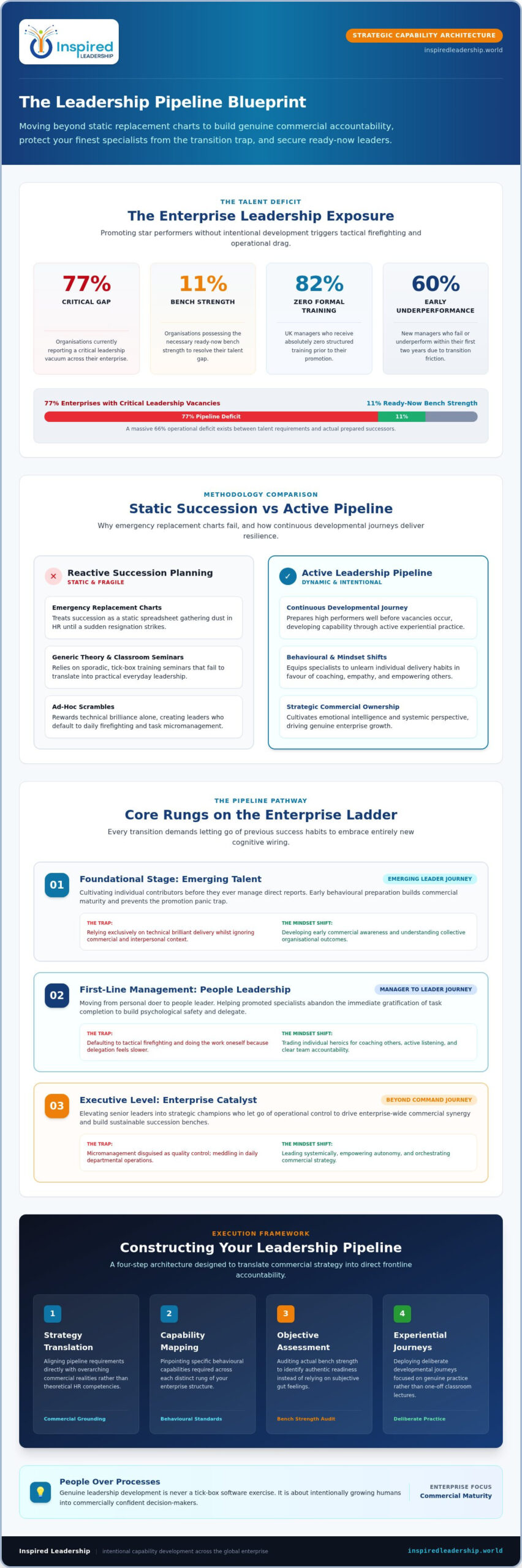
A staggering 77% of organisations report a critical leadership gap, yet only 11% possess the bench strength to solve it. Promoting your star technical performer often triggers quiet panic when they drown in daily tactical firefighting instead of leading people. Genuine leadership pipeline development cannot happen through static competency matrices or sporadic, tick-box seminars.
You already know that crossing your fingers and hoping brilliant specialists will magically intuit commercial accountability just burns out your finest talent. It leaves your senior executive team constantly scrambling to plug critical vacuums whenever a key figure departs. Real capability requires deliberate, experiential practice rather than generic corporate theory.
In this guide, you will discover how to construct an intentional leadership pipeline that turns high-potential talent into confident, accountable leaders. We will examine how to bridge the classic transition trap, foster genuine commercial ownership, and secure a predictable flow of capable managers across your entire organisation.
Key Takeaways
- Why reactive succession planning leaves your business exposed, and how proactive leadership pipeline development establishes a reliable stream of ready-now leaders.
- The essential mindset shifts required at each tier, helping brilliant individual contributors let go of daily firefighting and embrace genuine people leadership.
- The practical reasons one-off classroom workshops fail, and why experiential developmental journeys protect promoted specialists from the transition trap.
- A four-step framework to translate commercial strategy into frontline accountability through targeted capability mapping and objective assessment.
What Is Leadership Pipeline Development and Why Does It Matter?
Think of leadership pipeline development as an active developmental architecture rather than a static spreadsheet gathering dust in HR. It builds a steady stream of capable talent equipped to step upward before a crisis forces your hand. Foundational leadership development is not about ticking software boxes, but growing humans into commercially grounded decision-makers.
For medium-sized enterprises, a dry bench is an existential threat. When a key director resigns without a successor, operational wheels grind to an abrupt halt. You suddenly face either frantic internal firefighting or costly recruitment fees that bleed your operating margins.
Succession Planning vs an Active Leadership Pipeline
Traditional succession planning often amounts to little more than an emergency replacement chart. These static documents quickly fail when market pressures shift or named successors decide to move elsewhere. An active pipeline, by contrast, treats progression as a continuous developmental journey that prepares people for tomorrow’s commercial realities.
The Hidden Operational Cost of Vacant Leadership Roles
When leadership vacuums appear, team psychological safety evaporates and daily output stalls. Frustrated colleagues pick up the slack without extra authority, whilst disengagement steadily creeps across frontline teams. That friction directly impacts your bottom line before you even calculate the cost of external headhunters.
Organisations cannot afford to leave their talent bench to chance. If you want to assess your current bench strength, you can contact Inspired Leadership to explore how intentional development shields your business. Building lasting commercial capability begins well before roles become vacant.
The Core Tiers of an Effective Enterprise Pipeline
Every leadership transition forces you to help people unlearn the exact habits that made them successful in their previous roles. Moving from specialist to manager requires abandoning the instant gratification of personal delivery in favour of coaching others to succeed.
As highlighted in Harvard Business Review’s classic analysis on Developing Your Leadership Pipeline, resilient organisations treat succession as a continuous developmental engine rather than an ad-hoc promotion scramble. Preparing high performers early through an intentional emerging leader journey ensures your talent bench develops commercial maturity well before taking on direct reports.
Transitioning from Individual Contributor to First Line Manager
New managers often get stuck doing the work themselves because delegation feels slower than personal intervention. With research showing that 82% of UK managers receive zero formal training before appointment, they inevitably default to tactical firefighting. Supporting them with a dedicated manager to leader journey establishes emotional intelligence and clear accountability from day one.
Transitioning Specialists and Senior Leaders into Enterprise Catalysts
Elevating brilliant technical minds into senior executive seats brings a different danger: micromanagement disguised as quality control. Without deliberate behavioural coaching, experienced directors continue meddling in operational detail rather than steering commercial strategy. Enrolling executive talent into a specialised beyond command journey equips them to let go of tactical control and lead systemically.
Mastering leadership pipeline development means recognising that every rung on the ladder requires entirely different mental wiring. If your organisation wants help designing developmental pathways that retain your finest minds, you can speak with our team to review your structure.
Overcoming Common Pitfalls in Leadership Pipeline Architecture
Most leadership pipeline development initiatives stumble right at the start because companies reward technical brilliance with management responsibility. Handing your star engineer a people management title without behavioural guidance is a recipe for workplace chaos. Industry research shows that 60% of new managers fail or underperform within their first two years.
When high performers step up, their instinct is often to control every moving part rather than empower their colleagues. They hoard decisions, micro-manage deliverables, and unintentionally shatter team confidence. Real leadership requires trading personal heroics for active listening, empathetic guidance, and emotional stability.
Why High Individual Performers Often Struggle as Managers
Technical experts derive their professional identity from knowing the answers. In management, however, insisting on being the smartest person in the room alienates direct reports and chokes collaboration. New leaders must learn that their primary deliverable is no longer code, calculations, or sales calls, but the capability of their team.
Escaping the One-Off Workshop Trap
Packing managers into an intense two-day classroom workshop rarely shifts ingrained workplace habits. Participants return to overflowing inboxes on Monday morning, promptly shelving their glossy binders. Systemic benchmarks like the U.S. Office of Personnel Management’s guidelines on Federal Supervisory, Managerial & Executive Training show that sustainable competency requires prolonged, progressive reinforcement.
Behavioural change demands sustained developmental journeys spread over several months. This rhythm gives leaders breathing room to apply practical tools, reflect on setbacks, and build genuine commercial accountability. You cannot microwave human maturity.
How to Build and Measure Your Leadership Pipeline: A 4-Step Framework
Constructing sustainable bench strength requires replacing subjective guesswork with an intentional, four-step operational framework. You cannot build capacity overnight, but a clear roadmap ensures every managerial promotion is deliberate rather than a desperate reaction. Through disciplined leadership pipeline development, you systematically convert high-performing specialists into confident, commercially accountable leaders who drive long-term performance.
Diagnosing Capability Gaps Across Your Management Cadre
Length of service does not automatically equal leadership readiness. Promoting colleagues simply because they have survived the longest breeds operational inertia, often creating cultural bottlenecks where defensive managers resist fresh commercial priorities. Utilising an objective leadership assessment uncovers authentic behavioural capability and blind spots, ensuring you invest resources where they genuinely improve team engagement.
Aligning Leadership Accountability with Commercial Goals
Ditch superficial vanity metrics like attendance rates or learning portal logins, as they reveal nothing about genuine workplace competence. True leadership pipeline development proves its commercial value through accelerated internal promotion velocity, reduced turnover among critical specialists, and measurable productivity improvements. Establishing balanced scorecards directly links everyday coaching behaviours to operational delivery, embedding rigorous accountability across every single business tier.
Building a self-sustaining talent bench requires consistent, expert guidance rather than quick fixes. When you are ready to cultivate confident managers who deliver measurable commercial results, you can contact Inspired Leadership to explore experiential developmental journeys designed for your business.
Transforming Internal Potential into Commercial Capability
Relying on emergency outside hires won’t build a resilient talent bench for your growing enterprise. Sustainable leadership pipeline development requires intentional, lived practice that helps brilliant specialists step back from tactical tasks and embrace people leadership. Grounded in over two decades of corporate leadership transformation experience, our human-centred approach connects authentic behavioural growth directly to measurable commercial accountability.
Growing mid-sized enterprises thrive when developmental journeys address real operational friction rather than abstract textbook theories. When you invest in structured pathways across every management tier, you create an agile business culture that retains top talent and smoothly absorbs sudden departures.
Your future executive leaders are already sitting within your organisation right now. Equip them with the confidence to step forward, and let us help you turn raw ambition into lasting capability.
Frequently Asked Questions
What is the primary objective of leadership pipeline development?
The primary objective of leadership pipeline development is creating a predictable, internal flow of capable leaders who are ready to step into critical roles before vacancies appear. Rather than panicking during sudden resignations, your business maintains operational momentum. It shifts talent strategy from reactive crisis management to systematic capability building, safeguarding enterprise agility and long-term commercial performance.
How does a developmental journey differ from a traditional training workshop?
A developmental journey creates sustained behavioural change over several months, whereas a traditional workshop delivers fleeting theoretical inspiration that evaporates by Monday morning. Rather than sitting passively through slides, emerging leaders tackle live commercial challenges, receive ongoing coaching, and apply accountability within their actual workplace. This continuous rhythm ensures new habits stick permanently, delivering measurable operational results instead of abandoned workbooks.
Why do technical specialists struggle when promoted into leadership positions?
Technical specialists struggle because the skills that made them outstanding individual contributors, like granular problem-solving and solo execution, actively hinder people management. When promoted without transition support, they instinctively micromanage or hoard tasks to maintain quality. Successful leadership requires trading personal heroics for active coaching, emotional intelligence, and empowering colleagues to deliver outcomes independently.
How long does it take to see tangible results from a leadership pipeline?
You will typically notice initial behavioural shifts, such as improved delegation and clearer commercial accountability, within three to six months of starting an intentional journey. However, a mature pipeline that consistently produces ready-now successors across multiple tiers takes between twelve and eighteen months to solidify. Building sustainable capability is an ongoing organisational rhythm, not an overnight sprint.
What key metrics prove that an enterprise leadership pipeline is working?
Effective leadership pipeline development proves its value through higher internal promotion rates, shorter onboarding times for vacant roles, and sharply reduced attrition among high-potential specialists. You should also track team productivity, employee retention beneath newly promoted managers, and frontline engagement levels. When operational performance remains steady despite senior personnel changes, your pipeline is doing its job.