

Your last leadership workshop was probably a total waste of money. When you weigh up the impact of a leadership journey vs program, it becomes clear why those two-day retreats fail to stick. You’ve likely watched your budget evaporate whilst your managers revert to old habits by the following Tuesday.
You aren’t alone in this cycle of “train and hope,” but it’s time to stop pretending that a one-off event can fix deep-seated habits. It is a common frustration that technical experts deserve better than a few slides and a lukewarm buffet to help them lead. You deserve a strategy that doesn’t just fill heads with theory but actually changes how people show up at work.
In this article, you’ll discover why traditional training fails to deliver results and how a sustained journey creates lasting behavioural change in your organisation. We’ll look at the mechanics of human transformation and how to build a scalable strategy that ensures your leaders finally own their actions. It’s time to move past the highlighter pens and focus on what actually works.
Key Takeaways
- Understand why finite events are often just expensive biscuits in disguise and how the choice of a leadership journey vs program determines if your managers actually change their behaviour.
- Discover how spaced repetition and a community of practice turn abstract theories into concrete habits that survive the daily office grind.
- Identify how to escape the “Specialist-to-Leader Trap” to ensure your technical experts can scale your culture effectively as your organisation grows.
- Learn why moving away from one-off workshops towards a sustained journey is the only way to protect your budget and build lasting leadership capability.
Beyond the Tick-Box: The Fundamental Difference Between a Program and a Journey
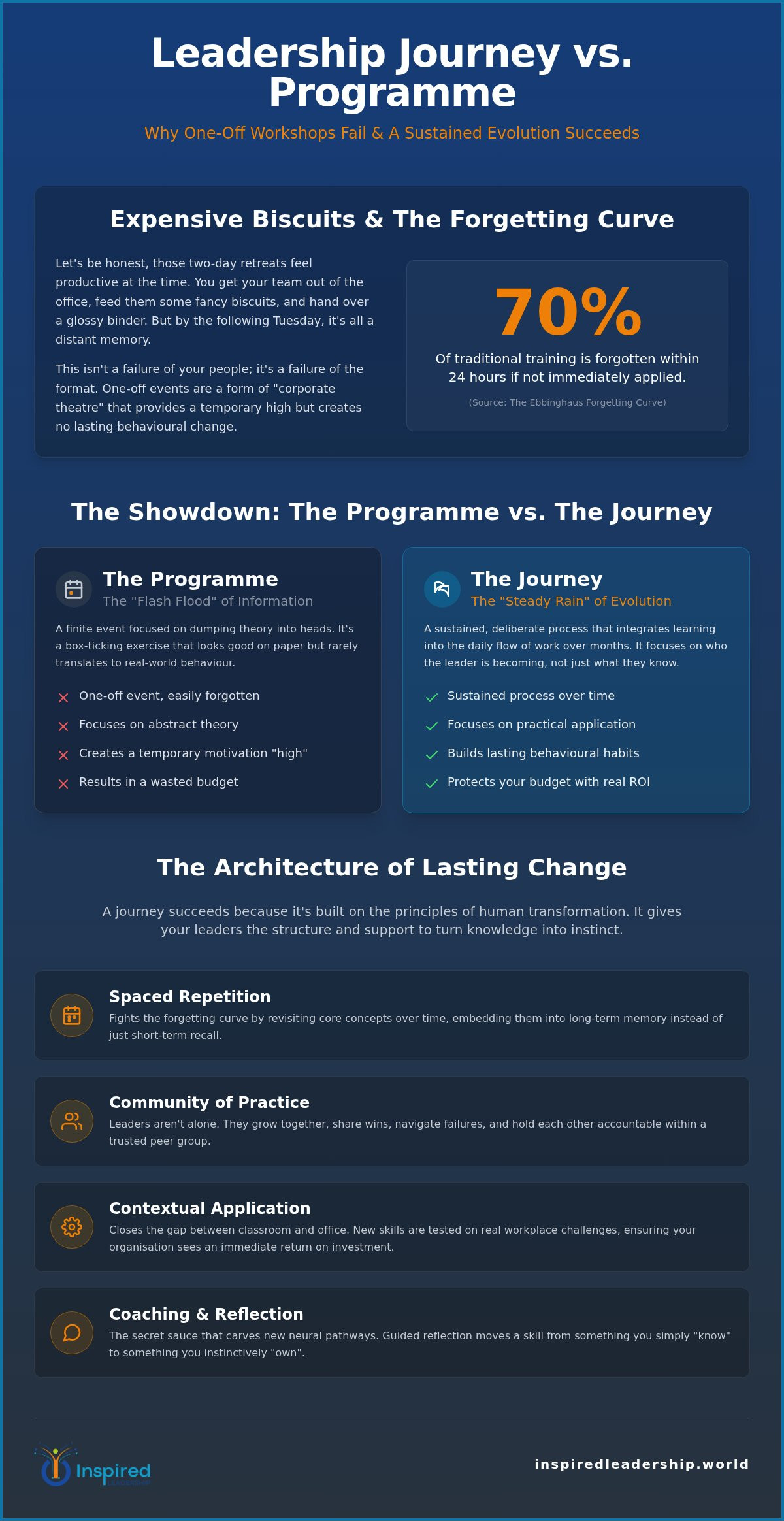
Most organisations treat leadership training like a box-ticking exercise. You send your managers to a hotel for two days, feed them expensive biscuits, and hand over a glossy binder that inevitably gathers dust. This is the fundamental conflict in the leadership journey vs program debate; one is a fleeting event, while the other is a genuine evolution of character.
The Problem with Corporate Theatre
We’ve all seen “corporate theatre” in action. These workshops feel wonderful in the moment because your team gets to escape their inboxes and talk about big ideas. However, the reality is often disappointing. Research into the forgetting curve shows that 70 percent of traditional training is forgotten within 24 hours if it isn’t applied immediately.
One-off workshops fail to move the needle on performance because they lack the structure to combat this mental decay. It is a frustrating cycle that leaves technical experts caught in the specialist-to-leader trap, struggling to manage people whilst they cling to their old, comfortable technical habits. You end up wasting your budget on a temporary high that vanishes the moment a crisis hits the office.
Defining the Leadership Journey
A journey is not just a high-brow synonym for a course. It is a sustained, deliberate sequence of insights, applications, and reflections that integrate learning into the daily flow of work over several months. This approach forces a shift from simply “knowing” things to actually “doing” them in the heat of the moment.
The program mindset focuses on the curriculum, but the journey mindset focuses on the person you are becoming. It requires you to commit to a process of transformation rather than just wanting to “get it done” so you can tick a box on an HR form. True leadership capability isn’t found in a binder; it’s built through the messy, consistent practice of new behaviours.
The Architecture of Change: Why Journeys Succeed Where Programs Fail
When you look at the leadership journey vs program model, the difference lies in structural integrity. Programs are like flash floods; they provide a lot of information quickly, but most of it runs off without soaking in. Journeys are the steady rain that actually nourishes the soil through spaced repetition.
This approach builds a community of practice amongst your leaders. They aren’t just sitting in a room together; they are growing together, sharing wins, and navigating failures in real time. Having coaching and peer support on hand helps you manage the inevitable friction that comes with ditching old habits.
Neuroscience and Behavioural Habituation
Your brain is a creature of habit. It requires time and repeated action to carve out the new neural pathways needed for effective leadership behaviours. Reflection is the secret sauce here, as it moves a skill from something you simply “know” to something you instinctively “own.”
The Importance of Contextual Application
Journeys allow you to test new skills on real workplace challenges as they happen. This removes the frustrating gap between the classroom and the office, ensuring your organisation sees an immediate return on investment. If you want to see how this architecture fits your specific team, you can get in touch with us to discuss your needs.
By breaking down macro organisational goals into micro growth steps, you ensure that progress is sustainable. This structural difference is why a leadership journey vs program strategy is the only way to achieve genuine results. You aren’t asking people to change overnight; you are giving them the space to evolve whilst they do their actual jobs.
Choosing the Right Path for Your Medium-Sized Organisation
Medium-sized firms inhabit a unique space where culture can either scale beautifully or shatter under pressure. You need to expand your leadership capability without losing the scrappy agility that fueled your early success. This is why the debate over a leadership journey vs program is more than just semantics; it is about protecting your most valuable asset: your people.
Avoid providers who offer rigid, “off-the-shelf” solutions. A genuine journey includes long-term support and measurable checkpoints that force leaders to take ownership of their own growth. You should be investing in a transformation that adapts to your environment rather than a static product that stays on a shelf. To complement this, you can explore Corporate Training and Innovation Consulting to see how creative workshops can drive organisational breakthroughs.
Technical talent turnover is a silent budget killer. By providing a sustained journey, you give your high-potential experts a clear, supported path into management. This reduces the risk of them jumping ship whilst they feel unsupported in their new leadership roles. To further strengthen your management and skills development strategy, visit DCH Conseil & Formation.
Before you commit your budget, it helps to know exactly where your current strategy is leaking. Our Leadership Assessment is designed to help you identify these gaps before they become crises. It is a pragmatic way to ensure your next move is a calculated investment rather than a shot in the dark.
Starting Your Evolution: How Inspired Leadership Partners for Impact
We don’t do one-off workshops. They are the fast food of the corporate world; they taste okay at the time but leave you feeling empty and sluggish an hour later. When you weigh up a leadership journey vs program, you quickly realise that lasting organisational health requires a better diet of sustained development.
Our journeys, such as the Manager to Leader Journey, are built to scale capability across your whole firm. We act as a strategic catalyst, helping you turn vague leadership theories into tangible organisational action that sticks. Your team deserves more than a dusty binder; they deserve a structured path to becoming the leaders your company actually needs to survive and thrive.
Tailored Journeys for Every Level
Whether you are nurturing emerging talent or sharpening your senior executives, we provide a disciplined alternative to superficial training. For those at the top of the tree, our Beyond Command Journey offers the depth required to lead complex divisions with confidence. We focus on movement and sustainability, ensuring that change isn’t just a passing phase but a permanent state of professional growth.
Taking the First Step
Deciding to move from a program mindset to a journey mindset is a leadership act in itself. It shows you are ready to prioritise people over processes and results over meaningless tick-boxes. It’s time to build an organisation that thinks, owns its actions, and refuses to settle for the mediocrity of traditional training.
You can start this evolution today by exploring our full range of tailored offerings. We encourage you to download our brochure to see how we can partner with you to create genuine, lasting impact. Let’s stop the corporate theatre and start the real work of transformation together.
Time to Stop Ticking Boxes and Start Growing
You’ve seen why the traditional approach to training is fundamentally broken. By choosing a leadership journey vs program, you are finally prioritising long-term behavioural change over fleeting workshop highs. We bring 20 years of corporate expertise to help you scale your medium-sized enterprise whilst maintaining your unique culture.
Our specialised technical talent accelerators ensure your experts don’t just know how to engineer solutions; they learn how to lead people with confidence. You deserve a strategy that respects your budget and actually delivers a tangible return on your investment. Let’s move beyond the dust-gathering binders and start building the leaders your organisation deserves.
You have the vision to grow your business, so don’t let outdated training methods hold your team back. We are ready to help you turn that vision into a sustainable reality. It is time to invest in the human potential that will drive your future success.
Frequently Asked Questions
How long does a typical leadership journey take compared to a program?
A standard training program is often a finite event, like a two-day workshop with expensive biscuits, whereas a leadership journey is a sustained experience spanning several months. This extended timeline allows your managers to integrate new behaviours into their daily work through spaced repetition. It’s about genuine evolution rather than just attendance, ensuring that the learning actually sticks.
Is a leadership journey more expensive than a standard training course?
When comparing a leadership journey vs program, the initial investment may appear higher, but the return on value is significantly greater. One-off courses often result in wasted budget because 70 percent of training is forgotten within 24 hours. A journey protects your investment by ensuring tangible behavioural change, meaning you’re investing in a permanent shift in performance rather than just a seat in a room.
Can a leadership journey be delivered virtually for remote teams?
Yes, we design our journeys to be highly effective for remote and hybrid teams across the globe. We use digital platforms to create a community of practice where leaders can connect and learn from each other regardless of their location. This virtual delivery doesn’t sacrifice depth, allowing for frequent, bite-sized applications of leadership concepts that keep your teams connected and growing.
What happens if my managers are too busy for a multi-month journey?
The “too busy” excuse is exactly why one-off workshops fail; they pull people away from their jobs for days at a time. A journey is designed to be woven into the daily flow of work rather than being an extra burden. By focusing on micro-level growth steps, your managers can apply new insights in real time, leading more effectively whilst doing the work rather than instead of it.
How do we measure the success of a leadership journey in our organisation?
Success is measured through tangible behavioural change, such as a reduction in the specialist-to-leader trap friction and improved retention of high-potential technical talent. We focus on results-driven outcomes, like how effectively your managers lead their teams and translate organisational goals into action. We don’t just count heads in a room; we track the actual evolution of your leadership culture.