
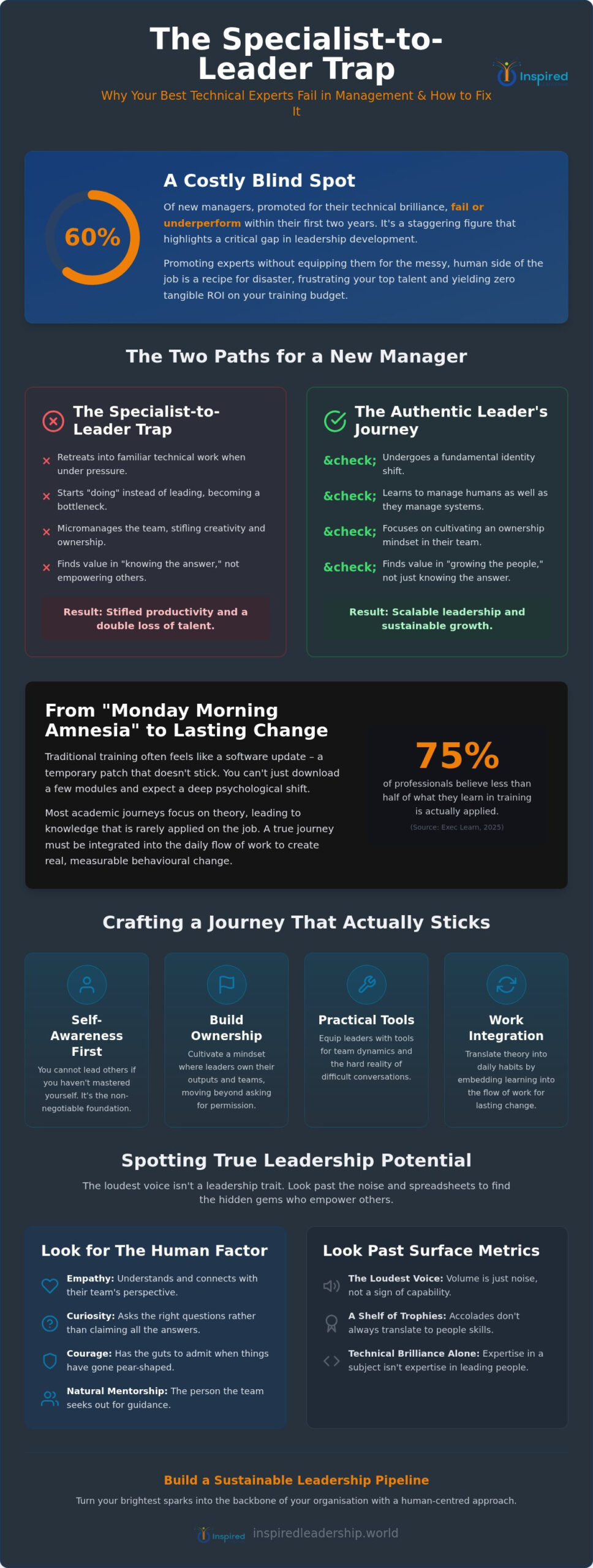
Did you know that 60% of new managers promoted for their technical brilliance fail or underperform within their first two years? It’s a staggering figure that highlights why standard leadership development for high potentials often misses the mark. You’ve likely seen it yourself when your best developer gets promoted, only to struggle with the messy, human side of the job.
It’s frustrating to watch top talent flounder whilst your training budget yields zero tangible ROI. We’re going to show you how to fix this by transforming your experts into authentic leaders through a pragmatic, results-driven journey. You’ll discover how to move beyond the “Specialist-to-Leader Trap” and build a pipeline that actually scales.
We’ll explore how to cultivate people who can manage humans as well as they manage code or spreadsheets. From driving ownership to ensuring measurable behavioural change, this is about making leadership feel natural rather than like a heavy burden. Let’s look at how a human-centred approach turns your brightest sparks into the backbone of your organisation.
Key Takeaways
- Understand why your most brilliant technical experts are at risk of failing in management and how you can help them navigate the Specialist-to-Leader Trap.
- Discover how to structure a leadership development for high potentials journey that prioritises tangible behavioural change and an ownership mindset.
- Identify the quiet leaders amongst your team by looking for the human factor, such as curiosity and empathy, instead of just chasing accolades.
- Build a sustainable leadership pipeline that scales with your organisation, ensuring a consistent language of leadership from the board down to your first-line managers.
Why your best technical experts might be your biggest leadership risk
You’ve seen it a thousand times. You take your most brilliant engineer, give them a shiny new title, and suddenly the team is in chaos. Promoting for technical brilliance whilst ignoring human-centred capability is a recipe for disaster.
True leadership development for high potentials isn’t about teaching someone how to fill out a performance review. It’s about facilitating a fundamental shift in identity. Your expert needs to stop finding their value in “knowing the answer” and start finding it in “growing the people.” For those seeking to align their innate strengths with their professional identity, working with a strategist like Patricia Grassals can provide the Human Design insights needed to make this transition sustainable.
Traditional training fails because it treats leadership like a software update. You can’t just download a few modules on conflict resolution and expect someone’s personality to change. It requires a deeper psychological shift that most academic journeys simply ignore.
The Specialist-to-Leader Trap explained
When experts feel out of their depth, they retreat into what they know: the technical work. They start “doing” instead of leading, which leaves the team feeling micromanaged and undervalued. This creates a bottleneck that stifles productivity and kills innovation.
The cost is high, as 60% of new managers underperform in their first two years according to Careertrainer.ai. You aren’t just losing a great leader; you’re often losing the technical expert they used to be too. It’s a double blow to your organisation’s talent pool.
To avoid this, you need to focus on the behavioural dynamics that drive performance. You can explore this further through The Human Factor Journey to understand how to bridge that gap. Stop rewarding technical skill with leadership roles without providing a structured path for the transition.
Designing a leadership journey that actually sticks
Stop thinking of training as a one-off event that ends when the slides are closed. If you want leadership development for high potentials to actually work, it has to be a systemic journey that translates theory into daily habits. Data from Exec Learn (December 2025) suggests that 75% of professionals believe less than half of what they learn in training is actually applied on the job.
This disconnect happens because most programs focus on academic theory rather than building an ownership mindset. You need your leaders to stop asking for permission and start owning their outputs and their teams. A real journey is structured to fit into a busy corporate calendar without feeling like a secondary burden that people resent.
We believe that moving away from “Monday morning amnesia” requires a blend of accountability and practical application. By integrating learning into the flow of work, you ensure that new behaviours aren’t just practiced but perfected over time. This is how you move from a collection of individuals to a scalable leadership pipeline that actually delivers on its promises.
The core components of a transformational journey
Everything starts with self-awareness; you cannot lead others if you haven’t mastered yourself first. Once that foundation is set, the focus must shift to practical tools for managing team dynamics and those inevitable difficult conversations. This isn’t just about “soft skills” but about the hard reality of human interaction in a high-stakes environment.
Our Manager to Leader Journey is designed precisely for this kind of measurable behavioural change. It moves beyond the classroom to ensure that insights become permanent parts of your organisation’s culture. If you’re ready to build a pipeline that delivers real ROI, feel free to reach out for a chat about your team’s specific needs.
Spotting the quiet leaders amongst the noise
You have probably sat in meetings where the loudest voice gets all the attention. But volume isn’t a leadership trait; it’s usually just noise. Real potential often sits quietly in the corner, asking the right questions rather than providing all the answers.
We need to look for the human factor instead. Empathy, curiosity, and the courage to admit when things have gone pear-shaped are far better indicators of future success than a shelf full of trophies. These traits suggest a person who values growth over ego.
Look for the people your team actually goes to for help when the pressure is on. These individuals are often natural mentors who lead without needing a formal title to feel important. This is where leadership development for high potentials becomes a bit of a detective job that requires looking past the spreadsheet.
You are looking for the hidden gems who empower others rather than just themselves. If you aren’t sure where to start, our Leadership Assessment can help you identify these quiet leaders within your technical teams before they decide to take their talents elsewhere.
Behaviours over KPIs
Your top salesperson might be brilliant at closing deals, but that doesn’t mean they should lead the department. In fact, promoting your best individual contributor often results in losing a great producer and gaining a mediocre boss. It is a classic mistake that ruins morale and productivity.
Performance is about what someone does today; potential is about what they could do tomorrow. You need to distinguish between technical mastery and the capacity to hold space for a team’s growth. Focus on how people treat their colleagues and how they handle setbacks, as these behaviours predict long-term leadership success.
Scaling your leadership pipeline for sustainable growth
Scaling leadership development for high potentials in a medium-sized enterprise shouldn’t require a massive, bloated HR department or a budget that makes your CFO weep. You need a system that is lean, agile, and actually delivers results without the usual corporate theatre. This approach is the only way to escape the Specialist-to-Leader Trap we discussed earlier, ensuring your growth isn’t throttled by management bottlenecks.
By creating a consistent language of leadership that flows from the boardroom to the first-line managers, you ensure everyone is pulling in the same direction. This consistency prevents the mixed signals that often confuse emerging talent and stall organisational progress. It’s about building a culture where leadership isn’t just a fancy title, but a shared set of behaviours and expectations that everyone understands.
When your senior leaders step up as active mentors and sponsors, the journey becomes part of the organisation’s DNA rather than just another tick-box exercise. You aren’t just training individuals; you’re architecting a resilient system that can withstand the pressures of rapid scaling. To support this evolution, you can discover more about Business Transformation and Systems Implementation Programs which help align operational efficiency with leadership development. It’s about creating a legacy of capability that remains long after the initial training sessions have finished.
Start by getting a clear, honest assessment of where your leadership gaps actually sit. You can’t fix what you haven’t measured, so identify the specific friction points that are currently holding your team back from reaching their full potential. This clarity allows you to target your investment where it will have the most significant impact on your bottom line.
Once you know the gaps, select a path focused on long-term behavioural change, such as the Emerging Leader Journey. This ensures that your high potentials aren’t just learning theory but are actually changing how they show up and interact with their teams every single day. We highly recommend you download the brochure on that page to see how the structure supports real-world application.
Finally, measure your success through team engagement scores and tangible performance outcomes to prove the real-world ROI of your investment. When you see your technically brilliant people actually managing humans with confidence, you’ll know your pipeline is secure. Feel free to explore our full range of journeys to see how we help firms like yours build a thriving leadership system that lasts.
Secure your organisation’s future through human-centred leadership
You now have the blueprint to move beyond the Specialist-to-Leader Trap and transform your technical experts into authentic leaders. By focusing on behavioural change rather than academic theory, you can ensure that your leadership development for high potentials delivers a measurable return on investment. We’ve spent 20 years refining this results-driven alternative to traditional training, specifically with our specialised focus on high-potential technical talent.
Building a scalable pipeline isn’t about hope; it’s about a structured system that rewards potential over just performance. You’ve seen how to spot the hidden gems and how to avoid the micromanagement spiral that kills team morale. Leadership isn’t a software patch you can just install overnight, so it’s time to start investing in a journey that actually sticks.
Your team is waiting for the leader they deserve. Let’s make sure they get one who is ready to lead with confidence and empathy.
Frequently Asked Questions
How is a leadership journey different from a standard training course?
A journey is a sustained experience designed to embed new habits over time, whereas a standard course is often just a forgettable one-off event. We focus on translating insight into tangible action within your organisation rather than just ticking boxes. By moving beyond the classroom, a journey ensures that leadership development for high potentials becomes part of their professional identity instead of a fleeting memory.
Can technical experts really learn the “soft skills” needed for leadership?
Absolutely, but you have to stop calling them “soft skills” and start treating them as essential human-centred capabilities. Technical experts thrive when you provide logical, pragmatic frameworks for managing people and team dynamics. They don’t need fluffy theory; they need battle-tested tools that help them navigate the Specialist-to-Leader Trap without losing their technical edge or their sanity.
How do I measure the ROI of a leadership development journey for high potentials?
You measure ROI through tangible shifts in team productivity and engagement scores rather than just attendance logs. Research from the Human Capital Institute shows that organisations can see an average return of $7 for every $1 invested in leadership development for high potentials. We look for measurable behavioural change, such as improved ownership mindsets and a reduction in the failure rates often seen in new managers.
What is the most common reason high-potential employees fail in new roles?
Most high potentials fail because they struggle to let go of the technical tasks that made them successful in the first place. This leads to micromanagement and team frustration whilst the new leader drowns in an impossible workload. Without a structured journey to shift their identity from expert to enabler, they continue doing the work instead of actually leading the humans who do it.
How long does a typical leadership journey take to show results?
You’ll often see initial shifts in confidence and communication within the first few weeks of starting a journey. However, systemic behavioural change and a truly scalable leadership pipeline typically take six to twelve months to fully mature. Lasting transformation isn’t a sprint; it’s a deliberate process of building an ownership mindset that flows from the board down to your first-line managers.