
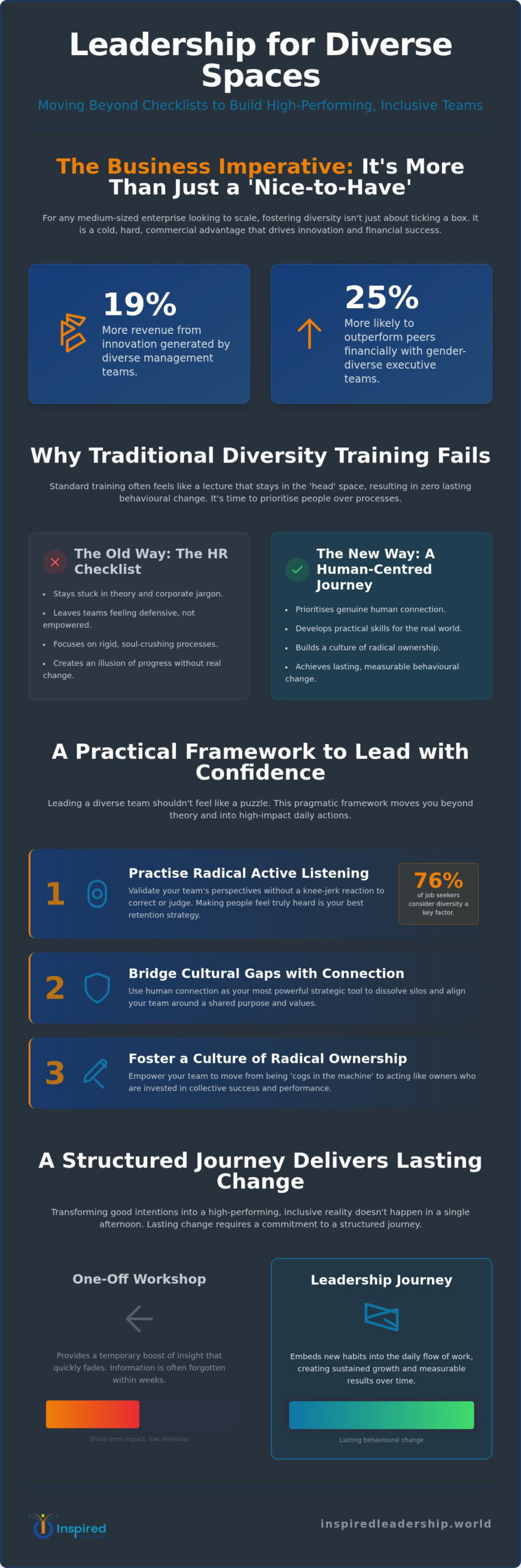
Did you know that diverse management teams generate 19% more revenue from innovation than their less-diverse counterparts? This isn’t just about being a “good person” or ticking a box for HR; it is a cold, hard business imperative for any medium-sized enterprise looking to scale. When we talk about leadership development for diverse spaces, we are really talking about the difference between a stagnant culture and one that thrives on radical ownership and genuine human connection.
You might feel that traditional diversity training is often a bit of “woke” fluff that fails to deliver a real return on investment. Frankly, I don’t blame you. It is frustrating to watch culture dilute as you grow, especially when your brilliant technical experts struggle to manage the messy, beautiful reality of human beings.
I promise to show you how to move past the corporate checklists and develop practical leadership skills that actually work in the real world. We will explore how to transform your managers into leaders who foster a culture where everyone feels they belong and can perform at their peak. It is time to ditch the superficial workshops and start a journey that prioritises people over processes.
Key Takeaways
- Learn how to balance a culture of belonging with measurable commercial results as you scale your medium-sized organisation.
- Discover why human connection is your most powerful strategic tool for bridging cultural gaps and maintaining your unique culture whilst you grow.
- Master a practical three-step framework designed to help you lead diverse groups with genuine confidence and radical ownership.
- Understand why a structured journey is the only effective approach to leadership development for diverse spaces if you want to achieve lasting behavioural change.
Why Leadership Development for Diverse Spaces is Critical for Medium Enterprises
Companies with gender-diverse executive teams are 25% more likely to outperform their peers financially. This isn’t just about understanding diversity, equity, and inclusion for the sake of a glossy brochure. True leadership development for diverse spaces is the high-wire act of fostering deep belonging whilst simultaneously driving commercial results.
Medium-sized businesses face a unique set of growing pains. You aren’t a tiny startup where everyone knows each other’s favourite tea, but you also don’t have the massive HR departments of the Global 500. Scaling your culture amongst varied backgrounds requires more than just a firm handshake and a “good vibes only” policy.
There is a persistent myth that diversity is just an HR tick-box exercise for corporate giants with too much time on their hands. In reality, it is a survival skill for any business that wants to innovate. It is a strategic advantage that keeps you ahead of the competition and attracts the best talent in a tight market.
Moving Beyond the Corporate HR Checklist
Standard diversity training usually stays stuck in the “head” space, offering plenty of theory but zero behavioural change. It often feels like a lecture that leaves your team feeling defensive rather than empowered. To actually move the needle, you need a human-centred approach that prioritises people over rigid, soul-crushing processes.
The good news is that your medium-sized organisation has a secret weapon: agility. You can build an inclusive culture faster than a corporate tanker can turn around. By starting a manager to leader journey, you can ensure your technical experts gain the human skills needed to lead with confidence. This transformation is often supported by understanding the principles of social cohesion, much like the work done by Communities Together to engage and unite diverse groups.
Moving from insight to tangible action doesn’t happen by accident or after a single afternoon workshop. It requires a structured journey that embeds new habits into the daily flow of work. This is how you turn “good intentions” into a high-performing, inclusive reality.
In 2026, your technical prowess is essentially the entry fee to the game. The real competitive advantage lies in the human skills that machines simply can’t replicate. When we look at leadership development for diverse spaces, we see that the ability to build authentic connections is your most valuable strategic asset.
Without a shared ownership mindset, diverse teams often hit invisible friction points that kill productivity. You might notice silos forming or hear the dreaded “that’s not my job” echoing through the corridors. This is why The Human Factor Journey is designed to bridge these gaps and get everyone pulling in the same direction.
Organising Your Team Around Shared Values
Aligning a diverse group around a central purpose isn’t about slapping a motivational quote on the wall and hoping for the best. It requires deep empathy and a genuine willingness to see the world through someone else’s lens. High-performance teams thrive when you prioritise compassion over mere compliance.
Brilliant technical experts often find these “soft” skills incredibly frustrating during their leadership transition. They’ve spent years being rewarded for having the right answers, not for being relatable. If your technical leads are currently baffling their teams, you should reach out for a sensible conversation about how to help them.
Effective leadership development for diverse spaces recognises that your experts need a specific kind of support. It isn’t about turning them into someone they’re not, but about giving them the tools to connect with the humans they lead. When your team feels understood, they stop acting like cogs and start acting like owners.
Practical Steps to Lead Diverse Teams with Confidence
Leading a diverse team shouldn’t feel like a high-stakes puzzle you can’t solve. It requires a pragmatic framework that moves beyond theory and into the daily grit of management. Leadership development for diverse spaces works best when you focus on three immediate, high-impact steps that prioritise human connection over HR scripts.
Step one is to practice radical active listening. This means validating your team’s perspectives without that knee-jerk reaction to correct or judge them. Since 76% of job seekers consider diversity a key factor in their career choices, making your people feel truly heard is your best retention strategy.
Step two involves defining ownership with absolute clarity. You must establish clear accountability for every team member, ensuring that “who does what” is never a mystery. When everyone takes ownership of their slice of the pie, the whole organisation moves faster and with much less friction.
Step three is to encourage the right kind of friction. You need to create safe spaces where healthy conflict and diverse problem-solving are celebrated rather than suppressed. Diverse management teams generate 19% more revenue from innovation, but only if they feel safe enough to disagree with the boss once in a while. To help build this culture of trust through shared experience, you can visit TeamLabs for professionally facilitated team-building games.
Many of you are brilliant technical specialists who have accidentally fallen into the “specialist-to-leader trap.” You are used to having all the answers, but leading a diverse group means managing emotions and varied backgrounds, not just data points. It is a bit of a shock to the system, but you don’t have to navigate it alone.
The Manager to Leader Journey provides the specific tools you need to make this transition with your integrity intact. It helps you swap your “expert” hat for a leadership mindset that actually scales. Always remember: “A leader’s job is no longer to be the smartest person in the room, but to ensure the room is smart enough to win.”
Designing a Leadership Journey That Delivers Results
Let’s be honest, those one-off workshops are a total waste of your time and hard-earned money. They might provide a temporary high, but they rarely lead to lasting behavioural change in complex, diverse environments. Effective leadership development for diverse spaces requires a sustained approach that embeds new habits over time rather than a single afternoon of slide decks and stale biscuits.
A transformational leadership journey for a medium enterprise isn’t about broad theories; it is about practical, grit-under-the-fingernails application. It involves a structured progression from individual insight to collective organisational action, ensuring that every lesson learned is actually used on Monday morning. You can see the tangible results of this evidence-based approach by looking at our Inspired Leadership Testimonials.
This results-driven alternative focuses on movement and sustainability rather than just “getting through” a syllabus. It bridges the gap between internal psychological states and external performance outcomes, which is exactly what a growing business needs to survive. By moving from macro-level issues to micro-level growth, we ensure the transformation is both deep and measurable.
Why an Ownership Mindset is the Ultimate Strategy
When your people truly own their roles, the exhausting need for micro-management simply evaporates. This is particularly vital in diverse teams where different perspectives can lead to friction if there isn’t a shared commitment to the end goal. An ownership mindset ensures that everyone is moving in the same direction without you having to breathe down their necks like an anxious hawk.
Of course, these journeys only truly fly when they have genuine executive sponsorship from the top. It isn’t enough to just send your managers off; you need to be the architect of the change you want to see in your organisation. If you are ready to move past the “command and control” era, I invite you to explore our Beyond Command Journey and start building a culture that actually performs.
Taking the Next Step in Your Leadership Evolution
You’ve seen the data and you know that the old way of ticking boxes is well and truly dead. Effective leadership development for diverse spaces isn’t about sitting in a dark room watching slides until your eyes glaze over. It’s about building a culture where human connection and radical ownership are the default settings for every team member.
With over 20 years of corporate experience, I’ve seen exactly where most medium enterprises stumble when they try to scale. We specialise in helping your brilliant technical experts make that tricky transition into empathetic leaders who actually know how to lead people. Our results-driven methodology ensures you get a real return on your investment, rather than just a pile of dusty, unused workbooks.
Stop waiting for a miracle and start building the high-performing team you actually deserve. It is time to swap the soul-crushing corporate jargon for practical solutions that actually stick in the real world. I am ready to help you navigate this transition with confidence and a bit of well-earned sass.
Frequently Asked Questions
What is leadership development for diverse spaces?
Leadership development for diverse spaces is the process of equipping your leaders with the human skills to foster belonging whilst driving commercial results. Instead of just ticking HR boxes, it focuses on building authentic connections across varied backgrounds. This approach ensures that every individual feels they can perform at their peak, regardless of their cultural or professional starting point.
How does a leadership journey differ from a standard training course?
A journey is a sustained, results-driven progression that embeds new behaviours into the daily flow of work, whereas a standard course is usually a one-off event. We don’t believe in the spray and pray method of traditional workshops that leave you with nothing but a binder. By focusing on a structured journey, we ensure that insights actually translate into tangible organisational change.
Why do technical experts struggle to lead diverse teams?
Technical experts are usually rewarded for having the right answers, which is a world away from managing human emotions. They often fall into the specialist-to-leader trap, where they try to manage people like they manage data points. Leadership development for diverse spaces helps them swap their expert hat for a leadership mindset that handles the messy reality of human connection with confidence.
Can a medium-sized enterprise afford a structured leadership journey?
The real question is whether you can afford the cost of a stagnant, disengaged culture whilst you try to scale. It is much cheaper than replacing your best people every six months because they can’t stand the vibe. By investing in a structured journey, you reduce the high costs associated with turnover and micro-management. It is a strategic investment in your future stability.
How do you measure the ROI of leadership development in diverse spaces?
You measure it through improved profitability, higher innovation revenue, and better talent retention rates. Companies with ethnically diverse leadership are 36% more likely to see above-average profitability, which is a significant commercial win. You will also notice a shift in team dynamics, with individuals taking more radical ownership of their actions. These measurable performance outcomes prove that human skills are a hard business asset.