
Your latest AI investment might be the most expensive paperweight in your office if your people haven’t mastered the art of a difficult conversation. In an era where every competitor has access to the same software, leveraging human skills as competitive advantage is the only way to truly stand out. It’s exhausting to watch your brilliant technical experts flounder the moment they’re handed a management title.
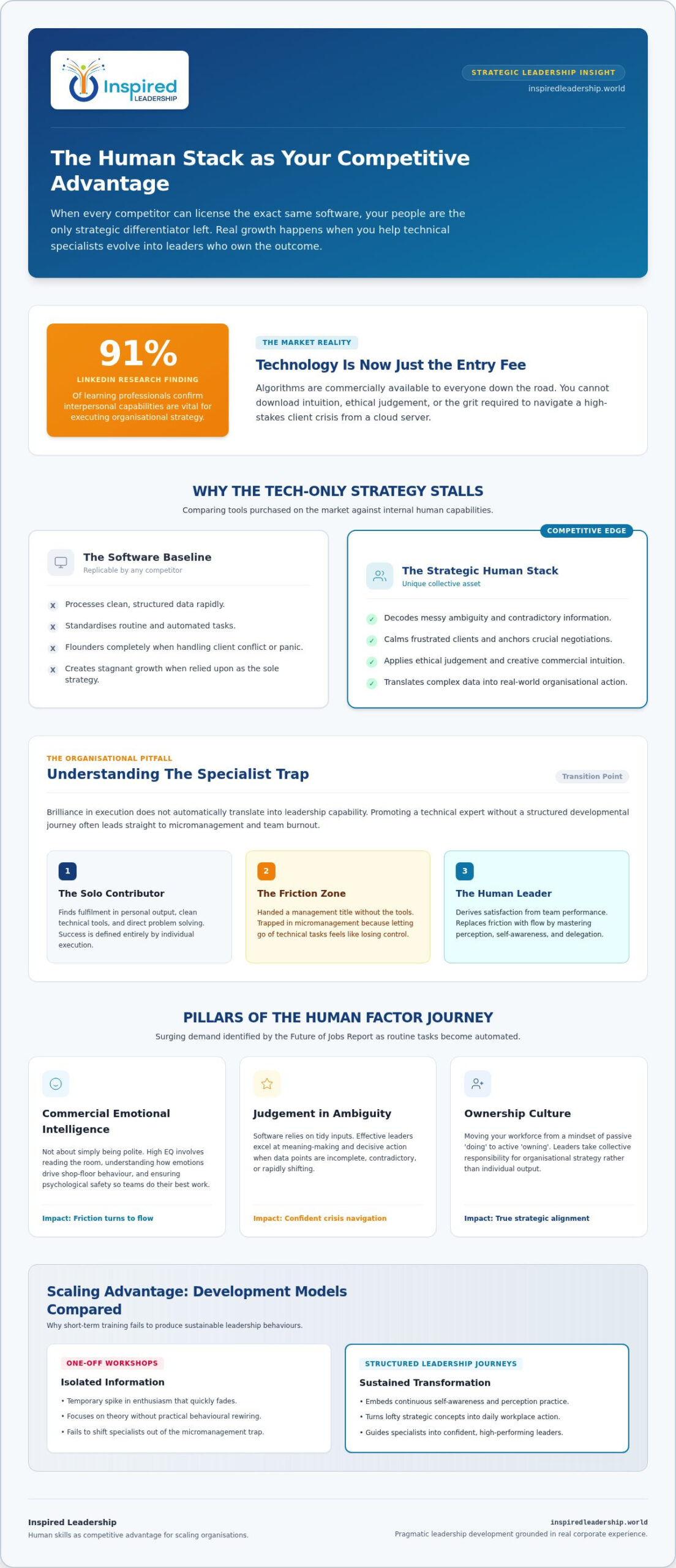
You’ve likely spent a small fortune on tech, yet your growth remains as stagnant as a pond in mid-summer. LinkedIn research confirms that 91% of learning professionals now see these interpersonal capabilities as vital for executing strategy. You deserve a workforce that doesn’t just follow a process, but actually owns the outcome.
This article reveals why human-centric leadership is the ultimate strategic lever for your organisation. We’ll explore why one-off workshops fail and provide a clear roadmap for transitioning your specialists into high-performing leaders. Let’s look at how to turn your technical talent into the leadership force your strategy demands.
Key Takeaways
- Realise why your expensive tech is just a baseline and how your team’s ability to connect is what actually closes the deal.
- Identify the specific human traits that AI will never replicate, allowing you to navigate the messy ambiguity of modern business with ease.
- Master the art of leveraging human skills as competitive advantage by helping your technical specialists transition into leaders without losing their minds.
- Stop wasting money on one-off workshops and start investing in leadership journeys that turn lofty ideas into real-world organisational action.
Why Technical Prowess is No Longer Your Only Winning Card
You can buy the best AI on the market tomorrow, but so can your biggest rival. Technology has shifted from being a unique edge to a basic entry fee for doing business. Harnessing human skills as competitive advantage is the only way for medium-sized firms to break through the stagnant growth ceiling.
The Myth of the Tech-Only Strategy
Relying solely on software is a slow race to the bottom that ignores the human element. You can purchase the same algorithms as the company down the road, yet you cannot buy their team’s collective intuition or the way they handle a client crisis. Intuition is the one thing your competitors can’t download from a cloud server.
Defining Human Skills in a Strategic Context
We often treat core soft skills like optional extras, yet they are the behaviours that translate complex data into tangible organisational action. Human skills are the strategic infrastructure of a modern enterprise. It’s about moving from a culture of ‘doing’ to a culture of ‘owning’.
When your technical experts move through a human factor journey, they stop being mere contributors and start becoming the engine of your strategy. They learn to navigate the messy ambiguity of business that no software can touch. This transition is what separates the firms that scale from those that simply survive.
The Human Factor: Skills AI Simply Cannot Replicate
AI is brilliant at crunching data, but it’s hopeless at calming a frustrated client or sparking a genuine brainstorming session. Real competitive advantage comes from the skills that require a pulse, such as creativity and ethical judgement. You need leaders who can perceive emotions and understand how they influence behaviour across the shop floor.
Emotional Intelligence as a Performance Driver
EQ isn’t about being ‘nice’ or avoiding conflict; it’s about reading the room to drive better commercial outcomes. High-EQ leaders foster a culture where people feel safe enough to actually do their best work without fear of failure. According to the Future of Jobs Report, demand for these interpersonal capabilities is surging as routine tasks become automated.
This is why we focus so heavily on perception and self-awareness during The Human Factor Journey. It transforms how your managers interact with their teams, turning friction into flow. By prioritising human skills as competitive advantage, you ensure your organisation stays agile whilst others struggle with rigid, tech-only processes.
Judgement in the Face of Ambiguity
Algorithms thrive on clean data, but your leaders must thrive on making the right call when the data is missing or contradictory. The ‘Human Factor’ involves meaning-making and navigating the messy ambiguity of real-world business that no software can decode. This type of human judgement is what separates a static organisation from a market leader that anticipates change.
Investing in these capabilities isn’t a luxury; it’s a strategic necessity for any medium-sized enterprise looking to scale. If you’re ready to sharpen these edges in your workforce, get in touch with us to discuss your team’s development.
Navigating the Specialist-to-Leader Journey Without Losing Your Mind
Your best technical expert is often the person most likely to crash and burn when you hand them a management title. We call this the ‘Specialist Trap’. It happens when you reward brilliance in ‘doing’ by forcing a high-performer into a role that requires ‘leading’, usually without giving them the right tools to succeed.
Transitioning from a doer to a leader requires a complete rewiring of how a person perceives value and success. Recognising human skills as competitive advantage means understanding that technical genius doesn’t automatically translate to people management. Without a structured journey, your new managers will likely default to micromanagement and burnout whilst they struggle to find their feet.
The Shift from Doing to Leading
Leading is a distinct skill set that requires the courage to let go of the technical tools you love. You must teach your managers to find satisfaction in the success of their team rather than their own solo output. This mental shift is vital, as McKinsey Global Institute research on human capital shows that firms prioritising people development achieve far greater long-term resilience.
Building Leadership Capability at Scale
You can download the brochure for the Manager to Leader Journey to see exactly how we guide specialists through this transition. A single great leader is a lucky fluke, but a system of great leaders is a sustainable competitive advantage. Scale-ups need a repeatable way to turn technical talent into people-centric managers who actually know how to lead whilst the pressure is on.
When you treat leadership as a systemic capability rather than a random personality trait, you unlock a lasting human skills as competitive advantage. It stops the cycle of talent attrition and ensures your specialists thrive instead of just surviving. This transition is the foundation of any high-performing organisational culture.
Scaling Human Advantage: Turning Insights into Organisational Action
A competitive advantage isn’t just a lofty bullet point in your boardroom presentation. It only becomes real when your leadership insight translates into tangible daily action across every level of your business. By leaning into human skills as competitive advantage, you create a culture that doesn’t need constant hand-holding or micro-management to achieve results.
Developing an Ownership Mindset
When your people truly own their actions, you can finally stop wasting your life policing every minor detail and start actually growing the business. This fundamental shift is the ultimate outcome of a well-executed Beyond Command Journey. It replaces the outdated command-and-control model with a team that thinks for itself and takes genuine pride in its collective output.
You deserve a workforce that doesn’t wait for permission to be brilliant or solve a problem. This mindset is what allows medium-sized enterprises to remain agile whilst their larger, more bureaucratic rivals are still waiting for a committee meeting to end. It turns your staff from mere employees into active stakeholders in your company’s success.
The Results-Driven Alternative to Training
Stop looking for one-off workshops that offer a quick fix but no lasting change. Sustainable growth happens when you treat leadership as a deliberate, long-term journey rather than a box-ticking exercise for the HR department. This approach ensures that the insights gained are actually applied to real-world challenges, leading to measurable improvements in performance and organisational health.
Human-centric leadership is the secret sauce that allows your company to punch well above its weight in an increasingly commoditised market. By prioritising human skills as competitive advantage, you are building a resilient, self-sustaining organisation that thrives on its own initiative. This is the strategic lever that turns a good company into a market-defining leader. To explore how professional consulting can help your business achieve this growth, click here to learn more about michelboutinstudio.
Stop pretending your shiny new software will do the heavy lifting of leadership for you. Real power lies in the way your team communicates, collaborates, and navigates the messy parts of business that AI simply can’t touch. Leveraging human skills as competitive advantage is the only way to ensure your organisation doesn’t just survive, but actually thrives.
We’ve spent 20 years refining a results-oriented, no-nonsense approach that turns brilliant technical experts into high-performing leaders. Our specialised journeys for technical talent are designed to rewire how your managers think, moving them from ‘doing’ to ‘owning’. It’s about time your leadership results finally matched your technical ambitions.
Explore our Manager to Leader Journey and download the brochure today.
You have the talent; now give them the human-centric tools they need to lead. Let’s get to work on building a workforce that thinks for itself and owns its actions.
Frequently Asked Questions
Why are human skills considered a competitive advantage in 2026?
AI has commoditised technical tasks like coding and data analysis, making human traits like ethical judgement and empathy the only true differentiators. As of 2026, transparency requirements in automated hiring push firms to value human-centric leadership even more. Using human skills as competitive advantage allows you to navigate ambiguity that machines simply cannot decode, ensuring your organisation remains agile whilst rivals rely on rigid, soulless algorithms.
What is the ‘Specialist Trap’ in leadership development?
The Specialist Trap occurs when you promote your most brilliant technical expert into a management role without providing a structured journey for the transition. You essentially trade a top-tier ‘doer’ for a struggling ‘leader’ who lacks the interpersonal tools to manage people effectively. This often leads to micromanagement and burnout because the skills that made them a great engineer don’t automatically make them a great people manager.
How do human skills differ from traditional soft skills?
Whilst ‘soft skills’ are often dismissed as vague or optional extras, human skills are the strategic infrastructure of a modern enterprise. They are focused on tangible outcomes, like how your team organises, collaborates, and solves problems together. We view these capabilities as high-performance behaviours that translate internal psychological states into external results, rather than just being ‘nice’ to your colleagues in the breakroom.
Can human skills really be taught in a corporate environment?
Yes, but you must ditch the boring one-off workshops that everyone forgets by Friday. Real transformation happens through systemic journeys that integrate peer coaching and deliberate on-the-job practice. We use a results-driven approach based on 20 years of corporate experience to ensure these behaviours actually stick rather than just ticking a box for the HR department.
How does human-centric leadership improve the bottom line for medium enterprises?
Human-centric leadership reduces the hidden costs of friction, such as high staff turnover and stagnant productivity caused by poor management. When your team has an ownership mindset, they solve problems faster and require less policing from senior executives. This efficiency allows your medium-sized company to punch well above its weight, turning human skills as competitive advantage into a measurable increase in your long-term financial performance.