
Every year, organisations spend billions of rands on leadership development, psychometric testing, and exhaustive 360-degree reviews. Yet, if you sit in a boardroom or look at senior executive teams, the same frustrating question keeps coming up: “How do we actually measure leadership capability, and know exactly where to focus our development budget?”
The truth is, most traditional corporate measurement models are broken. They measure the wrong things at the wrong levels. They treat leadership as a popularity contest or a static set of traits measured in a vacuum. They hold frontline managers accountable for macro-financial targets they cannot control, while ignoring the daily emotional chaos vibrating through their teams.
If you want to know if your leadership pipeline is actually getting stronger, you have to stop measuring the person and start measuring the ecosystem around them. Leadership capability isn’t an abstract score; it is a visible trail of impact.
By looking at leadership through four distinct, generic levels, we can throw out the corporate myths and look at the real, undeniable metrics of capability.
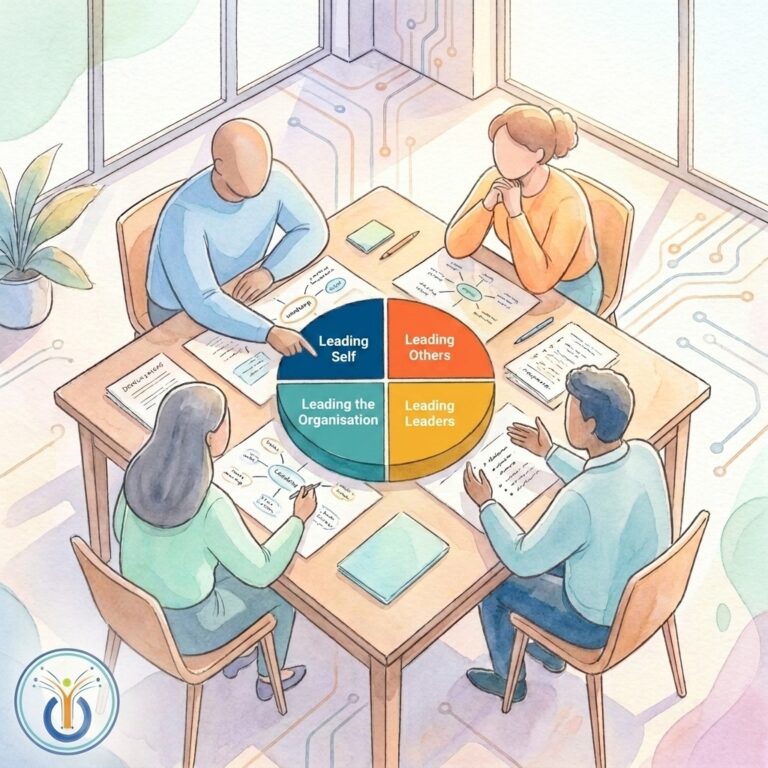
Level 1: Leading Self (Individual contributors/professionals)
How to measure individual contributor performance beyond task completion
What we think “Good” looks like: Individual KPI achievement and task completion scores.
The Real Metric: Drama-Free Delivery.
When organisations evaluate whether an individual contributor or an early-career professional is ready for advancement, they usually look at their output. Did they hit the deadline? Did they complete the task list?
But two people can deliver the exact same project on the exact same day, and have two completely different levels of personal capability. One delivers with an absolute trail of chaos: rushing, missing meetings, stress-dumping on colleagues, and running on frantic adrenaline. The other delivers with complete stability.
Leading self well means showing up present, calm, and prepared. It means doing what you say you will do, taking radical ownership of your task list, providing unsolicited feedback, and actively asking for feedback. It means proactively engaging with peers to solve broader issues the moment your own work is complete. Crucially, it means knowing when to disconnect, take leave, and recharge so you don’t burn out.
Don’t measure how busy people are. Measure the friction of their delivery. If an employee is consistently reliable, predictable, and working without self-inflicted panic, they have mastered Leading Self.
Level 2: Leading Others (first-line supervisors and managers)
How to measure a manager's effectiveness through team growth and climate
What we think “Good” looks like: Low team turnover, high retention rates, or long-service milestones.
The Real Metric: Velocity of Growth & Team Climate.
When an individual steps into a first-line management role, the corporate trap is to praise them for a “stable” team. But a team where everyone has sat in the same seat for five years doing the same thing isn’t a sign of great leadership; it is a sign of a comfort trap. And growth and comfort do not co-exist.
Managers who unleash the best in others are great leaders; very often, this requires a push into discomfort. Therefore, the true measure of a Level 2 leader is the upward and outward movement of their people. Are their team members expanding in scope, impact, and skills? Are they outgrowing their roles? Are they being headhunted by other departments or even companies? A capable leader is an incubator of talent, not a hoarder of it. When talent leaves, it creates a hole which can be filled by younger, new people who bring with them ideas, insights and external perspectives radically needed to support innovation. (The current trend is to avoid backfilling leavers to decrease headcount through natural attrition. This sounds like the path of lowest cost and least resistance but when we don’t bring in new people, we lose the innovation and fresh perspective they bring, and as a result the organisation pays a high retention tax.)
How do we measure leadership capability at this level? 360 reviews give some individual feedback and focus, but shouldn’t be used to evaluate and measure leadership capability in isolation. Instead, measure the team’s effectiveness. When a team answers scaled questions like “My work priorities are clear” ; “I have the tools required to do my work” and “I am comfortable raising issues and risks,” it is a direct reflection of the leader’s capability.
An excellent Leader of Others acts like an orchestra conductor. They might know how to play the individual instruments, but they choose not to (which often takes enormous self-restraint). Instead, they understand that every single person on the team is different and has different strengths and talents. They bring in the bass when it makes sense, adjust the tempo, and lower the volume of the strings as needed. They leverage unique strengths without shaming deficiencies. When the leader is at their best, everyone else is at their best.
However, for a manager to conduct this way, the organisation must grant them discretion. Blanket corporate policies, like rigid in-office work mandates, hamstring individual manager discretion. True Level 2 capability requires the business to step back and let the manager decide exactly what working environment works best to unlock the highest level of performance for their specific people.
Level 3: Leading Leaders (middle managers/directors)
How to measure middle management performance and organisational alignment
What we think “Good” looks like: Constant attendance in high-level executive meetings and acting as a passive mailbox for corporate emails.
The Real Metric: The Snowplough Effect.
When a leader is promoted to managing other managers, they step away from frontline execution. Their primary job becomes alignment and advocacy.
First, they must master the metric of alignment through regular, disciplined repetition. They cannot assume that because a strategy was stated once in a memo, it is understood. They must take the complex discussions from executive meetings and actively cascade them through their division, so that first-line managers have total clarity on the business’s direction.
Second, they must become a “Snowplough.” First-line managers should be focused entirely on their people so their people can take care of the clients. But if those first-line managers are spending 80% of their energy fighting internal corporate politics, department silos, and policy restrictions, they cannot unlock growth.
A capable Level 3 leader drives ahead of their teams, using their positional power to clear the tracks. They fight the corporate fights, handle cross-department negotiations, lobby for budget, and secure the necessary tools.
How do you measure the capability of a leader of leaders? You look at the frustration levels of their direct reports. When an upline leader is successfully playing the role of a snowplough, the friction disappears. If first-line managers are still spending their days fighting restrictions and begging for tools, the snowplough is stationary. But if systemic obstacles are being cleared out of the way, leadership capability is active.
Level 4: Leading the Organisation (executive/C-suite)
How to measure executive leadership capability and strategic alignment
What we think “Good” looks like: High external profile, market presence, and a polished public image.
The Real Metric: Strategic Alignment & Ultimate Business Performance.
This is where the buck stops. Business performance and overall results belong to the CEO and the Board alone. It is a fundamental corporate failure to hold lower-level managers accountable for macroeconomic results they cannot control.
At Level 4, capability is measured by the leader’s ability to set the direction of the business, or ruthlessly change it if the market shifts, and get the entire organisation aligned to achieve the outcomes. They must define what success looks like and establish a handful of clear priorities for that specific season or quarter.
Achieving this requires a balancing act. Outwardly, the leader must constantly read, watch, network, and sense the market. Inwardly, they must engage in inspirational vision-setting and constant, repetitive communication, reminding the organisation why they exist, who they serve, and which problems they are solving
The Golden Thread: Listen, Listen, Listen
If there is a single heartbeat that connects all four levels of leadership capability, it is listening.
- At Level 1, you listen before you speak, you ask more questions to avoid assumptions.
- At Level 2, you listen to your employees because they know their jobs best and are listening to your clients.
- At Level 3, you listen to your managers so you know which obstacles to snowplough out of their way.
- At Level 4, you listen to your uplines to keep a pulse on reality, while listening to the market to steer the ship.
Stop measuring individual personalities. Start measuring the clarity, growth, and drama-free delivery. Real leadership capability is observed not by who they are or what they do, but the impact their behaviour has on others, and the environment they create for others to perform in. That is what true leadership capability looks like.
For organisations looking to bridge these gaps and equip their managers to step cleanly into these levels, our framework and core journeys at Inspired Leadership provide the exact tools needed to shift your team from stable to growing.
Frequently Asked Questions
What is leadership capability and how is it measured?
Leadership capability is not a personality trait or a score on a psychometric test, it is the visible impact a leader has on the people and environment around them. It is best measured by looking at four levels: how drama-free an individual’s delivery is, how fast a manager’s team is growing, how clear and unblocked a director’s managers are, and how aligned an executive’s organisation is to a defined strategy.
What are the four levels of leadership?
The four levels are Leading Self (individual contributors), Leading Others (first-line managers), Leading Leaders (middle managers and directors), and Leading the Organisation (executives and C-suite). Each level has a distinct real-world metric that goes beyond traditional KPIs and 360-degree reviews.
Why do traditional leadership metrics fail?
Most traditional models measure the wrong things — task completion, tenure, or personality traits assessed in isolation. They hold managers accountable for outcomes they cannot control, while ignoring the daily environment they create for their teams. Real leadership capability is observed through impact and behaviour, not through popularity scores or static assessments.
How do you measure a manager's effectiveness?
The most reliable measure of a manager’s effectiveness is the velocity of growth in their team. Are team members expanding in skills and scope? Are they being promoted or headhunted? Is the team climate — measured by whether people have clarity, tools, and psychological safety — consistently strong? These are the signals that reveal a capable manager, not low turnover or long-service milestones.