
Your boardroom is likely filled with the most brilliant minds in the building, yet your strategy is still gathering dust on a shelf. Embarking on executive team development journeys is the only way to stop the polite nodding and start the real, messy work of collective leadership. You shouldn’t have to spend your time refereeing between technical experts rather than leading a unified front.
You probably know the feeling of investing in expensive workshops that result in plenty of “aha” moments but zero actual change. It’s exhausting to watch high-potential leaders retreat into their functional silos the moment the flipchart paper is taken down. You deserve a senior team that feels a deep, personal responsibility to execute the plan together.
In this guide, we will explore how to transform your leadership group from individual stars into a high-performance engine. We are moving beyond the fluff of traditional training to build a culture of genuine accountability and measurable organisational results. It’s time to see your leaders finally pulling in the same direction amongst the pressures of a scaling business.
Key Takeaways
- Stop wasting budget on one-off workshops and discover why structured executive team development journeys are the only way to fix systemic friction at the top.
- Identify the “polite meeting” trap where real decisions happen in corridors, and learn how to bring that vital energy back into the boardroom.
- Shift your senior leaders from being protective functional experts to becoming a unified engine that takes full ownership of your organisation’s strategy.
- Learn how to scale leadership capability effectively so your strategic vision actually reaches the shop floor instead of dying in a slide deck.
Why Traditional Executive Training Fails Your Organisation
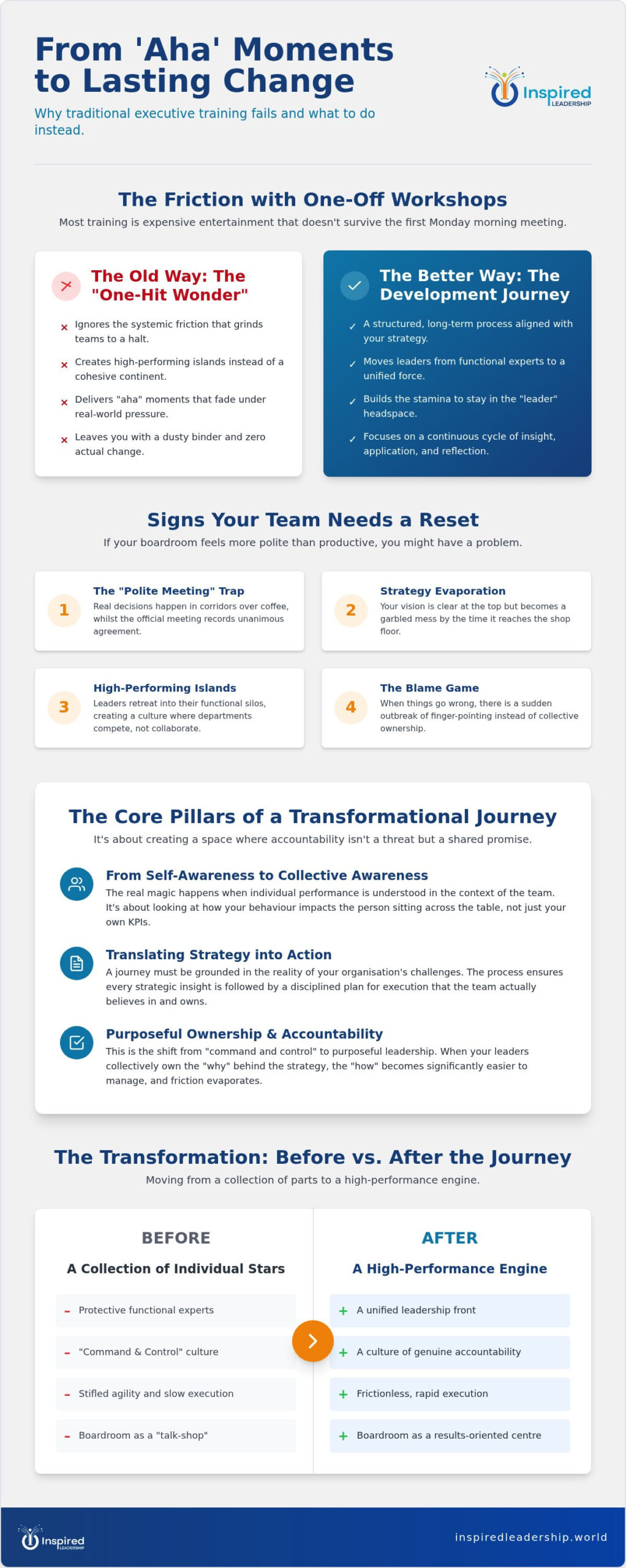
Most executive training feels like a corporate version of a “one-hit wonder.” You spend two days in a fancy hotel, eat too many biscuits, and then return to a desk buried in emails. These one-off events ignore the systemic friction that actually grinds your team to a halt, leaving you with nothing but a dusty binder.
True transformation requires executive team development journeys that live in the real world, not just on a whiteboard. If your training doesn’t survive the first Monday morning meeting, it’s just expensive entertainment. We have to stop treating leadership like a tick-box exercise and start treating it as a behavioural evolution.
The Silo Trap in Medium-Sized Enterprises
As your business scales, your leaders often retreat into what they know best: their technical expertise. It’s a security blanket amongst the chaos of growth. This creates a “command and control” culture where departments stop talking and start competing.
You end up with a collection of high-performing islands rather than a cohesive continent. Stifled agility is the price you pay for these boardroom walls, and it’s a cost your bottom line can’t afford indefinitely. To scale successfully, your experts must learn to let go of their functional safety nets.
Why Insight is Not Enough
Having an “aha” moment in a workshop is easy. Having the courage to hold a peer accountable whilst under immense quarterly pressure is another thing entirely. A true journey focuses on The Human Factor to bridge that gap between theory and action.
We focus on the internal psychological states that drive external performance. It’s about building the stamina to stay in the “leader” headspace when things get messy. Without this focus, your senior team will keep falling back into old, comfortable habits the moment the pressure mounts.
What Defines an Executive Team Development Journey?
Think of a journey as the antidote to those forgettable workshops we discussed earlier. It is a structured, long-term process designed to align your senior leaders with your actual organisational strategy. Unlike a standard course, executive team development journeys are a continuous cycle of insight, application, and reflection that delivers tangible outcomes. You aren’t just learning; you’re evolving.
The goal is to move your team from a group of high-performing individuals to a cohesive leadership force. You want an engine that drives results, not a collection of parts that only work when the sun is shining. If you are ready to stop the “silo shuffle,” it might be time to start a conversation about your team’s specific needs.
The Core Pillars of a Transformational Journey
Self-awareness is the starting point, but collective awareness is where the real magic happens. You must focus on building a culture where everyone thinks and owns their actions. This goes beyond individual performance and looks at how your behaviour impacts the person sitting across the table.
This shift in mindset is central to our Beyond Command Journey, which helps leaders move past simple instruction to purposeful ownership. It’s about creating a space where accountability isn’t a threat but a shared promise. When your leaders own the “why,” the “how” becomes significantly easier to manage.
Translating Strategy into Action
A journey must be grounded in the reality of your specific organisational challenges. It is not about generic leadership models that look good on a PowerPoint slide but fail in a crisis. Instead, the process ensures that every strategic insight is followed by a disciplined plan for execution that your team actually believes in.
This approach turns your boardroom from a talk-shop into a results-oriented command centre. You’ll find that when your leaders are aligned, the friction that usually slows down execution simply evaporates. It’s the difference between hoping for success and architecting it through consistent, collective behaviour.
Identifying the Friction: Signs Your Team Needs a Reset
If your boardroom meetings are suspiciously polite, you have a problem. Real decisions shouldn’t be happening in the corridor over a lukewarm coffee whilst the official minutes record nothing but consensus. This “shadow governance” is a screaming signal that your executive team development journeys need a serious reboot.
You might also notice that your brilliant strategy is clear at the top but becomes a garbled mess by the time it hits the shop floor. When things go wrong, there is often a sudden outbreak of finger-pointing rather than a culture of collective ownership. It’s frustrating to lead a team that agrees in the room but retreats into silos the second they leave.
The Specialist-to-Leader Struggle
Many of your executives were likely promoted because they were the best technical minds in the business. However, being a brilliant specialist doesn’t automatically mean they have the “Human Factor” skills required to lead complex teams. This transition requires a fundamental shift in identity that a generic weekend workshop simply can’t provide.
You can’t fix a systemic issue by guessing where the cracks are. Consider using a Leadership Assessment to pinpoint exactly where the friction lies amongst your senior leaders. It’s much better to have data-backed insights than to keep throwing spaghetti at the boardroom wall.
The Cost of Stagnation
Ignoring these friction points creates a toxic “wait and see” culture. Your middle managers will stop taking risks because they don’t see a unified front at the top. Investing in long-term executive team development journeys helps prevent this talent drain by proving you value collective growth over individual ego.
Building a high-performance team isn’t something you can simply outsource and then forget. It requires a partner who acts as both a strategic catalyst and a pragmatic architect to help you design a sustainable leadership future. Successful executive team development journeys focus on building capability at scale, ensuring that excellence isn’t just a luxury for the chosen few.
Real transformation happens when you stop managing rigid processes and start leading people with genuine empathy and insight. It is time to move beyond the old “command” style and foster an organisation that actually thinks and acts for itself. You want a leadership team that owns its outcomes, not one that waits for permission to breathe every time a challenge arises.
Part of this evolution involves finding new ways to foster positive group dynamics and reduce stress within the team. If you are looking for creative ways to improve workplace wellbeing, you can learn more about Latterguru.dk and their professional laughter courses for businesses.
Choosing the Right Journey for Your Team
Whether you are looking for a Manager to Leader Journey or a specialised accelerator for your top tier, the focus must always remain on measurable results. Don’t forget your future pipeline whilst you are fixing the present. Integrating graduate leadership development ensures that your culture of accountability is baked into the business from day one.
Your Next Steps Toward Transformation
Please stop settling for traditional training methods that fail to deliver a tangible return on your investment. You need to address the messy human dynamics that are causing your organisation to stagnate right now. It is time to get serious about how your leaders interact when the stakes are high and the pressure is on.
If you are ready to see what a results-driven alternative looks like, we have a clear path forward for you. You can download the brochure for The Human Factor Journey to see exactly how we bridge the gap between insight and action. Let’s start building a leadership engine that actually drives your business forward.
Take Command of Your Leadership Future
You have spent enough time watching your strategy stall whilst your leaders retreat into their functional bunkers. It is time to replace polite boardroom nodding with the kind of authentic ownership that actually drives results for medium-sized enterprises. With 20 years of corporate experience, we know that the “Specialist-to-Leader” transition is where most organisations either thrive or quietly stagnate.
Investing in executive team development journeys isn’t just about professional development; it’s about building a collective engine that thinks for itself. You deserve a senior team that has the courage to lead with empathy and the discipline to execute under pressure. Let’s move beyond the silos and start building the high-performance culture your business deserves.
Your team is ready for a real transformation, and we are ready to act as your pragmatic architect. The path from insight to action starts with a single, bold decision to change the way you lead.
Frequently Asked Questions
What exactly is an executive team development journey?
An executive team development journey is a structured, long-term process that prioritises collective behaviour and organisational alignment over generic skills. It isn’t a one-off workshop where you eat biscuits and forget the slides by Tuesday. Instead, it involves a continuous cycle of learning and real-world application. This approach transforms how your senior leaders interact, ensuring they lead the organisation as a unified force rather than isolated experts.
How long does a leadership journey typically take?
A meaningful journey usually spans several months to a year, depending on your specific goals for the business. We don’t believe in quick fixes because deep behavioural shifts take time to stick. This timeframe allows your leaders to turn new insights into daily habits whilst under actual corporate pressure. It is a disciplined way to build lasting leadership capability at scale across your entire senior management team.
Why do you use the term ‘journey’ instead of ‘program’?
We use the term “journey” because professional growth is a continuous evolution, not a static destination you reach after a few PowerPoint slides. A “program” often implies a rigid beginning and end, which doesn’t reflect the messy reality of leadership. Our executive team development journeys are immersive experiences that integrate with your daily work. It suggests a transformational path that changes how you think and act forever.
How do you measure the ROI of executive development?
ROI is measured through tangible outcomes like improved team alignment, faster strategy execution, and a clear increase in ownership amongst your leaders. We set specific objectives at the start so we can track how behavioural changes impact your bottom line. It’s about moving beyond just “feeling better” after a session. We want to see your collective unit actually performing better in the real world.
Can a development journey fix a toxic executive culture?
A journey won’t solve every systemic issue overnight, but it provides a solid framework to address the underlying behaviours causing the friction. By focusing on the “Human Factor” and building genuine empathy, we help your leaders navigate conflict and rebuild trust. It requires a real commitment to change from the top. However, it is the most effective way to reset team dynamics and stop the boardroom rot.