

If your managers are still hiding behind their technical expertise whilst your culture drifts into a disjointed mess, that glossy poster of “integrity” in the lobby is officially dead weight. You’ve likely noticed that as you scale, different departments start acting like rival kingdoms with their own conflicting rules of engagement. It’s a bit of a nightmare when brilliant technical experts fail to lead simply because no one has defined what “leading” actually means in your world.
You know that sustainable growth requires more than just a bigger payroll; it demands a unified approach that doesn’t crumble the moment things get busy. Developing a leadership philosophy for your organisation is the secret to transforming vague aspirations into a shared behavioural contract that everyone actually follows. This isn’t about more corporate fluff, but about creating a strategic foundation where every manager finally takes ownership of their impact.
In this article, you’ll discover how to craft a philosophy that moves the needle and turns your “experts” into genuine leaders. We’ll look at how to bridge the gap between executive intent and front-line reality to ensure your culture stays intact as you grow. It’s time to swap the jargon for a practical, battle-tested framework that makes leadership your most reliable asset.
Key Takeaways
- Learn how to transform those dusty lobby posters into a living behavioural contract that your team actually respects and follows every day.
- Discover why developing a leadership philosophy for your organisation is the only way to stop your technical experts from acting like glorified task-masters.
- Identify the three essential pillars of a functioning philosophy, starting with a clear “Theory of People” that sets the standard for every interaction.
- Master the art of scaling your culture by giving first-line managers the clear language they need to lead consistently across every department.
- Follow a pragmatic two-step implementation guide to audit your current “unspoken” rules and define the non-negotiables that will drive your growth.
The “Poster on the Wall” Trap: Why Typical Philosophies Fail
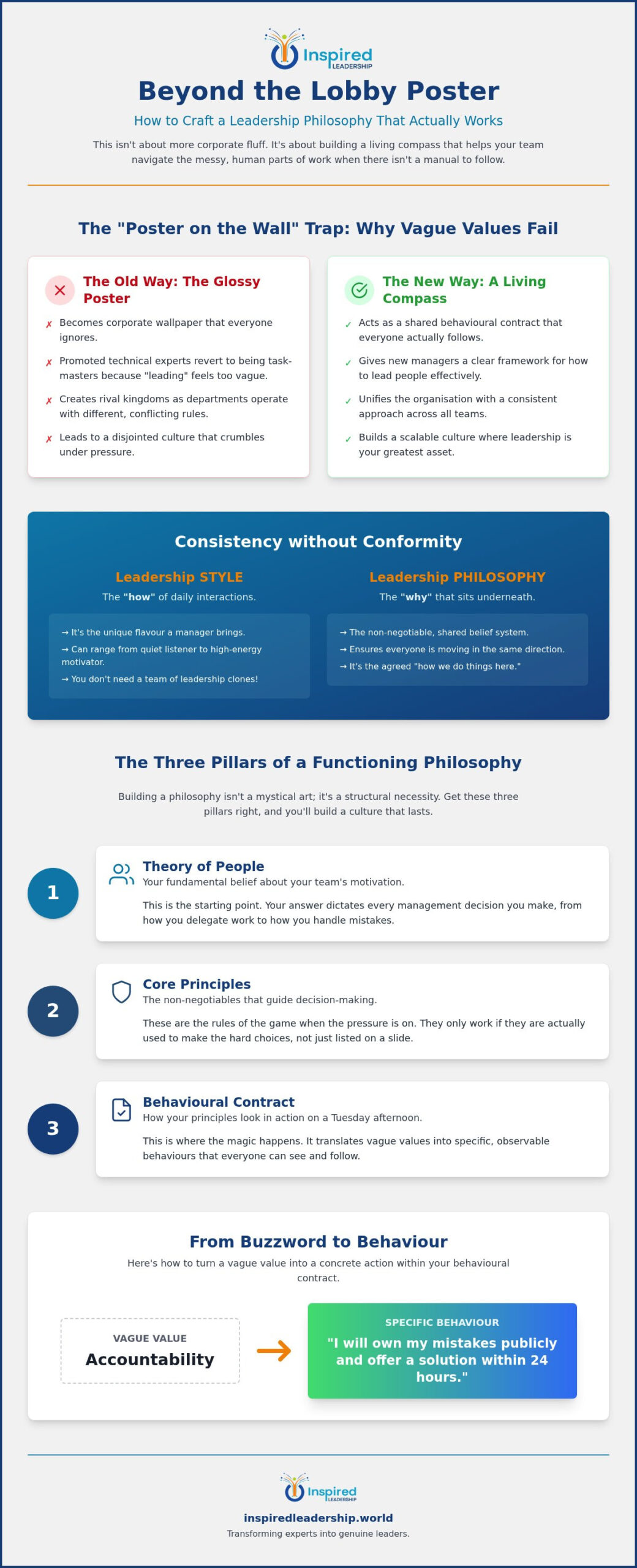
Let’s be honest about those glossy posters in your lobby. If your “core values” are just a list of nice-to-have adjectives like “integrity” and “excellence,” they’re probably doing more harm than good. They become corporate wallpaper that everyone ignores whilst they get on with the actual work of surviving the day.
Developing a leadership philosophy for your organisation isn’t about finding better adjectives for a plaque. It’s about building a living compass that helps your team navigate the messy, human parts of work when there isn’t a manual to follow. Without this, your culture is just a collection of individual habits, many of which might be working against your growth.
It’s incredibly draining to watch your best technical people struggle when they’re promoted. You’ve likely seen it happen; a brilliant engineer or accountant gets the “manager” title and immediately reverts to being a technical expert because leading people feels too vague. They cling to the tools they know because they don’t have a shared behavioural contract to lean on when things get difficult.
A leadership philosophy is that contract. It is the agreed-upon “how we do things here” that survives even when you aren’t in the room to supervise. It transforms leadership from a solo performance into a scalable, organisational capability that actually moves the needle.
The Difference Between Style and Philosophy
You don’t need a team of leadership clones. Your managers can and should have different foundational leadership styles, ranging from the quiet listeners to the high-energy motivators. Style is simply the “how” of their daily interactions; it’s the unique flavour they bring to the role.
Philosophy, however, is the “why” that sits underneath everything. It’s the non-negotiable belief system that ensures every manager, regardless of their personality, is moving in the same direction. This consistency is exactly what we focus on during our manager to leader journey, helping your experts find their footing as true people-leaders.
When everyone shares the same philosophy, you get consistency without conformity. You get a culture that can scale because the “rules of the game” are clear for everyone, from the boardroom to the shop floor. Developing a leadership philosophy for your organisation ensures that even as you grow, your leadership remains your greatest competitive advantage.
The Three Pillars of a Functioning Organisational Philosophy
Building a philosophy isn’t a mystical art; it’s a structural necessity. If you want to succeed in developing a leadership philosophy for your organisation, you need three sturdy pillars to hold the weight of your culture. Without them, you’re just throwing expensive words at a wall and hoping they stick.
The first pillar is your Theory of People. This is the fundamental belief you hold about your team’s potential and motivation. Your answer dictates every management decision you’ll ever make, from how you delegate to how you handle mistakes.
Next come your Core Principles, the non-negotiables that guide decision-making when the pressure is on. You can find many guides on how to create your leadership philosophy to help list these out. Just remember they only work if they are actually used to make the hard choices.
Finally, we have the Behavioural Contract, which is how your principles look in action on a rainy Tuesday afternoon. If you lack this third pillar, the first two are just expensive daydreaming. It’s the difference between merely saying “we value respect” and actually stopping a manager from belittling a junior staff member.
Crafting Your Behavioural Contract
To make this work, you must translate vague values into specific, observable behaviours. Take “Accountability,” for example. In a behavioural contract, this means “I will own my mistakes publicly and offer a solution within 24 hours,” rather than just a buzzword on a slide deck.
You also need to be brutally clear about what you will not tolerate. A philosophy that only lists “good” things is a wish list, not a contract. If you’re struggling to define these boundaries, it might be time to chat with us about your specific challenges to see how we can help.
From the Boardroom to the Floor: Scaling Your Philosophy
Scaling a philosophy is where most businesses trip up. It’s easy for a founder to have a vision, but much harder to ensure that vision survives a game of “telephone” through five layers of management. Your first-line managers are the real gatekeepers here; they are the ones who translate your high-level intent into the daily experience of your workforce.
If these managers are still operating as technical experts, they’ll likely struggle when you start developing a leadership philosophy for your organisation. They often view “leadership” as a distraction from the “real work” of fixing things. This is a classic friction point in any manager to leader journey, where the comfort of technical certainty meets the messy reality of people management.
To get genuine buy-in, you need to involve your leadership team in the creation process rather than just emailing them a PDF. Facilitate sessions where they can debate the non-negotiables and define what success looks like in their specific departments. This collaborative approach ensures that the philosophy isn’t just “the CEO’s idea,” but a shared agreement they feel responsible for upholding.
Translating Insight into Action
Once your philosophy is defined, it must become the yardstick for everything, including your performance reviews and feedback loops. If someone is a technical wizard but a total nightmare to work with, your philosophy should give you the language to address that behaviour directly. It stops being a personal attack and starts being a conversation about our shared contract.
Before you start building, you need to know exactly where the cracks are currently showing. Taking a leadership assessment is a brilliant way to identify where your current culture is diverging from your intended path. It provides the data-backed starting point you need to move from “feeling” that things are disjointed to actually fixing them.
Turning Philosophy into Performance: Your Implementation Journey
Execution is where most leadership initiatives go to die. To avoid that fate, you must start with a brutal audit of your current “unspoken” philosophy. Look at what is actually happening on the ground when things get stressful, because that is your real culture, regardless of what you’ve written in the employee handbook.
Once you’ve identified the gaps, it’s time to facilitate a “Crucible Session” with your senior leaders. This isn’t a polite chat over tea; it’s a high-stakes meeting to define the non-negotiables that will guide every decision. You are looking for the shared beliefs that will underpin developing a leadership philosophy for your organisation that actually sticks.
Your next step is to embed this philosophy into every single stage of the employee journey. It should dictate who you hire, how you onboard new talent, and how you handle performance reviews. If your philosophy doesn’t influence who gets promoted and who gets fired, it’s just a creative writing exercise.
Finally, remember that your philosophy should evolve as your organisation matures. Review it annually to ensure it still serves your strategic goals and reflects the reality of your growing team. A living document is far more powerful than a static set of rules that no longer fits the size of your business.
The Strategic Catalyst Approach
Traditional one-off workshops are essentially the fast food of professional development; they feel good for an hour, but the benefits vanish by Monday morning. This is why we focus on a structured journey that prioritises long-term behavioural change over simple certificates. We act as a partner for leaders who value tangible outcomes and sustainable growth rather than just ticking a training box.
At Inspired Leadership, we’ve spent 20 years helping managers make the critical manager to leader journey with practical, battle-tested methods. We don’t do fluff, and we certainly don’t do “motivational” speeches that lack a roadmap. If you are ready to stop talking about culture and actually start leading, let’s chat about how we can transform your team.
From Aspiration to Action: Leading with Intent
You’ve seen how typical philosophies fail when they remain as mere adjectives on a lobby wall. By defining your Theory of People and building a solid behavioural contract, you can finally stop the cultural drift. This approach ensures your managers move past “technical expert” mode and start leading with genuine intent.
Developing a leadership philosophy for your organisation is the most effective way to scale your culture whilst you grow. With 20 years of corporate experience, we specialise in medium-sized enterprise scaling and results-driven behavioural change. We know that real transformation only happens when you move beyond theory and into a structured journey.
If you’re ready to stop the creative writing exercises and start building a team that actually knows how to lead, we’re here to help. You’ve got the roadmap; now it’s time to take that first step toward a more resilient, leader-led future.
Frequently Asked Questions
What is the difference between a leadership philosophy and a mission statement?
A mission statement defines your destination and where you are going, but a leadership philosophy dictates how you behave whilst you are getting there. Think of the mission as the mountain peak and the philosophy as the non-negotiable rules for the climb. It ensures your team doesn’t burn the forest down just to reach the summit.
Can an organisation have more than one leadership philosophy?
No, having multiple philosophies is a guaranteed recipe for internal chaos and departmental silos. You need one core behavioural contract for the entire company to ensure consistency and trust as you scale. Whilst individual managers will naturally have different personal styles, they must all operate within the same foundational philosophy to keep the culture intact.
How do I get my technical managers to buy into a leadership philosophy?
You get technical managers on board by focusing on pragmatic, measurable results like better staff retention and reduced friction. Most experts have a low tolerance for corporate fluff, so show them how developing a leadership philosophy for your organisation solves their daily operational headaches. When they see it as a tool to improve performance rather than a soft HR initiative, they’ll actually start to lead.
How often should we update our organisational leadership philosophy?
You should review your philosophy every two to three years or during any period of major organisational scaling. As your business matures and your team grows, your non-negotiables might need a slight sharpen to stay relevant. It’s about ensuring the rules of the game still reflect the reality of your current team and your long-term strategic goals.
Is it possible to change a toxic leadership philosophy?
Yes, it is entirely possible to shift a toxic culture, but it won’t happen through a one-off workshop or a clever email. It requires a structured journey that courageously addresses the specific behaviours that have been tolerated for far too long. You must be willing to hold everyone, especially your senior leaders, accountable to the new contract you are building together.