
What if the most polished leadership journey is the wrong one for your organisation? If you’re weighing leadership development for heads of HR, you already know engaging content means little if it misses your priorities or changes nothing about how people work.
That can make the buying decision frustrating. Generic material may sound convincing, but attendance and positive feedback don’t show whether leaders behave differently afterwards. You need development that strengthens your own leadership, helps managers and teams take ownership, and gives you credible evidence to share with senior stakeholders.
This guide offers a practical framework for choosing development linked to current organisational needs, observable behaviours and meaningful measures of progress. You’ll learn how to assess relevance, support application at work and connect individual growth with capability across your organisation. Leadership development should earn its place in everyday work.
Key Takeaways
- Separate your own leadership growth from the wider task of building leadership capability across your organisation.
- Compare development approaches by how well they connect to real priorities, support practice and reinforce behaviour at work.
- Use a clear framework to assess leadership development for heads of hr, from defining the challenge to reviewing evidence of progress.
- Explore how a tailored leadership journey can translate individual insight into stronger capability across your organisation.
Why leadership development for heads of HR must connect people priorities to business reality
You’re responsible for developing other people, yet finding time to strengthen your own leadership can feel like one more item on an already crowded list. Your personal growth and your organisation’s wider leadership capability are connected, but they aren’t the same task.
Effective leadership development for heads of hr should help you develop your judgement and influence while building leaders’ ability to think for themselves and take ownership of their actions and outputs. Understanding Leadership Development explores the distinction between developing individual leaders and building the relationships that help leadership happen across a group. Effective HR leadership development means practising observable behaviours in real work and linking them to organisational priorities.
Which leadership challenges should the development address?
Before comparing providers or formats, name the organisational challenge you want to address. “Managers need development” is a starting point, not a useful outcome. Look beneath the symptom: inconsistent management might point to unclear expectations, limited accountability or difficulty having direct conversations.
Next, connect the behaviour you want to strengthen to a practical outcome. If teams struggle to collaborate during change, for example, leaders might need to share context clearly, invite challenge and agree who owns each decision. Those behaviours can support smoother coordination, although development alone can’t guarantee that result.
How an assessment can clarify development priorities
A structured assessment can help you see where leadership strengths already exist and where development may be most useful. That gives you a clearer starting point than choosing familiar topics first and hoping they fit.
A leadership assessment can surface priorities to explore. A conversation about your organisation’s needs can then connect those insights to wider capability building. If your own priorities include senior leadership development, explore the Beyond Command leadership journey and download its brochure to see how it aligns with your needs.
How to compare leadership development approaches for HR leaders
Different formats suit different needs. A one-off session can introduce a shared idea; coaching can support reflection on an individual challenge; a structured leadership journey can connect learning with practice and workplace application. Choose by looking at the challenge, who’s taking part and what they need to do differently.
Exposure introduces leadership ideas; sustained practice helps people apply them in real work.
| What to compare | One-off learning | Coaching | Leadership journey |
|---|---|---|---|
| Relevance | Focused topic | Individual need | Shared priorities and role needs |
| Practice | Often limited to the session | Personal reflection | Learning linked to workplace action |
| Reinforcement | May be brief | Through follow-up conversations | Built into an ongoing process |
| Organisational fit | Useful for a common introduction | Centred on the individual | Can connect leadership levels |
| Evaluation | Participation and feedback | Personal progress | Behaviour and application at work |
What separates a leadership journey from a one-off intervention?
A journey gives participants time to reflect, try new approaches and bring their experience back into the learning. A manager might practise delegating a decision, notice how the team responds, then revisit the experience and adjust their approach.
A single event can be a useful introduction, but attendance alone can’t show whether behaviour has changed. For leadership development for heads of hr, compare how each option supports continued application, not just how compelling the session looks on paper.
How to assess relevance for different leadership levels
Emerging leaders may need to build confidence and understand their influence. First-line managers often need to translate priorities into clear expectations, while technical leaders may need to balance specialist expertise with collaboration. Senior leaders may focus on direction, culture and decisions across the organisation.
These groups can work towards shared priorities, such as accountability, while practising behaviours that fit their responsibilities. If first-line managers are a key audience, explore the manager-to-leader journey and download its brochure to assess its fit with your needs.
How to evaluate leadership development for heads of HR before committing
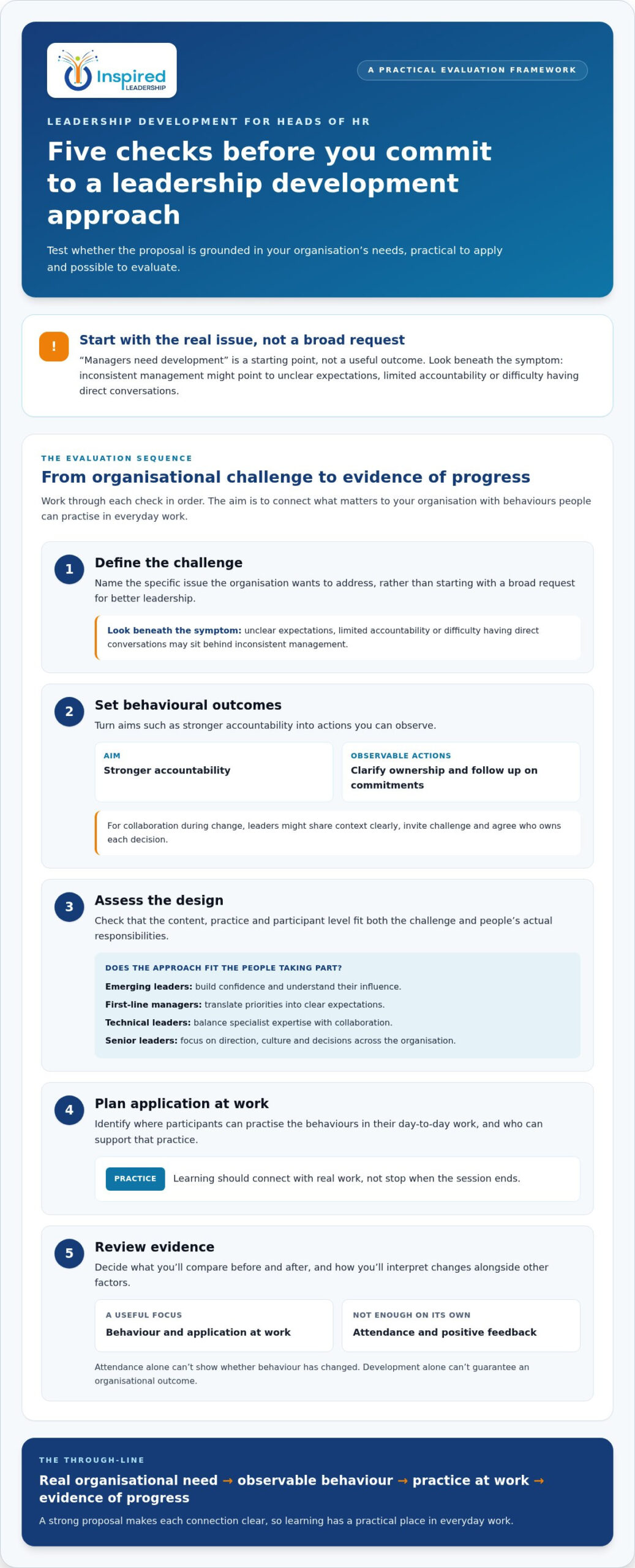
A strong proposal should explain what could change beyond the learning room. Use this sequence to test whether leadership development for heads of hr is grounded in your organisation’s needs, practical to apply and possible to evaluate.
- Define the challenge. Name the specific issue the organisation wants to address, rather than starting with a broad request for better leadership.
- Set behavioural outcomes. Turn aims such as stronger accountability into actions you can observe, such as clarifying ownership or following up on commitments.
- Assess the design. Check that the content, practice and participant level fit the challenge and people’s actual responsibilities.
- Plan application. Identify where participants can practise the behaviours in their day-to-day work, and who can support that practice.
- Review evidence. Decide what you’ll compare before and after, and how you’ll interpret changes alongside other factors.
What evidence can show whether development is being applied?
Attendance and satisfaction tell you whether people took part and how they felt about the experience. They don’t show whether behaviour changed at work. Set a baseline before the journey begins, then revisit the same measures consistently: participant reflections, manager observations and relevant organisational indicators, such as whether teams are having clearer conversations about ownership.
Look for patterns across these sources rather than treating one measure as a verdict. If priorities, structures or workloads also change, be cautious about attributing an organisational result to development alone.
How to make learning transfer part of the design
Check that participants will have real opportunities to practise behaviours, not just discuss them. Someone working on delegation could hand over a suitable decision, reflect on what helped or got in the way, then discuss the experience with a manager or peer.
Make that reinforcement fit your organisation’s working rhythms. A brief, focused conversation can help turn an insight into a repeatable action. Without follow-through, even useful learning can remain a nice idea.
If developing first-line managers is a priority, explore the manager-to-leader journey and download its brochure.
How Inspired Leadership can shape a development journey around your organisation
Once you’ve clarified the challenge, the behaviours you want to see and how you’ll assess progress, look for a development partner whose approach fits your organisation, not just the topic. Inspired Leadership designs leadership journeys for medium-sized enterprises, focusing on building capability across the organisation and helping people turn insight into action.
This matters when development needs to reach beyond individual growth. Leaders need space to think, make sound decisions and take ownership of their actions and outputs, while the organisation builds capability that supports its priorities.
Match the journey to the leadership challenge
For senior-level development, explore Inspired Leadership’s Beyond Command leadership journey. Consider how the development focus can reflect your organisation’s context, including the behaviours leaders need to support collaboration, accountability or change.
A tailored approach should connect those priorities with participants’ responsibilities, rather than expecting one set of content to fit every leadership level. That gives you a clearer basis for understanding how individual learning can contribute to broader organisational capability.
Build confidence through relevant experience
As you weigh up an approach, consider participants’ experience alongside your own evaluation criteria. Look for evidence that the development feels relevant to real work and gives people opportunities to apply what they learn.
For leadership development for heads of hr, a useful next step is to clarify your priorities, the people you need to support and the behaviours that matter in your organisation. A conversation can help you explore how a tailored journey could address those needs.
Make your next leadership decision count
Your next step doesn’t need to be a sweeping redesign. Start with one leadership moment that matters now: where do people need to make clearer decisions, take greater ownership or work across boundaries with more confidence? Naming that moment helps keep leadership development for heads of hr grounded in the work people actually do.
Then bring the question to the people who will shape and experience the development. What would they need to do differently, and what would help them practise it in the flow of work? Those conversations can turn an ambitious intention into a thoughtful choice, without pretending development alone can solve every organisational challenge.
You don’t need every detail mapped out before you begin. A clear priority is a strong place to start. If first-line manager capability is that priority, explore the manager-to-leader journey and download its brochure.
Frequently Asked Questions
What should leadership development for heads of HR include?
It should strengthen the capabilities you need to influence organisational decisions, not only manage people processes. This may include business understanding, clear communication with senior colleagues and confidence using workforce insights to frame practical choices. For example, practise explaining how a people priority connects to a team’s ability to deliver, then use that thinking in a real leadership discussion.
How can HR leaders measure the impact of leadership development?
Use a mix of evidence that shows what participants are doing differently and why it matters. A short update for senior stakeholders could pair a specific example, such as a manager inviting challenge before making a team decision, with a relevant organisational indicator. Include context about other changes that may have influenced the result, so you can show contribution without claiming development was the sole cause.
Is a leadership journey more effective than a one-off workshop?
Neither format is automatically more effective; the right choice depends on what people need to achieve. A focused session may suit a narrow need, such as introducing a common language for feedback. If participants need to change how they handle recurring situations, a journey can give them opportunities to revisit and apply learning. Choose based on the work behaviour required, not the neatness of the calendar invite.
How do you choose a leadership development provider for an organisation?
Look for a clear connection between your organisation’s challenge and the experience participants will have. Bring a real example, such as a decision that repeatedly stalls between teams, and consider whether the proposed approach helps leaders address that situation in practice. A relevant fit should make sense for your organisation’s scale and context, rather than relying on impressive-sounding themes that could belong to almost anyone.
Can leadership development support both HR leaders and the wider organisation?
Yes, when your own development and wider capability-building are considered together, but not treated as identical needs. Your growth can help you model the behaviours you want leaders to practise, while development for other groups reflects their responsibilities. For instance, a shared focus on ownership might mean setting clearer expectations with executives, while managers build confidence in agreeing responsibilities with their teams.