

Leadership fatigue isn’t a personal resilience problem; it can be a warning that the system is asking too much of the people holding it together. If your days are packed with decisions, change keeps arriving and your team still needs steadiness, feeling depleted isn’t a character flaw. The most useful leadership fatigue strategies start by looking beyond the individual.
You may already know the familiar advice: take a break, manage your time, find more resilience. Those steps can help, but they won’t resolve unrelenting demands or give you the support you need to lead. Start by identifying what’s driving the fatigue, rather than quietly adding another task to your list.
This article explores pressures that can drain leadership capacity, from repeated change to unclear priorities and insufficient support. You’ll find practical ways to respond as a leader, alongside organisational changes that can restore trust, protect capacity and build the skills leaders need to turn insight into action. The aim isn’t to help you endure more. It’s to create the conditions for sustainable leadership.
Key Takeaways
- Leadership fatigue is a useful signal of sustained pressure, not a clinical diagnosis or proof that you’ve failed.
- Use leadership fatigue strategies to identify pressure points, clarify priorities and agree what can change.
- Open conversations about workload, decision-making authority and support can help address strain before it becomes entrenched.
- Sustainable capacity depends on more than individual effort: aligned expectations and practical organisational backing matter too.
Leadership fatigue strategies start with recognising what is draining capacity
Sustained responsibility, competing demands and repeated change can wear down even thoughtful, capable leaders. You may be expected to turn shifting priorities into action, keep decisions moving and reassure your team, sometimes all before lunch. That strain deserves attention, not a lecture about being more resilient.
Leadership fatigue is the sustained depletion of a leader’s mental and emotional capacity under ongoing work pressures, which can make it harder to think clearly, make decisions and support others. It’s a useful descriptive term, not a clinical diagnosis. It points towards a practical question: what is consuming your capacity, and what could change?
What can leadership fatigue look like at work?
You might notice less patience in conversations, difficulty choosing between options or a growing urge to withdraw from decisions and colleagues. These signs don’t prove that you’re fatigued: they can also reflect a demanding week, uncertainty about your role, poor communication or pressures outside work.
Context matters. Temporary tiredness may ease after rest; leadership fatigue tends to persist when the demands causing it remain. Burnout is a more specific form of work-related strain, so the terms aren’t interchangeable. A pattern is a prompt to explore what’s happening, not a label to apply to yourself or someone else. For broader context, this overview of stress management techniques for leaders discusses stress and approaches to managing it.
Why leaders can feel caught between competing demands
Leaders often translate organisational priorities into practical work while listening to concerns, resolving obstacles and helping people adjust. If priorities conflict or change before a team can make progress, you can end up carrying pressure in both directions.
Imagine a manager asked to accelerate a new process while keeping existing work on schedule. Their team needs clear guidance, but the manager is still waiting for a decision about what can be paused. The resulting frustration may look like a personal short fuse; the missing priority call is part of the picture too.
For managers moving into broader leadership responsibilities, visit the manager-to-leader journey page and download its brochure.
Why leadership fatigue builds: demands, change and missing support
Leadership fatigue rarely has a single cause. Competing priorities pull your attention in different directions, unclear responsibilities leave you guessing who owns a decision, and a steady stream of choices can make routine work feel heavier. The strain grows when you’re accountable for results but lack the authority, information or support needed to shape them.
Sustained demands drain leadership capacity fastest when the support, authority and time available to meet them fall short.
How repeated change affects leaders and their teams
Every new initiative asks people to redirect attention, learn what’s changing and work out what it means for their day-to-day responsibilities. When one change is barely established before another arrives, teams can lose confidence that the latest commitment will last.
Unresolved changes from the past matter too. If an earlier initiative was announced but stalled because decisions or resources never followed, a leader may have to spend credibility explaining why the next one deserves attention. With limited capacity, there’s less room to listen carefully, communicate clearly and help people make sense of what’s ahead.
Why resilience alone is not a complete solution
Personal coping skills can help you manage pressure and recover perspective. They can’t resolve conflicting priorities or replace the authority and practical backing needed to do the work. Asking leaders to simply become more resilient risks turning an organisational problem into their private homework.
Two conditions can make support more tangible. Psychological safety means people can raise concerns, admit uncertainty and ask for help without fearing humiliation. Autonomy means leaders have appropriate room to make decisions about how work gets done. Together, these conditions help surface obstacles and give leaders scope to respond.
Leadership development can complement changes to workload and organisational support. Explore the Human Factor journey and download its brochure to consider how this development could fit your organisation’s leadership needs.
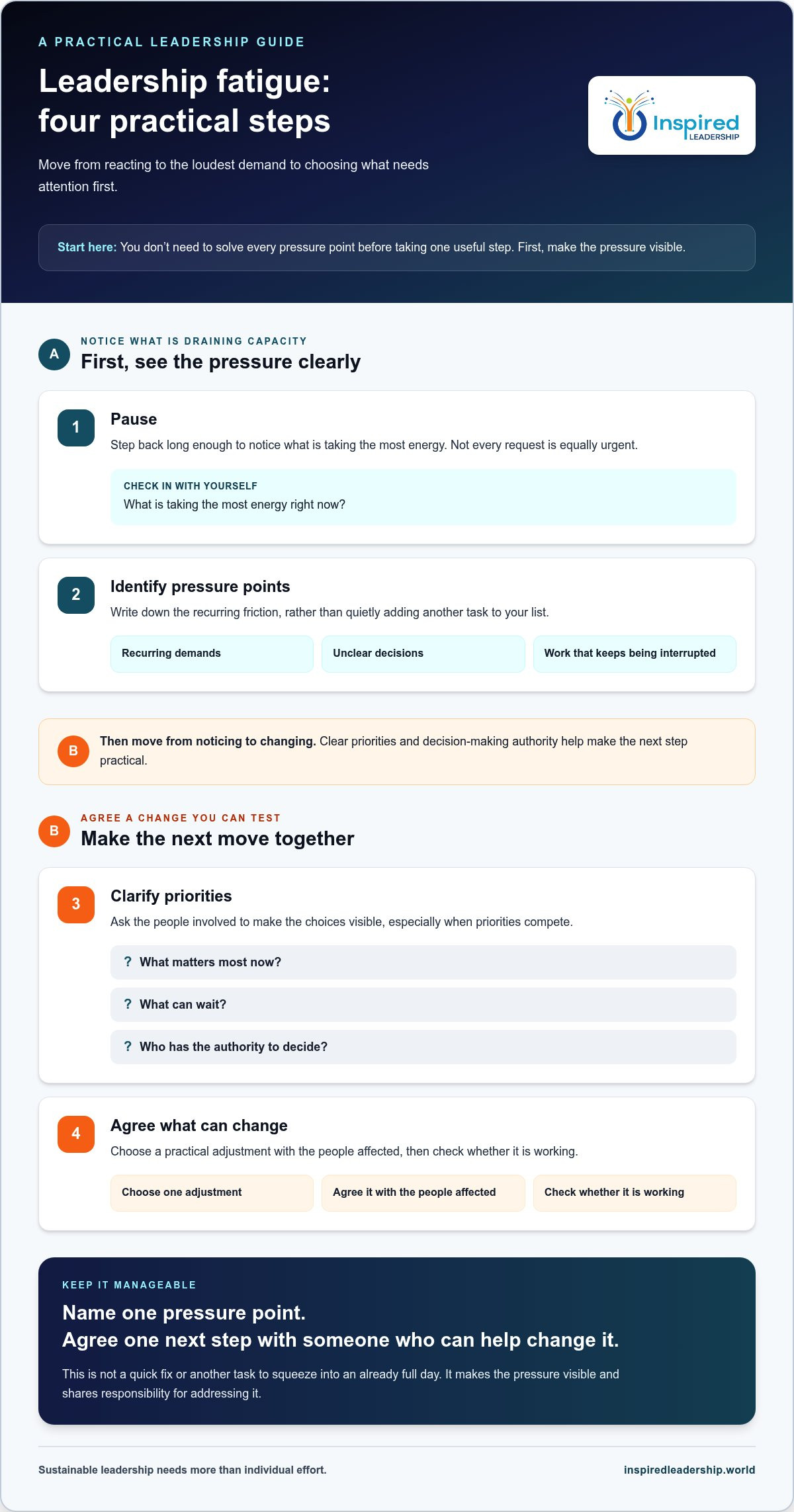
Leadership fatigue strategies you can put into practice
You don’t need to solve every pressure point before taking a useful step. A short pause can help you move from reacting to the loudest demand towards choosing what needs attention first.
- 1. Pause. Step back long enough to notice what’s taking the most energy, rather than treating every request as equally urgent.
- 2. Identify pressure points. Write down recurring demands, unclear decisions and work that keeps being interrupted.
- 3. Clarify priorities. Ask what matters most now, what can wait and who has the authority to decide.
- 4. Agree what can change. Choose a practical adjustment with the people affected, then check whether it’s working.
Name one pressure point, then agree one next step with someone who can help change it. This isn’t a quick fix or another task to squeeze into an already full day. It makes the pressure visible and shares responsibility for addressing it.
What can you change this week?
Pick one recurring demand you have the authority to clarify, defer or stop. You might set a clearer deadline for a routine request or agree which meeting can be shortened or removed.
Protect focused time for work that genuinely needs your judgement, such as a difficult decision or an important conversation. A calendar packed with meetings can look productive whilst leaving no room to lead.
How can leaders ask for support constructively?
Describe the effect of the demand, then make a specific request: “Preparing these updates is taking time from team conversations. Can we agree which updates are essential, and who decides the priority?” This gives colleagues something concrete to respond to.
When communicating change, explain why it’s happening, acknowledge what people experienced before and be clear about what is still uncertain. Then follow through on your commitments. Leadership fatigue strategies work best when responsibility is shared, not quietly handed to one leader to fix alone.
Explore the manager-to-leader journey and download its brochure
Make leadership fatigue strategies sustainable through organisational support
Personal changes can create breathing room, but they won’t hold if priorities keep shifting and expectations remain impossible to meet. Sustainable leadership fatigue strategies need visible organisational backing: clear direction, realistic workloads and authority that matches responsibility.
Practical support also includes access to colleagues who understand the role, recognition of the effort involved and space to raise recurring obstacles. If leaders keep reporting the same barrier, such as conflicting deadlines or decisions that stall, that information needs to reach people who can change the conditions, not disappear into another meeting note.
What organisational support makes change more sustainable?
Start by making priorities explicit. When everything is labelled urgent, leaders are left to make hidden trade-offs, often without the authority to pause lower-priority work. Agree what can be deferred, give leaders room to decide how work gets done and create regular opportunities to compare challenges with peers.
Recognition matters too. Acknowledge the work of guiding people through change, not only the final result. Leaders can share recurring barriers with their managers, who can bring those patterns into planning and resourcing decisions. That creates shared ownership instead of asking each leader to quietly work around the same problem.
When structured leadership development can help
Advice can help you reflect, but insight is easier to use when there’s ongoing practice and support from colleagues. A first-line manager development journey can help managers build capability while applying what they learn to real workplace situations. The aim is to connect reflection with practical action, alongside reviewing demands and providing organisational backing.
For example, managers might practise setting expectations, handling difficult conversations or deciding what to delegate, then reflect on how those approaches work in their teams. The manager-to-leader journey offers a practical starting point for exploring development needs.
If you’re considering how to support your managers sustainably, discuss the leadership challenge and the development your organisation needs.
Make sustainable leadership capacity your next priority
Make space for an honest conversation about what your managers need to lead well, and what the organisation may need to change around them. Leadership fatigue strategies become more sustainable when new insight leads to practical action, shared responsibility and habits that can be used in the flow of work.
Inspired Leadership designs leadership development journeys for medium-sized enterprises, with a focus on translating insight into action across organisations. This work can sit alongside a wider review of priorities, expectations and support, so development isn’t asked to compensate for demands that need addressing.
You don’t have to wait until your managers are running on fumes to start the conversation. A clear, thoughtful next step can help create better conditions for them and the people they lead.
With the right support around them, your leaders can build capacity with care and keep moving forward.
Frequently Asked Questions
What does leadership fatigue mean?
Leadership fatigue describes strain that affects how readily you can use your attention, judgement and emotional energy in a leadership role. It isn’t a clinical diagnosis or a verdict on your ability. For example, routine decisions may take more effort than usual. Treat that change as a reason to look at what’s happening around you, rather than as proof you’re failing.
How is leadership fatigue different from burnout?
The terms are related, but they aren’t interchangeable. Leadership fatigue is a broad descriptive way to discuss depleted capacity in a leadership role; burnout refers to a more specific experience of prolonged work-related strain. Neither should be diagnosed from one behaviour, such as irritability or indecision. If distress is persistent or affecting your health, consider seeking appropriate professional support as well as discussing work pressures.
Can leadership fatigue affect a whole team?
Yes. A leader with less capacity may have less energy for checking understanding, responding calmly or keeping people informed, and that can shape how the team experiences its work. But similar team difficulties can arise from shared pressures, such as changing deadlines or unclear expectations. Look for patterns across conversations and workload, then ask team members what is making it harder to do good work.
What is the first step when you feel fatigued as a leader?
Choose one recent moment that felt harder than it should have, and note what was happening around it. Was the decision unclear, was information missing, or had another urgent request interrupted the work? This small, specific example gives you something useful to discuss with a colleague or manager. It can make a workload conversation more practical than simply saying, “I’m overwhelmed.”
Can leadership development help prevent leadership fatigue?
Leadership development can help you practise skills such as setting expectations, delegating and responding to difficult conversations, which may make demanding situations easier to handle. It can’t guarantee that fatigue won’t occur, and it shouldn’t be used as a substitute for workable demands or organisational support. A development journey is most useful when you can apply new approaches at work and reflect with others on what helps.